
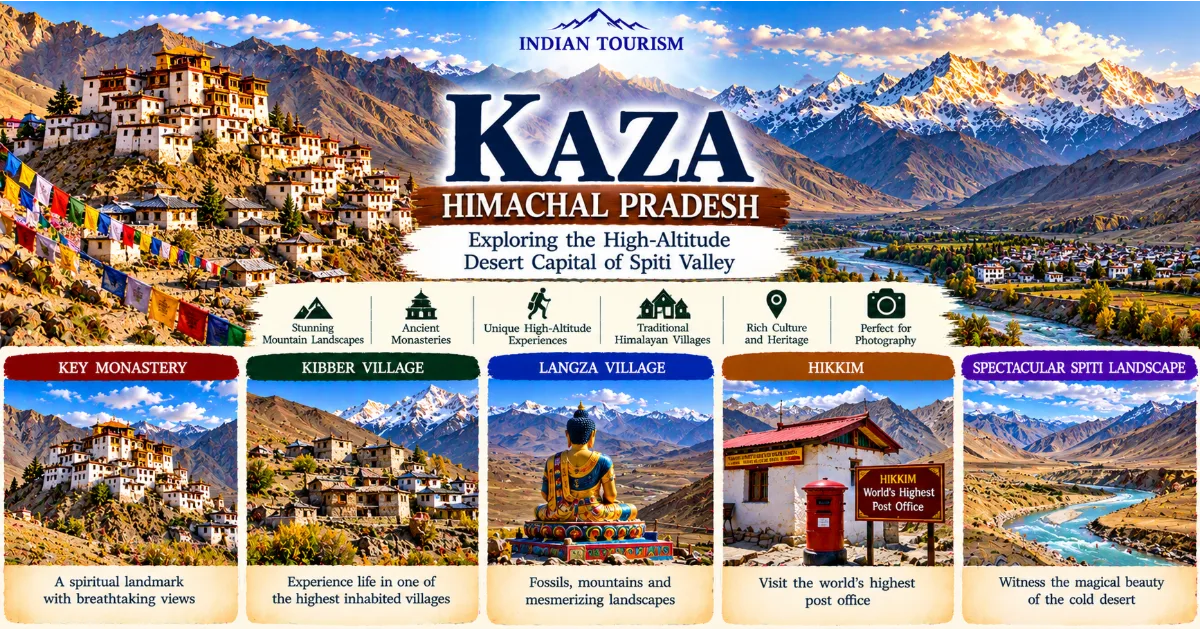
Discovering the Extraordinary Landscape of Kaza
Himachal Pradesh is famous for its green valleys, snow-covered mountains, cedar forests and charming hill stations, but the state also contains a landscape that looks strikingly different from the familiar image of the Himalayas. In the cold desert region of Spiti, mountains rise in shades of brown, grey and rust, villages cling to high slopes, ancient monasteries overlook deep valleys, and winding roads cross vast stretches of rugged terrain. At the heart of this extraordinary region lies Kaza, an important town in the Spiti Valley and a destination that attracts travellers seeking adventure, culture, history and solitude.
Kaza offers an introduction to one of the most distinctive geographical and cultural regions of northern India. Located at a high altitude in the Lahaul and Spiti district of Himachal Pradesh, the town serves as an important administrative and commercial centre for surrounding villages. It is also a practical base for exploring monasteries, traditional settlements, mountain viewpoints and some of the most dramatic landscapes in the western Himalayas.
The experience of visiting Kaza differs considerably from a holiday in Shimla or Manali. Instead of dense forests and busy shopping streets, travellers encounter open mountain valleys, sparse vegetation, rocky slopes and a sky that often seems unusually expansive. The surrounding landscape reveals the powerful influence of altitude, wind, water and geological processes that have shaped the region over thousands of years.
Yet Kaza is not simply a destination for people who enjoy dramatic scenery. It is also a place where visitors can learn about the traditions of Spiti, the influence of Tibetan Buddhism, the resilience of mountain communities and the challenges of living in a cold desert environment. Monasteries, village homes, cultivated fields and local markets provide glimpses into a way of life shaped by geography and generations of adaptation.
For photographers, Kaza offers striking contrasts between barren mountains, whitewashed buildings, prayer flags and distant snow-covered peaks. For cultural travellers, it provides access to monasteries and villages with distinctive traditions. For adventure enthusiasts, it serves as a starting point for carefully planned journeys through some of the highest inhabited regions of Himachal Pradesh.
Kaza is best approached with patience and preparation. The altitude, remote location and changing weather require travellers to plan carefully, allow time for acclimatisation and remain flexible about road conditions. Those who take these precautions can discover a destination that offers far more than beautiful photographs. Kaza provides an opportunity to understand the geography, culture and extraordinary human adaptability of the Himalayan cold desert.
Understanding Kaza and the Spiti Valley
Where Is Kaza Located?
Kaza lies in the Spiti Valley in the Lahaul and Spiti district of Himachal Pradesh. The region is situated in the eastern part of the state, close to the high mountain landscapes that connect the western Himalayas with the Tibetan Plateau. Its geographical position gives it a distinctive climate and terrain compared with many other parts of Himachal Pradesh.
The town occupies a valley landscape surrounded by rugged mountains and sparse vegetation. The Spiti River flows through the wider region, and its course has helped shape the settlement patterns and travel routes of the area. Villages developed in locations where water, agricultural land and access to local routes made habitation possible.
Kaza is often used as a base for exploring nearby settlements and monasteries. It provides access to local services, accommodation, food and transport arrangements, although facilities remain more limited than in major urban centres. Visitors should therefore plan essential arrangements before travelling into more remote parts of the valley.
The surrounding landscape changes according to altitude, sunlight and season. During summer, cultivated fields and village settlements create pockets of colour within the otherwise rugged terrain. In winter, snow and extreme cold can transform the region and make travel much more difficult.
What Makes Spiti a Cold Desert?
A cold desert is an environment where precipitation is limited and temperatures can become extremely low, particularly during winter. Spiti lies in the rain shadow of major Himalayan ranges, which means that much of the moisture carried by monsoon winds is intercepted before reaching the valley.
As a result, the landscape is relatively dry, with sparse vegetation and exposed geological formations. The mountains display a wide range of earthy colours, including grey, ochre, brown and red. Their appearance changes throughout the day as sunlight moves across the ridges.
The cold desert environment also influences agriculture, architecture and settlement patterns. Water is a valuable resource, and cultivated land is often concentrated in areas where irrigation is possible. Traditional houses are designed to respond to cold winters and local construction materials, while village life follows seasonal rhythms that differ from those of warmer regions.
For visitors arriving from lower elevations, the landscape can feel almost otherworldly. However, the environment is not empty or lifeless. It supports communities, wildlife, crops and cultural traditions that have developed through generations of adaptation.
Understanding this environment helps travellers appreciate why Spiti is so distinctive. The beauty of the region comes not from dense vegetation or abundant rainfall, but from the relationship between mountains, light, open space and the people who call the valley home.
Kaza Town: The Gateway to Spiti's Cultural Landscape
Exploring the Local Market
Kaza's market area provides a useful introduction to everyday life in Spiti. Local shops, small eateries, accommodation providers and service establishments support residents as well as visitors travelling through the region.
The market is generally more practical than the commercial shopping areas found in major hill stations. Travellers may find basic supplies, warm clothing, snacks, travel necessities and locally available products. The range of goods depends on the season and the availability of transport into the valley.
Walking through the market can reveal how tourism and local life intersect. Visitors arrive seeking mountain experiences, while residents use the town for shopping, work, education, administration and other everyday needs. The market therefore functions as more than a tourist attraction.
Travellers should not assume that every product associated with Spiti is locally made. When purchasing handicrafts, textiles or other regional items, ask sellers about their origin if authenticity matters to you. Buying thoughtfully from local businesses can help ensure that tourism supports the regional economy.
The market is also a convenient place to obtain local advice about road conditions and nearby destinations. Because weather and access can change quickly in mountain regions, information from people familiar with current conditions can be particularly valuable.
Experiencing the Rhythm of Mountain Life
Kaza's daily rhythm reflects the realities of a high-altitude settlement. Weather, daylight, transport availability and seasonal activity all influence how people organise their routines.
During the warmer months, the town becomes an important stop for travellers exploring Spiti. Accommodation providers, drivers, guides and local businesses experience greater tourist activity. In colder months, the environment becomes more demanding, and many travel services may operate differently or become unavailable.
Visitors should remember that the town is not simply a staging area for excursions. It is also home to people whose lives continue throughout the year, including periods when tourism is limited. Respecting local routines and understanding the seasonal nature of the region helps create a more meaningful travel experience.
Taking time to observe the town without rushing can be rewarding. A visit to a local eatery, a conversation with a host or a walk through the surrounding settlement may reveal aspects of Spiti that are not apparent from a roadside viewpoint.
Key Monastery: A Spiritual Landmark Above the Valley
Discovering One of Spiti's Most Recognisable Monasteries
Key Monastery, also known as Ki Monastery, is one of the most prominent cultural landmarks associated with Spiti Valley. Located on an elevated position above the surrounding landscape, the monastery is recognised for its distinctive architecture, religious importance and dramatic setting.
The monastery belongs to the Tibetan Buddhist tradition and has long served as a centre of religious learning and monastic life. Its buildings appear to rise from the rocky slopes, creating a striking visual relationship between the architecture and the surrounding mountains.
The monastery is an important destination for travellers interested in the cultural history of Spiti. It offers a way to understand the influence of Tibetan Buddhism in the region and the role religious institutions have played in preserving traditions, teachings and community connections.
Visitors should remember that Key Monastery is an active religious institution. Monks may be engaged in study, prayer, teaching and other responsibilities throughout the day. Travellers should behave respectfully, follow local instructions and avoid disturbing religious activities.
Architecture, Art and Religious Traditions
The architecture of Key Monastery reflects the practical and cultural demands of its mountain environment. Buildings occupy an elevated site, and their arrangement follows the available terrain. The complex has developed over time, with different structures contributing to its overall character.
Inside religious buildings, visitors may encounter paintings, images, prayer spaces and other objects associated with Buddhist practice. These features can help explain the importance of religious art in preserving teachings and communicating spiritual ideas.
Photography rules can vary between spaces, so visitors should ask before taking pictures indoors. Some areas may be restricted, and certain religious objects should be observed without touching them.
A visit is more rewarding when approached as a cultural experience rather than a checklist item. Taking time to understand the monastery's role in local religious life helps visitors appreciate its significance beyond its appearance in travel photographs.
Kibber Village: Life in a High-Altitude Settlement
A Village Surrounded by Rugged Mountains
Kibber is one of the well-known villages in the Spiti region and can be explored as part of a journey from Kaza. The settlement is associated with high-altitude living, traditional architecture and a landscape of rugged mountains and open terrain.
The village demonstrates how communities have adapted to a demanding environment where growing seasons are short, winters can be severe and water availability requires careful management. Homes, fields and village paths form part of a settlement pattern shaped by both natural conditions and local traditions.
Visitors may find Kibber particularly interesting because it provides an opportunity to observe village life away from larger tourist centres. The landscape also offers striking views of the surrounding mountains, with changing light creating different patterns of shadow and colour across the slopes.
As with other settlements in Spiti, Kibber is a living community. Travellers should respect private property, avoid entering homes without invitation and ask permission before photographing residents.
Wildlife and the Surrounding Environment
The wider landscape around Kibber and other parts of Spiti is associated with high-altitude wildlife, including species adapted to cold desert conditions. The broader region is known for conservation interest related to animals such as the snow leopard, although sightings are rare and should never be expected as a guaranteed part of a visit.
Wildlife observation requires patience, local knowledge and respect for the animals' habitat. Travellers should not approach, chase, feed or attempt to attract wild animals. Disturbing wildlife for photographs can cause stress and interfere with natural behaviour.
If interested in wildlife, visitors should consider seeking guidance from knowledgeable local guides or conservation organisations operating in the region. Any wildlife-focused excursion should prioritise safety, habitat protection and the welfare of the animals.
The natural environment is fragile, and even seemingly small disturbances can have consequences in a landscape where resources are limited. Responsible behaviour helps protect the ecological value of the region.
Hikkim and the Experience of Remote Village Life
A Village in the High Himalayas
Hikkim is one of the villages associated with the wider Kaza region and is frequently included in itineraries exploring the remote settlements of Spiti. Its location and surrounding landscape make it an appealing stop for travellers interested in village life and the geography of high-altitude habitation.
The village has gained attention among travellers because of its association with a high-altitude post office. Visitors interested in this feature should confirm its current operating arrangements locally, since services can vary according to season and practical conditions.
Beyond any individual attraction, Hikkim offers a glimpse into the challenges and character of remote mountain settlements. The surrounding terrain is rugged, and everyday activities take place within a landscape where weather, distance and transport can strongly influence access to services.
A visit should be planned with realistic expectations. Travellers may find fewer facilities than in Kaza, and the experience depends largely on the landscape, local culture and conditions at the time of arrival.
Appreciating Remote Communities
Remote villages are often presented as unusual travel destinations, but they are also home to families, workers and children whose daily routines should not be disrupted by tourism.
Visitors should be mindful of noise, photography and access to private spaces. Avoid treating residents as objects of curiosity, and do not assume that people are available for photographs or conversations simply because their village attracts tourists.
Purchasing locally available goods or using local services where appropriate can help support the community. However, respectful interaction matters just as much as spending money.
Travellers who approach Hikkim with curiosity and sensitivity can gain a better understanding of the realities of mountain life and the effort required to maintain communities in remote environments.
Langza Village: Fossils, Mountains and Cultural Heritage
Discovering Langza's Distinctive Landscape
Langza is another memorable destination within the broader Spiti Valley region. The village is known for its mountain setting, traditional settlement character and the fossil-bearing geological landscape found in parts of the surrounding area.
The region's geological history stretches far beyond human settlement. Fossils discovered in parts of Spiti provide evidence of ancient marine environments and the complex processes through which the Himalayas developed. These geological features offer a striking reminder that the high mountains visible today were shaped by changes over immense periods of time.
Visitors interested in geology may find Langza particularly rewarding because the landscape invites questions about the relationship between ancient seas, tectonic movement and mountain formation. However, travellers should avoid collecting fossils or removing geological material from protected or sensitive areas.
Langza is also valued for its traditional architecture and mountain views. The village's setting provides opportunities for photography and quiet observation, especially when weather conditions allow the surrounding peaks to become visible.
Respecting Geological and Cultural Heritage
Fossils are important scientific evidence, not simply souvenirs. Removing them can damage geological sites and reduce the information available to researchers and future visitors.
Travellers should observe any local rules concerning fossil-bearing areas and avoid digging or breaking rocks. If a fossil or unusual geological feature is discovered, it is better to photograph it in place and seek guidance from knowledgeable local sources.
The village's cultural environment also deserves respect. Religious structures, homes and community spaces should be approached according to local customs. Visitors should ask before taking photographs in sensitive locations.
Langza demonstrates how natural history and human culture can exist together in one landscape. A thoughtful visit can deepen appreciation for both the geological history of the Himalayas and the communities that live among these mountains today.
Best Time to Visit Kaza
Summer: The Main Travel Season
Summer is generally the most practical period for many travellers planning a road journey to Kaza and the surrounding villages. Warmer conditions and improved access on major routes can make it easier to explore the region, although mountain weather remains unpredictable.
During the summer travel season, visitors may find more accommodation choices, transport services and opportunities to arrange local excursions. The surrounding landscape can also show greater activity in cultivated areas, with fields and village gardens adding colour to the otherwise dry terrain.
This period can be busy, particularly during popular holiday weeks. Booking accommodation in advance and allowing extra time for road journeys can reduce stress.
Travellers should remember that summer does not eliminate the risks associated with high altitude. The air remains thin compared with lowland environments, and temperatures can drop sharply after sunset. Warm clothing and appropriate acclimatisation remain important.
Autumn: Clear Landscapes and Colder Nights
Autumn can provide beautiful conditions for photography and cultural exploration. The air may feel crisp, and clear days can reveal the details of the surrounding mountain ranges.
However, temperatures decline as winter approaches, and some services may begin to reduce their operations. Travellers should confirm accommodation availability, transport arrangements and current road conditions before departure.
The later the season, the more important it becomes to maintain a flexible itinerary. A route that is manageable during the main travel season may become more difficult when snow or severe weather arrives.
Autumn can be rewarding for experienced travellers who are prepared for colder conditions and who do not require every tourist service to operate at full capacity.
Winter: Severe Cold and Limited Access
Winter in Spiti can be extremely harsh. Temperatures may fall well below freezing, snowfall can affect roads and many travel arrangements become more complicated.
Kaza remains a settlement with local residents, but visiting as a tourist during winter requires substantially more preparation than travelling in summer. Accommodation options may be limited, transport can be disrupted and some excursions may be inaccessible.
Travellers considering a winter visit should obtain current local guidance and make sure that accommodation, heating, food and transport arrangements are reliable. They should not assume that standard summer itineraries can be followed safely.
Winter journeys into remote areas should be undertaken only when conditions and experience make them appropriate. In many cases, postponing the trip until safer conditions return is the better choice.
Monsoon Considerations
Spiti lies in a rain-shadow region, so its climate is much drier than that of many other parts of Himachal Pradesh. However, the wider mountain road network can still be affected by heavy rainfall, landslides and rockfalls, particularly along routes approaching the region.
Travellers should not assume that a dry valley means every road leading to it is safe. Weather conditions can differ substantially between the plains, lower hills and high mountain areas.
Before travelling, check the full route rather than only the forecast for Kaza. Follow official advisories and local instructions, and avoid continuing when road conditions become unsafe.
How to Reach Kaza
The Route Through Shimla and Kinnaur
One commonly used approach to Kaza travels through Shimla and the Kinnaur region before continuing towards the Spiti Valley. This route allows travellers to experience changing landscapes, from forested hills and river valleys to increasingly dry and rugged mountain terrain.
The journey is long and can be demanding. Narrow roads, steep slopes, roadworks and changing weather can affect travel time. Drivers should plan conservatively and avoid attempting to cover excessive distances in a single day.
Travellers who choose this route should check road conditions and identify suitable overnight stops in advance. It is important to allow time for unexpected delays rather than relying on an exact arrival time.
The route can be rewarding because the scenery changes gradually, helping visitors understand the transition from the greener parts of Himachal Pradesh to the cold desert environment of Spiti.
The Route Through Manali
Another approach may be possible through Manali and the high mountain passes connecting the wider Lahaul and Spiti region. This route is strongly dependent on seasonal conditions and the status of the relevant roads and passes.
It is not available under the same conditions throughout the year. Snow, road maintenance, landslides and official restrictions can affect access, so travellers must confirm the current situation before planning their journey.
Because the route involves high elevations, travellers should pay particular attention to altitude and acclimatisation. Moving quickly from a lower elevation to a high pass can increase the risk of altitude-related illness.
Do not rely on an old travel account or a previous year's itinerary as proof that a route is currently open. Obtain up-to-date local information before departure.
By Bus and Local Transport
Public transport may connect Kaza with other towns and settlements, but service frequency and operating conditions vary by season. Travellers should confirm schedules, departure points and onward connections before making reservations.
Within the region, local taxis and other transport arrangements may be available for excursions to nearby villages and monasteries. It is useful to agree on the route, expected duration and return arrangements before setting out.
Remote destinations should not be approached with the assumption that transport will always be available at short notice. Planning ahead is especially important during the quieter seasons and in bad weather.
Where to Stay in Kaza
Accommodation Choices
Kaza offers a range of accommodation that may include hotels, guesthouses and homestays. The range of facilities varies by property and season, so travellers should confirm the details before booking.
Important considerations include room heating, hot water, meal availability, cleanliness, access to medical assistance and the property's ability to operate during the intended travel period. These factors become particularly important when temperatures are low.
Homestays can provide opportunities to learn about local food, customs and everyday life. Guests should respect household routines and understand that services may be simpler than those offered by large commercial hotels.
During the main travel season, booking ahead is sensible. Travellers should also check cancellation conditions in case weather or road closures affect the journey.
Why Acclimatisation Matters
Kaza lies at a high altitude, and visitors arriving from lower elevations may need time to adjust. Altitude affects people differently, and physical fitness alone does not guarantee that someone will avoid altitude-related illness.
Travellers should plan a gradual ascent where possible and allow time to rest after arrival. Avoid strenuous activity immediately, drink fluids regularly and pay attention to symptoms such as headache, nausea, dizziness or unusual fatigue.
Severe or worsening symptoms require prompt medical attention. Do not continue to higher elevations when feeling unwell without appropriate medical guidance.
Accommodation planning should therefore include more than comfort and price. Allowing time for acclimatisation can make the entire trip safer and more enjoyable.
Local Food and Culinary Experiences
Food in Kaza reflects the environment and cultural traditions of Spiti. Visitors may encounter familiar Indian dishes alongside meals influenced by Tibetan and Himalayan culinary traditions.
Depending on the establishment, options may include thukpa, momos, noodle dishes, rice, lentils and other warming meals. The availability of particular dishes varies between restaurants and homestays, especially outside the main travel season.
Traditional food provides insight into how communities adapt their diets to local conditions. Warm meals and ingredients that can be stored through colder periods have practical importance in a region where winter can limit the availability of fresh produce.
Travellers with dietary restrictions should ask about ingredients and preparation methods. In smaller settlements, food choices may be limited, so carrying a few suitable snacks can be helpful.
Visitors should also be mindful of water safety and follow local guidance about drinking water. Avoid leaving food packaging or other waste behind, particularly near monasteries, village paths and natural viewpoints.
Responsible Tourism in Spiti
Protecting a Fragile Environment
Spiti's cold desert landscape may appear barren, but it is an ecosystem shaped by limited water, extreme temperatures and specialised forms of life. Vegetation grows slowly in many areas, and waste can remain visible for long periods.
Travellers should carry their rubbish back to suitable disposal points, avoid damaging plants and stay on established paths where possible. Do not remove fossils, rocks or other natural objects from sensitive areas.
Water conservation is especially important in a dry region. Visitors should use water thoughtfully and respect the practical challenges faced by accommodation providers and residents.
Supporting local businesses, choosing responsible accommodation and using experienced local guides where appropriate can help distribute tourism benefits within the region.
Respecting Religious and Cultural Sites
Monasteries and temples are active parts of community life. Visitors should dress appropriately, follow local instructions and ask before photographing religious activities or indoor spaces.
Avoid touching religious objects, interrupting ceremonies or entering areas marked as restricted. If a monk, caretaker or local resident provides guidance, follow it respectfully.
Cultural traditions may differ from those visitors know elsewhere in India. Approaching these differences with curiosity and respect makes the experience more rewarding for everyone.
Preparing for Remote Travel
Travelling through Spiti requires preparation because services are spread across a large and difficult landscape. Carry appropriate clothing, essential medication, personal identification and a reliable means of communication.
Mobile connectivity can be limited, and not every settlement offers the same services. Travellers should tell someone about their itinerary when exploring remote areas and avoid setting out on unfamiliar routes without checking conditions.
Road travel should be planned around daylight and current conditions. Drivers should maintain safe speeds, avoid risky overtaking and follow all local restrictions.
Responsible travel begins before arrival. Good preparation reduces risks and helps visitors appreciate the region without placing unnecessary pressure on local communities or emergency services.
A Suggested Four-Day Kaza Itinerary
Day One: Arrival and Rest
Arrive in Kaza and settle into your accommodation. Keep the first day relaxed, especially if travelling from a significantly lower altitude.
Explore the nearby market if you feel comfortable, arrange local transport and ask about current road conditions. Avoid strenuous walking or attempting to visit several high-altitude destinations immediately after arrival.
Use the evening to prepare for the following days and confirm any planned excursions with local providers.
Day Two: Key Monastery and Kibber
Begin with a visit to Key Monastery, allowing time to appreciate its setting and religious significance. Follow local instructions and avoid disturbing monastic activities.
If conditions and your health permit, continue towards Kibber for village exploration and mountain views. Keep the schedule flexible and return to Kaza with enough daylight remaining.
This day combines cultural heritage with the experience of high-altitude settlement life.
Day Three: Langza and Hikkim
If road conditions are suitable, consider an excursion towards Langza and Hikkim. These villages provide opportunities to observe the landscape, explore local heritage and learn about the geological and cultural character of Spiti.
Confirm access and transport arrangements before departure. Do not assume that every attraction or service will be operating throughout the year.
Return to Kaza according to the road conditions and the amount of daylight available.
Day Four: Local Exploration and Departure
Spend the final morning enjoying the surrounding landscape or exploring parts of Kaza that you have not yet visited. Avoid planning an exhausting excursion immediately before a long onward journey.
Check road conditions and transport schedules before departure. If travelling through a high pass or a remote mountain route, make sure the current conditions support the journey.
Travellers with more time may extend their stay to explore additional parts of Spiti, provided that weather, transport and acclimatisation are taken into account.
Conclusion: Why Kaza Deserves a Place on Your Himachal Pradesh Travel List
Kaza offers an extraordinary introduction to the cold desert landscapes and cultural traditions of Spiti Valley. Its rugged mountains, open skies, ancient monasteries and traditional villages reveal a side of Himachal Pradesh that differs sharply from the forested hill stations more commonly associated with the state.
The town is an important base for exploring the wider region, with access to places such as Key Monastery, Kibber, Langza and Hikkim. Each destination provides a different perspective on the relationship between geography, culture and human settlement in the high Himalayas.
For travellers interested in photography, cultural heritage, geology and remote mountain landscapes, Kaza can be a deeply rewarding destination. Its appeal lies not only in the scenery but also in the opportunity to understand how communities have adapted to a demanding environment.
Preparation is essential. The altitude, changing weather, long road journeys and limited services require careful planning. Travellers should allow time for acclimatisation, confirm road conditions, respect local customs and protect the fragile environment.
Kaza is not a destination that needs to be rushed. A thoughtful journey allows time to appreciate the quiet beauty of the mountains, learn about local traditions and observe the everyday life of a remarkable Himalayan region.
For anyone looking to discover a different side of Himachal Pradesh, Kaza offers an unforgettable journey into the heart of Spiti Valley, where ancient culture and dramatic natural landscapes come together in one of the most distinctive regions of the Indian Himalayas.
#IndianTourism #HimachalPradesh #Kaza #SpitiValley #LahaulAndSpiti #KeyMonastery #Kibber #Langza #Hikkim #HimalayanTravel #ColdDesert #MountainTourism #ExploreHimachal #TravelIndia #ResponsibleTourism
