
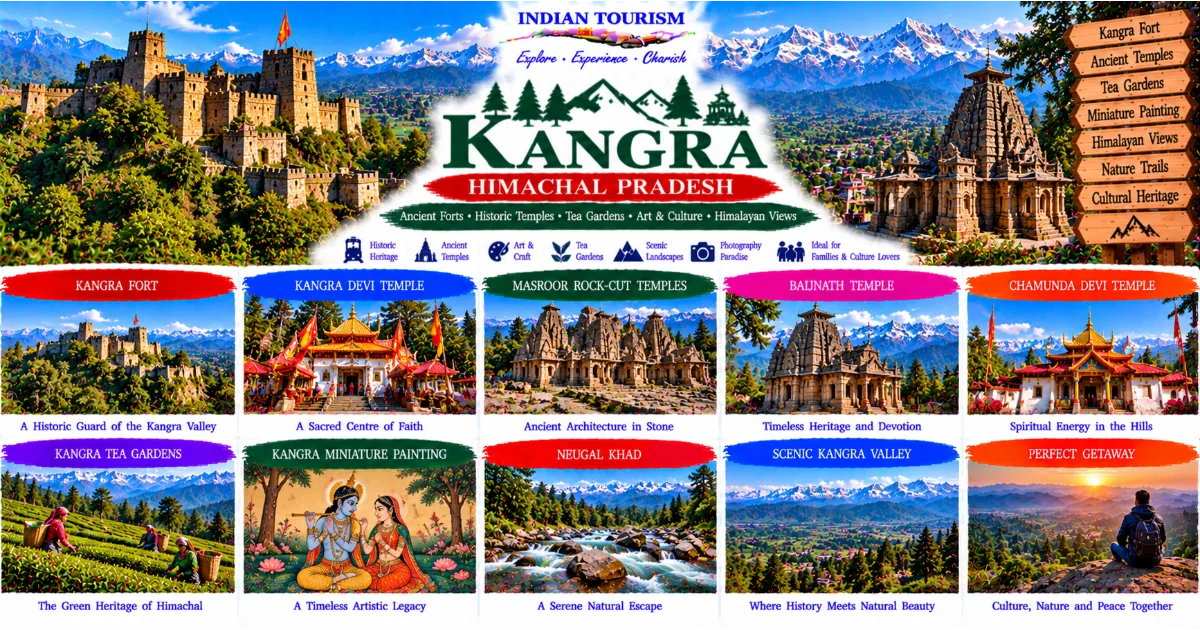
Discovering Kangra, One of Himachal Pradesh's Historic Regions
Kangra is one of the most historically significant and culturally distinctive regions of Himachal Pradesh. Set in the western Himalayan foothills, the region combines dramatic mountain scenery, ancient temples, historic fortifications, traditional art, agricultural landscapes and village life. For travellers who want to understand the deeper history of Himachal Pradesh, Kangra offers an experience that extends far beyond conventional sightseeing.
The region is particularly famous for Kangra Fort, one of the most important historic forts in northern India, and for its association with Kangra miniature painting, a celebrated tradition of Indian art. Its religious heritage includes the revered temples of the Kangra Valley, while the surrounding countryside offers tea gardens, rivers, forests and views of the Dhauladhar mountain range.
Kangra also has a distinctive cultural identity shaped by centuries of regional kingdoms, religious traditions, artistic patronage and interactions between mountain communities and the plains. Its historical sites provide insight into the political importance of the region, while its temples and artistic traditions reveal how faith and creativity have influenced everyday life across generations.
Visitors can explore Kangra as part of a wider journey through Himachal Pradesh. Dharamshala and McLeod Ganj offer Tibetan cultural heritage, Palampur is known for its tea-growing landscape, and Bir Billing attracts adventure travellers interested in paragliding. These destinations can be combined with Kangra to create an itinerary that balances history, culture, nature and outdoor activities.
Kangra is suitable for travellers with different interests. History enthusiasts can explore its fort and heritage sites, religious travellers can visit important temples, art lovers can learn about Kangra painting, and nature lovers can appreciate the surrounding mountains and countryside. Families can also enjoy a cultural journey through the region, provided travel distances and walking conditions are planned realistically.
This guide explores Kangra's history, major attractions, religious traditions, art and architecture, local food, accommodation, nearby destinations and practical travel advice. It also explains how to experience the region responsibly while respecting its communities and protecting its cultural and natural heritage.
Understanding Kangra's Geography and Regional Identity
Kangra is located in the western part of Himachal Pradesh, where the lower Himalayan foothills meet the fertile Kangra Valley. The wider region includes towns, villages, agricultural land, forested slopes, river systems and mountain scenery.
The Dhauladhar range forms a dramatic backdrop to much of the valley. Its high ridges and steep slopes influence the local climate and landscape, while the lower terrain supports settlements and agriculture. On clear days, the mountains can provide striking views from suitable locations across the region.
Kangra's geography has influenced its history. Mountain valleys and natural routes shaped settlement patterns, trade, agriculture and military strategy. Fortifications such as Kangra Fort occupied strategically important positions, while temples and settlements developed in relation to local communities and regional centres of power.
The valley is also known for its agricultural traditions. Rice, wheat, tea and other crops are associated with different parts of the region, depending on local conditions. Agriculture continues to form an important part of the rural economy and contributes to the character of the landscape.
Kangra is not a single compact tourist destination. Attractions are spread across a wider area, and travelling between them can require time on mountain roads. Visitors should group nearby sites together rather than attempting to cover every major attraction in a single day.
The region is also home to living communities. Temples remain active places of worship, farms continue to operate, and towns serve the everyday needs of residents. Visitors should respect private property, religious customs and local activities.
Weather can change quickly in the Himalayan foothills. Rain may affect road conditions, while fog can reduce visibility. Winter mornings and evenings can be cold, and mountain views depend on the weather. Checking the forecast and current road conditions before travelling helps make the visit more comfortable.
Understanding Kangra's geography provides an important foundation for appreciating its heritage. The landscape is not merely a backdrop to the region's history. It has helped shape the development of settlements, religious institutions, art and regional identity.
Kangra Fort: Exploring Centuries of History
Kangra Fort is one of the most important historic landmarks in Himachal Pradesh. Located on a strategically positioned hill near the confluence of the Banganga and Manjhi rivers, the fort reflects the long history of regional power, military defence and political change in the Kangra Valley.
The fort is associated with the Katoch dynasty, one of the region's historic ruling families. Its strategic position helped make it an important centre of authority, and its history includes periods of regional rule, conflict and changing political control.
The fort's location is one of its most striking features. Its elevated position offers views of the surrounding landscape and illustrates why the site was valuable for defence. The approach, gateways, walls and remaining structures provide insight into the planning and construction of historic fortifications.
Visitors exploring the fort can appreciate the scale of the complex and the relationship between its architecture and the natural terrain. The surviving remains reveal how defensive structures were adapted to a hilltop location, where access routes and elevation could provide strategic advantages.
The history of Kangra Fort is complex. It experienced numerous conflicts and changes in control over the centuries, reflecting the importance of the Kangra region in the political history of northern India. The fort was also affected by the devastating earthquake of 1905, which caused widespread destruction in the region.
Visitors interested in history should allow enough time to explore the site rather than treating it as a brief photographic stop. Reading about the Katoch dynasty and the wider history of the Kangra Valley can provide context for the structures and the fort's strategic importance.
The terrain may include steps, slopes and uneven surfaces, so comfortable footwear is recommended. Visitors should follow safety instructions and avoid climbing on fragile walls or entering restricted areas.
Photography can be rewarding, particularly when the surrounding valley is visible. However, visitors should remain aware of their footing and avoid approaching exposed edges for photographs.
Kangra Fort is more than a historic structure. It represents the political, military and cultural history of the region and offers one of the most valuable opportunities to explore Kangra's past.
Kangra Miniature Painting: A Celebrated Artistic Tradition
Kangra is internationally recognised for its association with Kangra miniature painting, a distinctive tradition of Indian art that developed under regional royal patronage. The style forms part of the wider Pahari painting tradition, which flourished in the hill states of the western Himalayas.
Kangra paintings are particularly admired for their delicate lines, graceful figures, expressive faces, detailed landscapes and careful use of colour. Many works depict themes drawn from Hindu mythology, poetry and devotional literature, including stories associated with Krishna and Radha.
The paintings often portray natural settings with flowering trees, rivers, gardens and rolling landscapes. These elements are not simply decorative backgrounds. They help communicate mood, emotion and the relationship between the human figures and the natural world.
The tradition developed through the interaction of artists, patrons and regional cultural influences. Royal courts supported artistic production, while religious literature and poetry provided subjects for painters. Over time, Kangra painting became associated with a refined visual language that combined narrative detail with a strong sensitivity to nature.
Visitors interested in this art form can look for museums, cultural collections, exhibitions and legitimate local sources of interpretation. The availability of displays may vary, so travellers should confirm current opening arrangements before planning a visit around a particular collection.
It is important to distinguish original historical paintings from modern reproductions and contemporary works inspired by the tradition. Buyers interested in purchasing art should ask about the artist, materials, production method and authenticity.
Supporting practising artists and legitimate craft businesses can help sustain traditional skills. Visitors should avoid assuming that every painting sold as a Kangra miniature is an original historical work.
Kangra miniature painting adds a distinctive cultural dimension to the region. It demonstrates that Kangra's heritage is not limited to forts and temples but also includes an artistic tradition that has contributed to the wider history of Indian painting.
Kangra Devi Temple: Faith and Regional Tradition
Kangra Devi Temple, also known as the Brajeshwari Devi Temple, is one of the most important religious landmarks in the Kangra region. Dedicated to the goddess Brajeshwari, the temple attracts devotees from different parts of India and holds a significant place in local religious life.
The temple is associated with longstanding traditions of goddess worship and is part of the wider network of important religious destinations in Himachal Pradesh. Its religious significance extends beyond its architecture, connecting communities through prayer, festivals and shared devotional practices.
The temple's history includes periods of destruction and rebuilding, reflecting the wider historical experiences of the Kangra region. The present complex forms part of a living religious tradition, and visitors may encounter worshippers participating in daily rituals or visiting during important religious occasions.
Travellers should follow local instructions concerning footwear, clothing, offerings and photography. Religious spaces may have restrictions, and visitors should avoid interrupting worshippers or obstructing ceremonies.
The temple can become busy during festivals and other important religious dates. Visitors planning to attend a celebration should confirm the local calendar and allow extra time for traffic and crowds.
A visit can also provide insight into the role of temples in regional culture. Religious institutions often function as gathering places where traditions are maintained and passed from one generation to another.
Visitors unfamiliar with local customs should observe respectfully and ask politely when uncertain about a practice. Modest clothing and quiet behaviour are appropriate.
Kangra Devi Temple is an important stop for travellers interested in the spiritual heritage of Himachal Pradesh. It offers a connection with the living religious culture of the valley and complements the region's historic and artistic attractions.
Chamunda Devi Temple: A Sacred Destination in the Kangra Valley
Chamunda Devi Temple is another important religious site in the wider Kangra region. Dedicated to the goddess Chamunda, the temple attracts devotees and visitors interested in the spiritual traditions of Himachal Pradesh.
The temple is part of a landscape in which religious institutions, villages and natural surroundings are closely connected. Its setting provides an opportunity to appreciate the relationship between faith and the mountain environment.
The temple holds significance for devotees who visit to offer prayers and participate in religious practices. Visitors may also learn about local traditions associated with goddess worship, although specific customs and festival arrangements should be understood through reliable local guidance.
Travellers should confirm current access arrangements and opening details before visiting. Festival periods can bring larger crowds and changes to traffic, so extra planning may be necessary.
Respectful behaviour is important. Visitors should follow instructions concerning footwear, clothing, offerings and photography and avoid disturbing religious ceremonies.
The surrounding landscape can be attractive for photography, especially when the weather provides clear views. Visitors should use safe stopping points and avoid obstructing roads.
Chamunda Devi Temple can be combined with other cultural attractions in the Kangra Valley. However, travel times should be considered carefully, and visitors should avoid trying to cover too many distant sites in one day.
For religious and cultural travellers, the temple offers a meaningful opportunity to understand the traditions that continue to shape the identity of the region.
Masroor Rock-Cut Temples: Ancient Architecture Carved from Stone
The Masroor Rock-Cut Temples are among the most distinctive historic attractions in Himachal Pradesh. Located in the Kangra region, this group of temples is known for its rock-cut architecture and its unusual arrangement of shrines carved from sandstone.
The complex is often associated with early medieval temple architecture and is particularly valuable for understanding the artistic and religious traditions of the region. The temples demonstrate the skill required to shape a natural rock formation into a group of religious structures.
The architecture includes carved details and forms that reflect the artistic conventions of their period. The complex has experienced damage over time, including effects associated with natural events, but the remaining structures continue to reveal important aspects of historic craftsmanship.
The site's setting also contributes to its appeal. The temples stand within a landscape that offers views of the surrounding countryside, creating a connection between the architecture and its natural environment.
Visitors interested in history and architecture should allow time to observe the structures carefully. The site is more rewarding when explored with some background knowledge of Indian temple design and the history of the Kangra region.
Access arrangements, entry fees and opening hours should be confirmed before travelling. Visitors should follow all instructions designed to protect the monument and should not climb on fragile structures or touch delicate carvings unnecessarily.
Photography can help record the architectural details, but visitors should avoid obstructing other people or entering restricted areas.
The Masroor Rock-Cut Temples provide a valuable contrast with Kangra Fort. While the fort reflects military and political history, Masroor illustrates the region's artistic and religious achievements. Together, these sites demonstrate the breadth of Kangra's historical heritage.
Baijnath Temple: Architecture and the Worship of Lord Shiva
Baijnath Temple is a significant religious and architectural attraction within the wider Kangra region. Dedicated to Lord Shiva, it is associated with a longstanding tradition of worship and is admired for its stone architecture.
The temple's design reflects the importance of religious architecture in the Himalayan foothills. Its carved details, structural form and relationship with the surrounding settlement make it interesting for visitors who appreciate historic buildings.
For devotees, the temple remains a place of worship. Religious activities continue throughout the year, and the atmosphere may change during festivals and important dates on the religious calendar.
Visitors should follow local rules concerning footwear, clothing, offerings and photography. The temple should be approached respectfully, particularly when worshippers are engaged in prayer.
Architecture enthusiasts can appreciate the way the building combines practical construction with religious symbolism. Historic temples often reveal information about the skills, materials and artistic preferences of the communities that built them.
Travellers should confirm current access arrangements and allow enough time for the journey from their accommodation. Baijnath can be combined with other attractions in the Kangra Valley, but the route should be planned according to available time and road conditions.
Visitors should avoid touching or climbing on fragile structures and should respect any restrictions intended to preserve the site.
Baijnath Temple adds another important dimension to Kangra's cultural heritage. It demonstrates the continuing role of religious architecture in connecting the region's history with contemporary community life.
Kangra Valley Tea Gardens: Agriculture and Landscape
The Kangra Valley is associated with tea cultivation, particularly in and around Palampur and neighbouring areas. Tea gardens create distinctive cultivated landscapes that contrast with the surrounding forests, villages and mountain slopes.
Tea cultivation developed in the region during the nineteenth century and has become part of its agricultural identity. The industry connects growers, processors, traders and consumers, while the landscape itself attracts visitors interested in rural scenery and local products.
Visitors exploring the tea-growing areas can learn about the relationship between climate, soil, rainfall and the cultivation of tea. Where authorised visitor arrangements are available, a visit to a tea estate may provide insight into harvesting and processing.
Not every tea garden is open to the public. Visitors should confirm access before travelling and should not enter private agricultural land without permission.
The appearance of the gardens changes throughout the year according to the growing cycle and agricultural work. Travellers interested in a particular stage of production should ask local businesses about the best time to visit.
Tea products may be available in shops and markets. Buyers should check packaging, origin information and storage instructions before purchasing.
The tea-growing landscape offers a useful perspective on Kangra's economy. It shows how agriculture contributes to local livelihoods and how the natural environment influences regional products and tourism.
Visitors should respect farm workers, avoid picking leaves without permission and dispose of waste responsibly. Responsible agricultural tourism can help support local producers while protecting the landscape.
Kangra Museum and Cultural Collections
Visitors interested in the region's history and art can look for museums and cultural collections that interpret the heritage of Kangra and the wider Himachal Pradesh region. Displays may include objects related to local history, traditional life, religious art, handicrafts and regional painting.
The availability of specific collections and exhibitions can vary, so visitors should confirm current opening arrangements before planning a visit around a particular museum.
Museums provide context that may be difficult to gain from looking at monuments alone. Objects, photographs, maps and interpretive displays can explain how communities lived, how regional kingdoms developed and how artistic traditions changed over time.
Visitors interested in Kangra miniature painting should look for reliable interpretation of the Pahari painting tradition and its relationship with regional courts, poetry and devotional literature.
Cultural institutions should be treated respectfully. Visitors should follow photography rules, avoid touching displayed objects and observe any restrictions designed to protect collections.
A museum visit can also be valuable for families and students because it provides a structured introduction to local history. Children may find it easier to understand historic sites when they have some background knowledge.
Travellers should avoid assuming that every collection is permanently displayed or that a particular object will be available to view. Exhibitions can change, and access may be limited.
Exploring cultural collections adds depth to a Kangra itinerary. It helps connect the region's forts, temples, art and everyday traditions into a broader historical story.
Local Markets and Traditional Products
Kangra's towns and villages have markets that serve both residents and visitors. These markets offer everyday goods, food products, clothing and selected regional items, providing a glimpse into the local economy.
Travellers may find Kangra tea, packaged agricultural products, handicrafts and other goods associated with Himachal Pradesh. Product availability varies by location and season.
Visitors interested in traditional art should ask about the origin and production method of items marketed as Kangra paintings or regional handicrafts. Contemporary reproductions and handmade products can both be valuable, but buyers should understand what they are purchasing.
Shopping from legitimate local businesses can support artisans and traders. Visitors should pay agreed prices and avoid products made from protected wildlife or materials whose source is unclear.
Food products should be checked for freshness, packaging and storage conditions. A receipt is useful for expensive purchases.
Markets can become busy at certain times of day, so visitors should allow enough space for pedestrians and avoid blocking shop entrances. Photography should be respectful, and permission should be sought before taking close-up pictures of shopkeepers or customers.
Local markets are useful places to discover everyday food and ask about regional products, but travellers should confirm important travel information through reliable sources rather than relying entirely on informal advice.
Shopping can complement a cultural visit, offering a practical connection with the region's crafts and agricultural products.
Local Food and Culinary Traditions of Kangra
Kangra's food culture reflects the agricultural landscape and culinary traditions of Himachal Pradesh. Visitors can find everyday North Indian meals alongside regional dishes and seasonal ingredients associated with the wider Himalayan foothills.
Siddu is one regional preparation worth asking about. It is a wheat-based dish associated with parts of Himachal Pradesh and is often served with accompaniments that vary by household or restaurant.
Dham is a festive meal tradition found in different regional forms across the state. It is associated with celebrations and community gatherings, although availability varies and not every restaurant serves it.
The wider Kangra region also has a connection with tea cultivation. Visitors can sample Kangra tea in cafés and shops or purchase packaged products from reputable businesses.
Local markets may offer seasonal produce, while restaurants in larger towns generally provide a wider selection of meals. The range of dishes depends on the establishment and location.
Visitors should check menu prices before ordering and communicate dietary restrictions or food allergies clearly. Those planning longer excursions should carry drinking water and suitable snacks if food outlets may be limited along the route.
Food packaging should be disposed of responsibly. Visitors should never leave rubbish near temples, forts, streams or scenic viewpoints.
Exploring local food can make a cultural visit more meaningful. Regional dishes and agricultural products provide insight into how local communities use the resources available in their environment and preserve culinary traditions across generations.
Best Time to Visit Kangra
Kangra can be visited throughout much of the year, but the best time depends on the activities planned and the visitor's preferences.
Spring can be pleasant for sightseeing, temple visits and exploring the countryside. The landscape may look particularly attractive as vegetation develops, although weather and visibility vary.
Summer is a popular time for travel in Himachal Pradesh because visitors from the plains seek cooler conditions. Kangra can serve as a base for exploring forts, temples and nearby hill destinations. Popular holidays may bring additional traffic and accommodation demand.
The monsoon brings greener landscapes but also creates travel challenges. Heavy rainfall may affect roads, reduce visibility and make paths slippery. Visitors should check current forecasts and road conditions before travelling between attractions.
Autumn can provide comfortable conditions for sightseeing and photography. Travellers may appreciate the cooler weather and opportunities to explore the historic sites without relying on snow-related activities.
Winter brings colder temperatures, especially during mornings and evenings. Visitors should carry warm clothing and confirm heating arrangements at their accommodation. Snowfall in the valley itself is not guaranteed, although higher parts of the surrounding mountains may show snow when conditions permit.
Visitors planning to attend religious festivals should confirm dates and local arrangements. Major events can bring crowds and changes to transport and access.
The best time to visit depends on the intended experience. Cultural and historical sightseeing can be rewarding throughout much of the year, while outdoor exploration requires attention to weather and road conditions.
How to Reach Kangra
Kangra is accessible by road, while air and rail travellers generally use transport connections serving the wider region before continuing to individual attractions.
By Road
Road travel is a practical way to explore Kangra and the surrounding valley. Visitors can use private vehicles, taxis or available bus services from towns and cities in northern India.
The journey may involve mountain roads and winding sections, so travel times depend on the starting point, traffic and weather. Drivers should proceed carefully during rain and fog.
Visitors should identify the exact location of their accommodation and planned attractions before travelling. Kangra Fort, the temple sites and other regional landmarks are spread across the wider area.
By Rail
Rail travellers can use stations serving the wider Kangra region or the plains, depending on the chosen route and available services. The Kangra Valley narrow-gauge railway may appeal to visitors interested in historic rail journeys and mountain scenery.
Travellers should confirm current schedules, station locations and onward transport arrangements before booking. Rail services may not provide the most direct connection to every attraction.
By Air
Kangra Airport, also known as Gaggal Airport, serves the wider region, subject to current flight availability. Travellers should confirm operating schedules and available connections before booking.
An onward road transfer is required to reach the town and individual attractions. Journey times depend on traffic, weather and the final destination.
Getting Around Kangra
Kangra's attractions are spread across the valley, so transport planning is important. Some town centres can be explored on foot, while forts, temples and rural sites may require road transport.
Taxis and private vehicles provide flexibility for visiting multiple attractions. Travellers should agree on fares, waiting charges and planned stops before beginning an excursion.
Walking is suitable for selected areas, but historic sites may involve steps, slopes and uneven surfaces. Visitors should check accessibility before travelling, particularly when accompanying children or older family members.
Families and travellers with mobility limitations should consider the distance between attractions and the time required for transfers. A relaxed itinerary is usually more enjoyable than attempting to visit every major site in a single day.
During the monsoon, road conditions may change because of heavy rain. Visitors should check current advisories and allow additional time for travel.
Grouping nearby attractions together can reduce unnecessary journeys. For example, a visit to Kangra Fort can be combined with other sites in the immediate area, while more distant temples and cultural attractions may be planned for another day.
Where to Stay in Kangra
Accommodation in the wider Kangra region includes hotels, guesthouses, homestays and properties in nearby towns. The best option depends on budget, transport arrangements and the attractions visitors plan to explore.
Travellers who want convenient access to Kangra Fort and the town may prefer accommodation nearby. Visitors planning a broader itinerary may choose to stay in Dharamshala or Palampur, depending on their priorities.
Visitors should confirm the exact location of their accommodation before booking. A property described as being in the Kangra region may still require a significant road journey to reach a particular attraction.
Heating, hot water, parking and meal availability should be checked, especially during winter. Facilities vary between properties, so visitors should confirm what is included in the quoted price.
Homestays can provide a more personal experience and opportunities to learn about local food and everyday life. Guests should communicate arrival times and dietary requirements clearly.
Booking ahead is advisable during popular holidays and major religious festivals. Visitors should review cancellation policies, additional charges and parking arrangements before confirming a reservation.
Choosing accommodation according to the itinerary can make the visit more comfortable. Travellers exploring several parts of the Kangra Valley may find it useful to select a base with suitable transport connections.
Nearby Dharamshala and McLeod Ganj
Dharamshala and McLeod Ganj are important nearby destinations for travellers exploring Kangra. They offer a combination of Tibetan cultural heritage, Buddhist institutions, local markets and mountain scenery.
Visitors can explore religious and cultural sites, learn about Tibetan traditions and enjoy cafés serving regional and international food. The Tsuglagkhang Complex and Namgyal Monastery are associated with Tibetan Buddhist traditions, while Norbulingka Institute focuses on preserving Tibetan art and craftsmanship.
The wider region also offers access to natural attractions and walking routes. Visitors should check weather and trail conditions before planning outdoor excursions.
Kangra and Dharamshala offer complementary experiences. Kangra is particularly associated with its historic fort, temples and artistic heritage, while Dharamshala is known for Tibetan cultural institutions and its relationship with the Dhauladhar mountains.
The road journey should be planned according to current conditions and the available time. Travellers should avoid attempting too many attractions in a single day.
Combining the two destinations can provide a broader understanding of the cultural and historical diversity of Himachal Pradesh.
Nearby Palampur: Tea Gardens and Countryside
Palampur is another useful addition to a Kangra itinerary. Known for its tea gardens and views of the Dhauladhar range, it offers a quieter agricultural landscape and opportunities to learn about Kangra tea.
Visitors can explore the town, enjoy local food and appreciate the surrounding countryside. Where authorised visitor arrangements are available, tea estate visits may provide insight into cultivation and processing.
Palampur's landscape differs from the historic character of Kangra's fort and temples. Its tea-growing identity and agricultural traditions provide a complementary experience.
Visitors should respect private agricultural land and confirm access before entering tea gardens or production facilities. The journey between destinations should be planned according to current road conditions.
Combining Kangra and Palampur creates a varied itinerary that includes history, religious heritage, agriculture and mountain scenery.
A Suggested Three-Day Kangra Itinerary
A three-day visit provides enough time to explore several major attractions without rushing.
On the first day, arrive and settle into the accommodation. Begin with Kangra Fort, allowing time to explore its historical remains and appreciate the surrounding landscape. Later, explore the nearby town and visit Kangra Devi Temple if time and access arrangements permit.
On the second day, focus on religious and architectural heritage. Visit Masroor Rock-Cut Temples and consider Baijnath Temple if the journey fits the available schedule. Travellers should confirm access arrangements and allow sufficient time for travel between sites.
On the third day, choose an excursion according to personal interests. Visitors interested in religious traditions may visit Chamunda Devi Temple, while those who want to explore the agricultural landscape can travel towards Palampur. Art enthusiasts may use the day to learn about Kangra miniature painting through reliable cultural collections or exhibitions where available.
Travellers with additional time can extend the journey to Dharamshala, McLeod Ganj or Bir Billing. These destinations offer different experiences, but travel times should be included in the plan.
Families should include rest breaks and choose activities suitable for all members. Visitors with mobility limitations should check the terrain and accessibility of individual sites.
The itinerary should remain flexible, particularly during the monsoon and winter. Weather, traffic and attraction access may affect the schedule.
A relaxed approach allows visitors to appreciate Kangra's history, art and cultural traditions rather than treating the region as a brief stop on a longer journey.
Responsible Tourism in Kangra
Kangra's forts, temples, art traditions, agricultural land and natural landscapes are important parts of its identity. Responsible tourism helps protect these resources while supporting local communities.
Visitors should dispose of waste properly and avoid leaving plastic bottles, food packaging or other rubbish near temples, historic monuments, streams and scenic viewpoints.
Religious sites should be treated respectfully. Travellers should follow local instructions concerning footwear, clothing, offerings and photography and avoid disturbing worshippers.
Historic monuments require particular care. Visitors should not climb on fragile structures, scratch walls, remove objects or enter restricted areas. These actions can damage cultural heritage and reduce the site's value for future generations.
Agricultural land and tea gardens are working properties. Visitors should ask permission before entering fields, picking crops or photographing farm workers.
Supporting local accommodation providers, restaurants, guides, artisans and legitimate sellers of regional products can help tourism contribute to the local economy. Visitors should pay agreed prices and treat workers respectfully.
Mountain roads require careful driving, especially during rain, fog and winter conditions. Travellers should follow official advisories and avoid unsafe journeys.
Responsible tourism also means respecting residents and their privacy. Ask permission before photographing people or private homes, and keep noise under control in residential areas.
By protecting historic sites, respecting religious traditions and supporting local livelihoods, visitors can help ensure that Kangra remains a rewarding destination for future generations.
Is Kangra Suitable for Families, Couples and Cultural Travellers?
Kangra can suit a wide range of travellers because it combines historical attractions, religious heritage, artistic traditions and natural scenery.
Families may enjoy exploring the fort, visiting temples and learning about regional history. Parents should consider walking distances, steps and uneven surfaces when planning activities with children.
Couples may appreciate the mountain scenery, heritage sites and peaceful countryside. A relaxed itinerary combining cultural exploration with scenic drives can provide a rewarding holiday.
History enthusiasts can spend time exploring Kangra Fort and the Masroor Rock-Cut Temples. Art lovers may be particularly interested in the Kangra miniature painting tradition, while religious travellers can visit important temples in the valley.
Nature lovers can appreciate the Dhauladhar views and surrounding agricultural landscape. Visitors who want adventure activities can combine Kangra with Bir Billing or other destinations in the wider region.
Travellers seeking extensive nightlife or large commercial entertainment facilities may prefer to combine Kangra with bigger towns. The region's main appeal lies in its history, culture and landscape.
Visitors with mobility limitations should check the accessibility of individual sites before planning a visit. Historic monuments and temples may involve steps, slopes or uneven surfaces.
Kangra's greatest strength is its cultural depth. It provides opportunities to understand the region through its architecture, art, religious traditions and landscape, making it particularly rewarding for travellers who enjoy learning as they explore.
Conclusion: Why Kangra Deserves a Place on Your Himachal Pradesh Travel List
Kangra is one of the most rewarding destinations in Himachal Pradesh for travellers interested in history, architecture, religious heritage and traditional art. Its historic fort, important temples, celebrated miniature painting tradition and agricultural landscape provide a rich introduction to the cultural identity of the Kangra Valley.
Kangra Fort reveals the region's strategic and political history, while the Masroor Rock-Cut Temples demonstrate the skill of historic stone architecture. Kangra Devi Temple, Chamunda Devi Temple and Baijnath Temple reflect the continuing importance of religious traditions in local life.
Kangra miniature painting adds a distinctive artistic dimension, connecting the region with the wider history of Indian painting. The tea-growing landscape around Palampur provides another perspective on local livelihoods and the relationship between agriculture and tourism.
Nearby Dharamshala, McLeod Ganj and Bir Billing can extend the journey with Tibetan cultural heritage, monasteries and adventure activities. These destinations can be combined with Kangra to create a varied itinerary.
The best time to visit depends on personal interests and weather conditions. Spring, summer and autumn can be suitable for sightseeing, while the monsoon requires additional attention to road conditions. Winter brings colder temperatures, and mountain views depend on visibility.
Good planning makes the experience more comfortable. Confirm access arrangements for historic sites and temples, choose accommodation according to the itinerary and allow sufficient time for travel between attractions.
Responsible tourism is essential. Visitors should protect historic structures, respect religious customs, avoid littering and support local businesses where appropriate.
For the Indian Tourism series, Kangra demonstrates how a destination can be understood through its history, art, faith and landscape. It offers more than scenic views. It provides a chance to explore the traditions and achievements that have shaped one of Himachal Pradesh's most culturally significant regions.
Whether you visit for Kangra Fort, ancient temples, miniature painting, tea-growing landscapes or the wider Himalayan scenery, Kangra offers a meaningful opportunity to discover the history and cultural richness of Himachal Pradesh.
#IndianTourism #HimachalPradesh #Kangra #KangraTourism #KangraFort #KangraMiniaturePainting #MasroorRockCutTemples #KangraDeviTemple #BrajeshwariDeviTemple #ChamundaDeviTemple #BaijnathTemple #KangraValley #DhauladharRange #HimachalHeritage #IndianHistory #HimachalCulture #KangraTea #Palampur #ResponsibleTourism #ExploreIndia
