
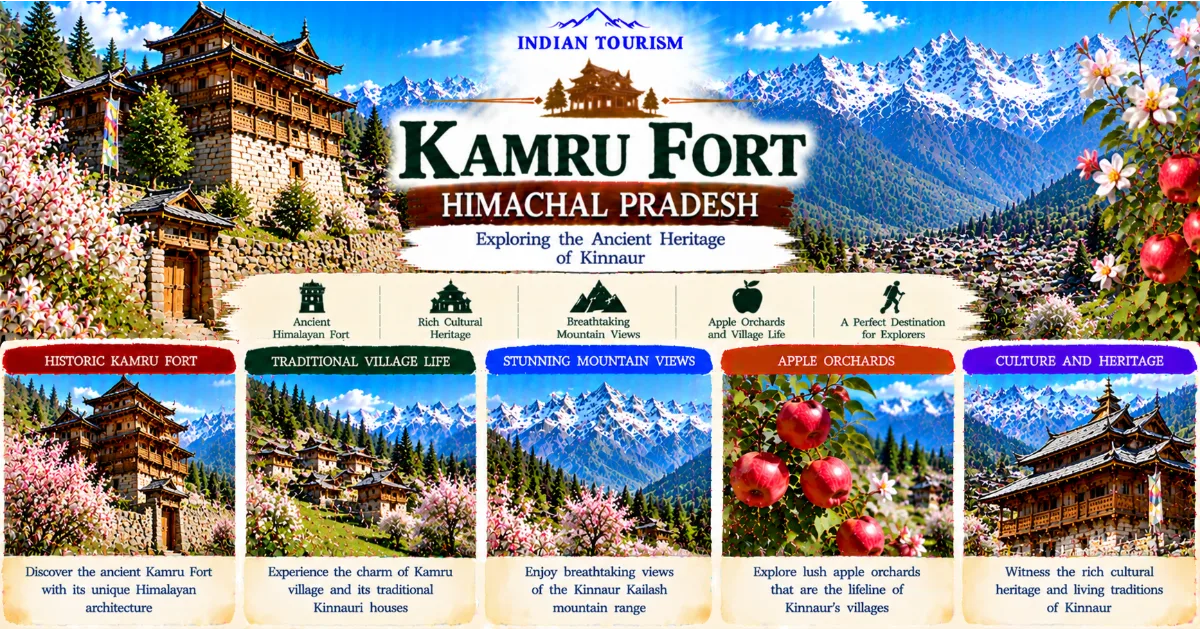
Where Himalayan History Meets Traditional Architecture
Himachal Pradesh is known for its dramatic mountain landscapes, ancient temples, peaceful villages and remarkable architectural traditions. Beyond its popular hill stations, the state preserves historic structures that reveal how communities lived, worshipped, traded and defended their settlements across generations. Kamru Fort, located near Sangla in Kinnaur district, is one of the region's most distinctive heritage landmarks. Rising above the traditional village of Kamru, the fort offers visitors an opportunity to explore Kinnaur's architectural character, cultural traditions and historical landscape.
Kamru Fort is not simply a building standing on a hillside. It belongs to a broader cultural environment in which settlements, religious institutions, agricultural land and mountain routes developed together. The surrounding village reflects the relationship between people and the difficult geography of the Himalayas, while the fort's traditional construction demonstrates how architecture could communicate authority, preserve community identity and provide a prominent place within the settlement.
The structure is widely associated with the historical rulers of Bushahr, a former princely state whose territory included important parts of the present-day Shimla and Kinnaur regions. The history of individual structures in the Himalayas can be complex, and stories about their origins may combine documentary evidence with oral tradition. Kamru Fort is therefore best appreciated as a monument embedded in a living cultural landscape rather than as a site whose entire past can be reduced to a single legend.
The fort is also important for understanding the distinctive combination of architectural and religious influences found in Kinnaur. The region has long been shaped by Hindu traditions, Buddhist influences and local forms of worship. Temples, shrines and traditional buildings often occupy central positions in village life, and their significance extends beyond their physical appearance.
For travellers exploring Sangla Valley, Kamru Fort provides a rewarding cultural stop. It complements the area's mountain scenery with an opportunity to understand the people, history and craftsmanship that give Kinnaur its identity. A thoughtful visit allows travellers to look beyond panoramic views and appreciate the heritage that continues to shape life in this part of Himachal Pradesh.
Where Is Kamru Fort Located?
Kamru Fort is situated in Kamru village in Kinnaur district, close to Sangla in the Baspa Valley of Himachal Pradesh. The wider valley is known for its mountain scenery, settlements, orchards and connection to the Baspa River. Kamru's position places it within a landscape where steep slopes and narrow areas of cultivable land have influenced the location and structure of villages for generations.
The village lies within a region where travel routes follow the contours of the mountains. Roads connect settlements across the valley, but the surrounding terrain means that journeys may take longer than expected from map distances alone. Narrow stretches, bends, steep gradients and changing road conditions are characteristic of mountain travel.
Kamru Fort occupies a prominent position within the village environment. Its elevated setting contributes to its visual presence and creates a strong connection between the historic structure and the surrounding settlement. The approach involves moving through village surroundings, making the journey part of the cultural experience rather than simply a transfer between a car park and a monument.
Sangla is a practical base for visitors exploring the fort and other destinations in the Baspa Valley. It offers a useful starting point for discovering the area's villages, landscapes and cultural sites. Travellers can plan a visit to Kamru Fort as part of a wider day exploring the valley, provided they allow enough time for the mountain roads and local access arrangements.
Before travelling, visitors should confirm the current route, access conditions and any restrictions at the site. Historic buildings may have specific rules regarding entry, photography and religious activity. Local guidance is particularly useful when a monument forms part of an active village or religious complex.
The Historical Significance of Kamru Fort
Kamru Fort is closely associated with the history of the former Bushahr princely state. Bushahr played an important role in the political and cultural history of the western Himalayan region, with connections to mountain trade, local administration and the development of settlements across what are now parts of Himachal Pradesh.
The history of Himalayan political centres differs from that of large lowland capitals. Mountain rulers operated within landscapes shaped by difficult transport, limited agricultural land, regional alliances and routes connecting neighbouring valleys. Authority was often expressed through a combination of fortified or elevated structures, religious institutions, family traditions and control over important settlements.
Kamru's association with Bushahr gives the fort historical significance beyond the boundaries of the village. It represents a connection between local architecture and the wider political structures that once governed the region. The fort's prominence also reflects the importance of maintaining visible centres of authority within a landscape where communities could be separated by mountains and long travel times.
Historical accounts of the fort are sometimes accompanied by legends concerning royal succession, ancient rulers and the origins of the surrounding settlement. Such stories form part of the region's cultural memory, but they should be distinguished from claims supported by reliable historical records. Oral traditions can preserve important community perspectives even when their details cannot be independently verified.
The building should therefore be understood through several overlapping dimensions. Its association with regional rulers provides a political context. Its architecture reflects local construction traditions. Its relationship with nearby religious sites reveals the importance of worship and community identity. Its continued presence in Kamru village shows how historic structures can remain meaningful even as the surrounding society changes.
For visitors, the historical value of Kamru Fort lies partly in this combination. The monument is not isolated from the landscape around it. It belongs to a living village and a wider region whose identity has developed through centuries of adaptation, cultural exchange and changing political circumstances.
Traditional Architecture of Kamru Fort
One of the most striking aspects of Kamru Fort is its traditional Himalayan architectural character. The building reflects construction methods associated with Kinnaur, where stone and timber have historically been important materials. Such architecture developed in response to local resources, weather conditions and the practical demands of building on steep mountain terrain.
Traditional Himalayan structures often use combinations of materials rather than relying on a single construction method. Stone can provide strong walls and a durable base, while timber can contribute structural support and flexibility. The arrangement of these materials varies between buildings and periods, reflecting local craftsmanship and the resources available to the builders.
Kamru Fort's vertical form gives it a distinctive presence within the village. The building rises above its surroundings, drawing attention to its historic and cultural importance. In a mountain settlement, height and position can influence both the appearance of a structure and the way people experience it as they move through the village.
Wooden balconies, carved details and traditional roof forms are important features of Himalayan architectural heritage more broadly. Visitors should observe which details are actually present at Kamru Fort rather than assuming that every element found in other Kinnauri buildings appears here in exactly the same form. Historic structures are individual works shaped by their own construction histories and later modifications.
The fort's architectural value is also connected to craftsmanship. Traditional construction required knowledge of materials, load distribution, weather exposure and the practical challenges of transporting building supplies across mountainous terrain. Builders worked within limitations that would be unfamiliar to many modern construction projects, and their solutions became part of the region's architectural identity.
Preserving this heritage requires care. Timber can deteriorate, stonework can be affected by water and weather, and changes in use can place pressure on historic structures. Restoration must balance the needs of safety and continued use with respect for traditional materials and construction techniques.
Visitors can help protect the site by avoiding contact with fragile architectural details, following access rules and not removing stones, wood fragments or other material as souvenirs. A historic building is most valuable when it remains intact for future generations.
The Relationship Between Kamru Fort and the Village
Kamru Fort cannot be fully understood without considering Kamru village itself. The surrounding settlement provides the everyday context in which the fort's historical significance has been preserved. Homes, lanes, cultivated land and religious spaces form part of a village environment shaped by both natural conditions and cultural traditions.
Traditional villages in Kinnaur are often arranged according to the contours of the landscape. Buildings occupy available terraces, paths connect different levels and agricultural land is located wherever the terrain permits cultivation. This arrangement reflects practical responses to steep slopes and limited flat ground.
Walking through Kamru can help visitors understand how these elements fit together. The relationship between the fort and the houses around it offers a sense of how historic structures form part of a larger settlement rather than functioning as independent attractions. The route through the village may reveal traditional construction details, local shrines and changing views of the surrounding mountains.
However, the village is a residential community. Its lanes and courtyards are part of daily life, and not every attractive location is open to visitors. Some spaces may be privately owned, used for religious purposes or required for agricultural work. Travellers should follow public routes and ask before entering any enclosed area.
The village experience is often most rewarding when approached at a slow pace. Rather than rushing through the settlement to photograph the fort, visitors can notice how the houses respond to the terrain, how local paths connect different parts of the village and how traditional and modern structures coexist.
This broader perspective makes Kamru more than a heritage stop. It becomes an opportunity to understand how historical identity continues within a working Himalayan settlement.
Religious Traditions and Cultural Identity
Kinnaur has a rich religious and cultural history shaped by Hindu traditions, Buddhist influences and local practices. These traditions have developed through long periods of contact between communities across the Himalayas. Their expressions differ between villages, and individual religious sites may have particular histories and rules.
Kamru is associated with a local temple tradition, and the village's religious environment contributes to the cultural significance of the fort. Religious buildings in Kinnaur are not simply architectural attractions. They can serve as places of worship, community gathering and the preservation of inherited customs.
A temple or shrine may also be linked to local festivals, seasonal observances and decisions that matter to the community. These roles can be difficult for visitors to understand from the building's exterior alone. Speaking respectfully with local residents, when appropriate, can provide a more meaningful introduction than relying entirely on photographs or brief descriptions.
Religious customs should never be treated as a tourist performance. Visitors should observe signs concerning footwear, photography, access and appropriate behaviour. If a religious ceremony is taking place, travellers should remain unobtrusive and follow instructions from those responsible for the site.
The region's religious diversity also reminds visitors to avoid assuming that all communities follow identical practices. Traditions can vary from one settlement to another, and local explanations are more reliable than generalisations based on the wider district.
Cultural identity is maintained through buildings, rituals, language, family traditions and shared community life. Kamru Fort forms one part of this larger picture. Its significance becomes clearer when visitors recognise the relationship between the historic structure, the village and the religious traditions that continue to shape the region.
Kamru Fort and the Legacy of Bushahr
Bushahr was one of the historically significant princely states of the western Himalayas. Its political and cultural influence extended across areas that today form part of Himachal Pradesh. Like other Himalayan states, Bushahr developed within a geographical environment where terrain, local alliances and regional trade routes played important roles.
The history of a princely state is rarely contained in a single monument. It is reflected in administrative centres, family traditions, religious institutions, settlements and the movement of people and goods. Kamru Fort is one place through which visitors can begin to understand this broader historical landscape.
Mountain rulers faced distinctive challenges. Communication between settlements could be slow, and journeys across steep terrain required time and planning. Agricultural production varied according to altitude and local conditions, while trade and exchange helped connect communities with neighbouring regions. Political authority depended on relationships with local groups as well as the ability to manage resources and maintain connections across difficult terrain.
Buildings associated with rulers could express status and continuity, but they also existed within communities that had their own religious practices, agricultural routines and local leadership structures. A historic fort should therefore not be interpreted only through the lives of rulers. It also reflects the labour of craftspeople, builders and residents whose work helped sustain the surrounding settlement.
The transition from princely rule to modern administration changed the political environment of the region. Nevertheless, historical sites remain important reminders of the institutions and traditions that shaped local identity. They can help residents and visitors understand how present-day communities developed within a much longer history.
When visiting Kamru Fort, travellers can consider the monument as one part of a wider story of governance, architecture and cultural exchange. This approach provides a more balanced understanding than relying on dramatic legends alone.
The Natural Beauty Surrounding Kamru Fort
The setting of Kamru Fort is one of the reasons it attracts visitors exploring Sangla Valley. The surrounding landscape combines mountain slopes, cultivated land, forests and settlements that reflect the environmental diversity of Kinnaur.
The Baspa Valley is known for its scenic character, with the river and its surrounding terrain helping define the wider landscape. Mountain slopes rise above cultivated areas, and villages occupy locations shaped by the availability of water, land and transport routes. The resulting scenery changes with altitude, season and weather.
During clear conditions, distant mountain ridges provide a dramatic background to the settlement. Clouds may gather around the higher peaks, creating shifting patterns of light and shadow. The landscape can look different within a short period, making it worthwhile to pause and observe rather than treating the visit as a quick photographic stop.
Vegetation also changes through the year. Warmer months may bring greener fields and orchard growth, while autumn can introduce changes in foliage and agricultural activity. Winter conditions can make the landscape appear quieter and more austere, particularly when snow affects higher elevations.
Visitors should remember that the natural environment is not separate from local livelihoods. Orchards, fields and grazing areas contribute to the economy of the valley. Travellers should avoid damaging plants, disturbing livestock or entering cultivated land without permission.
Photography can be rewarding, but safety matters more than obtaining an ideal composition. Mountain roads, steep edges and uneven paths can present hazards, especially when attention is focused on a camera or mobile phone. Use safe stopping points and remain aware of the surroundings.
Best Time to Visit Kamru Fort
Kamru Fort can be included in a Kinnaur trip during different seasons, but each period offers a distinct experience. The most suitable time depends on road conditions, weather, personal interests and the type of landscape the traveller hopes to see.
Spring: Fresh Growth and Changing Landscapes
Spring can bring fresh vegetation and renewed activity to the surrounding countryside. As temperatures rise, orchards and cultivated areas begin to change, although the exact timing depends on local altitude and weather.
This season may appeal to visitors interested in village walks and the agricultural landscape. Mornings and evenings can remain cold, so warm clothing is advisable. Travellers should also check road conditions, especially if their journey includes higher or exposed mountain routes.
Summer: A Practical Season for Sightseeing
Summer is often a convenient period for exploring Sangla Valley and nearby heritage sites. Daytime conditions can be comfortable for walking, and the surrounding landscape may appear greener than during colder months.
The fort can be combined with other village and valley destinations, but visitors should allow sufficient time for travel and local access. Weather can still change quickly in the mountains, and a warm layer is useful even when the day begins pleasantly.
Monsoon: Prioritise Road Safety
Monsoon travel requires careful planning because rain can affect mountain roads and slopes. Landslides, falling rocks and temporary road closures can disrupt journeys. Conditions vary across the region, so current local information is more useful than assumptions based on general seasonal patterns.
Travellers should confirm road status before departure, avoid unstable areas and follow official instructions. A flexible itinerary is essential when weather conditions may affect access.
Autumn: Clear Days and Agricultural Activity
Autumn can be an attractive period for visiting Kinnaur. The air may feel crisp, visibility can be excellent on clear days, and the surrounding orchards may reflect the seasonal agricultural cycle.
Visitors interested in local produce may find this period particularly rewarding, although harvest timing varies by crop and elevation. Warm clothing becomes increasingly important as temperatures fall in the evening.
Winter: A Quieter Mountain Experience
Winter can offer a different atmosphere, but cold conditions and possible snowfall require additional preparation. Roads may be affected by snow or ice, and access arrangements can change.
Travellers planning a winter visit should confirm road conditions, local accommodation availability and the operating status of the site. Suitable footwear and insulated clothing are important, and visitors should not assume that every road or pathway will remain accessible.
For many travellers, the warmer months and early autumn offer a practical balance between sightseeing and travel flexibility. The final decision should always be based on current conditions rather than the calendar alone.
How to Reach Kamru Fort
Kamru Fort is reached through the road network serving Kinnaur and Sangla Valley. The route and travel time depend on the starting point, road conditions and the transport arrangements available on the day.
By Road
Travellers coming from Shimla and other parts of Himachal Pradesh generally follow mountain roads towards Kinnaur before continuing into the Baspa Valley. The journey passes through changing terrain, with steep gradients, bends and stretches where careful driving is necessary.
Mountain travel should not be planned using distance alone. Road conditions, weather, construction and traffic can substantially affect journey times. Drivers unfamiliar with the region may find it helpful to use a local driver experienced in mountain conditions.
By Bus
Public transport connects important settlements in Himachal Pradesh, and buses may provide access to towns and villages along the broader Kinnaur route. However, services to smaller settlements can be limited or may require connections.
Travellers should confirm the latest schedule locally and ask where to alight for Sangla or the most suitable nearby point. The final approach to Kamru Fort may require local transport and walking.
By Train
There is no railway station at Kamru Fort or in the immediate village. Visitors arriving by train must continue by road from a suitable station serving their wider itinerary.
By Air
There is no airport in Kamru. Travellers arriving by air need to arrange onward road transport. Since reaching Kinnaur involves a substantial mountain journey, it is sensible to avoid tight connections and allow for possible delays.
The Final Approach
Once in the Sangla area, visitors should confirm the exact access route and any local requirements. The final portion of the visit may involve walking through village lanes and navigating uneven surfaces. Follow local directions, respect residential areas and avoid parking in a way that blocks traffic or access for residents.
Places to Explore Near Kamru Fort
Kamru Fort can be combined with several destinations in Kinnaur, depending on the amount of time available and the condition of the roads.
Sangla Village
Sangla is an important starting point for exploring the Baspa Valley. The settlement provides access to local services and offers views of the surrounding mountains and agricultural landscape. Visitors can spend time exploring accessible parts of the village, learning about local life and enjoying the valley's scenery.
Chitkul
Chitkul is one of the best-known settlements in the Baspa Valley. Its mountain setting, traditional architecture and high-altitude environment attract travellers interested in the landscapes of Kinnaur. It is best approached as a planned excursion with sufficient time for the road journey.
Road access and weather should be checked before visiting, particularly during colder months or periods of unsettled conditions. Travellers should avoid rushing the journey merely to add another destination to their itinerary.
Rakchham
Rakchham is another scenic settlement in the Baspa Valley. Its surroundings combine mountain scenery, cultivated areas and village landscapes. A visit can provide a different perspective on the valley's rural character.
Travellers should respect private land and follow local access guidance. Quiet observation and short walks along appropriate public routes are often more rewarding than attempting to explore every visible path.
Batseri
Batseri offers another opportunity to appreciate traditional village life and the landscape of the Baspa Valley. Visitors may notice local architectural features, orchards and the way settlements adapt to the mountain environment.
As with other villages, Batseri should be approached as a living community. Photography and walking should not interfere with household privacy or agricultural work.
Kalpa
Kalpa lies in the wider Kinnaur region and is known for its mountain views and traditional settlement character. It can be included in a broader journey through Kinnaur, although travellers should account for the road distance and avoid trying to cover too many locations in a single day.
Reckong Peo
Reckong Peo serves as an important administrative and commercial centre for Kinnaur. It can be useful for transport arrangements, supplies and access to local services. A stop here offers insight into the contemporary life of the district beyond its smaller villages.
Things to Do During a Visit
The most rewarding activities at Kamru Fort involve observing its architecture, understanding its historical setting and exploring the surrounding village respectfully.
Study the Architecture
Take time to observe the building's form, materials and relationship with the hillside. Notice how the structure fits into the settlement and how its position affects the way it is viewed from nearby paths.
Avoid touching fragile details or climbing onto parts of the building that are not open to visitors. Historic structures can be damaged by seemingly minor actions, and safety restrictions should be respected.
Explore the Village on Foot
Walking through accessible village lanes can reveal how homes, public paths and cultivated land fit together. The route may include uneven surfaces and slopes, so comfortable footwear is important.
Keep residential access clear and do not enter courtyards or private buildings without permission. A respectful walk allows visitors to observe local life without intruding on it.
Learn About Local Traditions
If a suitable opportunity arises, ask local residents about the village's history or the meaning of particular architectural features. Conversations should be polite and voluntary, and visitors should accept that some people may not have time to speak.
Local knowledge can provide useful context, but stories about the past may differ between families or sources. It is appropriate to appreciate oral traditions without presenting every detail as established historical fact.
Photograph the Fort and Surroundings
The fort and village landscape can provide attractive photographic subjects. The best perspective depends on light, weather and the areas open to visitors.
Ask permission before photographing people at close range and observe restrictions at religious sites. Avoid stopping vehicles or standing in unsafe places to obtain a particular view.
Enjoy the Wider Valley
A visit to the fort can be combined with time spent appreciating the Baspa Valley's scenery. Rather than treating the monument as the only reason to stop, allow time to observe the mountains, orchards and village landscape that give the site its wider context.
Food and Local Culinary Experiences
The food culture of Kinnaur reflects the region's climate, agricultural traditions and cultural connections across the Himalayas. Everyday meals vary by household, but visitors may encounter locally prepared dishes featuring grains, vegetables, pulses and seasonal ingredients.
Food options directly around a small village may be limited, depending on the season and local businesses. Travellers should not assume that restaurants will be open throughout the day. It is practical to ask about meal arrangements before travelling and to carry suitable snacks for a longer excursion.
The wider Sangla area offers a convenient place to look for meals and refreshments. Local establishments may provide home-style cooking and a chance to experience regional hospitality. Visitors with dietary restrictions should explain their needs clearly and confirm ingredients when necessary.
Local agricultural products can also form part of the experience. Apples and other produce are important to the wider regional economy, although availability varies throughout the year. Buying directly from legitimate local sellers can support residents and provide a connection to the area's agricultural traditions.
Visitors should dispose of food packaging responsibly and avoid leaving waste along village lanes or beside the river. Food is part of the travel experience, but the environmental impact of tourism must remain a consideration.
Accommodation Near Kamru Fort
Travellers usually find it practical to arrange accommodation in Sangla or another established settlement in the wider Kinnaur region, depending on availability and the itinerary. Options can include guesthouses, homestays and hotels, with facilities varying between properties.
A homestay can provide a more personal introduction to local hospitality and everyday routines. Guests should remember that a homestay is also a private household, and they should respect the host's rules regarding shared spaces, meals, quiet hours and photography.
Before booking, confirm the availability of heating, hot water, meals, parking and suitable transport access. During colder periods, heating arrangements and road conditions deserve particular attention. Travellers should also check cancellation terms in case weather affects the journey.
During busy travel periods, booking in advance can reduce uncertainty. Visitors should not assume that accommodation will be available immediately near the fort itself.
Camping should only take place where it is permitted and where the landowner or local authorities have given the necessary approval. Avoid lighting fires in unsafe areas and carry all waste away. The mountain environment should be left as clean as it was found.
Responsible Tourism at Kamru Fort
Historic places require careful treatment, especially when they remain connected to active religious traditions and village life. Responsible tourism helps protect the monument while ensuring that visitors do not disrupt the people who live around it.
Respect all access restrictions and follow instructions provided by local authorities, site caretakers or residents. Do not climb onto fragile structures, remove historic materials or leave marks on walls. Even small acts of damage can accumulate over time.
If the fort or a nearby religious site has rules concerning footwear, clothing, photography or behaviour, follow them. Visitors should not assume that every part of a heritage site is open for unrestricted exploration.
Keep noise to a reasonable level and avoid intrusive photography. A village is a residential environment, and its residents should not have to change their routines simply because tourists have arrived.
Waste management is equally important. Carry rubbish until it can be disposed of appropriately, avoid single-use packaging where practical and never leave plastic or food waste in the surrounding landscape.
Support local businesses when possible. Choosing local accommodation, buying products from legitimate sellers and eating at local establishments can help ensure that tourism benefits the community. Fair payment and respectful communication are important parts of this relationship.
Responsible travel also means being realistic about road conditions and weather. Follow local guidance, allow sufficient time and do not put yourself or others at risk for the sake of completing an itinerary.
A Suggested One-Day Itinerary
A one-day visit to Kamru Fort works well when combined with time in Sangla and the surrounding Baspa Valley. The exact schedule should depend on the starting point, weather, road access and the site's opening arrangements.
Begin the day with breakfast in Sangla or another nearby settlement. Confirm local access conditions before setting out, particularly if the weather has changed overnight. Carry water, a warm layer and comfortable shoes.
Travel towards Kamru and allow time to approach the village without rushing. Explore the accessible area around the fort, observing its traditional construction and the relationship between the structure and the settlement. If access to the interior is restricted, appreciate the site from permitted public areas rather than attempting to enter.
Spend some time walking through the village along suitable public paths. Notice the architecture, cultivated land and mountain views, while respecting private property and the daily activities of residents.
Return to Sangla for lunch or a break. If time and road conditions permit, explore another nearby village or enjoy the surrounding scenery. Avoid including distant destinations simply to make the day more crowded.
Plan the return journey with enough daylight remaining. Mountain roads can be demanding, and unexpected delays are possible. A flexible schedule makes the experience safer and more enjoyable.
A Two-Day Itinerary for Kamru and Sangla Valley
Travellers with two days available can explore the area at a more relaxed pace. This approach makes it possible to appreciate the fort and village environment without rushing between locations.
On the first day, travel to Sangla and settle into the accommodation. Depending on the arrival time, spend the afternoon exploring accessible parts of the settlement and enjoying the valley's scenery. Resting after the mountain journey can make the next day's visit more comfortable.
On the second day, visit Kamru Fort and spend time observing its architecture, historical setting and surrounding village. Return to Sangla for a meal and, if conditions permit, explore a nearby destination such as Batseri or Rakchham.
Visitors who wish to include Chitkul should assess the road journey and available daylight before making a decision. It may be more appropriate to dedicate additional time to the wider valley rather than combining too many destinations in one day.
The objective of this itinerary is not to maximise the number of stops. It is to provide enough time to understand the cultural and natural setting of the region while keeping travel manageable.
Practical Tips for Travellers
Prepare for changing temperatures by wearing layers. Even in warmer months, mornings and evenings can be cool, and conditions may change quickly in the mountains. Comfortable walking shoes are important because village lanes and approaches can be uneven.
Carry essential medication and personal supplies. Do not rely on a small village having every service available, especially during the quieter travel season. Visitors with medical concerns should plan according to their needs and seek appropriate professional advice before undertaking demanding travel.
Mobile connectivity can be inconsistent in mountainous areas. Download necessary maps in advance, keep important information accessible and inform someone of your general itinerary if travelling independently.
Carry some cash for small purchases, as payment facilities may vary. Keep valuables secure and avoid carrying unnecessary amounts of money.
Check road and weather conditions before departure and remain flexible throughout the journey. If a route is closed or local authorities advise against travel, change the plan rather than taking an unsafe alternative.
Respect local customs and remember that a heritage site may also be a place of worship. Follow instructions concerning access and photography, and avoid interrupting religious activity.
Finally, allow time to appreciate the destination. Kamru Fort is most rewarding when visitors approach it as a place of history and living culture rather than simply another item to photograph.
Conclusion: Discovering the Heritage of Kinnaur
Kamru Fort offers travellers a valuable introduction to the history and cultural character of Kinnaur. Its association with the former Bushahr princely state, its traditional Himalayan architecture and its position within Kamru village make it an important heritage destination in the Baspa Valley.
The fort's significance extends beyond its physical structure. It reflects the relationship between political history, religious traditions, local craftsmanship and the settlement patterns that developed in a challenging mountain environment. Exploring the village alongside the monument helps visitors understand how heritage continues to exist within everyday community life.
A visit can be combined with Sangla and other nearby destinations, allowing travellers to experience both the historical and natural dimensions of the region. Careful planning is essential because road conditions, weather and local access arrangements can affect the itinerary.
The most meaningful way to experience Kamru Fort is through curiosity and respect. Observe the architecture, learn about the broader history of Kinnaur, support local businesses and follow the rules that protect the monument and its surroundings. By doing so, visitors can appreciate not only a remarkable historic structure but also the living culture that gives it meaning.
For travellers exploring Himachal Pradesh, Kamru Fort is a reminder that the Himalayas preserve stories not only in their mountains and rivers but also in the buildings, villages and traditions shaped by generations of people who have called this region home.
#IndianTourism #HimachalPradesh #KamruFort #Kinnaur #SanglaValley #HimalayanHeritage #HistoricForts #ExploreHimachal #IncredibleIndia #CulturalTourism #HeritageTravel #TravelIndia
