
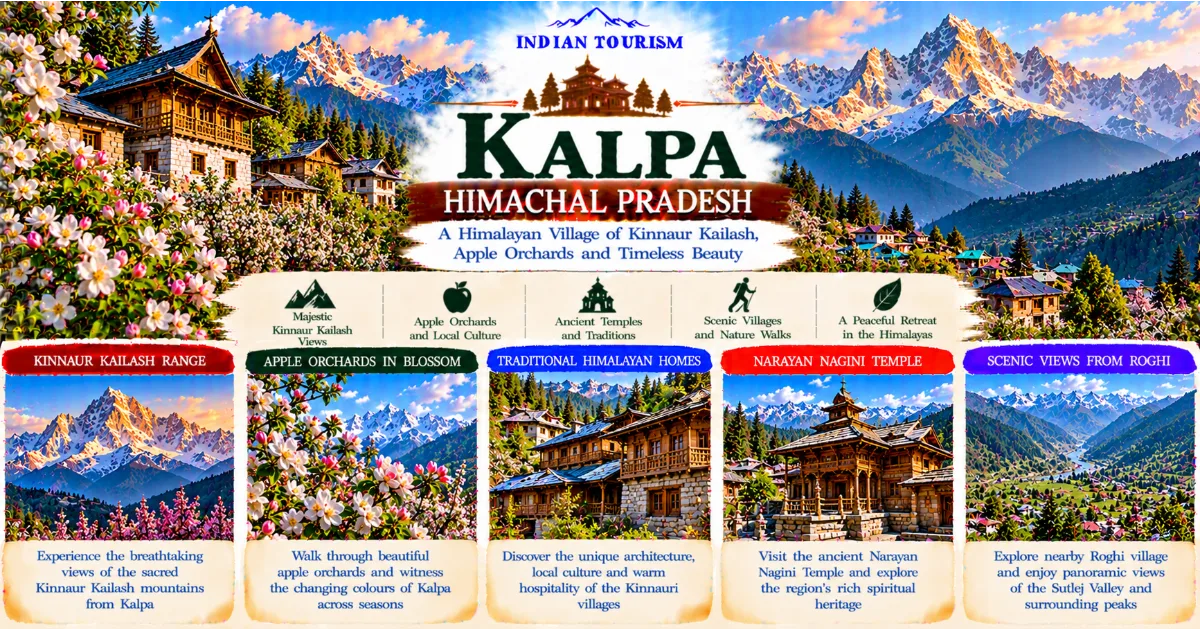
Discovering the Timeless Beauty of Kalpa
Kalpa is one of the most captivating mountain destinations in Himachal Pradesh, a village where traditional Himalayan life unfolds beneath the magnificent presence of the Kinnaur Kailash mountain range. Located in the Kinnaur district, above the town of Reckong Peo, Kalpa is known for its spectacular mountain views, apple orchards, traditional architecture, ancient religious traditions and peaceful atmosphere. The village offers a combination of natural beauty and cultural depth that makes it particularly appealing to travellers who want to experience the Himalayas beyond crowded commercial destinations.
The landscape around Kalpa is defined by dramatic contrasts. Towering mountains rise above the valley, cultivated terraces follow the contours of the slopes, and clusters of traditional homes stand among trees and orchards. On clear days, the Kinnaur Kailash range dominates the horizon, creating a striking backdrop for everyday village life. Changes in sunlight, cloud cover and season transform the mountains throughout the day, making Kalpa a rewarding destination for photography and quiet observation.
Kalpa also provides a glimpse into the cultural traditions of Kinnaur, a region with distinctive architecture, religious practices, food traditions and community identities. Hindu and Buddhist influences have shaped the wider cultural landscape, and visitors can encounter temples, monasteries and sacred spaces that reflect centuries of interaction between communities and traditions.
Apple cultivation is another important part of Kalpa's identity. Orchards spread across the surrounding countryside, and seasonal agricultural work influences the rhythm of village life. During flowering season, the landscape can appear especially delicate, while the harvest period brings activity to farms and local markets. The orchards are not simply scenic features but an important part of the local economy.
Kalpa is also a useful base for exploring nearby destinations, including Reckong Peo, Roghi Village and the wider Kinnaur region. Travellers with additional time can plan journeys towards Sangla Valley and other settlements, although mountain distances and road conditions require realistic scheduling.
A visit to Kalpa is most rewarding when travellers allow time to appreciate the landscape rather than rushing between viewpoints. The village's appeal lies in the combination of mountain scenery, agricultural traditions, cultural heritage and the quiet routines of everyday life.
Where Is Kalpa Located?
Kalpa is located in the Kinnaur district of Himachal Pradesh in northern India. It sits at an elevation of roughly 2,960 metres above sea level, overlooking the Sutlej River valley and facing the dramatic Kinnaur Kailash mountain range.
The village lies above Reckong Peo, the administrative headquarters of Kinnaur district. Reckong Peo serves as an important service centre for the surrounding region, providing transport connections, shops and other facilities that travellers may need before continuing to smaller settlements.
Kalpa's elevated position gives it expansive views of the surrounding mountains and valleys. The terrain rises sharply in several directions, while cultivated land occupies suitable slopes and terraces. Roads connect the village with nearby settlements, but the landscape remains distinctly mountainous.
The region's elevation influences both weather and vegetation. Temperatures can vary significantly between sunny afternoons and cold nights, while winter conditions may bring snow and icy roads. Travellers should prepare for cooler conditions even when visiting during the warmer months.
Kalpa's location also makes it an attractive base for exploring parts of Kinnaur. However, destinations that look close on a map may require substantial driving time because roads follow the contours of the mountains. Travellers should avoid assuming that several remote villages can be comfortably visited in a single day.
The village combines relative accessibility with a strong sense of mountain isolation. Visitors can reach it by road, arrange accommodation and explore the local area, yet the surrounding landscape retains the scale and character of the high Himalayas.
The Kinnaur Kailash Range: Kalpa's Most Spectacular Natural Landmark
The Kinnaur Kailash mountain range is the defining visual feature of Kalpa. Its towering peaks dominate the horizon and create the dramatic setting that has made the village famous among travellers, photographers and mountain enthusiasts.
The mountains are significant not only for their appearance but also for their religious importance. Kinnaur Kailash is regarded as sacred in Hindu traditions and is associated with Lord Shiva. The landscape around the range is therefore both a natural environment and a spiritual setting for many people.
The appearance of the mountains changes according to weather and light. During clear mornings, the peaks may stand sharply against the sky, while clouds can partially conceal them and create a different atmosphere. Snow cover varies by season, and the contrast between white peaks, darker rock faces and green or brown slopes gives the range a distinctive character.
Kalpa is particularly well known for its views of the mountain landscape from village lanes, orchards and suitable public viewpoints. Travellers do not necessarily need to undertake a demanding trek to appreciate the scenery. Simply spending time in the village can provide memorable views when the weather is clear.
Visitors should remember that mountain visibility is never guaranteed. Cloud cover, haze and seasonal weather may obscure the peaks, so it is worth allowing more than one morning or evening for photography.
The sacred significance of the region also calls for respectful behaviour. Avoid treating religiously important places as ordinary recreational spaces, and follow local guidance when visiting temples or other sacred locations.
For many travellers, the Kinnaur Kailash range becomes the lasting memory of Kalpa. Its scale, changing appearance and spiritual associations give the village a distinctive identity within Himachal Pradesh.
The Sacred Landscape of Kinnaur Kailash
Kinnaur Kailash holds an important place in the religious imagination of the region. The mountain is associated with Lord Shiva, and local beliefs, stories and pilgrimage traditions contribute to its cultural significance.
The sacred landscape extends beyond the mountain's physical form. It includes the villages, temples, routes and community traditions connected with the surrounding region. These relationships help explain why the mountains are viewed with reverence by many residents and pilgrims.
The Kinnaur Kailash Parikrama is a demanding high-altitude pilgrimage undertaken by experienced trekkers and devotees under suitable conditions. It is distinct from viewing the mountain range from Kalpa. The route involves substantial elevation changes, difficult terrain and exposure to rapidly changing mountain weather.
Visitors should not confuse the scenic experience of staying in Kalpa with undertaking the pilgrimage itself. The trek requires specific preparation, current information about route access, suitable equipment and an honest assessment of physical fitness.
Anyone planning the pilgrimage should obtain up-to-date guidance from reliable local or official sources. Conditions can change because of snow, rain, rockfall and other hazards. Local rules and arrangements may also vary from season to season.
For travellers who are not undertaking the trek, the mountain can still be appreciated from suitable viewpoints and village surroundings. Learning about its religious significance can deepen the experience and help visitors understand the relationship between landscape and faith in Kinnaur.
The sacred identity of Kinnaur Kailash is one of the reasons Kalpa offers more than a conventional mountain holiday. It is a destination where natural scenery and spiritual meaning are closely connected.
Kalpa's Traditional Architecture and Village Streets
Kalpa's architecture reflects the practical and cultural traditions of Kinnaur. Traditional homes, religious buildings and village structures have developed in response to the region's climate, terrain and available construction materials.
Wood and stone have historically played important roles in the architecture of the wider Kinnaur region. Buildings may feature wooden balconies, carved details, sloping roofs and structural forms suited to mountain conditions. The exact design varies between villages and individual buildings.
Traditional construction methods often reflect accumulated knowledge about cold winters, seasonal snowfall, earthquake risk and the availability of local materials. Modern buildings increasingly incorporate contemporary construction techniques, but older structures continue to provide insight into regional craftsmanship.
Walking through Kalpa's lanes offers an opportunity to notice these details. The arrangement of homes, courtyards, storage areas and cultivated land reveals how residents use limited space on steep slopes.
Religious architecture is another important element of the village environment. Temples and other sacred buildings may incorporate distinctive roof forms, carved woodwork and local artistic traditions. Their appearance reflects the interaction of religious practices and regional building styles.
Visitors should remember that many traditional buildings are private homes or active religious spaces. Ask permission before entering courtyards or photographing residents, and avoid touching fragile wooden carvings or other architectural features.
The village's architecture is best appreciated as part of everyday life rather than as a collection of isolated monuments. Homes, temples, lanes and orchards together create the cultural landscape that gives Kalpa its character.
Narayan-Nagini Temple and Local Religious Traditions
The Narayan-Nagini Temple is among the religious sites associated with Kalpa and the wider Kinnaur region. The temple reflects the importance of local deities and traditional forms of worship in the cultural life of Himalayan communities.
Religious traditions in Kinnaur have developed through centuries of interaction between Hindu and Buddhist influences, local beliefs and community practices. In many villages, local deities have a significant role in festivals, collective decision-making and cultural identity.
Temple architecture can provide insight into regional craftsmanship. Woodwork, carved details and the arrangement of sacred spaces often reflect local artistic traditions. Visitors should take time to observe these features respectfully, following any instructions provided by temple authorities or local residents.
The experience of visiting a village temple is different from entering a large urban religious complex. Sacred places may remain closely connected with community life, and activities taking place there may be intended primarily for local worshippers.
Photography may be restricted in some areas, and visitors should ask before taking pictures of religious ceremonies or people engaged in worship. Dress and behaviour should be appropriate to the setting.
Religious sites should not be viewed only as attractions. They are part of the living cultural landscape, and their importance extends beyond architectural appearance.
For travellers interested in Kinnaur's heritage, temple visits can provide a deeper understanding of how belief, community and place are connected.
Apple Orchards: The Agricultural Heart of Kalpa
Apple cultivation is one of the most recognisable features of Kalpa and the surrounding Kinnaur countryside. Orchards occupy suitable slopes and terraces, creating a landscape that changes noticeably throughout the agricultural year.
Apple growing has become an important part of the regional economy, providing income and employment for many households. The work involves far more than harvesting fruit. Farmers must manage trees, monitor weather, maintain irrigation where needed, protect crops and organise the transport of produce.
The flowering season brings a delicate transformation to the landscape. Apple trees produce blossoms that contrast with the surrounding mountains and cultivated slopes. The timing and intensity of flowering depend on weather conditions and can vary from year to year.
During the growing season, orchards gradually develop fuller foliage and fruit. Harvest periods bring increased activity as apples are collected, sorted, packed and transported. The exact harvest timing depends on variety, elevation and seasonal conditions.
Visitors should understand that orchards are working agricultural properties. The trees and fruit represent a household's livelihood, and entering without permission can damage crops or interfere with work.
If you would like to explore an orchard, ask your accommodation host or a local farmer whether a visit is possible. Some agricultural experiences may be arranged with permission, while other properties may not be open to visitors.
Buying local produce when available can support farmers and provide a connection with the region's agricultural economy. However, availability varies according to season.
Apple orchards give Kalpa much of its distinctive character. They demonstrate how local communities have adapted agriculture to a mountain environment and created livelihoods within a landscape that can be challenging to cultivate.
Best Time to See Apple Blossoms in Kalpa
Apple blossom season is one of the most attractive periods for visitors who want to see Kalpa's orchards at their most delicate. The exact timing varies according to temperature, elevation, weather and the condition of individual orchards.
Spring generally brings the transition from winter conditions towards warmer weather. During suitable periods, apple trees produce blossoms that brighten the surrounding landscape. The contrast between the flowers, village buildings and mountain scenery can create excellent photographic opportunities.
Visitors should not assume that blossoms will be present on a fixed date every year. Cold spells, warm weather and other seasonal factors influence flowering. Anyone travelling specifically for blossom photography should seek current local information before booking.
The flowering period can be relatively short, so flexibility helps. Allowing additional days in the region may improve the chances of experiencing the orchards at the desired stage.
Visitors should also respect agricultural work. Blossoms and young fruit are part of the farming cycle, and branches should never be pulled or damaged for photographs.
Walking along public village lanes can provide beautiful views without entering private orchards. If a farmer permits a visit, follow their instructions and avoid stepping on cultivated ground.
Apple blossom season offers a different experience from the main harvest period. It is quieter and more focused on the delicate changes of spring, making it especially appealing to photographers and travellers who enjoy slow exploration.
Autumn in Kalpa: Apple Harvest and Golden Mountain Light
Autumn brings another distinctive experience to Kalpa. The apple harvest becomes an important part of local agricultural life, while cooler temperatures and changing light create a different atmosphere from spring and summer.
During the harvest period, orchards become active as fruit is collected and prepared for transport. Visitors may observe this activity from public roads or through an arranged visit, provided they respect the work taking place.
The surrounding landscape can also become visually striking. The light changes as the sun moves across the mountains, while the orchards and village slopes develop different colours according to vegetation and seasonal conditions.
Travellers interested in agriculture may find autumn particularly rewarding because it offers an opportunity to understand how produce moves from the orchard to the market. The work involves planning, labour and transport, all of which are influenced by the region's terrain.
Harvest timing varies according to apple varieties, altitude and weather. It is therefore important to check local conditions rather than relying on a single fixed calendar.
Autumn evenings can be cold, so visitors should carry warm clothing and confirm heating arrangements at their accommodation.
For travellers seeking a balance between mountain scenery and local culture, the harvest season provides a valuable perspective on Kalpa. It reveals the economic activity behind the beautiful orchards and demonstrates how agriculture remains central to the village's identity.
Roghi Village: A Scenic Neighbour of Kalpa
Roghi Village lies in the wider Kalpa area and is known for its dramatic mountain setting and traditional village atmosphere. It can provide a useful excursion for travellers who want to explore more of the local landscape without moving to a distant region.
The village is surrounded by steep terrain, cultivated slopes and views of the wider Kinnaur landscape. Traditional homes and agricultural areas reveal how settlements adapt to the limited flat ground available in the mountains.
The journey to Roghi can be scenic, but mountain roads require care. Travellers should check current conditions and avoid stopping in unsafe places for photographs.
Roghi is also associated with the Roghi viewpoint area, where the terrain can create dramatic perspectives across the surrounding slopes and valleys. Visitors should use designated or locally recommended viewpoints and remain well away from unprotected edges.
The village is a living community, so visitors should keep noise levels reasonable, respect private property and ask before photographing residents.
A visit to Roghi can be combined with Kalpa as part of a relaxed itinerary. However, travellers should not assume that every path or viewpoint is suitable for all visitors, particularly during rain, snow or icy conditions.
The appeal of Roghi lies in its combination of village life and dramatic scenery. It offers another perspective on the Kinnaur landscape while remaining connected to the cultural and agricultural traditions of the region.
Reckong Peo: The Administrative Centre Near Kalpa
Reckong Peo is the administrative headquarters of Kinnaur district and an important service centre for travellers exploring the region. Located below Kalpa, it provides access to shops, transport connections and other facilities that may be more limited in smaller villages.
The town serves as a practical base for organising journeys into Kinnaur. Visitors may need to arrange onward transport, purchase supplies or confirm information about road conditions before continuing to more remote destinations.
Reckong Peo also provides a useful opportunity to understand the contemporary life of the district. Administrative offices, businesses, schools and transport services reflect the needs of a population spread across difficult terrain.
Travellers staying in Kalpa may visit Reckong Peo for practical reasons, but the two places offer different experiences. Kalpa is particularly associated with mountain views, orchards and village atmosphere, while Reckong Peo functions more directly as a regional service centre.
The journey between them is relatively short compared with many mountain routes, but conditions can still vary. Visitors should allow time for local traffic and changing weather.
For longer trips through Kinnaur, Reckong Peo can be useful for confirming onward travel plans. However, travellers should obtain current information before depending on a particular service or connection.
The Sutlej River Valley and the Landscape Around Kalpa
The Sutlej River is one of the major geographical features of Kinnaur. Its valley forms a dramatic corridor through the mountains and has influenced settlement, transport, agriculture and the development of infrastructure in the region.
From Kalpa and nearby viewpoints, travellers can appreciate the scale of the surrounding landscape. The river lies below the village, while steep mountain slopes rise towards the high peaks. Roads often follow the contours of the terrain, creating long journeys through narrow valleys.
The river system is important to local ecosystems and human communities. Water supports settlements and agriculture, while the surrounding slopes provide habitats for vegetation and wildlife.
The landscape also demonstrates the challenges of mountain development. Infrastructure must be built within difficult terrain, where landslides, rockfall and changing water conditions can affect roads and other facilities.
Visitors should observe rivers and steep slopes from safe locations. Do not attempt to descend to the water without a suitable route, and avoid standing near unprotected edges.
The Sutlej Valley is particularly rewarding for photography because of its dramatic contrasts. The deep river corridor, cultivated slopes, distant peaks and changing light combine to create a landscape that feels both immense and intricate.
Understanding the river valley helps explain why Kalpa developed where it did. The village's position above the Sutlej provides its distinctive views while connecting it with the wider geography of Kinnaur.
Buddhist and Hindu Influences in Kinnaur
Kinnaur's cultural landscape reflects the interaction of Hindu traditions, Buddhist influences and local religious practices. These traditions have developed over centuries through geography, community relationships, trade and cultural exchange.
Religious buildings may reflect different architectural styles, while local festivals and community customs reveal how belief is expressed in everyday life. The precise traditions vary from village to village, and visitors should avoid assuming that the entire district follows one uniform pattern.
Hindu temples and Buddhist monasteries both form part of the wider heritage of Kinnaur. Their presence illustrates the region's historical connections with neighbouring Himalayan areas and the movement of religious ideas across mountain routes.
Local deities also hold an important place in community identity. In some places, religious traditions are closely connected with seasonal celebrations, collective gatherings and customary practices.
Visitors can learn about these traditions by exploring appropriate public religious sites, reading interpretive information and listening respectfully to local residents. It is important to distinguish between practices that are open to visitors and those intended for private or community observance.
Dress and behaviour should be appropriate to the setting. Follow instructions regarding footwear, photography and access, and avoid disrupting worship.
The coexistence of different religious traditions is one of the defining cultural features of the wider Kinnaur region. It contributes to the depth of the visitor experience and demonstrates how the Himalayas have served as both a physical barrier and a corridor for cultural exchange.
Food and Culinary Experiences in Kalpa
Food in Kalpa reflects the wider culinary traditions of Kinnaur and Himachal Pradesh. Meals are influenced by local agriculture, seasonal ingredients, household customs and the practical demands of mountain life.
Visitors may encounter preparations based on grains, pulses, vegetables and other locally available ingredients. The exact dishes vary between households and restaurants, and menus may combine regional food with familiar North Indian options.
Traditional food is connected with the agricultural calendar. Ingredients available during one season may be less common during another, while household recipes reflect the preferences and practices of individual families.
Travellers interested in local cuisine should ask their hosts about regional dishes and the ingredients used. A home-style meal at a legitimate homestay can provide a more personal introduction to local food traditions than a standard restaurant menu.
Food availability may be limited in smaller settlements, especially outside the main travel season. Confirm meal arrangements before arrival if you have particular requirements.
Visitors with allergies or dietary restrictions should communicate their needs clearly. It is sensible to carry suitable snacks for excursions, particularly when travelling beyond the main village.
Respect local food customs and avoid wasting food. Purchasing meals from local businesses can support livelihoods while giving travellers a deeper connection with the region.
Exploring Kalpa's food is not simply a question of finding a place to eat. It offers a way to understand the relationship between agriculture, climate and everyday life in the mountains.
Best Time to Visit Kalpa
Kalpa can be visited in different seasons, and the best period depends on whether you want to see apple blossoms, experience the harvest, enjoy clear mountain views or explore the village during winter.
Spring: March to April
Spring is particularly appealing to travellers interested in the possibility of apple blossoms. The landscape begins transitioning away from winter, although temperatures can remain cold and conditions may vary from year to year.
Visitors should check local reports if blossom viewing is their main purpose. Flowering dates depend on weather, and the season cannot be guaranteed for a specific booking.
Summer: May to June
Summer is generally a practical time for exploring Kalpa, with conditions that may suit village walks, photography and excursions to nearby settlements.
Days can be pleasant, but mornings and evenings may remain cool. Travellers should carry layers and check road conditions before planning longer journeys.
Monsoon: July to September
The monsoon can bring greener scenery, but it may also create landslides, road disruptions and reduced visibility. Mountain travel requires additional caution during heavy rainfall.
Visitors should check current conditions and remain flexible with their plans.
Autumn: October to November
Autumn is appealing for travellers interested in apple harvesting and changing mountain light. Cooler temperatures and clear periods can create excellent photography opportunities.
Evenings become increasingly cold, so warm clothing and suitable accommodation are important.
Winter: December to February
Winter can bring snow, icy roads and very low temperatures. Conditions vary from year to year, and some travel routes may become difficult.
Visitors should confirm road status, accommodation arrangements and heating facilities before travelling. Winter journeys require particular attention to weather and access.
For many visitors, late spring through autumn offers the widest range of experiences, but the ideal dates depend on the activity planned and the conditions that year.
How to Reach Kalpa
Kalpa is connected by road with other parts of Himachal Pradesh, but the mountainous terrain means that travel times can be substantial.
By Road
The journey to Kalpa usually follows mountain roads through the wider Kinnaur region. Travellers coming from Shimla and other parts of Himachal Pradesh should plan for a long drive with winding sections and changing elevations.
Check road conditions before departure, particularly during the monsoon and winter. Landslides, road repairs, snow and rockfall can affect travel.
Drivers should be comfortable with mountain roads and should avoid rushing. If you are unfamiliar with the region, consider using an experienced local driver.
By Bus
Bus services connect parts of Kinnaur with other regional centres, although schedules and travel times can vary. Visitors should confirm current services and the location of the final stop before travelling.
If onward transport is needed between Reckong Peo and Kalpa, arrange it in advance where possible.
By Train
Kalpa does not have a railway station. Travellers arriving by train must continue by road from a suitable rail connection serving their itinerary.
By Air
There is no airport in Kalpa. Visitors arriving by air must arrange onward road transport from an airport that fits the wider journey.
Local Transport
Taxis and local vehicles may be available for trips between Kalpa, Reckong Peo, Roghi and nearby locations. Confirm the fare, expected journey time and return arrangements before setting out.
Mountain roads can make short distances take longer than expected, so allow enough time for sightseeing and return travel.
Accommodation in Kalpa
Kalpa offers a range of accommodation options, including hotels, guesthouses, homestays and smaller properties. Some are valued for their mountain views, while others provide easier access to village streets and local services.
Visitors should compare accommodation according to their priorities. A property with a panoramic view may be located farther from shops or transport, while a centrally located option may be more convenient for exploring on foot.
Before booking, confirm heating, hot water, meals, parking, access and cancellation arrangements. These details are particularly important during colder months, when temperatures can fall significantly overnight.
Homestays can provide a personal introduction to local hospitality and food traditions. Facilities vary, so travellers should communicate their needs clearly rather than assuming that every property offers the same services.
Advance booking is advisable during popular travel periods. If you plan to visit during apple blossom season or the autumn harvest, confirm availability before making non-refundable travel arrangements.
Respect household rules, keep noise levels reasonable and dispose of waste responsibly. Supporting locally operated accommodation helps tourism contribute to the community.
A good accommodation choice can make the difference between a rushed visit and a comfortable stay that allows time to enjoy the mountain landscape.
A Three-Day Kalpa Itinerary
A three-day itinerary offers a useful introduction to Kalpa and its immediate surroundings.
On the first day, travel to Kalpa and settle into your accommodation. Spend the remaining time exploring accessible village lanes, observing traditional architecture and enjoying the mountain views when the weather permits.
On the second day, visit local religious sites and explore the village's agricultural landscape. If an orchard visit is available with the owner's permission, use the opportunity to learn about apple cultivation. Later, enjoy the scenery from a safe viewpoint and spend time photographing the Kinnaur Kailash range.
On the third day, arrange an excursion to Roghi Village or visit Reckong Peo for practical needs and a closer look at the wider district. Confirm road conditions before departing and allow enough time to return safely.
This itinerary should remain flexible because mountain weather can change quickly. If cloud cover obscures the peaks, use the time to explore village life and cultural attractions rather than attempting unnecessary travel.
Visitors who want to undertake longer treks or explore more distant parts of Kinnaur should add extra days.
A Five-Day Kalpa and Kinnaur Journey
A five-day stay provides more time to appreciate Kalpa without rushing and allows a wider exploration of the surrounding region.
Spend the first day travelling to Kalpa and settling into accommodation. Use the evening to enjoy the village atmosphere and observe the changing light on the mountains.
On the second day, explore Kalpa's traditional architecture, religious sites and orchard landscape. If your visit coincides with flowering or harvest, learn about the agricultural work taking place.
On the third day, visit Roghi Village and suitable viewpoints. Choose safe stopping places and avoid approaching unprotected edges.
Use the fourth day to explore Reckong Peo and plan any further excursions according to current road conditions. Visitors with more time may consider other destinations in Kinnaur, but travel distances and weather should determine what is realistic.
On the fifth day, begin the return journey or remain longer if your itinerary requires additional time.
This schedule is a framework rather than a fixed timetable. Visitors should adjust it according to weather, transport availability and their interests. A relaxed itinerary is more rewarding than trying to visit too many mountain settlements in a short period.
Responsible Tourism in Kalpa
Responsible tourism helps preserve Kalpa's landscape, cultural heritage and agricultural livelihoods. The village's appeal depends on the continued health of its environment and the respect shown to the people who live there.
Treat orchards as working farms. Ask permission before entering, avoid damaging branches and do not pick fruit without consent.
Respect temples and sacred sites. Follow local instructions, observe appropriate dress and behaviour, and ask before photographing religious ceremonies or worshippers.
Carry rubbish to suitable disposal points. Avoid leaving plastic packaging, bottles or food waste in orchards, along roads or at viewpoints.
Support local businesses and artisans where possible. Buying genuine regional products and using local accommodation can help tourism contribute to the community.
Drive carefully on mountain roads and avoid stopping at unsafe bends or exposed edges for photographs.
Be mindful of water and other resources. Remote mountain settlements may face practical challenges in providing services, and visitors should avoid unnecessary waste.
Respect residents' privacy. Ask before photographing people or entering private property, and remember that village life continues beyond the tourist experience.
Responsible travel allows Kalpa to remain a place where natural beauty, cultural traditions and agricultural life can be experienced together.
Practical Travel Tips for Kalpa
Carry warm layers even during summer because evenings and early mornings can be cold.
Wear comfortable footwear for village lanes, uneven paths and short walks.
Confirm accommodation heating and hot-water arrangements before booking for winter.
Check current road conditions before travelling, particularly during the monsoon and colder months.
If you want to see apple blossoms or the harvest, ask local hosts about seasonal timing before finalising dates.
Carry essential medication, drinking water and suitable snacks for longer excursions.
Download maps and important information in advance because mobile connectivity may vary.
Ask permission before entering orchards or photographing residents.
Avoid approaching unprotected edges at mountain viewpoints, especially during rain, snow or strong winds.
Allow extra time for mountain travel and keep your itinerary flexible in case of road closures or weather changes.
Conclusion: Why Kalpa Belongs on Your Himachal Pradesh Travel List
Kalpa is a destination where the grandeur of the Himalayas meets the quiet rhythms of village life. Its views of the Kinnaur Kailash range, traditional architecture, apple orchards and religious traditions create a travel experience that extends beyond conventional mountain sightseeing.
The sacred mountain landscape provides the setting for a region rich in cultural meaning. Village temples, local customs and traditional homes reveal how communities have maintained distinctive identities while adapting to changing social and economic conditions.
Apple cultivation adds another dimension to the experience. The orchards demonstrate the importance of agriculture to the local economy and transform the surrounding landscape through the flowering and harvest seasons.
Nearby Roghi Village and Reckong Peo provide opportunities to explore the wider area, while the surrounding mountains offer countless possibilities for photography and quiet observation. Visitors should nevertheless plan carefully, as weather, road conditions and elevation can influence travel.
Kalpa is most rewarding when experienced at a relaxed pace. Spend time watching the light change across the mountains, walk through accessible village lanes, learn about local traditions and appreciate the work that sustains the orchards.
For travellers seeking a meaningful journey through Himachal Pradesh, Kalpa offers a rare combination of Himalayan scenery, agricultural heritage and living culture. It is a destination where the mountains are not merely a backdrop but an integral part of the history, identity and everyday life of the people who call Kinnaur home.
#IndianTourism #Kalpa #HimachalPradesh #Kinnaur #KinnaurKailash #AppleOrchards #RoghiVillage #ReckongPeo #HimalayanVillages #MountainTravel #HimalayanCulture #HeritageTourism #ResponsibleTourism #ExploreHimachal #IncredibleIndia
