
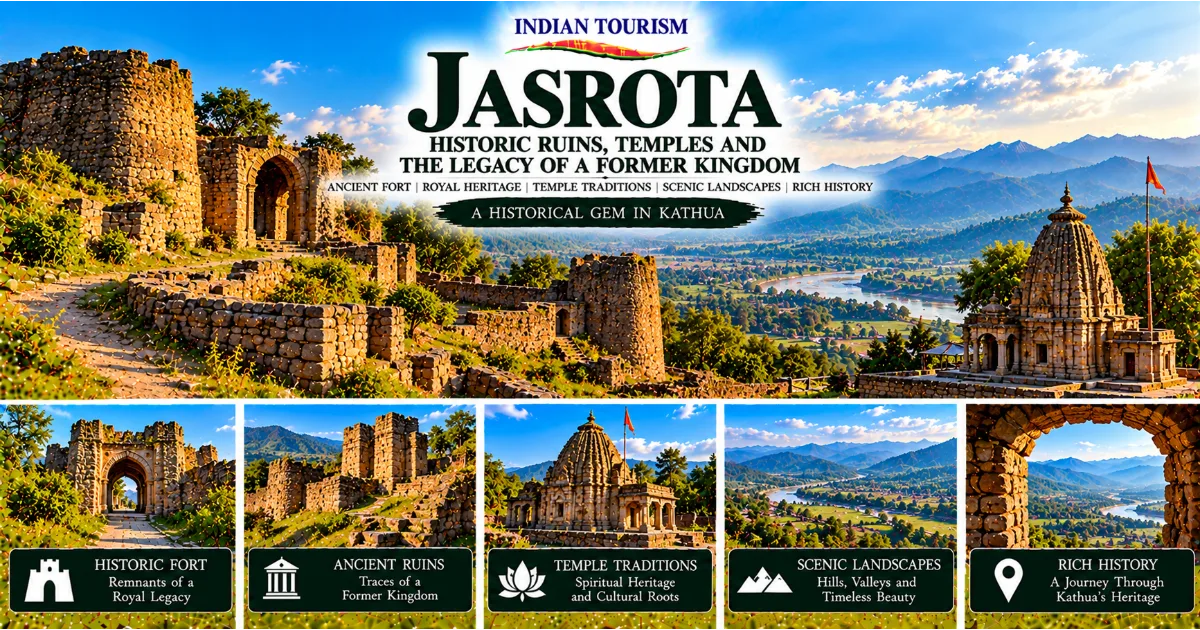
Discovering Jasrota's Historical Landscape
Jasrota is one of the historically intriguing places in the Jammu region of Jammu and Kashmir, offering a glimpse into the legacy of a former principality and the changing political landscape of the western Himalayas. Known for its historic ruins and its association with the Jasrotia rulers, the area invites travellers to look beyond the region's celebrated mountain scenery and discover the stories preserved in old settlements, religious structures and remnants of royal authority.
Located in the wider Kathua district, Jasrota is particularly interesting for visitors who enjoy exploring places where history and landscape meet. The surrounding countryside, the remains associated with the former kingdom and the region's cultural traditions create an experience different from a conventional holiday centred on crowded attractions. A visit can become an opportunity to reflect on how smaller kingdoms emerged, how they interacted with larger powers and how their legacies continued to influence local identity long after their political importance changed.
Jasrota should not be approached simply as a collection of old stones. Historic ruins often preserve only fragments of a much larger story. Walls, foundations, temple remains and settlement patterns can help visitors imagine the organisation of an earlier community, but a responsible account must distinguish visible evidence from local tradition and historical interpretation. The precise age and original function of individual structures should be confirmed through reliable heritage documentation rather than guessed from appearance alone.
For travellers interested in history, architecture, regional culture and quieter destinations, Jasrota offers a rewarding subject for exploration. It can also form part of a wider journey through Kathua and the Jammu region, connecting heritage visits with local food, rural landscapes and an appreciation of the communities that continue to give the area its character.
1. Where Is Jasrota?
Jasrota is associated with the Kathua district of Jammu and Kashmir, in the southern part of the Jammu region. This broader area forms an important geographical transition between the plains to the south and the increasingly varied terrain leading towards the Himalayan foothills. Its landscape includes agricultural land, settlements, streams and hills, creating a setting in which routes, water sources and defensible locations historically influenced where communities developed.
The location is significant because the Jammu region has long connected different geographical and cultural zones. Movement between the plains and the mountain districts encouraged the development of settlements along useful routes. These connections supported trade, political communication, pilgrimage and the movement of people between communities with different local traditions.
Jasrota's historical identity is closely linked to the former Jasrota principality and the ruling families associated with it. The story of this small kingdom belongs to the broader history of the hill states of the northwestern Himalayas, where local rulers governed territories of varying size while negotiating relationships with neighbouring principalities and larger political powers.
The experience of visiting Jasrota is therefore not only about reaching a historical site. It is also about understanding a landscape that once supported a political centre and the communities connected to it. The surrounding countryside helps establish the setting in which the former kingdom developed, while the surviving remains offer physical points of connection to its past.
Travellers should confirm the precise location of the ruins, access arrangements and the condition of the approach before leaving for the site. Historic remains may not have the visitor facilities found at major monuments, and local directions can be valuable when planning a visit.
2. The Legacy of the Jasrota Principality
The history of Jasrota is associated with the rise and development of a regional principality in the Jammu hills. Like many smaller kingdoms in the Himalayan foothills, such a principality depended on its relationship with the land, its local population, its neighbouring rulers and the political powers that influenced the wider region.
The history of these hill states cannot be understood solely through the succession of rulers. Their survival depended on agriculture, settlement networks, local resources, military arrangements and the ability to maintain relationships with other political authorities. A small kingdom might possess a distinctive identity while also participating in broader systems of allegiance, diplomacy and conflict.
Jasrota's ruling lineage, commonly associated with the Jasrotia Rajputs, forms an important part of the area's historical identity. The former kingdom left a legacy that can still be explored through regional historical accounts and the remains associated with its old centre. However, the history of individual rulers, the dates of particular events and the exact chronology of structures should be approached through credible historical sources.
Political authority in the hill regions often changed over time. Shifts in alliances, conflicts between ruling houses and the expansion of larger powers could alter the status of a local kingdom. A place that once served as a political centre might later lose administrative importance while remaining significant to the identity of its inhabitants.
This pattern is common in the history of regional states. Political boundaries are not permanent, and the fortunes of a dynasty may change even when the communities and cultural traditions associated with it continue. Jasrota provides a useful setting for thinking about this distinction between the end of a political arrangement and the persistence of a historical legacy.
For visitors, the most rewarding approach is to view Jasrota as part of a larger historical landscape. The remains associated with the former principality offer a starting point for learning about regional authority, local architecture and the connections between the Jammu hills and the wider political history of northern India.
3. Understanding the Historic Ruins
Ruins can tell stories in ways that differ from well-preserved palaces or restored monuments. Their value often lies in the surviving arrangement of walls, foundations, platforms and architectural fragments. These elements may reveal something about how a place was organised, although their interpretation requires care.
At Jasrota, visitors interested in heritage should look at the remains as evidence of a former settlement and its historical importance. The relationship between the surviving structures and the surrounding terrain can provide useful clues about the site's development. Changes in ground level, the placement of walls and the relationship between different structures may help visitors consider how people moved through the settlement.
It is important not to assume that every surviving fragment belonged to the same period. Historic settlements frequently experienced rebuilding, repairs, changes in use and gradual abandonment. Structures that appear close together today may have been created or modified at different times. Later communities may also have reused building materials from earlier structures.
Stonework and masonry can offer clues about construction techniques. Visitors may notice differences in the size of stones, the arrangement of courses or the condition of joints. Yet such observations should not be treated as proof of a particular date without supporting archaeological or architectural evidence. Similar materials and techniques can remain in use for long periods.
The absence of a complete building does not mean that the site has little to offer. Even foundations and partial walls can help visitors understand the scale of a former settlement and imagine how its spaces might have related to one another. Looking carefully at the ground plan and the surrounding landscape can be more informative than searching for a single dramatic feature.
Visitors should also remember that ruins are fragile. Walking on unstable walls, removing loose stones or entering unsafe spaces can damage the remains and create unnecessary risks. Explore only areas that are accessible and permitted, and follow any directions provided by local authorities or site caretakers.
4. Temples and the Religious Heritage of Jasrota
Religious traditions have played an important role in the history of the Jammu region. Temples, shrines and other places of worship have served as centres of devotion, community gatherings and cultural continuity. Their architectural forms and local traditions can provide valuable insights into the lives of the people who built, maintained and visited them.
Jasrota's heritage is associated with historic religious structures and temple remains, making the area relevant to travellers interested in the relationship between regional kingdoms and religious patronage. Across South Asia, rulers sometimes supported the construction or maintenance of temples as expressions of devotion, public responsibility and political identity. Religious institutions could also contribute to the cultural life of settlements by supporting festivals, rituals, learning and community networks.
However, the history of a specific temple must be established through evidence related to that structure. A surviving foundation, carved fragment or local tradition may point towards an earlier religious use, but it does not automatically establish the building's exact age or the identity of its original patrons. Reliable documentation, inscriptions, archaeological findings and carefully recorded local histories can help distinguish established facts from possibilities.
When visiting religious sites in and around Jasrota, travellers should be attentive to their present-day status. A place that appears old or partly ruined may still hold religious significance for local people. Dress respectfully, ask before photographing worshippers and follow any instructions about footwear, access or offerings.
The atmosphere of a temple or shrine may also differ according to the time of day and the religious calendar. Visitors should avoid disrupting prayers or ceremonies for the sake of photographs. If a local person offers an explanation of a tradition, listen respectfully and recognise that practices may vary between communities.
Religious heritage is not limited to the physical structure. Stories, songs, festivals, family traditions and patterns of pilgrimage can all preserve connections to the past. A thoughtful visit to Jasrota can encourage interest in these living traditions while respecting the difference between historical study and religious belief.
5. Architecture and the Artistic Traditions of the Jammu Hills
The architectural heritage of the Jammu hills reflects the region's geography, available materials, building skills and cultural connections. Historic structures were created to meet practical needs, but they could also express social standing, religious devotion and the ambitions of rulers or patrons.
At a former political centre such as Jasrota, the surviving architectural remains may encourage questions about the kinds of buildings that once occupied the settlement. Administrative spaces, residences, religious structures and ordinary dwellings would have served different purposes, and their design would have reflected differences in resources and status. The available evidence must guide any interpretation of the former layout.
Traditional construction in the wider region has often made use of locally available stone, timber and other materials. The selection depended on the purpose of the building, the local environment and the skills of the people responsible for construction. Weather, seasonal rainfall and changes in temperature also influenced the maintenance and survival of buildings.
Architectural details deserve close observation. Doorways, wall thickness, foundations, surface finishes and the arrangement of stonework may help visitors understand how structures were built. Carved elements, where present and accessible, can offer clues about decorative traditions and artistic preferences. These details should be photographed and studied without touching fragile surfaces or attempting to remove material.
It is also useful to recognise that regional architecture rarely develops in isolation. Builders and patrons may borrow ideas from neighbouring areas, adapt techniques to local conditions or combine different traditions. The resulting structures can reflect cultural contact as well as local identity.
Jasrota's ruins therefore provide an opportunity to consider architecture as a record of social and political life. Even where only fragments survive, the remains can prompt questions about the people who designed the structures, the workers who built them and the communities that used the spaces over time.
6. The Relationship Between Jasrota and Its Landscape
The landscape around a historical settlement is often essential to understanding why it developed in a particular place. Access to water, suitable ground for construction, agricultural land and connections with nearby routes could influence the location of a political centre. A site also needed to relate to the settlements and resources that supported its population.
Jasrota's setting in the Kathua area places it within a region where the terrain gradually changes from the plains towards the hills. This transition has influenced settlement patterns and movement for centuries. The natural environment shaped how people travelled, cultivated land and connected with neighbouring communities.
When exploring the ruins, visitors should take time to observe the surrounding countryside. The shape of the land, the location of nearby settlements and the routes approaching the site may help establish a sense of the historical environment. These observations cannot independently prove the original purpose of the settlement, but they provide useful context for understanding the practical choices people made in the past.
The landscape also contributes to the experience of the visit. Depending on the season, the countryside may appear bright and green, dry and golden or softened by mist and cloud. The changing light can reveal different details in the terrain and architecture, making the site interesting for photography and quiet observation.
Agriculture remains an important part of life in many areas of the Jammu region. Fields, orchards and rural settlements reflect generations of adaptation to local conditions. Travellers should remember that the countryside is not simply a scenic backdrop. Much of it is privately owned or actively used by residents, so visitors should remain on appropriate paths and avoid entering cultivated land without permission.
The best heritage journeys combine historical curiosity with respect for the present-day landscape. Jasrota can be appreciated both as a place connected to a former kingdom and as part of a living rural environment.
7. Jasrota's Place in the History of the Jammu Region
The history of Jasrota becomes more meaningful when viewed alongside the development of other regional states in the Jammu hills. For centuries, the area now known as Jammu and Kashmir contained numerous local centres of authority. Some controlled relatively small territories, while others developed stronger political and economic influence through alliances, military strength and control over important routes.
These smaller kingdoms were not isolated from the wider world. They interacted with neighbouring principalities and larger powers, sometimes through cooperation and sometimes through rivalry. Their rulers had to respond to changes in political conditions while maintaining relationships with the people and settlements within their territories.
The history of regional states also demonstrates that political influence can change without erasing cultural identity. A principality might lose its independence, its administrative role might diminish or its ruling family might no longer exercise the authority it once held. Yet place names, local traditions, historic structures and community memories can preserve connections to the former kingdom.
Jasrota is valuable as a destination because it helps visitors consider this wider pattern. Rather than understanding history only through large empires and famous capitals, travellers can explore how smaller political centres contributed to the complex history of the subcontinent.
A careful account should avoid assigning every regional development to one ruler or one dramatic event. Historical change usually results from several factors, including political relationships, economic resources, military developments and changing administrative arrangements. Where specific details about Jasrota remain uncertain, it is better to acknowledge those limits than to create a confident but unsupported story.
For visitors who enjoy historical research, a trip to Jasrota can become the beginning of a deeper exploration of the hill states, their ruling lineages and their connections with the wider Jammu region. Reading reliable regional histories before travelling can make the visible remains more meaningful and help distinguish documented events from later interpretations.
8. Local Traditions and the Living Heritage of Kathua
A historic site is only one part of a region's cultural heritage. The traditions maintained by local communities are equally important because they show how people continue to express their identity through language, food, celebrations, craftsmanship and everyday practices.
The wider Kathua region contains a variety of local traditions shaped by its geography and historical connections. Village life, agricultural activity, family celebrations and religious observances all contribute to the cultural character of the area. These traditions may differ between communities and localities, so visitors should avoid assuming that one practice represents the entire district.
For travellers exploring Jasrota, conversations with residents can provide a valuable introduction to the area's contemporary life. Local people may share information about place names, traditional activities or the way the surrounding landscape has changed. Such conversations should be approached naturally and respectfully. Not everyone will want to discuss local history or be photographed, and visitors should accept that without pressure.
Local food is another way to understand regional culture. Meals prepared in homes and small eateries may reflect seasonal ingredients, family preferences and methods passed between generations. Asking about a dish can lead to a better understanding of the ingredients and customs associated with it. Visitors should also be considerate of dietary practices and avoid treating unfamiliar food traditions as curiosities.
Crafts and locally produced goods can provide another connection to the region. Where local artisans or small businesses are available, purchasing directly from them may help support household incomes and traditional skills. Ask about the origin of an item and whether it was made locally rather than assuming that every product sold near a heritage destination comes from the surrounding community.
Responsible cultural tourism requires patience. The aim is not to collect photographs of every aspect of local life, but to learn about a place while recognising that its people have their own priorities and routines. A visit to Jasrota becomes more rewarding when it combines historical interest with courtesy towards the people who live in the region today.
9. Best Time to Visit Jasrota
The most suitable time to visit Jasrota depends on weather, road conditions and the type of experience you prefer. For most heritage travellers, comfortable temperatures and reasonably dry conditions make outdoor exploration easier.
Spring, from March to April, can be a pleasant time to explore the wider Kathua region. Temperatures generally become more comfortable for walking and sightseeing, while the countryside may show seasonal changes in vegetation. Visitors should still check the local forecast because conditions can vary from one part of the region to another.
Summer, from May to June, can bring warmer weather, particularly in the lower-lying parts of the Jammu region. If travelling during this period, plan outdoor activities for the morning or later afternoon, carry drinking water and protect yourself from direct sunlight. Take breaks as needed rather than attempting to explore the ruins in the hottest part of the day.
The monsoon season, from July to September, requires extra attention to rainfall and access conditions. Wet ground may become slippery, and heavy rain can affect roads and walking routes. If the weather is unsettled, avoid unstable sections of the ruins and postpone the visit if local advice indicates that access is unsafe.
Autumn, from October to November, can offer comfortable conditions for exploring historic sites and the surrounding countryside. The changing quality of the light may also be attractive for photography. It is still sensible to check the forecast before departure and allow enough time for the journey.
Winter, from December to February, may bring cooler mornings and evenings. Visitors should check expected temperatures and road conditions, especially if combining Jasrota with other destinations in the region. Carry suitable clothing and avoid planning an outdoor visit too late in the day if daylight is limited.
These are general seasonal guidelines, not a guarantee of weather or site access. Confirm current conditions locally before travelling, particularly if your itinerary depends on a specific route or a visit to fragile historic remains.
10. How to Reach Jasrota
Jasrota is in the wider Kathua area, and road travel is generally the most practical way to organise a visit. The exact route depends on your starting point and the current condition of local roads. Before departure, confirm the precise location of the ruins and ask about the most appropriate access point.
Travellers arriving from Jammu can plan a road journey towards Kathua and arrange onward transport to Jasrota. A private vehicle or locally hired taxi may provide flexibility, especially for visitors who wish to explore additional heritage sites in the district. Those using public transport should check available services to Kathua and establish how to complete the remaining journey.
Visitors arriving from other parts of India may reach the Jammu region by rail or air before continuing by road. The most convenient combination will depend on the origin of the journey, the time available and transport schedules.
Do not rely exclusively on the distance shown by a digital map. Local roads, traffic, diversions and the condition of the approach can affect journey times. If the ruins are not clearly signposted, seek directions from a reliable local source rather than taking an uncertain route across private property.
It is also sensible to keep enough flexibility in the itinerary for delays. If you plan to visit multiple destinations in one day, group nearby places together and avoid scheduling long drives immediately before sunset. Confirm the return transport arrangement in advance if you are not travelling in your own vehicle.
As with any heritage destination, access may be affected by conservation work, local restrictions or changes in site conditions. If an area is closed or unsafe, respect the restriction and choose another suitable activity. Reaching the monument is not worth compromising personal safety or damaging the historic remains.
11. A Suggested One-Day Heritage Itinerary
A one-day visit to Jasrota can be organised around the ruins, the surrounding countryside and an opportunity to experience local life in the Kathua region. The schedule should remain flexible because actual travel times and site access may vary.
Begin in the morning, when temperatures are often more comfortable for outdoor exploration. Travel towards Jasrota after confirming the location and access conditions. Allow sufficient time to reach the site without rushing, especially if your journey involves several road connections.
Once at the ruins, begin by observing the wider setting. Look at the relationship between the surviving structures and the terrain before concentrating on individual details. If a knowledgeable local guide is available, ask about the history of the former principality and the evidence supporting the interpretation of the remains.
Spend time examining the visible architecture from safe and permitted areas. Photograph the ruins from several viewpoints and make a note of features that interest you. Avoid climbing walls or entering unstable sections to obtain a closer look.
Around midday, take a break for lunch in a suitable nearby settlement or return towards Kathua, depending on the available facilities. A meal at a local establishment can add a cultural dimension to the trip and provide time to rest before continuing.
In the afternoon, consider exploring another accessible attraction in the district if road conditions and time allow. Choose a destination that fits comfortably into the schedule rather than attempting to cover several distant locations. If the weather becomes poor or the return journey is longer than expected, prioritise a safe trip back.
This itinerary is a planning framework, not a claim that every attraction or facility will be open. Check current access information before setting out and adapt the day to local advice.
12. Photography and Heritage Appreciation
Jasrota's ruins offer opportunities for photography that focus on architectural detail, the texture of old materials and the relationship between a historic site and its landscape. A thoughtful photographic approach can help visitors record what they see without misrepresenting the monument.
Begin with a wide view that shows the ruins in their setting. This establishes the scale of the site and its relationship with the surrounding countryside. Then move to closer views of visible masonry, foundations and architectural fragments from areas where photography is permitted.
Morning and late-afternoon light can help reveal surface textures and create depth in photographs. Strong midday light may produce harder shadows, although it can still be useful for recording details clearly. Take a few photographs from different angles instead of relying on a single image.
When sharing photographs, distinguish between the actual site and artistic reconstruction. Historic ruins are sometimes represented online with imagined towers, complete palaces or decorative features that are not supported by surviving evidence. If you create an illustrative image, label it appropriately so viewers do not mistake it for a documentary photograph.
Respect local people and religious practices. Ask permission before taking identifiable portraits, and do not photograph private activities without consent. If the site has any restrictions on photography, follow them.
Photography should never take priority over preservation. Do not stand on fragile walls, move stones or disturb vegetation to improve a composition. A photograph has value, but protecting the monument ensures that the site remains available for future visitors and researchers.
13. Responsible Tourism at Jasrota
Responsible tourism begins with recognising that historic ruins are vulnerable places. Weathering, vegetation growth, human activity and neglect can gradually affect the survival of old structures. Visitors can help reduce additional damage by treating the site carefully and following local guidance.
Do not remove stones, carved fragments or other material from the ruins. Objects that appear loose or insignificant may still be important to understanding the site's history. Avoid scratching names into surfaces, lighting fires near historic structures or leaving rubbish behind.
Stay within areas that are safe and accessible. Unstable masonry may collapse without warning, and uneven ground can make walking difficult. Children should remain under close supervision, and visitors with mobility concerns should establish the condition of the approach before travelling.
Support local communities wherever practical. Using local transport, buying food from nearby businesses and engaging knowledgeable guides can help tourism create economic opportunities. Fair payment for services and respectful behaviour are simple ways to make a positive contribution.
The wider landscape also deserves care. Avoid littering in fields, streams and roadside areas. Do not enter cultivated land without permission, and take care not to disturb animals or damage vegetation.
Visitors should be cautious when repeating historical claims. If you learn a story from a local account, preserve its context rather than presenting it automatically as a documented fact. If reliable information is available, use it to understand the site's chronology and historical significance. Responsible interpretation helps prevent confusion and respects the work of historians, archaeologists and local heritage communities.
14. Why Jasrota Is Worth Exploring
Jasrota deserves attention from travellers who want to understand the history of the Jammu region beyond its most widely recognised destinations. Its association with a former principality provides an opportunity to explore the development of regional authority, the legacy of ruling families and the role of historic settlements in the wider landscape.
The ruins encourage visitors to look closely and ask questions. What kinds of structures once occupied the site? How did the settlement relate to nearby communities? What can the surviving architecture tell us, and what remains uncertain? These questions are part of the value of heritage travel because they encourage curiosity rather than passive sightseeing.
The area's religious and cultural associations add another layer to the experience. Temples and other historic places can help visitors understand the relationship between community traditions and political history, while the surrounding countryside places the site within the everyday geography of the Kathua region.
Jasrota may not offer the facilities or level of restoration found at major tourist monuments. That makes preparation especially important. Check access arrangements, allow sufficient travel time and avoid expecting every historical question to have a simple answer. The destination is best appreciated through patient observation and an interest in the broader story of the region.
For travellers building a Jammu and Kashmir itinerary around heritage, Jasrota can be considered alongside other suitable historical destinations in the Jammu region. A carefully planned journey can combine old structures, local food, rural landscapes and opportunities to learn about the people who continue to shape the area's cultural identity.
Conclusion: Connecting the Present With the Past
Jasrota offers a meaningful introduction to the history of a former kingdom in the Jammu region. Its association with the Jasrotia rulers, its historic ruins and its religious heritage make it a destination worth considering for travellers interested in regional history and architecture.
The most rewarding visit is one that combines historical curiosity with respect for the site and its surroundings. Learn about the former principality through reliable sources, observe the surviving remains carefully and recognise the difference between established facts and interpretations that still require evidence.
Plan your journey according to current road and access conditions, make time to experience the wider Kathua region and support local communities wherever possible. By approaching Jasrota thoughtfully, visitors can appreciate not only the remains of a historic political centre but also the broader cultural landscape that gives the place its continuing significance.
#IndianTourism #Jasrota #Kathua #JammuAndKashmir #JammuTourism #HistoricRuins #HeritageTourism #IndianHistory #TempleHeritage #CulturalHeritage #ExploreIndia #HistoricalPlaces #ResponsibleTourism #HiddenHeritage #TravelIndia
