
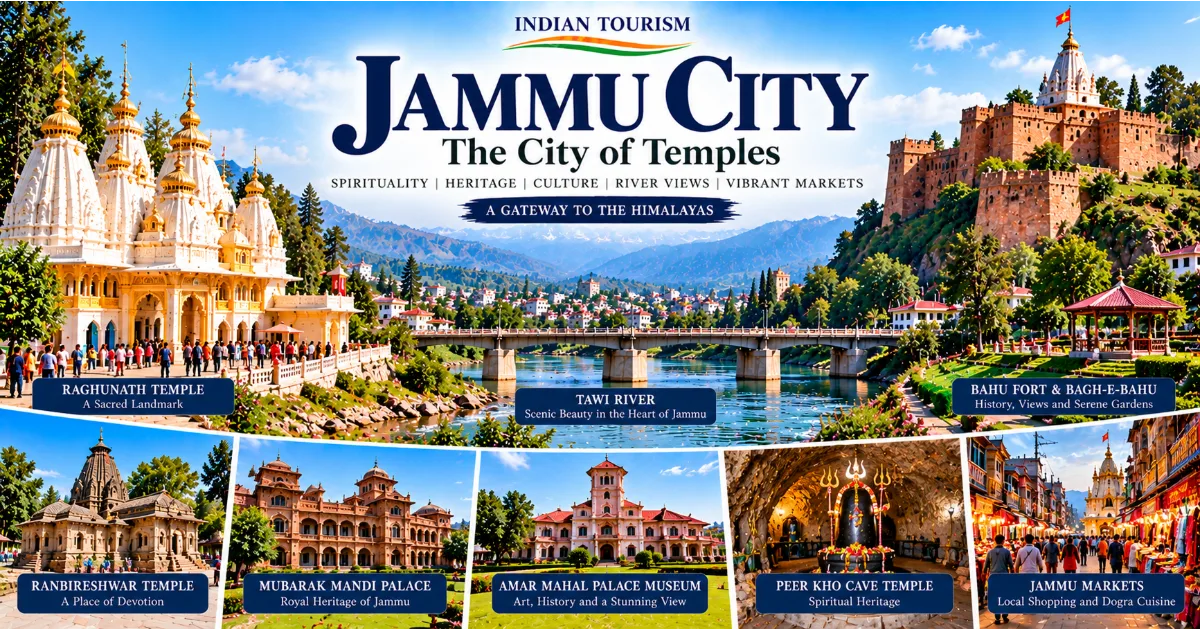
Welcome to the City of Temples
Jammu, one of the most important cities in the Jammu and Kashmir region, is a destination where religious traditions, royal history, local culture and everyday life come together against a backdrop of rolling hills and the Tawi River. Often known as the City of Temples, Jammu welcomes pilgrims, history enthusiasts, families and travellers who want to discover the cultural heritage of northern India. While many visitors pass through the city on their way to the Vaishno Devi shrine at Katra, Jammu deserves time of its own.
The city has a distinctive character shaped by its historical association with the Dogra rulers, its prominent temples, its traditional markets and its position as a gateway to the mountains. Its attractions range from the revered Raghunath Temple and the historic Bahu Fort to the grand architecture of Mubarak Mandi Palace and the riverside setting of Amar Mahal Palace. Each place reveals a different part of Jammu's story.
Jammu is also a city of contrasts. Busy roads and commercial areas exist alongside old neighbourhoods, religious courtyards and quieter viewpoints. Pilgrims move through the city on their way to sacred destinations, while local residents go about their daily routines in markets, educational institutions and residential districts. This mixture of tourism and everyday life gives Jammu an atmosphere that differs from a purpose-built holiday resort.
For travellers, the city can serve several purposes. It is a convenient starting point for the Vaishno Devi pilgrimage, a cultural destination in its own right and a useful base for exploring other parts of the Jammu region. Visitors can spend a day discovering major landmarks or stay longer to explore museums, temples, local food and nearby attractions.
The best way to experience Jammu is to look beyond the familiar label of the City of Temples. Its religious heritage is important, but its history, architecture, food, markets and relationship with the surrounding landscape are equally worth discovering. A well-planned visit provides a richer understanding of the region and its people.
Where Is Jammu City Located?
Jammu city is located in the southern part of the Jammu and Kashmir region of India. It lies along the Tawi River and is surrounded by a landscape that transitions from the plains towards the hills. Its geographical position has made it an important centre for administration, trade, transport and pilgrimage.
The city is often the first major urban destination encountered by visitors travelling into the Jammu region. It connects travellers with Katra, the base town for the Vaishno Devi pilgrimage, as well as with mountain destinations such as Patnitop and Bhaderwah. Jammu is also an important transport hub for people travelling farther into the region, although road conditions, schedules and travel times vary.
The Tawi River is one of the defining geographical features of the city. It flows through the surrounding landscape and provides a natural reference point for understanding Jammu's development. The river and its banks contribute to the city's setting, while nearby hills provide elevated viewpoints and a sense of connection with the wider mountain region.
Jammu's climate differs from that of the higher Himalayan destinations. Summers can be hot, while winters are generally cooler. Conditions in the surrounding hills may be different from those in the city, so travellers planning excursions should check the weather for each destination rather than relying on a single forecast.
The city's location makes it practical to combine cultural sightseeing with pilgrimage tourism. Visitors can explore Jammu's temples and historic buildings before travelling to Katra, or return to the city after completing the pilgrimage. With careful planning, Jammu can also be included in a longer itinerary covering Patnitop and other destinations in the region.
The Historical Story of Jammu
Jammu's history is closely connected with the development of regional kingdoms, religious traditions and the movement of people across northern India. Over many centuries, the city and its surrounding territory became important centres of political authority, trade and cultural exchange.
The wider Jammu region contains numerous historical sites associated with different periods. Temples, forts, palaces and traditional settlements reveal how rulers and communities shaped the landscape. The city's strategic location near routes leading towards the hills and plains contributed to its importance.
Jammu is particularly associated with the Dogra rulers, whose influence played a major role in shaping the modern history of the region. The Dogra dynasty rose to prominence in the nineteenth century, and Jammu became an important centre of their political and cultural life. Their legacy can still be seen in historic buildings, royal residences and institutions associated with the city's past.
The history of Jammu is not limited to royal families. Religious institutions, artisans, traders, farmers and local communities all contributed to its development. Temples served as places of worship and social gathering, while markets connected the city with surrounding settlements. Traditional crafts and food practices reflected the resources and customs of the region.
Modern Jammu has continued to develop as an urban centre with educational institutions, hospitals, transport facilities and commercial districts. Tourism remains an important part of the city's identity, particularly because of its connection with religious travel.
Visitors interested in history should approach the city as a place shaped by many generations rather than a collection of isolated monuments. A visit to a palace, temple or fort becomes more meaningful when understood within the broader context of political change, cultural exchange and everyday life.
Raghunath Temple: A Major Centre of Worship
Raghunath Temple is one of Jammu's best-known religious landmarks and an important destination for devotees of Lord Rama. Located in the city, the temple complex is associated with the religious and cultural history of the Dogra period and remains a significant centre of worship.
The temple is dedicated primarily to Lord Rama, an important figure in Hindu tradition who is revered as an embodiment of righteousness, duty and devotion. The wider complex includes multiple shrines, reflecting the diverse devotional practices associated with Hindu worship.
The architecture and layout of the temple provide an introduction to the religious heritage of Jammu. Visitors can observe the entrances, courtyards and shrines while following the rules established for worshippers. The atmosphere may be particularly active during festivals and religious occasions, when devotees gather for prayers and ceremonies.
For travellers interested in culture, Raghunath Temple offers an opportunity to understand the role of religious institutions in the life of the city. Temples are not merely buildings for sightseeing. They are living places of worship that support community traditions and provide spaces for prayer, festivals and charitable activities.
Visitors should dress respectfully, follow instructions from temple staff and be mindful of photography restrictions. Security arrangements may apply, and permitted items can change according to current rules. It is sensible to check the latest visitor guidance before arriving.
A visit to Raghunath Temple can be combined with a walk through nearby commercial areas, where shops sell religious items, traditional products and everyday goods. The contrast between the devotional atmosphere of the temple and the activity of the surrounding city provides a useful introduction to Jammu's character.
Bahu Fort: History Above the Tawi River
Bahu Fort is one of Jammu's most recognisable historic landmarks. Positioned on elevated ground overlooking the Tawi River, it offers a connection to the city's defensive history and provides a different perspective on the urban landscape.
The fort is associated with the traditional history of Jammu and is widely linked with Raja Bahu Lochan in local accounts. Over time, the structure underwent changes and became an important part of the city's heritage. Its elevated position made it a significant landmark, and its location continues to provide views of the river and surrounding areas.
A visit to Bahu Fort allows travellers to appreciate the relationship between geography and historical settlement. Elevated sites offered strategic advantages, including visibility over approaches to a settlement and the ability to observe movement across the surrounding terrain.
The fort's walls and architectural features provide a sense of its historical function, although the structure should not be viewed as an untouched monument from a single period. Historic buildings often reflect repairs, additions and changes made over many generations.
Visitors should check current access arrangements and opening conditions before planning their visit. Some areas may be subject to restrictions or maintenance. Walking surfaces can also be uneven, so comfortable footwear is useful.
Bahu Fort is especially appealing to travellers who enjoy combining history with scenery. The views of Jammu and the Tawi River provide opportunities for photography, while the fort itself adds a historical dimension to the visit.
The surrounding area is also associated with Bagh-e-Bahu, a garden that offers landscaped spaces and views of the city. Together, the fort and garden can form part of a relaxed sightseeing itinerary.
Bagh-e-Bahu: Gardens and Views of Jammu
Bagh-e-Bahu is a landscaped garden near Bahu Fort that offers a pleasant outdoor space for visitors. Its elevated setting provides views of parts of Jammu and the Tawi River, creating a contrast with the busy streets and commercial areas below.
Gardens play an important role in urban tourism because they provide places where visitors can slow down between visits to monuments and religious sites. At Bagh-e-Bahu, travellers can enjoy the open surroundings, take photographs and spend time appreciating the city's landscape.
The garden is particularly suitable for families and visitors who prefer gentle sightseeing rather than demanding outdoor activities. The experience depends on the season, weather and maintenance conditions, so travellers should check whether particular facilities are operating when they visit.
The garden's proximity to Bahu Fort makes it convenient to include both places in the same excursion. Visitors can explore the historic structure and then spend time in the landscaped surroundings, allowing a more varied experience without travelling across the city repeatedly.
As with any public garden, visitors should use designated paths, avoid damaging plants and dispose of waste properly. Busy periods may bring larger crowds, particularly during holidays and pleasant weather.
Bagh-e-Bahu demonstrates that Jammu's attractions are not limited to temples and palaces. The city's public spaces also contribute to its tourism experience, offering places to enjoy the outdoors and observe the relationship between the urban landscape and the surrounding hills.
Mubarak Mandi Palace: The Royal Heritage of Jammu
Mubarak Mandi Palace is one of Jammu's most significant historic complexes. Associated with the Dogra rulers, it served as a royal residence and administrative centre. The complex reflects the political and cultural history of the city and provides insight into the architectural ambitions of the ruling elite.
The palace is notable for its combination of architectural influences. Different sections reflect changing tastes and periods of construction, creating a complex that is more varied than a single uniform building. The design illustrates how royal residences could serve several functions, including accommodation, administration, ceremonies and the reception of important visitors.
The complex occupies an important place in Jammu's historical landscape. Its buildings and courtyards provide evidence of a period when the city played a central role in regional governance. Exploring the site can help visitors understand how royal authority was expressed through architecture and the organisation of space.
Like many historic structures, Mubarak Mandi has faced challenges related to age, maintenance and conservation. Restoration work and access arrangements can change over time. Travellers should verify current opening conditions before planning a visit and respect any areas closed for safety or preservation.
Visitors interested in heritage architecture may find the complex particularly rewarding. Rather than focusing only on decorative details, it is worth considering how the buildings functioned as part of a larger royal and administrative system.
Mubarak Mandi also illustrates the importance of preserving historic buildings in growing cities. Conservation allows future generations to learn about the past while creating opportunities for education and responsible tourism.
Amar Mahal Palace Museum: Art, Architecture and a View of the River
Amar Mahal Palace is another important landmark associated with Jammu's royal heritage. Situated on elevated ground overlooking the Tawi River and the surrounding landscape, the palace is known for its distinctive architecture and museum collections.
The building's appearance differs from many traditional structures in Jammu. Its European-inspired architectural style reflects the tastes and influences that shaped some royal residences during the modern period. The palace's setting adds to its visual appeal, with views across the river and parts of the city.
The museum provides an opportunity to explore aspects of the region's artistic and cultural history. Collections and displays may include paintings, royal memorabilia and other objects associated with the palace and its historical context. Visitors should check current exhibition details because collections and access arrangements can change.
Amar Mahal is especially appealing to travellers who enjoy art, history and architecture. The visit offers a different experience from a temple or fort, encouraging visitors to consider how royal patronage influenced collecting, artistic expression and the presentation of cultural identity.
The palace also provides an opportunity to reflect on the relationship between heritage buildings and their settings. Its elevated position gives it a visual connection with the river and the wider landscape, showing how architecture can be designed to take advantage of natural surroundings.
Before visiting, confirm opening hours, photography rules and any entry requirements. Visitors should treat the collections with care and follow museum instructions.
Amar Mahal Palace Museum is a valuable addition to a Jammu itinerary because it broadens the understanding of the city's history beyond religious architecture and military structures.
Ranbireshwar Temple: A Sacred Landmark of Jammu
Ranbireshwar Temple is one of Jammu's important Shiva temples. It is associated with the worship of Lord Shiva and attracts devotees throughout the year, with religious activity becoming particularly significant on occasions dedicated to the deity.
The temple forms part of the city's broader religious landscape. Its presence reflects the importance of Shaivite traditions in Jammu and the wider region. For many worshippers, the temple is a place for prayer, offerings and participation in religious ceremonies.
Visitors interested in architecture and religious culture can observe the temple's layout and devotional practices while respecting the needs of people who have come to worship. The experience is most rewarding when approached with patience rather than as a hurried stop on a sightseeing checklist.
Religious sites can become crowded during festivals and special occasions. Travellers should allow extra time and follow the directions of temple staff. Visitors should also check current rules about photography, footwear and items that may be carried inside.
Ranbireshwar Temple can be included in a city tour alongside Raghunath Temple and other heritage landmarks. This provides an opportunity to see how different temples contribute to Jammu's identity as a major religious centre.
The significance of a temple extends beyond its physical structure. It is also expressed through the community that maintains it, the rituals performed there and the traditions passed from one generation to another.
Peer Kho Cave Temple: Spiritual Heritage Beside the Tawi
Peer Kho Cave Temple is another important religious destination in Jammu. Associated with the worship of Lord Shiva, the temple is known for its cave setting and its connection with local religious traditions.
The cave environment gives the site a distinctive atmosphere compared with larger temple complexes. Visitors can experience a place where natural features and religious practice come together, creating a setting that has attracted worshippers over many generations.
The temple is associated with traditional accounts and local beliefs, and different versions of its history may be encountered. Travellers interested in the site's background should treat these narratives as part of a living devotional tradition and consult reliable local interpretation where available.
The temple's location near the Tawi River makes it a useful stop when exploring the city's religious and natural geography. It can be combined with other attractions depending on the route and available time.
Visitors should follow local instructions, particularly in areas where access is narrow or surfaces may be uneven. As at other religious sites, respectful dress and behaviour are important.
Peer Kho Cave Temple offers a reminder that Jammu's spiritual heritage includes a range of settings, from large urban temple complexes to sacred spaces associated with caves and natural features. Exploring these places can help travellers appreciate the diversity of religious traditions in the city.
Dogra Art Museum: Discovering Regional Culture
The Dogra Art Museum is an important cultural attraction for visitors interested in the art and history of the Jammu region. It provides an opportunity to explore artistic traditions, historical objects and cultural materials associated with the wider region.
Museums help travellers understand a place beyond what can be seen in its streets and monuments. Paintings, manuscripts, craft objects and other collections can reveal details about artistic techniques, historical patronage and everyday life that are not immediately apparent during a city walk.
The Dogra cultural tradition includes a rich variety of artistic and craft practices. Regional painting styles, decorative arts and historical objects reflect the interaction between local traditions and broader cultural influences. The museum provides a setting in which visitors can learn about these connections.
The exact displays and available galleries may change, so travellers should check current opening arrangements and exhibition information before visiting. Museum rules regarding photography, bags and visitor movement should be followed.
A visit can be particularly useful for students, families and travellers who want to deepen their understanding of Jammu's heritage. It can also provide context for the palaces, temples and historic sites visited elsewhere in the city.
Rather than treating the museum as a brief stop, visitors can take time to read the descriptions and consider the historical context of the objects. This approach can make the experience more meaningful and help connect individual artefacts with the broader story of the region.
The Tawi River: A Natural Landmark of Jammu
The Tawi River is an important geographical feature of Jammu and contributes significantly to the city's setting. The river flows through the region and forms part of the landscape that has influenced settlement, movement and development.
For visitors, the river provides a different perspective on the city. Elevated viewpoints near Bahu Fort and Amar Mahal Palace allow travellers to observe its course and understand how the urban landscape relates to the surrounding terrain.
Rivers often influence the development of settlements by providing water, shaping routes and creating natural boundaries. The Tawi is part of the wider geographical story of Jammu, connecting the city with the natural environment beyond its built-up areas.
The river's appearance changes according to season and weather. Water levels, flow and surrounding conditions can vary, so visitors should be cautious near the banks. Do not enter the water or approach unstable edges simply to take photographs.
Travellers should also respect environmental protections and avoid leaving rubbish near the river. Urban waterways can face pressure from waste and development, and keeping the surroundings clean is an important part of responsible tourism.
The Tawi can be appreciated as part of a wider city tour rather than as a single attraction. Observing it from suitable viewpoints adds context to visits to nearby landmarks and offers a reminder that Jammu's identity is shaped by both human history and natural geography.
Jammu's Traditional Markets and Shopping Areas
Jammu's markets provide a lively introduction to the city's everyday culture. They are places where residents shop for household goods, clothing, food, religious items and products connected with local traditions. For visitors, exploring the markets can offer a more immediate sense of the city than travelling only between major monuments.
The old commercial areas contain shops and narrow streets that reflect the long-standing role of trade in urban life. Depending on the location, visitors may find textiles, traditional garments, jewellery, utensils, sweets, dry fruits and religious souvenirs.
Shopping can be particularly interesting for travellers who want to learn about regional products. Jammu's wider cultural landscape includes traditional crafts and foods that reflect the history and resources of the region. Visitors should ask about the origin of products when seeking locally made items rather than assuming everything sold in a tourist-facing shop is produced nearby.
Market conditions can be busy, especially during festivals and pilgrimage periods. Keep personal belongings secure, be mindful of traffic and avoid blocking narrow walkways while taking photographs.
Prices vary between shops, and comparing a few options can help visitors make informed decisions. Bargaining may be appropriate in some settings, but it should be done respectfully.
Markets are also a place to observe everyday life. A visit becomes more rewarding when travellers pay attention to how people interact, what products are displayed and how religious and commercial activities share the same urban spaces.
The Food of Jammu: A Taste of Dogra Cuisine
Food is an important part of experiencing Jammu. The region's culinary traditions reflect local ingredients, family practices and the cultural influences that have shaped life across the hills and plains. Visitors can explore a range of traditional dishes as well as familiar North Indian meals.
Rajma with rice is one of the region's best-known foods. Red kidney beans are cooked with spices to create a hearty dish that is commonly served with rice. Recipes vary between households and restaurants, and the flavour can differ according to the ingredients and cooking method.
Kaladi is another regional speciality associated with Jammu. This traditional cheese is often cooked until its exterior becomes golden and is served as a snack or with bread. It is worth trying at a reputable local establishment where it is prepared fresh.
Ambal, a sweet-and-sour preparation often made with pumpkin, is associated with Dogra cuisine. Its balance of sweetness and tanginess provides a contrast with richer savoury dishes. The ingredients and method can vary across families and local kitchens.
Visitors may also encounter traditional breads, lentil dishes, seasonal vegetables and preparations associated with festivals or special occasions. Food traditions are not identical across the region, so asking local residents about their favourites can be a good way to discover dishes that are not always featured on standard menus.
Street food and sweets can also be part of the experience. Choose clean, busy establishments with fresh preparation, and take care with food that has been left exposed for long periods. Travellers with allergies or dietary restrictions should ask about ingredients before ordering.
A food-focused visit to Jammu can be a memorable part of the trip because it connects tourism with everyday culture. A regional dish often carries family memories and local traditions that are just as important as the city's monuments.
Festivals and Religious Celebrations in Jammu
Jammu's festival calendar reflects its religious and cultural diversity. Festivals bring communities together through worship, processions, family gatherings, food and public celebrations. They can also create particularly lively periods for visitors interested in local traditions.
Navratri is an important festival across the region and is closely connected with worship of the Goddess. The period can be especially significant for pilgrims travelling towards Vaishno Devi. Religious activity in Jammu and the surrounding area may increase during the festival, and accommodation and transport can experience greater demand.
Diwali is widely celebrated, with homes, shops and public spaces decorated with lights. Families gather for prayers and meals, and markets can become busy as people purchase gifts and festive supplies.
Shivratri is important for devotees of Lord Shiva and is observed at temples across Jammu. Visitors may encounter special prayers and increased attendance at religious sites.
Local fairs and regional celebrations also contribute to the cultural life of the Jammu region. Their timing and scale vary, so travellers interested in attending a particular event should check current local announcements.
When visiting during a festival, plan transport and accommodation carefully. Crowds may affect road movement, queues and access to attractions. Respect religious customs and follow instructions at public gatherings.
Festivals provide a valuable opportunity to learn about living traditions, but visitors should remember that these events are meaningful to participants. Photography should be considerate, and worshippers should not be disturbed for the sake of a picture.
The Best Time to Visit Jammu City
Jammu can be visited throughout the year, but the weather has a significant effect on comfort and sightseeing. The best time depends on whether the priority is outdoor exploration, temple visits, festivals or combining the city with nearby mountain destinations.
Spring
Spring generally brings more comfortable conditions than the hottest part of summer. The city can be pleasant for exploring temples, gardens and heritage buildings, although temperatures vary and rain may occur.
This season can be suitable for travellers who want to combine city sightseeing with trips to nearby areas. Visitors should still check the forecast and carry clothing appropriate for changing conditions.
Summer
Summer can be very hot in Jammu. Travellers planning outdoor sightseeing should consider beginning early in the day, taking breaks in shaded or indoor locations and drinking water regularly.
Museums, indoor heritage sites and temple visits can be arranged around the hottest hours where opening times permit. If the itinerary includes mountain destinations, remember that conditions in the hills may differ from those in the city.
Monsoon
The monsoon brings the possibility of rainfall and changing road conditions. Rain may affect traffic and travel times, particularly when planning excursions outside the city.
Visitors should check weather information before travelling and avoid unnecessary road journeys during severe conditions. Outdoor visits may need to be adjusted according to rainfall and local advisories.
Autumn
Autumn can offer a comfortable period for exploring Jammu's heritage and religious attractions. The weather may be more suitable for walking between selected sites, although conditions vary.
The season can also coincide with major festivals, including Navratri and Diwali, depending on the calendar. Travellers should check the dates and plan for increased demand where necessary.
Winter
Winter is generally cooler than summer and can be suitable for city sightseeing. Visitors may find it easier to explore outdoor landmarks without the intense heat of summer, although mornings and evenings can feel cold.
Those travelling onwards to higher mountain areas should check conditions separately. Weather in Jammu city does not reliably predict road and temperature conditions in places such as Patnitop.
For any season, the most useful preparation is to check the forecast close to departure and confirm the opening arrangements of the attractions you plan to visit.
How to Reach Jammu City
Jammu is connected to other parts of India by air, rail and road. The most suitable option depends on the starting point, travel budget and the destinations included in the wider itinerary.
By Air
Jammu Airport provides air connections with selected Indian cities, with schedules and routes varying over time. Travellers should check current flight information before booking and confirm the transfer from the airport to their accommodation.
Allow time for airport procedures and local traffic. If the visit includes a same-day road journey to Katra or another destination, ensure that the schedule provides enough flexibility for delays.
By Train
Jammu Tawi railway station is a major rail gateway for the region. It serves travellers arriving from different parts of India, although the available trains and journey times depend on the route and date.
The station is used by pilgrims heading towards Katra as well as visitors exploring Jammu city. From the station, travellers can arrange taxis or other local transport to reach their accommodation and sightseeing locations.
Train reservations may be in high demand during festival periods and school holidays. Booking early is useful when travel dates are fixed.
By Road
Jammu is connected by road with other cities and towns in northern India. Buses, taxis and private vehicles provide options for reaching the city, although journey times depend on traffic, weather and road conditions.
Travellers continuing towards Katra, Patnitop or other mountain destinations should check the onward route separately. A city arrival does not guarantee that the next leg of the journey will be free from delays.
Getting Around Jammu City
Local transport options include taxis, auto-rickshaws and other services operating in different parts of the city. The best option depends on the distance between attractions, the size of the group and the amount of time available.
For a sightseeing day that includes several monuments, a taxi arranged for a defined period may be convenient. Before starting, confirm the fare, the expected duration and whether waiting time is included.
Visitors who prefer independent travel should check the location of each attraction and plan the order of visits to reduce unnecessary backtracking. Some sites are close enough to combine, while others require a separate road journey.
Traffic can be heavy in busy commercial areas, particularly during festival periods and peak commuting hours. Allow extra time between locations and avoid scheduling a major attraction immediately before a tightly timed train or flight.
Walking can be enjoyable in suitable areas, but not every road is designed for pedestrians. Use safe crossings, remain alert to traffic and avoid walking along busy roads when a safer alternative is available.
If travelling with older family members or people with mobility limitations, confirm access conditions before visiting historic sites. Uneven surfaces, steps and crowded entrances may affect the experience.
A practical transport plan makes it easier to enjoy Jammu without spending too much of the day navigating traffic or searching for the next destination.
Where to Stay in Jammu
Jammu offers a range of accommodation options, from budget guesthouses to hotels with more extensive facilities. The best area to stay depends on the purpose of the visit, transport arrangements and whether the city is the main destination or a stop before the Vaishno Devi pilgrimage.
Travellers who plan to explore temples and historic landmarks may prefer accommodation with convenient access to the city centre. Those arriving by train may value a location that makes station transfers easier, while pilgrims continuing towards Katra may prioritise onward transport.
Before booking, check the property's exact location, recent guest feedback, room facilities and cancellation conditions. Photographs alone may not provide a clear understanding of traffic, noise or the distance to nearby attractions.
Families should consider room size, food options, accessibility and the needs of older travellers. If visiting during a major festival, reserve accommodation early because demand can increase substantially.
Visitors should also consider the time needed to reach the next destination. A hotel that is convenient for city sightseeing may not necessarily be the best choice for a very early departure towards another town.
Choosing accommodation according to the itinerary can make the trip more comfortable and reduce unnecessary travel across the city.
A Suggested One-Day Jammu City Itinerary
A full day can provide an introduction to Jammu's major religious and historical attractions, although visitors should check opening times and allow for travel between sites.
Begin the morning with a visit to Raghunath Temple, allowing enough time to experience the complex respectfully. If you are interested in religious heritage, take time to understand the temple's significance rather than rushing through the visit.
Continue to Ranbireshwar Temple or Peer Kho Cave Temple, depending on your interests and current access arrangements. Visiting two temples in the morning provides a useful introduction to the city's religious traditions.
After lunch, explore Mubarak Mandi Palace if access is available. The historic complex offers a different perspective on Jammu's royal and administrative past. Check whether any areas are closed for restoration before arranging the rest of the day around the visit.
Later, travel towards Bahu Fort and Bagh-e-Bahu. The fort provides historical context and views of the Tawi River, while the garden offers a place to relax and enjoy the surroundings.
If time and opening arrangements permit, Amar Mahal Palace Museum can be included as an additional stop. Visitors with a strong interest in art and history may prefer to spend longer at the museum and reduce the number of other attractions.
End the day with a meal featuring regional food and, if time allows, a short visit to a local market. This creates a balanced itinerary combining religious heritage, architecture, scenery and everyday culture.
The plan should remain flexible. Some sites may require more time than expected, and traffic can affect travel between locations.
A Suggested Two-Day Jammu Itinerary
A two-day visit allows travellers to explore the city at a more relaxed pace and include attractions that might be difficult to fit into a single day.
On the first day, focus on Jammu's religious heritage. Visit Raghunath Temple, Ranbireshwar Temple and Peer Kho Cave Temple according to current opening conditions. Spend time learning about the religious traditions associated with each site, and allow for queues or security checks where applicable.
In the afternoon, explore a nearby market and sample regional food. A relaxed evening can provide time to rest and prepare for the following day's sightseeing.
On the second day, concentrate on royal heritage and the city's landscape. Begin with Mubarak Mandi Palace if it is open to visitors, then continue to Amar Mahal Palace Museum. Allow sufficient time for the architecture and collections rather than treating each site as a quick photo stop.
Later, visit Bahu Fort and Bagh-e-Bahu. These locations offer an opportunity to combine history with views of the Tawi River and the surrounding city.
If the schedule permits, use the remaining time to explore local shops or another cultural attraction. Visitors interested in museums should confirm current opening hours before arranging the order of visits.
Those travelling onwards to Katra should leave enough time for the transfer and any pilgrimage-related arrangements. It is better to finish the city itinerary early than to risk missing a confirmed transport connection.
A two-day stay offers a more complete experience because it allows visitors to appreciate both the historic landmarks and the everyday rhythm of Jammu.
Jammu as the Gateway to Vaishno Devi
For many visitors, Jammu is the starting point for the pilgrimage to Mata Vaishno Devi. The shrine is located in the Trikuta Mountains, and Katra serves as the principal base for pilgrims travelling to Bhawan.
Jammu's transport connections make it a convenient arrival point for visitors coming from distant parts of India. From the city, travellers can continue to Katra by train or road, depending on their arrival arrangements and preferred route.
However, Jammu and Katra serve different purposes in the pilgrimage itinerary. Jammu offers urban accommodation, temples, museums and historic attractions, while Katra is organised around the needs of pilgrims beginning the mountain journey.
Travellers should decide how much time they want to spend in each place before booking. Those whose primary purpose is the pilgrimage may prefer to proceed to Katra after arrival, while visitors interested in regional history can reserve a day or two for Jammu.
The pilgrimage involves registration and current operational procedures that should be confirmed through authorised sources. Weather, crowd levels and available transport can affect the journey, so travellers should avoid relying on old schedules or assumptions.
Combining Jammu city with the Vaishno Devi pilgrimage provides a broader understanding of the region. The city introduces visitors to its religious and royal heritage, while the pilgrimage offers a different experience shaped by faith, mountain geography and community participation.
Family Travel in Jammu
Jammu can be a suitable destination for families because it offers a mixture of temples, gardens, historic buildings, markets and accessible urban services. A family itinerary can be adapted according to the ages, interests and physical abilities of the travellers.
Children may enjoy the open spaces around Bagh-e-Bahu, the views from suitable locations near Bahu Fort and the opportunity to discover the city's history through museums and monuments. Parents should supervise children closely near roads, steps, riverbanks and crowded public areas.
Families should avoid attempting too many attractions in a single day. Traffic and queues can make the schedule more demanding than expected, and children may need regular breaks for food and rest.
Older family members may prefer fewer locations with more time at each site. When visiting historic buildings, check for steps, uneven surfaces and other access challenges before arrival.
Food options in the city are varied, but travellers with dietary restrictions should confirm ingredients and preparation methods. Carrying essential medication and maintaining a flexible schedule can make the visit more comfortable.
Accommodation should be chosen according to the needs of the whole group. A convenient location, reliable transport and suitable food facilities can matter more than being close to every attraction.
A successful family trip to Jammu is one that balances sightseeing with time to rest. The city's variety makes it possible to create a meaningful visit without turning every hour into a scheduled activity.
Responsible Tourism and Respect for Local Traditions
Responsible tourism is important in Jammu because the city contains active religious sites, historic buildings, public spaces and residential neighbourhoods. Visitors should recognise that these places are part of everyday life for local communities, not merely attractions.
At temples, follow instructions regarding footwear, dress, offerings and photography. Avoid disturbing worshippers or interrupting ceremonies to take pictures. If a particular area is restricted, respect the boundary.
Historic buildings require care. Do not touch fragile surfaces unnecessarily, write on walls or enter closed areas. Restoration work and access restrictions are often necessary to protect structures that have survived for generations.
In markets, be considerate of residents and shopkeepers. Avoid blocking narrow streets and ask permission before photographing people. Purchase products responsibly and do not assume that every item marketed as traditional has been made locally.
Waste management is another important consideration. Carry rubbish until a suitable disposal point is available and avoid leaving plastic bottles or food packaging at gardens, river viewpoints and heritage sites.
Visitors should also use authorised transport and services. Confirm fares in advance where appropriate, follow road safety instructions and avoid arrangements that appear unsafe or misleading.
Responsible tourism helps maintain the quality of the visitor experience while respecting the people who live and work in Jammu. Small actions can make a meaningful difference to the preservation of the city's cultural and natural heritage.
Practical Travel Tips for Jammu City
A few simple preparations can make a visit to Jammu more comfortable. Check the weather before departure and choose clothing appropriate for the season. During summer, lightweight clothing, sun protection and regular hydration are important. In winter, carry a warm layer for mornings and evenings.
Plan temple and museum visits around current opening hours. Some sites may have special arrangements during festivals, maintenance periods or security-related changes. Confirm the details before travelling across the city.
Keep essential identification and travel documents secure. If continuing to Katra or another destination, check the onward transport schedule and allow sufficient time for transfers.
Use comfortable footwear because sightseeing may involve walking on uneven surfaces, steps and courtyards. Visitors with mobility concerns should check access arrangements in advance.
Carry a charged phone and keep important accommodation and transport details accessible. However, avoid depending entirely on digital access when travelling between locations.
During major festivals, expect heavier crowds and allow extra time for road movement. Book accommodation and transport early when dates are fixed.
Finally, leave room for unexpected discoveries. A local food stall, an interesting market or a conversation about a historic building can become one of the most memorable parts of a visit.
Conclusion: Discover the Many Sides of Jammu
Jammu is much more than a transit point on the way to the Vaishno Devi pilgrimage. It is a city with a distinctive identity shaped by religious traditions, Dogra history, royal architecture, local food and its setting along the Tawi River.
Raghunath Temple, Ranbireshwar Temple and Peer Kho Cave Temple reveal the city's spiritual heritage. Bahu Fort and Bagh-e-Bahu connect history with landscape, while Mubarak Mandi Palace and Amar Mahal Palace Museum offer insight into royal life, architecture and cultural patronage. Markets, regional cuisine and everyday neighbourhoods add another layer to the experience.
The city can be explored in a day, but a two-day visit offers more time to understand its history and culture. Travellers can also combine Jammu with Katra, Patnitop and other destinations in the region, provided the itinerary allows enough time for transport and rest.
Each season brings a different atmosphere, and major festivals can add a special dimension to the visit. Careful planning, respect for local traditions and attention to current travel conditions help make the journey smoother.
For anyone exploring Jammu and Kashmir, Jammu city is an essential part of the region's story. Its temples, palaces, river views and bustling markets reveal a place where heritage remains connected to everyday life.
Come to Jammu to discover its sacred landmarks, explore its royal past, taste its regional food and experience the welcoming character of a city that connects the plains with the mountains.
Jammu City Tourism: Explore the temples, discover the royal heritage and experience the cultural heart of Jammu and Kashmir.
#IndianTourism #JammuTourism #JammuCity #JammuAndKashmir #CityOfTemples #RaghunathTemple #BahuFort #BaghEBahu #MubarakMandiPalace #AmarMahalPalace #RanbireshwarTemple #PeerKhoTemple #DograHeritage #TawiRiver #DograCuisine #ExploreJammu #TravelIndia #IndianHeritage #CulturalTourism #IncredibleIndia

