
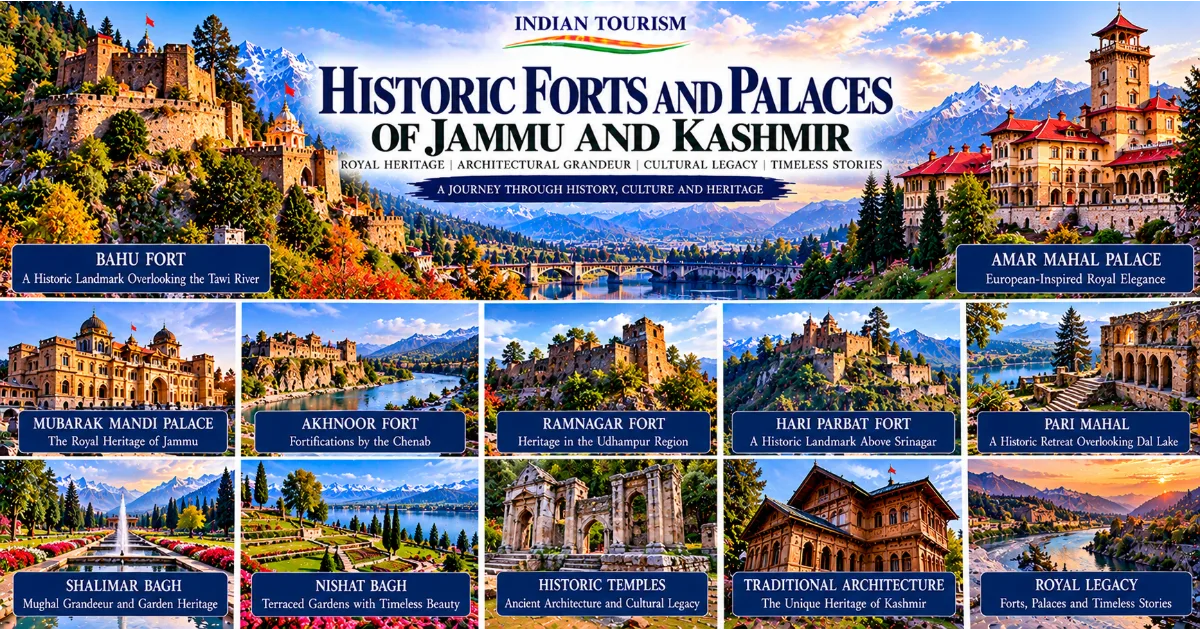
Discovering the Royal Past of Jammu and Kashmir
Jammu and Kashmir is widely celebrated for its Himalayan landscapes, beautiful lakes, sacred destinations and traditional handicrafts. Yet another remarkable aspect of the region's identity lies in its historic forts, royal palaces and heritage buildings. These structures preserve memories of rulers, dynasties, political changes, artistic traditions and the development of cities over many centuries.
From the hilltop walls of Bahu Fort in Jammu to the grand architecture of Mubarak Mandi Palace and the European-inspired elegance of Amar Mahal Palace, the region offers a fascinating journey through different architectural styles. In the Kashmir Valley, historic forts, wooden buildings, shrines and royal garden complexes reveal how geography, craftsmanship and cultural exchange shaped the built environment.
Forts were often constructed in strategic locations overlooking rivers, valleys or important routes. Their walls and elevated positions provided defensive advantages, while their internal spaces accommodated guards, administrative activities and other functions associated with political authority. Palaces, on the other hand, reflected the status, tastes and ambitions of rulers. Their courtyards, halls, decorative features and gardens communicated power while also providing spaces for residence and ceremony.
The history of Jammu and Kashmir cannot be understood through architecture alone. Each building belongs to a wider story involving regional kingdoms, changing political relationships, trade, religious institutions and the movement of artistic ideas. Some structures have been altered over time, while others have suffered damage or require conservation. Their present appearance may therefore reflect several periods of construction, restoration and reuse.
For travellers, exploring these sites offers more than an opportunity to photograph historic walls. A visit can reveal how rulers selected locations, how artisans worked with stone and wood, how palace life was organised and how architectural traditions changed in response to new influences.
This guide explores some of the most interesting forts, palaces and historic architectural landmarks associated with Jammu and Kashmir. It also explains how visitors can plan heritage journeys, appreciate architectural details and contribute to the responsible preservation of these important places.
1. Bahu Fort: A Historic Landmark Overlooking the Tawi River
Bahu Fort is one of Jammu city's most recognisable historic structures. Positioned on elevated ground overlooking the Tawi River, the fort occupies a strategic location that has long been associated with the history and development of Jammu.
The fort is traditionally linked with the early rulers of the region and is closely connected with local historical accounts about the origins of Jammu. Like many historic forts, its story combines architectural evidence, regional traditions and narratives passed down through generations. Visitors interested in its history should distinguish between established historical information and local legends, while appreciating the cultural significance of both.
The fort's elevated position provides views of the surrounding landscape and helps explain its defensive importance. From a historical perspective, hilltop fortifications allowed occupants to observe approaches, control access and take advantage of difficult terrain. The relationship between the fort, the river and the nearby settlement illustrates how geography influenced the location of defensive structures.
Within the fort complex is the Bahu Kali Temple, which remains an important religious destination. Its presence gives the site a distinctive character, combining military heritage with continuing devotional activity. Visitors should approach the temple respectfully and follow the rules governing entry, footwear and photography.
Bahu Fort is often included in a broader sightseeing tour of Jammu. It can be visited alongside other historic buildings, religious landmarks and city attractions. The surrounding area also offers opportunities to appreciate the city's changing urban landscape.
Travellers should check current opening arrangements and access conditions before visiting. Restoration work, security requirements and local management decisions may affect which areas are accessible.
Bahu Fort demonstrates how a historic structure can retain cultural importance long after its original defensive role has changed. Its value lies in its architecture, location, religious associations and continuing place in the identity of Jammu.
2. Mubarak Mandi Palace: The Royal Heritage of Jammu
Mubarak Mandi Palace is one of the most important royal architectural complexes in Jammu. Located in the historic part of the city, the palace served as a residence and administrative centre for the Dogra rulers. Its extensive complex reflects the political and cultural significance of Jammu during the period when the Dogra dynasty held power.
Unlike a single palace building designed in one consistent style, Mubarak Mandi developed over time. Different sections reflect different periods and architectural influences, producing a complex that combines traditional regional elements with features associated with later periods of construction.
The palace's courtyards, halls, balconies and building facades provide clues about the organisation of royal life. Spaces for official functions, administration and residence would have served different purposes, while the arrangement of buildings reflected the practical needs of a ruling household.
The complex is especially valuable for understanding the relationship between architecture and political authority. Royal buildings were not simply places to live. They were settings for meetings, ceremonies, administrative work and the reception of important visitors. Their design helped communicate the status and organisation of the ruling establishment.
Over time, parts of Mubarak Mandi have faced deterioration and conservation challenges. Historic complexes can be difficult to maintain because they contain buildings from different periods, use traditional construction materials and require substantial resources for structural repair. Restoration must balance safety, heritage protection and appropriate future use.
Visitors should check which sections are open to the public before arranging a visit. Access may change because of conservation work or other management requirements. Where entry is permitted, a guided explanation can help visitors understand the complex more fully than a brief walk through its courtyards.
Mubarak Mandi remains an essential destination for anyone interested in the royal history of Jammu. Its architectural diversity and historical associations make it a valuable reminder of the region's political and cultural development.
3. Amar Mahal Palace: European-Inspired Architecture in Jammu
Amar Mahal Palace stands out among Jammu's historic buildings because of its distinctive architectural character. Overlooking the Tawi River, the palace is associated with the Dogra royal family and reflects European-inspired design influences that entered parts of Indian royal architecture during the nineteenth and twentieth centuries.
The building's exterior has often been compared with European palace architecture. Its appearance differs from the more traditional forms found in some older regional structures, creating an interesting contrast within Jammu's architectural landscape.
The palace is particularly valuable for understanding how royal families incorporated new styles and ideas into their residences. Architectural influences travelled through political relationships, education, travel, imported materials and contact with architects and craftsmen from different backgrounds. The resulting buildings often combined outside influences with local conditions and tastes.
Amar Mahal is also associated with a museum collection and cultural heritage activities. Visitors interested in art and history may find the combination of architecture, collections and scenic setting especially rewarding. Current opening hours, admission arrangements and photography rules should be checked before visiting.
The palace's elevated location provides views of the river and surrounding city. These views help explain why prominent sites overlooking rivers and valleys were attractive locations for royal residences. The landscape formed part of the visual experience of the palace, rather than serving merely as a distant background.
When exploring Amar Mahal, visitors should pay attention to its proportions, windows, roofline and overall arrangement. Comparing these details with those of Mubarak Mandi can reveal how different architectural approaches existed within the same regional royal tradition.
Amar Mahal Palace illustrates the changing tastes of the Dogra period and demonstrates how architecture can preserve evidence of cultural exchange. It is a valuable stop for travellers seeking to understand Jammu beyond its temples and natural scenery.
4. Akhnoor Fort: Fortifications Beside the Chenab River
Akhnoor Fort stands near the Chenab River in the Jammu region and occupies a location with important historical and geographical associations. The fort is connected with the history of Akhnoor and reflects the significance of river routes, settlements and defensive positions in the region's past.
The Chenab has long shaped the surrounding landscape. Rivers provided water, influenced agriculture and created routes through otherwise difficult terrain. At the same time, river crossings and settlement sites could have strategic importance, making nearby elevated locations attractive for defensive structures.
Akhnoor Fort is associated with the Dogra period, and its construction history reflects the political developments of that era. The structure's position allows visitors to understand the relationship between fortification and the river landscape.
Historic forts often changed in function as political circumstances evolved. A structure originally associated with defence may later become a heritage landmark, archaeological site or subject of conservation. Its surviving walls can reveal construction techniques and spatial arrangements, although detailed interpretation requires reliable historical and archaeological information.
Visitors should confirm current access arrangements before travelling to Akhnoor Fort. The condition of the structure and any restoration or conservation work may influence which areas can be explored safely.
The surrounding area can also be included in a wider visit to Akhnoor, where the river and settlement landscape provide additional historical context. Travellers should remain on authorised paths and avoid climbing damaged walls or entering unstable sections.
Akhnoor Fort is an important destination for visitors interested in the relationship between rivers, settlements and military architecture. It shows how the natural geography of Jammu influenced the development of historic defensive sites.
5. Ramnagar Fort: Heritage in the Udhampur Region
Ramnagar Fort is a historic fortification associated with the former ruling establishment of Ramnagar in the Jammu region. It provides an opportunity to explore a lesser-known part of the area's royal and architectural history.
The fort's significance lies in its connection with regional rulers and the political organisation of the surrounding area. Smaller forts and palaces were important components of the wider network of royal residences and defensive structures. They helped establish authority, support administration and maintain links between settlements.
Compared with some of the more frequently visited landmarks in Jammu city, Ramnagar Fort may appeal particularly to travellers interested in exploring heritage beyond the most familiar tourist circuit. Its setting offers a chance to understand the history of the region through a more local perspective.
When visiting a historic fort, it is useful to look at the overall layout rather than concentrating only on decorative features. The position of gates, the arrangement of courtyards, the thickness of walls and the relationship between buildings can provide clues about how the structure functioned.
The surviving architecture may also reflect changes made during different periods. Repairs, additions and deterioration can alter the appearance of a fort over time. Visitors should avoid assuming that every feature belongs to the original construction phase.
Access and conservation arrangements should be confirmed before planning a trip. Some heritage sites may have limited facilities or sections that are closed for safety reasons.
Ramnagar Fort contributes to a more complete understanding of Jammu's historic landscape. Its importance lies in preserving the memory of regional political centres that might otherwise receive less attention than larger royal complexes.
6. Hari Parbat Fort: A Historic Landmark Above Srinagar
Hari Parbat is a prominent hill overlooking Srinagar, and the fortification associated with it forms an important part of the city's historical landscape. The hill has religious and cultural significance, while its elevated position also provides a strategic viewpoint over the surrounding urban area.
The fort's history reflects changing political control and the importance of Srinagar as a major centre in the Kashmir Valley. Different periods contributed to the development of fortifications on the hill, and the wider area contains religious landmarks associated with more than one tradition.
Hari Parbat is especially interesting because its significance extends beyond military architecture. The hill and its surroundings have connections with temples, shrines and historic neighbourhoods. This combination demonstrates how sacred landscapes and defensive positions could coexist within the same urban environment.
The fortification also offers a way to understand Srinagar's geography. From an elevated location, the relationship between the city, water bodies and surrounding mountains becomes clearer. Geography influenced trade, settlement, transport and the location of important structures.
Visitors should verify current access arrangements, because entry to particular sections may be restricted or subject to local conditions. Travellers should not assume that every part of the fort is open simply because the hill is visible from public areas.
Those exploring the wider Hari Parbat area should behave respectfully around religious sites and residential neighbourhoods. Modest clothing, careful photography and attention to local instructions are important.
Hari Parbat is a valuable destination for travellers interested in the interaction between political history, religious heritage and urban development. Its elevated setting and complex history make it one of the more distinctive heritage landmarks associated with Srinagar.
7. Pari Mahal: A Historic Structure Overlooking Dal Lake
Pari Mahal is a historic terraced structure overlooking Dal Lake and the surrounding landscape of Srinagar. Its location, architectural arrangement and garden setting make it a distinctive part of the city's heritage.
The structure is commonly associated with the Mughal period and is linked in historical accounts with Dara Shikoh, the Mughal prince known for his interest in philosophy and religious thought. Its historical associations make it relevant to visitors interested in the intellectual and cultural dimensions of Mughal-era Kashmir.
Pari Mahal's terraces create a sequence of spaces that follow the slope of the hill. This arrangement reflects a landscape design tradition in which architecture, elevation and views were carefully connected. Visitors moving through the terraces can observe how the structure frames the surrounding scenery.
The site differs from a conventional defensive fort or residential palace. Its character is shaped by its terraced layout and its association with learning and contemplation. The elevated position also provides views of Dal Lake and parts of Srinagar.
Visitors should check current opening arrangements and follow any restrictions concerning photography, movement or access to particular areas. Uneven steps and sloping surfaces may require care, particularly during wet or cold weather.
Pari Mahal can be combined with other heritage destinations around Srinagar, including the historic gardens and selected religious landmarks. A well-planned itinerary allows travellers to appreciate the differences between garden architecture, royal residences and fortifications.
The site is an example of how heritage structures can express several purposes at once. Its architecture, landscape setting and historical associations combine to create an experience that is both cultural and scenic.
8. Mughal Gardens: Royal Landscape Design in Kashmir
The Mughal gardens of Srinagar form an important part of the region's architectural heritage. Shalimar Bagh and Nishat Bagh are among the best-known examples, demonstrating how landscape design, water channels, terraces and carefully arranged vegetation were used to create formal garden spaces.
These gardens are not forts or palaces in the conventional sense, but they belong to the wider heritage of royal architecture. Gardens served as settings for leisure, gatherings and the enjoyment of nature, while their design communicated ideas about order, beauty and the relationship between rulers and the landscape.
Shalimar Bagh is associated with the Mughal emperor Jahangir and his interest in Kashmir. Nishat Bagh is known for its terraced arrangement and views across Dal Lake. Each garden has its own layout and atmosphere, although both reflect the importance of water and elevation in Mughal landscape design.
The terraces allow visitors to experience the garden gradually. Water channels and fountains, where operating, provide movement and sound, while trees and planted areas create changing perspectives. The relationship between the garden and the lake beyond is a central part of the visual experience.
Garden architecture also reflects practical concerns. Water supply, drainage, slope management and plant maintenance are essential to preserving a historic garden. Changes in water availability and environmental conditions can influence how these spaces are managed.
Visitors should remain on permitted paths, avoid damaging plants and respect restrictions around historic features. The gardens are cultural landscapes that require continuing care, not simply open spaces for photography.
Exploring the Mughal gardens alongside the forts and palaces of Jammu and Kashmir reveals a broader architectural story. Royal heritage was expressed through defensive walls and residential buildings, but also through carefully designed landscapes that transformed the natural environment into places of beauty and reflection.
9. The Architecture of Jammu and Kashmir's Forts
The forts of Jammu and Kashmir reflect the influence of geography, available building materials and changing military needs. Many were built on elevated locations, near rivers or beside routes that connected settlements. Their positions allowed occupants to observe movement through the surrounding landscape and made direct access more difficult for potential attackers.
Stone and other locally available materials played important roles in construction. The exact methods varied according to the location, period and resources available to the builders. Wall thickness, gateways, courtyards and defensive positions often reflected practical requirements rather than purely decorative ambitions.
The terrain could also influence the shape of a fort. A structure built on a steep hill might use the natural slope as part of its defence, while a fort near a river could take advantage of the surrounding landscape to control access. These features make it useful to study a fort in relation to its setting rather than as an isolated building.
Over time, military technology and political circumstances changed. Many forts lost their original defensive functions, and some became administrative centres, royal residences or heritage sites. Their later history may include repairs, changes in use and periods of neglect.
Conservation presents several challenges. Historic masonry can weaken through water infiltration, vegetation growth, temperature changes and structural movement. Uncontrolled visitor access can add further pressure, especially where walls and steps are already fragile.
Visitors should never climb unstable structures or remove stones, fragments or other materials. Such actions can damage the site and create safety risks. Respecting barriers and following guidance helps protect the building for future generations.
Understanding fort architecture allows travellers to appreciate the engineering knowledge and political circumstances that shaped these structures. Their enduring presence offers a physical connection with the region's complex past.
10. Palaces and the Life of Royal Courts
Palaces provide a different perspective on history from forts. While fortifications were strongly influenced by defence and strategic location, palaces were designed to accommodate residence, administration, ceremonies and the daily activities of royal households.
The palace complexes of Jammu reflect the organisation of royal life during different periods. Courtyards, reception spaces, residential sections and administrative areas could serve distinct purposes. The arrangement of these spaces often reflected hierarchy, privacy and the formal duties of rulers.
Architecture communicated authority through scale, ornamentation and the use of expensive materials. Large halls could accommodate official gatherings, while decorated interiors expressed the tastes and ambitions of the royal household. The design also reflected the influence of artisans, architects and cultural contacts.
Mubarak Mandi and Amar Mahal provide contrasting examples of royal architectural heritage. The former developed as a complex associated with Dogra rule, while the latter demonstrates the adoption of European-inspired design features. Together, they show that royal architecture changed over time rather than following a single fixed style.
Palaces also contain stories that cannot always be understood from the surviving buildings alone. Historical documents, paintings, collections and local accounts can provide context about the people who lived and worked within them. Where museums or guided interpretation are available, visitors should use these resources to deepen their understanding.
Many historic palaces require careful conservation because they contain multiple structures, decorative surfaces and traditional construction materials. Restoration must be based on appropriate research and professional expertise.
Travellers can support preservation by following visitor rules, avoiding contact with fragile surfaces and choosing legitimate heritage tours. Respectful tourism helps ensure that these buildings remain available for education and cultural appreciation.
11. Historic Buildings and the Influence of Cultural Exchange
Jammu and Kashmir's architecture reflects centuries of contact among regional kingdoms, the Mughal world, Central Asian networks and later political influences. These connections affected building techniques, decorative practices, materials and the use of space.
Cultural exchange rarely produced identical results everywhere. Architects and artisans adapted ideas to local climates, resources and traditions. A design feature introduced from elsewhere might be modified to suit regional construction methods or combined with an established local style.
The region's wooden architecture, stone fortifications, royal complexes and garden layouts demonstrate this variety. The differences between a traditional Kashmiri wooden building and a stone fort in Jammu reflect both the materials available and the purposes for which the structures were built.
Religious architecture also illustrates cultural exchange, although each tradition has its own history and meaning. Visitors should avoid assuming that similarities in decoration necessarily indicate identical religious practices or direct influence. Architectural interpretation requires attention to historical context.
The movement of artisans was another important factor. Skilled builders, woodworkers, stoneworkers and decorative artists transmitted techniques through apprenticeships and workshop traditions. Their contributions helped create buildings that were both functional and expressive.
Modern heritage tourism can help preserve knowledge about these traditions. Guided tours, conservation projects, museum interpretation and educational programmes provide ways to explain architecture to new audiences.
At the same time, heritage sites should not be simplified into a single story of cultural harmony or conflict. Their histories may include periods of cooperation, political change, rebuilding and loss. Understanding the complexity makes the region's architecture more meaningful.
The historic buildings of Jammu and Kashmir reveal that architecture is a record of relationships between people, landscapes and ideas. Each structure offers a different perspective on how those relationships developed over time.
12. Heritage Conservation: Protecting Forts and Palaces
Historic forts and palaces require continuous care. Weather, water infiltration, vegetation, structural movement and human activity can all affect their condition. Some buildings are also vulnerable because of limited maintenance resources or the complexity of their construction.
Conservation begins with understanding the structure. Specialists may examine building materials, historic records, structural behaviour and previous repairs before deciding what work is needed. Appropriate conservation aims to stabilise the building while preserving as much original material and historical evidence as possible.
Inappropriate repair can sometimes cause additional damage. Modern materials may behave differently from traditional masonry or timber, and alterations that ignore the original construction can affect the building's long-term stability. Professional assessment is therefore important.
Visitor management also contributes to preservation. Clear routes, suitable barriers, controlled access to fragile areas and accurate interpretation can reduce damage while allowing people to experience the site.
Tourism income may support maintenance, but visitor numbers alone do not guarantee good conservation. Sites need planning, funding, technical expertise and a long-term approach that recognises their cultural value.
Local communities have an important role in heritage protection. Residents often maintain knowledge about the history of a site and may have longstanding relationships with the surrounding landscape. Conservation programmes are stronger when they consider local perspectives and provide opportunities for community participation.
Visitors can help by avoiding litter, respecting restricted areas and not writing on walls or removing materials. They should also report visible damage or safety concerns to the responsible authorities rather than attempting repairs themselves.
Protecting historic buildings preserves more than their appearance. It safeguards evidence about craftsmanship, political history, social organisation and the changing use of space. Conservation allows future generations to learn directly from the structures that survive.
13. Photography and Heritage Exploration
Forts and palaces offer many opportunities for architectural photography. Their walls, gateways, courtyards, staircases, balconies and views can help communicate the character of a place. However, thoughtful photography requires more than capturing the most recognisable feature.
Visitors can look for the relationship between a building and its surroundings. A fort seen against a river valley may reveal its strategic position, while a palace photographed in relation to a courtyard can communicate the organisation of its spaces. Details such as carved wood, stonework and decorative patterns may also provide insight into craftsmanship.
Light changes the appearance of historic architecture. Morning and late afternoon can produce softer shadows, although access hours and weather should guide planning. Travellers should not enter restricted areas or remain after closing simply to obtain a particular photograph.
Photography rules vary between sites. Some museums and interiors may restrict photography, and religious areas may have additional requirements. Visitors should ask when uncertain and respect the privacy of other people.
Drones may be restricted by aviation rules, security requirements or heritage-site regulations. Travellers should never assume that aerial photography is permitted simply because a building is outdoors.
Photographers should also avoid placing equipment on fragile surfaces or climbing walls and monuments. Such behaviour can cause damage and create safety risks.
A useful approach is to combine photographs with written notes about the building's history and architectural details. This makes the visit more educational and helps preserve memories beyond the images themselves.
Heritage photography is most rewarding when it communicates the character of a place without compromising its safety, dignity or conservation.
14. Planning a Forts and Palaces Tour
A heritage tour of Jammu and Kashmir can be organised around the region's principal cities and accessible historic sites. Because distances and travel conditions vary, it is usually more practical to plan separate groups of destinations rather than attempting to visit everything in a single trip.
In Jammu city, travellers can consider Bahu Fort, Mubarak Mandi Palace and Amar Mahal Palace as part of a cultural itinerary. Their different architectural styles provide a useful introduction to the region's royal and religious history.
A separate excursion towards Akhnoor can include the historic fort and the surrounding river landscape, subject to current access conditions. Visitors interested in lesser-known heritage sites may also investigate Ramnagar Fort, checking transport arrangements and opening information in advance.
In Srinagar, Hari Parbat and Pari Mahal offer different perspectives on the city's historic landscape. The Mughal gardens can be included to explore royal landscape design and the role of water in historic architecture.
The time needed for each visit depends on the size of the site, available interpretation and personal interests. Visitors who enjoy photography or detailed historical learning should allow more time than those who prefer a quick overview.
A local guide can provide useful context, especially where the history of a building includes several periods of construction or restoration. Travellers should confirm the guide's experience and agree on fees before beginning the tour.
Accommodation should be chosen to reduce unnecessary travel. Weather, road conditions and traffic can affect journey times, particularly during winter or periods of heavy rain.
Before departure, check opening hours, admission arrangements, current conservation work and any access restrictions. A flexible itinerary helps ensure that the journey remains enjoyable even if a particular site is temporarily unavailable.
15. Responsible Heritage Tourism
Responsible heritage tourism begins with recognising that forts and palaces are fragile cultural assets. Their walls, floors, decorative surfaces and historic materials may have survived for generations, but they can be damaged by careless behaviour.
Visitors should remain on authorised paths and avoid climbing walls, touching fragile decorations or entering closed sections. Even seemingly minor actions, such as scratching a name into stone or removing a small fragment, can contribute to long-term damage.
Litter should always be disposed of properly. Historic sites often sit within wider urban or rural landscapes, and waste can affect both the building and its surroundings.
Respect for local communities is equally important. Many heritage sites are located near homes, markets and places of worship. Travellers should avoid blocking entrances, photographing people without permission or treating residents as part of a staged attraction.
Supporting local businesses can help spread tourism benefits. Visitors may choose locally owned accommodation, legitimate guides and regional craft products, while paying fair prices for services.
It is also important to understand the limits of what a visitor can learn during a short trip. Buildings may have complex histories, and interpretations can differ according to available evidence. Travellers should be open to reliable historical information rather than relying only on legends or promotional descriptions.
Responsible tourism includes accessibility and inclusion. Where facilities are available, visitors with mobility requirements should confirm access arrangements in advance. Historic buildings may contain steep steps and uneven surfaces, so clear information helps travellers make suitable decisions.
By visiting carefully and supporting conservation, travellers can help preserve the forts and palaces of Jammu and Kashmir as places of learning, cultural identity and public interest.
Conclusion: Walking Through the Architectural History of Jammu and Kashmir
The forts and palaces of Jammu and Kashmir offer a remarkable introduction to the region's political history, architectural diversity and cultural development. Bahu Fort and Akhnoor Fort demonstrate the strategic importance of elevated sites and river valleys, while Mubarak Mandi and Amar Mahal reveal different aspects of Dogra royal heritage.
In Srinagar, Hari Parbat, Pari Mahal and the Mughal gardens show how defensive structures, historic landscapes and cultural institutions shaped the city's identity. Together, these destinations reveal that architecture is not simply a collection of old buildings. It is a record of the people, ideas and circumstances that influenced the region over time.
For visitors, a heritage journey becomes more rewarding when it includes historical learning, careful observation and respect for local customs. A guided explanation of a courtyard, a closer look at traditional craftsmanship or a view from a historic fort can provide insight that goes beyond a photograph.
The preservation of these structures requires long-term commitment. Conservation work, responsible visitor management and community participation are essential to protect buildings that may be vulnerable to weather, structural deterioration and careless use.
Jammu and Kashmir's architectural heritage deserves to be explored with curiosity and care. Each fort, palace and garden contributes to a broader story about geography, power, craftsmanship and cultural exchange.
By protecting these historic places and sharing their stories accurately, travellers and local communities can help ensure that future generations continue to learn from the region's remarkable built heritage.
#IndianTourism #JammuAndKashmir #HeritageTourism #HistoricForts #RoyalPalaces #BahuFort #MubarakMandiPalace #AmarMahalPalace #AkhnoorFort #RamnagarFort #HariParbatFort #PariMahal #MughalGardens #DograHeritage #KashmirHeritage #JammuHeritage #IndianArchitecture #HistoricBuildings #CulturalTourism #ArchitecturalHeritage #HeritageConservation #ExploreJammu #ExploreKashmir #ExploreIndia

