
Where History Meets the Himalayan Landscape
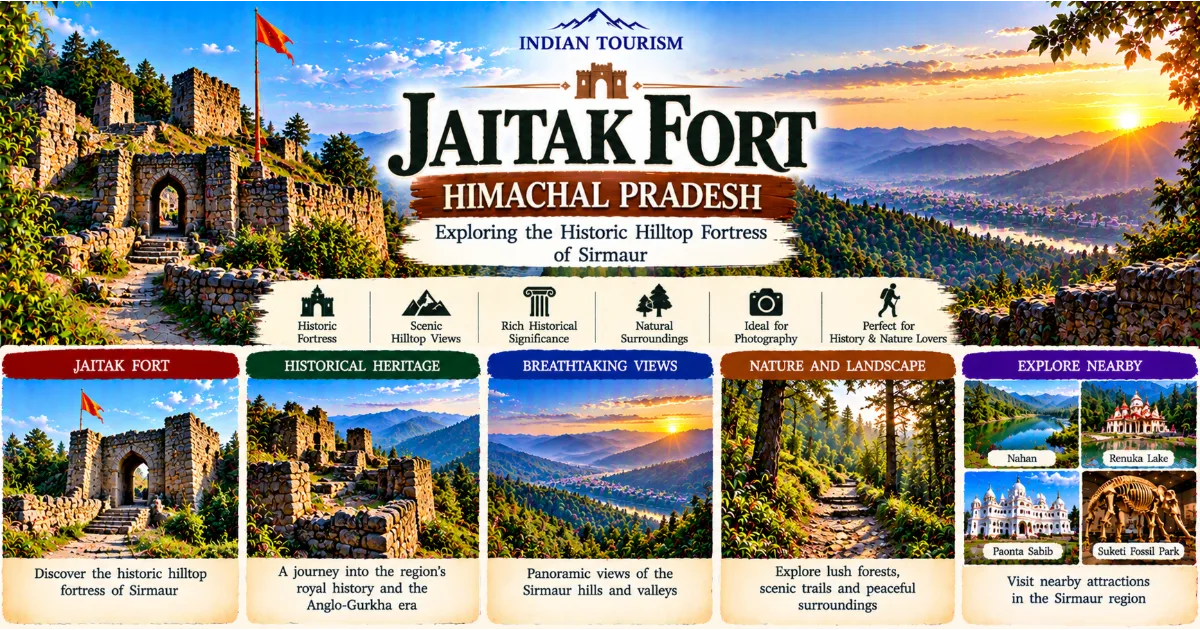
Himachal Pradesh is widely admired for its snow-covered mountains, green valleys, peaceful villages, ancient temples and colonial-era hill stations. Yet beyond its popular tourist destinations lies another side of the state, where history is preserved in old fortifications, traditional settlements and landscapes that have witnessed the rise and fall of regional kingdoms. Jaitak Fort, located in the Sirmaur region, represents this historical side of Himachal Pradesh. Set amid the hills near Nahan, the fort offers an opportunity to explore the political history of the region while enjoying the natural beauty of the surrounding mountains.
For travellers who enjoy destinations that combine heritage, landscape and a sense of discovery, Jaitak Fort can be an interesting addition to a Himachal Pradesh itinerary. Unlike busy tourist centres where hotels, restaurants and commercial attractions dominate the experience, historical hilltop sites often encourage visitors to slow down, observe their surroundings and imagine the lives of people who once depended on these strategic locations. The journey to such places can be as rewarding as the destination itself, particularly for travellers who appreciate rural scenery, quiet roads and the cultural character of the lower Himalayan region.
Jaitak Fort is especially significant because of its association with the history of Sirmaur and the conflicts that shaped the political landscape of the western Himalayas. Its story connects the region with the broader history of hill kingdoms, military campaigns and the changing balance of power during the early nineteenth century. Visiting the fort provides a reason to look beyond the usual descriptions of Himachal Pradesh as a holiday destination and understand how geography influenced the lives, ambitions and struggles of its people.
Understanding the Historical Importance of Jaitak Fort
The Kingdom of Sirmaur and Its Strategic Position
Sirmaur was one of the historic princely states of the western Himalayan region. Its territory included hills, valleys, forests and settlements connected through routes that were important for local administration, trade and military movement. Nahan developed as an important centre of the kingdom, and the surrounding hills formed part of a landscape in which rulers had to consider both the opportunities and challenges created by difficult terrain.
Mountain geography played a decisive role in the political history of this region. Ridges provided elevated positions from which movement could be observed, while narrow approaches could make the defence of a settlement or fort easier. Rivers, forests and steep slopes influenced how armies travelled and how quickly supplies could be transported. In such an environment, forts were more than structures used during warfare. They represented political authority, territorial control and the ability of a ruler to defend important locations.
Jaitak Fort is associated with this strategic history. Its position in the hills near Nahan reflects the importance of elevated ground during periods when military strength depended heavily on the ability to control routes and defend positions. The surrounding landscape helps visitors understand why hilltop fortifications were valued in regions where large armies could not always move freely.
The historical significance of the fort becomes clearer when it is considered as part of the wider story of Sirmaur rather than as an isolated ruin. Regional rulers had to maintain relationships with neighbouring kingdoms, respond to military pressure and protect their territories. These responsibilities created a political environment in which strong defensive positions could become important during moments of conflict.
The Gurkha Expansion into the Western Himalayas
One of the most important historical connections associated with Jaitak Fort is the expansion of Gurkha power into parts of the western Himalayan region during the late eighteenth and early nineteenth centuries. Gurkha military campaigns extended the influence of the Nepalese kingdom across several hill territories, bringing them into conflict with existing rulers and regional powers.
The expansion was part of a wider period of political change across the Himalayas. Local kingdoms had long competed for influence, territory and control over important routes. As military power expanded from the east, rulers in the western hills faced new challenges. The difficult geography that had traditionally protected some territories also became a landscape through which determined armies could advance.
Sirmaur was affected by this expansion, and the history of Jaitak Fort is closely associated with the Gurkha presence in the region. The fort became connected with the military struggles that unfolded as established hill rulers attempted to defend their authority against expanding forces. These events were not simply isolated battles. They reflected a larger transformation in regional politics, in which older arrangements of power were challenged by new military and administrative systems.
For visitors, this background adds depth to the experience of exploring the fort. A hilltop ruin may initially appear to be only a collection of weathered stones or surviving structural remains. When its historical context is understood, however, the site becomes a place through which the changing fortunes of kingdoms can be considered.
The Battle of Jaitak and Its Historical Context
Jaitak is particularly associated with the Anglo-Gurkha conflict that developed in the early nineteenth century. The conflict arose from expanding territorial ambitions, disputed boundaries and competing political interests between the expanding Gurkha state and the British East India Company. It eventually developed into the Anglo-Nepalese War, fought from 1814 to 1816.
The hills of Sirmaur formed part of the wider theatre of operations during this period. The fort and the surrounding area are remembered in connection with military resistance and the struggle for control of the region. The rugged terrain created considerable difficulties for military movement, making elevated defensive positions especially important. Troops operating in the hills had to contend with steep approaches, limited transport routes and the challenge of moving supplies through unfamiliar country.
The Anglo-Gurkha War ended with the Treaty of Sugauli in 1816, which reshaped territorial relationships and marked an important stage in the history of the Himalayan region. The conflict also formed part of the wider expansion of British influence across northern India. For Sirmaur and neighbouring hill territories, these developments contributed to a changing political environment.
When exploring Jaitak Fort, visitors should remember that historical events are often preserved through a combination of local traditions, regional histories and wider accounts of military campaigns. Individual details about particular engagements may differ between accounts. The most useful approach is to view the fort as a historical landscape connected with the larger struggle for political control in the western Himalayas.
The Landscape Around Jaitak Fort
Hills, Ridges and Forested Slopes
The natural setting is an important part of the appeal of Jaitak Fort. The Sirmaur region contains a varied landscape of hills, valleys, wooded slopes and rural settlements. The terrain changes with elevation, creating differences in vegetation, temperature and the appearance of the surrounding countryside.
From elevated locations, the landscape can reveal the relationship between hills and settlements. Villages may appear along slopes or on relatively level ground, while ridgelines form the natural boundaries of the views. During clear weather, the combination of distant hills and nearby vegetation can create an impressive sense of depth.
The scenery is particularly appealing to travellers who enjoy quiet places rather than heavily developed viewpoints. Jaitak Fort is best approached as a heritage destination in which the surrounding landscape contributes to the experience. Visitors who take time to observe the terrain may gain a better understanding of why earlier rulers considered elevated positions important.
The appearance of the landscape changes throughout the year. During the monsoon, vegetation becomes greener and the hills may appear especially lush. In the cooler months, clearer skies can provide better visibility, although weather conditions and access should always be checked before travelling. Spring and autumn can also offer pleasant conditions for exploring the surrounding countryside.
A Different Side of Himachal Pradesh
Many visitors associate Himachal Pradesh with famous destinations such as Shimla, Manali and Dharamshala. These places offer established tourism infrastructure, accommodation choices and a wide range of activities. Jaitak Fort represents a different kind of travel experience, one that is more closely connected with regional history and rural landscapes.
The destination may appeal to travellers who have already explored the state's better-known hill stations and want to understand its lesser-known historical sites. It can also interest students of history, photography enthusiasts, heritage travellers and people who prefer quieter excursions.
A visit requires a different mindset from a conventional sightseeing trip. The experience is not necessarily built around a large number of attractions or extensive visitor facilities. Instead, its value lies in understanding the site's historical associations, observing the natural setting and exploring the wider Sirmaur region.
Travellers should also maintain realistic expectations about the condition of historic structures. Forts that have experienced centuries of weathering, conflict and limited conservation may not retain their original appearance. Visitors should avoid assuming that every part of the original fortification remains intact and should follow local guidance regarding accessible areas.
Exploring Jaitak Fort as a Heritage Traveller
What to Look for During a Visit
A heritage visit becomes more meaningful when travellers pay attention to the relationship between the built environment and the landscape. At Jaitak Fort, the first consideration should be the elevated setting and the way the surrounding terrain influences movement and visibility. These features help explain why the location was associated with military activity.
Visitors can also observe surviving structural remains, where accessible, without disturbing them. Weathered walls, foundations, stones and other traces of older construction may offer clues about how a fortification occupied the available ground. However, interpretation should be cautious. Not every visible stone structure necessarily belongs to the same historical period, and detailed architectural conclusions should be left to reliable historical or archaeological documentation.
The broader landscape can be equally informative. Looking towards nearby ridges and valleys helps visitors imagine the challenges faced by people moving through the region before modern roads and vehicles existed. The same hills that create beautiful views today once shaped military strategy, communication and the movement of supplies.
Photography can be part of the visit, but it should not replace the experience of understanding the site. Wide landscape photographs can show the relationship between the fort and the surrounding hills, while closer photographs may record details of surviving structures. Visitors should avoid climbing unstable walls, removing stones or entering restricted areas to obtain better pictures.
Learning from the Region's Cultural Heritage
Jaitak Fort should ideally be explored alongside a broader interest in Sirmaur's history and cultural identity. The region has its own traditions, settlement patterns, religious sites and local practices that distinguish it from other parts of Himachal Pradesh.
A journey through the surrounding countryside can reveal how local communities have adapted to mountain conditions. Houses, agricultural plots, village paths and small places of worship form part of the living cultural landscape. These features should be approached with respect, particularly where visitors pass through inhabited areas or privately managed land.
Talking with local residents, where appropriate, can sometimes provide valuable insight into local place names and traditions. However, travellers should understand that oral histories may preserve memories in different forms from written historical accounts. Both can be meaningful, but they should not automatically be treated as identical kinds of evidence.
Responsible heritage tourism involves protecting the very qualities that make a place distinctive. Visitors should avoid littering, damaging old structures or treating religious and cultural spaces as mere photographic backgrounds. Respectful behaviour helps ensure that historical places remain meaningful to local communities as well as visitors.
Best Time to Visit Jaitak Fort
Spring and Early Summer
Spring can be a pleasant period for exploring the Sirmaur hills. Temperatures generally become more comfortable after winter, and the surrounding vegetation begins to show seasonal changes. For travellers interested in walking around historical sites and observing the countryside, this period can provide a good balance between comfortable weather and attractive scenery.
Early summer may also be suitable, although daytime temperatures can rise in lower and more exposed locations. Travellers should plan outdoor exploration for the cooler parts of the day, carry drinking water and avoid underestimating the effects of direct sunlight.
Because Jaitak Fort is a heritage destination rather than a resort with extensive indoor activities, weather has a direct effect on the quality of the visit. A clear day can improve visibility and make the surrounding landscape easier to appreciate. Before setting out, visitors should check local conditions and confirm whether the intended route is accessible.
Monsoon Season
The monsoon can transform the hills into a greener landscape, but it also brings challenges. Rain may make unpaved paths slippery, reduce visibility and increase the risk of landslides on vulnerable mountain roads. Waterlogged ground can also make it difficult to explore uneven terrain safely.
Travellers considering a monsoon visit should obtain current local advice before leaving. They should avoid walking across unstable slopes, stay away from exposed edges and follow any restrictions imposed by local authorities or land managers. If heavy rain is forecast, postponing the excursion is often the wiser decision.
The attraction of lush scenery should never outweigh basic safety. A historical site can be visited at another time, while a decision to continue into unsafe conditions can create unnecessary risks.
Autumn and Winter
Autumn often provides comfortable conditions for exploring the region, and clearer skies may improve views across the hills. For travellers who want to combine a visit to Jaitak Fort with other destinations in Sirmaur, this can be a useful season for planning a wider itinerary.
Winter can bring colder mornings and evenings, with conditions varying according to elevation. Travellers should carry suitable clothing and confirm road and trail conditions before starting their journey. The absence of snow at one location should not be taken as evidence that all nearby routes are free from weather-related difficulties.
There is no single best season for every visitor. The most appropriate time depends on the condition of the access route, the traveller's mobility, the purpose of the visit and the weather forecast. For a first visit, choosing a period with stable conditions and good visibility is generally sensible.
How to Reach Jaitak Fort
Travelling from Nahan
Nahan is a useful base for exploring the historic and natural attractions of Sirmaur. The town has regional significance and can serve as a starting point for travellers interested in Jaitak Fort and nearby destinations. Visitors should establish the precise access route before departure because the final approach may depend on local roads, the condition of paths and access arrangements.
A private vehicle or locally hired taxi may offer flexibility for exploring the area. Travellers who prefer public transport should confirm available services to the nearest suitable settlement and determine whether the remaining journey requires a local vehicle or walking.
Because access details can change, it is advisable to ask locally about the current route, parking possibilities and any restrictions. Do not assume that a map application will identify every usable path or distinguish between public roads and private tracks.
Travelling from Other Parts of Himachal Pradesh
Visitors coming from Shimla, Solan or other parts of Himachal Pradesh can plan Jaitak Fort as part of a broader journey through the region. The actual travel time will depend on the starting point, road conditions, traffic and the route chosen.
A flexible itinerary is preferable to a schedule that leaves little room for delays. Mountain roads can require more time than the distance on a map suggests, and roadworks or weather conditions may affect the journey. Travellers should plan their return before sunset when unfamiliar routes or limited local transport make late travel inconvenient.
Those travelling from outside the state may find it practical to reach a major transport centre first and continue towards Nahan by road. The most suitable transport arrangement depends on the origin of the journey and the amount of time available.
Practical Advice for the Final Approach
Before travelling, confirm the location of the accessible entry point and whether the site can be reached directly by vehicle. Ask whether any section requires walking and whether the route is suitable for the abilities of everyone in the group.
Wear shoes with good grip if the approach involves uneven ground. Carry water, sun protection and a light layer of clothing, depending on the season. Travellers should also bring a fully charged phone, but should not depend entirely on mobile connectivity in hilly areas.
If the route passes through villages or near agricultural land, remain on recognised paths and respect private property. Do not leave a vehicle in a way that blocks local traffic or access for residents.
Planning a Visit with Nahan and Nearby Attractions
Nahan as a Travel Base
Nahan can provide a convenient starting point for a trip focused on Sirmaur's history and landscapes. The town has a distinct regional character and allows visitors to experience an urban settlement that is smaller and less commercially crowded than some of Himachal Pradesh's most famous hill stations.
Travellers can use time in Nahan to learn more about the region's historical background, explore its local markets and experience its everyday culture. The town also offers an opportunity to plan transport and obtain local guidance before visiting less familiar destinations.
A stay in Nahan can be particularly useful for travellers who want to avoid rushing through several places in a single day. Rather than treating Jaitak Fort as a brief stop on a long road journey, visitors can allocate sufficient time for the heritage site and the surrounding region.
Renuka Lake
Renuka Lake is one of the best-known natural attractions of Sirmaur. Its setting, religious associations and surrounding greenery make it a contrasting experience to a historic hilltop fort. The lake is connected with local religious traditions and is an important destination for visitors interested in both nature and cultural heritage.
Including Renuka Lake in a wider Sirmaur itinerary can help travellers experience more than one aspect of the region. The lake offers a different landscape and atmosphere, while Jaitak Fort directs attention towards the military and political history of the hills.
The two destinations should be planned according to the available time and current road conditions. It is better to visit fewer places comfortably than to attempt a crowded itinerary that leaves little time to appreciate any of them.
Other Heritage and Cultural Stops
Sirmaur contains a range of settlements and religious sites that can enrich a heritage-focused journey. Travellers may choose to explore other locally significant places after consulting current information and confirming access arrangements.
The most rewarding itinerary is not necessarily the one that includes the greatest number of attractions. A thoughtful journey allows time to understand the relationship between a fort, a historic town, the surrounding countryside and the communities that continue to live in the region.
When planning additional stops, consider their distance from one another, the time required for the final approach and the availability of transport. Local advice is particularly useful when a destination is not widely developed for tourism.
Where to Stay and What to Eat
Accommodation Options
Nahan is a practical place to investigate accommodation for a trip to Jaitak Fort. Depending on the travel season and the visitor's budget, the town may offer different types of lodging, from simple guest accommodation to more comfortable hotels.
Travellers should check current availability, recent reviews, cancellation conditions and transport arrangements before confirming a stay. A property that appears close on a map may not necessarily be convenient for an early departure or a return journey from a rural attraction.
Staying in a regional town also makes it easier to ask about the condition of nearby roads and obtain updated local guidance. For visitors who value flexibility, this can be more useful than choosing accommodation far from the main travel route.
Those considering a rural homestay should confirm facilities in advance and respect the host community's customs. A homestay can offer insight into local life, but visitors should not assume that every property provides restaurant services, private transport or the same amenities as a commercial hotel.
Experiencing Local Food
Food is an important part of travelling through Himachal Pradesh. In the Sirmaur region, visitors can look for traditional North Indian meals, seasonal preparations and familiar dishes served in local eateries. The exact options will depend on the establishment and the time of year.
Travellers who want to experience regional cuisine should ask about locally prepared dishes rather than assuming that every restaurant offers the same menu. Simple meals made with seasonal ingredients can be a satisfying part of a journey through the hills.
It is sensible to carry water and a small snack when visiting a less developed heritage site, particularly if food outlets are not available near the entrance or along the approach. Avoid leaving food packaging or other waste behind.
Photography and Responsible Tourism
Capturing the Fort and Its Surroundings
Jaitak Fort may interest photographers who enjoy combining historical subjects with natural scenery. The elevated landscape, surviving remains and changing light can provide opportunities for wide views as well as detailed photographs.
Morning and late afternoon can produce softer light than the middle of the day, although the best time depends on cloud cover and the direction of the view. Travellers should take time to observe the surroundings before choosing a composition, rather than rushing to photograph the first visible structure.
A wide photograph can help communicate the fort's relationship with the hills, while closer images may document textures and construction details. Visitors should not climb unstable walls, cross barriers or approach exposed edges for a photograph. Safety is more important than obtaining a particular image.
Drones should only be used where permitted and after checking applicable regulations and local restrictions. A location's historical significance or quiet atmosphere does not automatically mean that aerial photography is allowed.
Protecting a Historical Site
Historic structures are vulnerable to gradual damage caused by weather, vegetation, human activity and neglect. Visitors can help protect them by avoiding the removal of stones, scratching names into surfaces, climbing fragile walls or moving objects from their original positions.
Waste management is equally important. Carry personal rubbish back to an appropriate disposal point, and avoid leaving plastic bottles, wrappers or food waste around the site. Even a small amount of litter can affect the experience of other visitors and the appearance of the surrounding landscape.
Respect for local residents should guide behaviour near villages and private land. Ask permission before photographing people closely, avoid blocking paths and follow any instructions provided by local authorities or caretakers.
Responsible tourism is not limited to protecting physical structures. It also involves recognising that heritage sites have meaning beyond their value as tourist attractions. Their history may form part of the identity of local communities, and visitors should approach them with curiosity and respect.
Who Should Visit Jaitak Fort?
History Enthusiasts
Jaitak Fort is particularly relevant for travellers interested in regional kingdoms, Himalayan military history and the political changes that took place during the early nineteenth century. Its historical associations provide a starting point for learning about the Gurkha expansion and the Anglo-Gurkha conflict.
Readers who enjoy history may find the destination more rewarding if they learn about Sirmaur before arriving. Understanding the broad context makes it easier to interpret the landscape and appreciate why a fortified position mattered.
Nature and Landscape Lovers
The surrounding hills can appeal to visitors who enjoy quiet scenery, rural roads and the natural character of the western Himalayas. The destination is suitable for travellers who value the combination of landscape and heritage rather than expecting a highly developed entertainment centre.
Weather conditions influence the quality of the views, so visitors should remain flexible. A clear day can make the surroundings easier to appreciate, while mist or rain may change the atmosphere and limit visibility.
Photographers and Slow Travellers
Photographers may appreciate the contrast between old structures and the natural landscape. Slow travellers may value the opportunity to spend time in a less commercial setting and understand a small part of Himachal Pradesh's historical geography.
The destination is less suited to visitors who expect extensive tourist facilities at every point or who prefer attractions with a large number of organised activities. Confirming access arrangements in advance can help ensure that expectations match the nature of the visit.
Important Travel Considerations
Jaitak Fort should be approached with preparation because the condition of the final access route and the facilities available at the site may differ from those at major tourist destinations. Visitors should confirm current access information locally, especially if travelling during the monsoon or after severe weather.
People with mobility limitations should establish whether the approach involves steep slopes, uneven paths or other physical challenges. Do not assume that a historical hilltop site is wheelchair accessible or that vehicles can reach the fort itself.
Carry enough water and suitable clothing for the conditions. Keep track of daylight, particularly if the visit includes walking along unfamiliar paths. Families travelling with children should supervise them closely around old walls, uneven ground and exposed edges.
Visitors should also respect any restrictions intended to protect the site. If a section is closed or access is discouraged, do not attempt to bypass barriers. Historical exploration should never come at the expense of personal safety or preservation.
Conclusion: Discovering the Historical Soul of Sirmaur
Jaitak Fort offers a way to explore a part of Himachal Pradesh that is often overshadowed by its famous hill stations and mountain resorts. Its historical associations connect the Sirmaur region with the changing political landscape of the western Himalayas, including the expansion of Gurkha power and the Anglo-Gurkha conflict of the early nineteenth century.
The fort's appeal lies in the relationship between history and geography. The surrounding hills help explain why elevated defensive positions mattered, while the region's wider cultural landscape provides context for understanding the communities and kingdoms that developed in this part of the Himalayas. A visit can become more meaningful when travellers take time to learn about Sirmaur, observe the terrain and explore the area's heritage with care.
Jaitak Fort is best suited to visitors who value historical context, natural surroundings and quieter travel experiences. It may not offer the extensive facilities associated with major tourist centres, so preparation and realistic expectations are important. Confirming access arrangements, choosing suitable weather and respecting the site will help make the excursion safer and more rewarding.
For anyone seeking to understand Himachal Pradesh beyond its familiar postcard landscapes, Jaitak Fort deserves consideration as part of a thoughtful journey through Sirmaur. It reminds travellers that the hills are not only places of natural beauty, but also landscapes shaped by kingdoms, conflicts, traditions and generations of human experience.
#IndianTourism #HimachalPradesh #JaitakFort #Sirmaur #Nahan #HimachalHeritage #HistoricalPlacesOfIndia #ExploreHimachal #IndianHistory #HeritageTourism #MountainTravel #TravelIndia
