
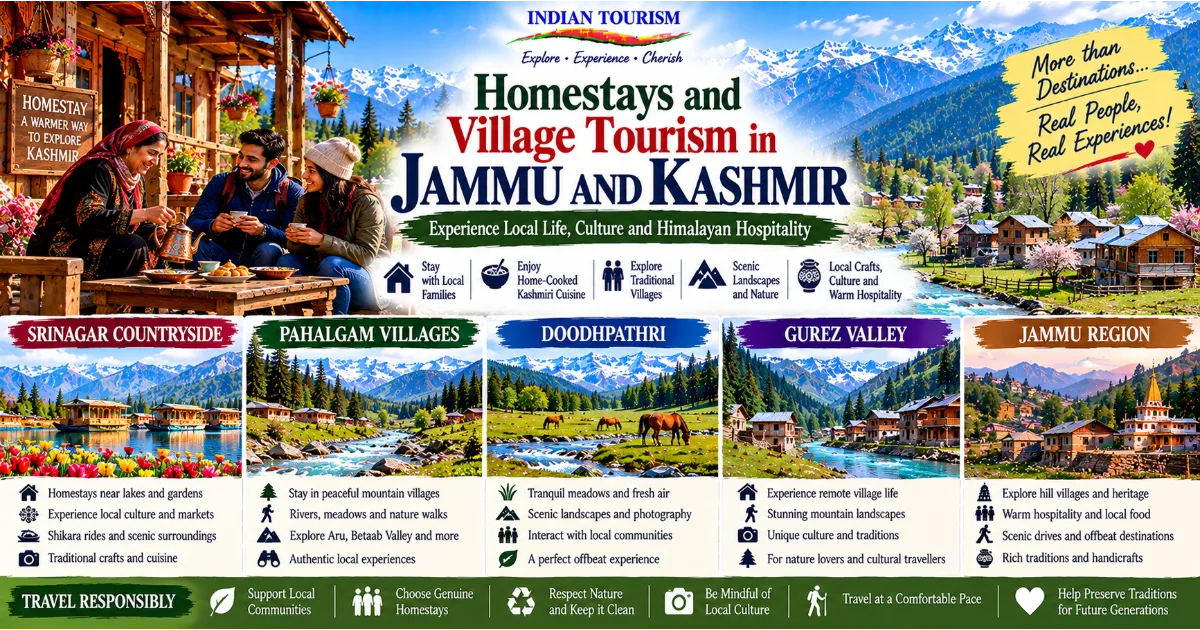
Discover Jammu and Kashmir Beyond Its Famous Tourist Destinations
Jammu and Kashmir is widely known for its snow-covered mountains, beautiful valleys, alpine lakes, Mughal gardens and traditional houseboats. Places such as Srinagar, Gulmarg, Pahalgam and Sonamarg attract travellers looking for spectacular landscapes and memorable holidays. However, there is another side of the region that deserves equal attention: its villages, traditional homes, agricultural landscapes, local crafts, food traditions and the everyday lives of the people who call these mountains home.
Homestays and village tourism offer travellers an opportunity to experience this less familiar side of Jammu and Kashmir. Instead of spending an entire holiday in hotels and visiting only popular sightseeing points, visitors can stay with local families, explore rural settlements, taste home-cooked meals, learn about regional customs and discover how mountain communities live through changing seasons.
A village stay can be a rewarding experience for many kinds of travellers. Families may appreciate the warmth of a home environment, couples may enjoy peaceful surroundings, photographers may discover distinctive landscapes, and cultural travellers may find opportunities to understand local traditions more deeply. Those interested in nature can explore orchards, village paths, meadows and nearby forests where access is permitted and conditions are safe.
Village tourism also has the potential to benefit local communities. When travellers book legitimate local accommodation, eat at family-run establishments, purchase handmade products and hire local guides, more of their travel spending can remain within the destination. This can support small businesses, create livelihood opportunities and encourage communities to preserve their cultural heritage.
However, rural tourism requires thoughtful planning. Accommodation standards vary, transport may be limited, mobile connectivity can be inconsistent, and weather can affect travel in mountain areas. Some villages have limited services for visitors, while others may be better equipped to welcome guests. Travellers should therefore select destinations carefully, confirm arrangements in advance and respect local customs.
This guide explores how to experience homestays and village tourism in Jammu and Kashmir, including possible destinations, cultural experiences, food, seasonal considerations, practical planning, responsible travel and ways to make a rural holiday comfortable and meaningful.
1. What Is a Homestay and Why Is It Different from a Hotel?
A homestay is an accommodation arrangement in which visitors stay in a residence operated by a local host or family. Depending on the property, guests may occupy a separate room within the family home, stay in an independent section of the property or use a small guesthouse managed by local residents.
The experience differs from a conventional hotel because the emphasis often extends beyond the room itself. Hosts may share information about nearby places, prepare regional dishes, recommend walking routes and explain local customs. Some properties offer gardens, courtyards, views of surrounding mountains or opportunities to observe everyday rural activities.
The degree of interaction depends on the accommodation. Some homestays encourage guests to share meals and conversations with the host family, while others provide greater privacy. Neither arrangement is automatically better. The right choice depends on the traveller's preferences, comfort requirements and expectations.
Before booking, visitors should ask whether meals are included, whether bathrooms are private, how hot water is provided, what heating arrangements are available in winter and whether the property is accessible by vehicle. They should also clarify whether the advertised accommodation is genuinely family-run or simply a guesthouse using the homestay label.
In Jammu and Kashmir, the term homestay can cover a variety of experiences. A property in a town may offer convenient access to shops and transport, while a rural homestay may provide a quieter environment surrounded by orchards, fields or mountain scenery. Some locations offer a blend of both, with village life within walking distance of a larger settlement.
2. Why Village Tourism Deserves a Place in Your Travel Plans
A closer connection with local culture
Popular tourist circuits usually focus on major attractions. Village tourism changes the pace of a journey by making ordinary local life part of the experience. Travellers may observe how homes are arranged, how local markets function, what people grow in their gardens and how seasonal weather influences daily routines.
These experiences should not be treated as performances created for visitors. A village is a living community, not an open-air museum. Travellers should remain respectful, ask permission before entering private spaces and avoid photographing residents without their consent.
Peaceful surroundings and a slower pace
Many travellers visit Jammu and Kashmir to escape busy urban environments. A carefully selected rural stay can offer quiet mornings, mountain views, fresh air and opportunities to spend time outdoors.
The atmosphere varies considerably by location. Some villages lie close to busy roads or popular tourist circuits, while others are reached through narrow mountain routes. Travellers should not assume that every rural destination is remote, silent or surrounded by untouched nature. Researching the specific property and its surroundings helps set realistic expectations.
Opportunities to discover regional food
Food is an important part of the homestay experience. Depending on the host family and region, guests may be offered rice-based meals, seasonal vegetables, locally prepared breads, lentils, dairy products, meat dishes and traditional beverages.
Kashmiri cuisine and the food traditions of the Jammu region have distinct characteristics. A stay in one part of the region should not be assumed to represent the entire culinary diversity of Jammu and Kashmir. Visitors can ask hosts about the origin of dishes, the ingredients used and whether a meal is associated with a particular season or occasion.
Supporting local livelihoods
Tourism can create opportunities for rural households when it is organised in a way that respects community priorities. Accommodation payments, meal charges, guided walks, transport services and purchases from local artisans can provide income beyond large hotels and established tourism businesses.
The benefits depend on how tourism is managed. Fair pricing, transparent bookings, safe working conditions and community participation matter. Travellers can contribute by paying agreed rates, avoiding unreasonable bargaining over small purchases and choosing businesses that demonstrate responsible practices.
3. Kashmir Valley: Village Experiences Around Srinagar
Srinagar as a starting point
Srinagar is a practical starting point for travellers who want to combine urban sightseeing with a rural stay. The city offers access to traditional markets, gardens, historic neighbourhoods, lakes and regional cuisine. From here, visitors can plan excursions to nearby villages and countryside areas, depending on road conditions and local access.
A useful approach is to spend the first part of the trip in Srinagar before moving to a quieter accommodation outside the main urban area. This allows travellers to become familiar with the region, arrange transport and purchase essential supplies before continuing into rural surroundings.
Some visitors prefer to stay in a traditional houseboat or a city guesthouse and take day trips to villages. Others may choose a rural homestay for several nights. The second option generally allows more time to settle into the surroundings rather than repeatedly travelling between the city and countryside.
When selecting a property, confirm its exact location, the distance from the nearest market and whether transport is available in the evening. A beautiful setting can be less convenient if groceries, pharmacies or restaurants are far away.
Doodhpathri and surrounding countryside
Doodhpathri is known for its green meadows, flowing streams and mountain scenery. It is an attractive option for travellers who want to explore a landscape different from the urban environment of Srinagar.
A village-focused visit to this area should be planned around verified accommodation and current road conditions. Visitors should confirm which rural settlements and local services are accessible before travelling. Accommodation options can vary, and the availability of genuine homestays should not be assumed simply because a destination is popular.
The area is especially appealing during suitable weather, when the surrounding meadows and hills can be enjoyed through gentle walks and photography. Visitors should remain on permitted routes, avoid disturbing grazing animals and take all waste back with them.
Pahalgam and the Lidder Valley
Pahalgam is famous for its mountain scenery, river landscapes and access to outdoor activities. It can also serve as a base for discovering settlements and countryside beyond the busiest visitor areas.
A rural stay in the wider Pahalgam area may offer opportunities to observe agricultural landscapes, local markets and traditional food practices. The experience depends on the specific village and accommodation, so travellers should investigate individual properties instead of relying on the destination name alone.
The Lidder Valley can experience substantial seasonal changes. Summer brings more visitors and generally more activity, while colder months require additional preparation. Snow, rain and road conditions can affect access, and travellers should confirm transport arrangements before departure.
Visitors should also check current permissions and restrictions for nearby trekking routes and protected or sensitive areas. A homestay does not automatically provide permission to enter restricted land or travel on every mountain path.
Gurez Valley: A More Remote Mountain Experience
Gurez Valley is known for its dramatic mountain setting, traditional settlements and distinctive cultural landscape. It may appeal to travellers interested in quieter destinations and the experience of staying away from the busiest tourism centres.
However, Gurez requires more careful planning than a short excursion from Srinagar. Access, weather, accommodation availability and local travel requirements may change according to the season and prevailing conditions. Travellers should verify current entry requirements, road status and accommodation arrangements before committing to a visit.
A stay in this region should be approached with patience. Visitors may encounter fewer commercial services than they would in larger towns, and plans may need to change because of weather or transport conditions.
Guests should be especially respectful when photographing homes, residents and community activities. The value of a visit lies not in treating the valley as an exotic backdrop, but in appreciating its landscape and cultural identity with humility.
4. Jammu Region: Village Life, Hills and Traditional Hospitality
Jammu is often associated with religious tourism, particularly visits to important pilgrimage destinations. Yet the wider Jammu region also includes hill settlements, agricultural areas, forests and communities whose lifestyles differ from those of the Kashmir Valley.
Patnitop and nearby rural areas
Patnitop is known for its mountain environment, pine-covered slopes and seasonal outdoor activities. It can be a convenient base for visitors who want to combine sightseeing with a stay in a quieter hill setting.
Travellers should look beyond the main resort area when searching for village accommodation, but they should verify whether a property is actually located in a village or simply marketed as rural. The distinction affects transport, access to shops and the kind of local experience available.
A homestay in the surrounding hills may provide opportunities for short walks, conversations with local hosts and views of the changing mountain landscape. During winter, cold temperatures and possible snow require warm clothing and confirmation of heating arrangements.
Bhaderwah and its surrounding settlements
Bhaderwah is known for its mountain scenery, meadows, forests and cultural traditions. The wider area may appeal to travellers who enjoy outdoor landscapes and want to explore destinations beyond the most familiar tourist circuits.
Village tourism here can be combined with local food, seasonal sightseeing and guided nature walks where permitted. The suitability of a specific village depends on transport, accommodation, weather and the interests of the traveller.
Visitors should confirm the condition of roads and walking routes, especially when travelling outside the main season. Mountain distances can be deceptive, and a route that looks short on a map may take considerably longer than expected.
Kishtwar and the wider mountain landscape
Kishtwar district includes varied landscapes and settlements, with some areas offering a strong sense of rural life and mountain geography. It may suit experienced travellers who are comfortable with more detailed planning and who are willing to verify local arrangements before arrival.
Not every part of a district is appropriate for independent tourism. Access may depend on road conditions, local restrictions, the availability of accommodation and current safety advice. Travellers should consult reliable local information and avoid attempting routes that have not been confirmed as accessible.
For a village-focused holiday, the priority should be finding a suitable host and a practical base rather than trying to cover a large number of distant places in a short period.
5. How to Choose the Right Homestay
Selecting accommodation is one of the most important parts of a successful village holiday. A well-chosen homestay can make a trip comfortable and memorable, while an unsuitable property can create avoidable problems.
Check location and accessibility
Ask for the property's exact location and the nearest recognisable town or village. Confirm whether a regular vehicle can reach the entrance or whether a walk is required from the main road. In mountain areas, steep paths and uneven surfaces may be difficult for older visitors, young children or travellers with mobility limitations.
If you plan to arrive after dark, confirm whether the host can guide you to the property or arrange transport. Avoid assuming that navigation applications will provide reliable directions on every rural road.
Understand room and bathroom arrangements
Accommodation descriptions should clearly explain the room type, number of beds, bathroom facilities and access to hot water. Some rural homes have modern facilities, while others offer simpler arrangements.
Travellers who require private bathrooms, specific accessibility features or separate sleeping arrangements should communicate these requirements before booking. Families should also ask about room capacity and whether additional bedding is available.
Ask about heating and winter comfort
Mountain weather can become cold even when daytime conditions appear pleasant. Before booking for autumn or winter, ask what heating is provided and whether blankets are sufficient for the expected temperatures.
Do not assume that every property has central heating, uninterrupted electricity or hot water throughout the day. Confirming these details beforehand is especially important for families with children and older travellers.
Clarify meals and dietary needs
Some homestays include breakfast, while others charge separately for every meal. Ask about meal timings, drinking water, vegetarian options and the availability of food for guests with allergies or dietary restrictions.
If you have a serious food allergy, explain it clearly and confirm whether the host can safely accommodate it. A rural property may have limited access to alternative ingredients, so carrying suitable emergency medication and essential food items may be necessary.
Look for reliable reviews and clear communication
Where reviews are available, look for detailed feedback about cleanliness, hospitality, location, food and accuracy of the listing. A large number of brief positive ratings is less informative than specific accounts of guests' experiences.
Before paying, obtain written confirmation of the booking, total cost, cancellation policy and contact details. Use legitimate booking arrangements and be cautious about unusual payment requests. If a property cannot provide basic information about the stay, consider alternatives.
6. Experiences to Enjoy During a Village Stay
Walk through orchards and cultivated fields
Orchards are an important part of rural life in parts of Jammu and Kashmir. Depending on the location and season, visitors may see apple trees, other fruit crops, vegetable plots and fields used for local agriculture.
The appearance of an orchard changes throughout the year. Spring may bring blossoms, summer can reveal growing fruit and green foliage, and autumn may coincide with harvesting in some areas.
Guests should ask before entering orchards or agricultural land. These places are working environments, and stepping through planted rows or picking fruit without permission can damage crops and affect livelihoods.
Learn about traditional crafts
Kashmir has a rich tradition of handicrafts, including textile work, embroidery, carpet weaving, woodwork and other forms of artistic production. The Jammu region also has diverse craft traditions, which vary across its communities.
A homestay host may be able to suggest a reputable artisan, workshop or local market where visitors can learn about particular crafts. Not every village will have a workshop open to tourists, so these experiences should be arranged in advance rather than expected automatically.
When purchasing handmade products, ask about the material, method of production and care requirements. Buy from sellers who can explain what they offer, and avoid assuming that every item described as traditional or handmade has the same origin or quality.
Experience home-cooked regional meals
Food is often one of the most memorable parts of a rural stay. Guests may have the opportunity to try dishes prepared in a family kitchen, learn how ingredients are used and understand how meals vary according to season and local preference.
A host may prepare familiar dishes or introduce visitors to foods they have not encountered before. The experience can be more personal than ordering from a standard restaurant menu because visitors can ask questions about recipes, ingredients and family traditions.
Guests should remain open-minded while communicating any dietary requirements. It is also considerate to ask before photographing a kitchen, meal preparation or family members.
Explore village paths and local landscapes
A walk through a village can reveal details that are easy to miss when travelling by vehicle. Visitors may notice the arrangement of houses, small shops, community spaces, water channels, gardens and the relationship between settlements and the surrounding landscape.
Walk only on public or permitted paths. Some routes cross private farmland, forest areas or terrain that becomes unsafe after rain or snowfall. A local guide can help identify suitable routes and explain the landscape.
Travellers should carry water, appropriate footwear and weather protection. In isolated areas, tell the host where you intend to walk and when you expect to return.
Spend time learning from local hosts
Not every meaningful travel experience needs to involve an organised activity. Sitting down for tea, discussing seasonal changes or asking about the history of a settlement can be just as rewarding.
Approach conversations with genuine curiosity. Avoid treating one person's experience as representative of every community in Jammu and Kashmir. Languages, customs, food traditions and social practices differ across the region.
Guests should also respect personal boundaries. Hosts may have work, family commitments or religious observances that limit their availability. A homestay is a shared living environment, not a guarantee of constant entertainment.
7. Local Food and the Culture of Hospitality
Food traditions in Jammu and Kashmir reflect geography, climate, agriculture and cultural history. The region includes distinct culinary traditions, and the dishes available at a homestay depend on the household, location and season.
In the Kashmir Valley, visitors may encounter rice-based meals, vegetable preparations, yoghurt-based dishes, breads, meat dishes and traditional preparations associated with celebrations or family gatherings. In the Jammu region, food traditions vary across plains, hills and mountain communities, with different uses of grains, pulses, dairy products, vegetables and spices.
A homestay offers an opportunity to ask how local ingredients are sourced and how meals change throughout the year. In agricultural communities, certain foods may be more common when particular crops are harvested. In colder weather, hosts may favour meals that are warming and suited to the season.
Hospitality also has social meaning. Offering tea or food may be an expression of welcome, but practices differ among households. Visitors should accept or decline politely and avoid assuming that hosts can provide unlimited meals or services beyond the agreed arrangement.
When staying for several nights, communicate meal timings and expectations clearly. If you wish to join a cooking activity, ask whether it is convenient and whether an additional charge applies. Respectful communication helps prevent misunderstandings and makes the experience more enjoyable for both guests and hosts.
8. Best Time to Experience Homestays and Village Tourism
The best time for village tourism depends on the destination, the type of experience you want and the level of comfort you require.
Spring: March to May
Spring can be a rewarding season for exploring gardens, village lanes and agricultural landscapes in suitable areas. Temperatures begin to rise in many locations, and the landscape gradually changes after winter.
Conditions vary by altitude. Higher settlements may remain cold or experience snow, while lower areas become more accessible. Travellers should confirm local road conditions and avoid relying on general seasonal expectations alone.
Spring may suit visitors interested in scenery, photography and quieter walks, provided the chosen destination is accessible and the accommodation is prepared for cool nights.
Summer: June to August
Summer is a popular period for travel to many parts of Jammu and Kashmir. Some mountain routes become more accessible, outdoor activities are more widely available and village stays can be comfortable in suitable locations.
However, popular destinations may become crowded, accommodation demand can rise and weather can still be unpredictable. Travellers should reserve suitable properties in advance and confirm transport arrangements.
Rain can affect mountain roads and walking routes. A flexible itinerary is useful, especially when the trip includes several rural locations.
Autumn: September to November
Autumn can offer a distinctive atmosphere in parts of the region. Depending on location, visitors may encounter changing foliage, harvest activity and cooler temperatures.
It can be a good time for travellers who want to combine village experiences with photography and seasonal food. Nevertheless, nights become colder, and daylight hours shorten as the season progresses.
Ask hosts whether outdoor activities, transport services and meals remain available during your planned dates. Some facilities may operate differently outside the busiest tourism season.
Winter: December to February
Winter can bring snow, cold temperatures and a very different rural atmosphere. For travellers who enjoy winter scenery and are prepared for challenging weather, a carefully planned stay may be memorable.
However, winter travel is not suitable for every village or every traveller. Road access may be affected, some properties may have limited heating, and services can become less reliable in remote locations.
Before booking, confirm whether the host will be available, whether the property can be reached safely and what heating and emergency arrangements are in place. Do not travel into isolated mountain areas without checking current local conditions.
9. How Much Does a Homestay Holiday Cost?
The cost of a homestay holiday varies according to location, season, room quality, meals, transport and the number of travellers. There is no single price that accurately represents all village accommodation in Jammu and Kashmir.
A simple family-run property may cost less than a premium hotel, but a remote location can increase transport expenses. Some stays include breakfast or dinner, while others charge separately. A property offering guided activities, private transport or specialised services may have a higher overall cost.
Rather than comparing room prices alone, calculate the total cost of the experience. Include accommodation, meals, local transport, fuel, guide charges, entrance fees where applicable, and any additional activity costs.
Travellers can manage expenses by staying for several nights in one area, eating meals at the homestay when appropriate and arranging transport efficiently. Travelling in a small group can sometimes reduce per-person costs, although room capacity and vehicle requirements must be considered.
Avoid choosing accommodation solely because it is the cheapest option. Cleanliness, safe access, reliable communication and suitable facilities are important. Paying a fair price for a well-managed local property can support the host while improving the overall quality of the trip.
10. A Sample Five-Day Village Tourism Itinerary
A five-day itinerary can combine the cultural attractions of Srinagar with a rural stay, provided transport and accommodation are confirmed in advance. The following is an example rather than a fixed route. Actual travel times and access will depend on the chosen village and prevailing conditions.
Day One: Arrive in Srinagar
Arrive in Srinagar and settle into your accommodation. Spend the day exploring suitable city attractions, local markets or gardens according to your arrival time and current access conditions.
Use the evening to confirm the next day's transport, check the weather and speak with your rural host. Purchase any essential supplies that may be difficult to find in a smaller settlement.
Day Two: Travel to a Selected Village
Travel to a verified homestay in a suitable rural area. After arrival, settle in and ask the host about village customs, nearby walking routes and practical facilities.
Keep the first day relaxed. A short walk around permitted public paths can help you become familiar with the surroundings without placing unnecessary pressure on the host or your schedule.
Day Three: Explore Local Life
Spend the day exploring the village and its nearby landscapes. Depending on local arrangements, you may visit an orchard, meet an artisan, learn about regional food or take a guided walk.
Arrange activities with permission and agree on any charges beforehand. Leave enough time for meals and rest rather than attempting to fit several distant attractions into one day.
Day Four: Discover the Wider Region
Use the fourth day for a suitable excursion to a nearby attraction, market or natural area. Select a destination that can be reached safely and returned from within daylight hours.
If weather changes or transport becomes uncertain, remain in the village and enjoy a quieter day. Flexibility is an important part of rural travel, particularly in mountainous regions.
Day Five: Return and Depart
Have breakfast, thank your hosts and return to Srinagar or continue to your next confirmed destination. Allow a generous travel buffer before a flight or onward journey.
This itinerary can be adapted for families, couples, photographers or cultural travellers. The most important principle is to choose one manageable rural base rather than spending the entire holiday travelling between distant villages.
11. Responsible Village Tourism: Respect the People and the Place
Village tourism can be beneficial when visitors understand that communities have their own priorities, privacy and ways of life.
Respect privacy and photography boundaries
Always ask permission before photographing residents, private homes, children, religious gatherings or activities taking place within a household. A public road does not automatically mean every person nearby has agreed to be photographed.
If someone declines, accept the decision without argument. Avoid sharing identifying details about a host family or property publicly unless you have permission.
Protect the natural environment
Mountain villages can be affected by waste, water shortages and pressure on local ecosystems. Carry reusable water bottles where practical, minimise single-use packaging and dispose of waste through the arrangements available at your accommodation.
Do not leave rubbish on trails, near streams or in meadows. Avoid disturbing wildlife and grazing animals, and do not remove plants, stones or other natural materials from protected areas.
Support local businesses fairly
Purchase suitable products directly from local artisans and small businesses when possible. Ask about the origin of handmade goods and pay agreed prices. Bargaining should never become a reason to undervalue a person's labour.
If you hire a guide or driver, clarify the service, route, duration and cost before starting. Transparent arrangements help avoid disputes and ensure that local workers are compensated fairly.
Follow local customs
Customs vary across communities and households. Ask your host about appropriate clothing, footwear, meal practices and behaviour at religious or community spaces.
A respectful traveller does not need to know every custom in advance. Willingness to listen, ask politely and adapt is usually more valuable than making assumptions.
Avoid treating rural life as entertainment
People in villages are not attractions. Their work, homes and family routines deserve the same respect that visitors expect in their own communities.
Do not enter private courtyards, fields or buildings without permission. If a host shares a cultural practice or family story, treat it with sensitivity and avoid exaggerating or misrepresenting it in photographs or social media posts.
12. Practical Safety Tips for Rural Travel
Safety planning is essential when visiting mountain settlements, particularly if the trip involves remote roads, changing weather or limited services.
Before travelling, check current local travel advisories, road conditions and any relevant restrictions. Requirements may change, and information from an old travel account may no longer be reliable.
Share your itinerary with a trusted person and keep the host's contact information accessible. In areas with unreliable mobile coverage, arrange a clear meeting point and agree on what to do if transport is delayed.
Carry essential medication, identification, some cash and weather-appropriate clothing. Do not assume that every village has an ATM, pharmacy or medical facility nearby. Travellers with specific medical needs should plan access to appropriate services before choosing a remote stay.
Use reputable drivers and avoid travelling on unfamiliar mountain roads in poor visibility or after dark when possible. If weather deteriorates, ask local residents or authorities about safe options instead of insisting on continuing the journey.
For walks and hikes, choose routes appropriate to your fitness and experience. Avoid crossing swollen streams, walking on unstable slopes or entering restricted areas. A local guide may be valuable where paths are difficult to identify or conditions are changing.
Families travelling with children should check barriers, stairs, heating equipment, water safety and the availability of suitable sleeping arrangements. Older travellers may prefer properties close to a main road or village centre rather than accommodation requiring a steep walk.
13. Homestays for Families, Couples and Solo Travellers
Family holidays
Families may appreciate the relaxed pace of a village stay, especially when children have opportunities to enjoy open spaces and learn about local food or agriculture. The most suitable accommodation will depend on age, accessibility and comfort requirements.
Parents should confirm sleeping arrangements, bathroom access, meal options and safe places for children to play. A property near a village centre may be more practical than a remote house when frequent access to shops or medical services is important.
Couples and honeymoon travellers
Couples may enjoy the privacy, scenery and slower rhythm of a carefully selected rural homestay. A balcony, garden, mountain view or cosy shared dining space can make a simple property feel special.
Privacy levels differ, so couples should discuss room arrangements and facilities before booking. A village stay can be combined with a more conventional hotel if the trip requires both rural character and additional amenities.
Solo travellers
Solo travellers can find homestays useful for learning about a destination through conversations with hosts and local recommendations. However, they should pay particular attention to verified accommodation, transport arrangements and communication.
Share the booking details with someone you trust, arrive during daylight where possible and make sure you understand how to leave the village if plans change. Choose a property whose location and facilities match your comfort level.
Older travellers and visitors with accessibility needs
Rural accommodation can involve uneven paths, steps, steep approaches and limited transport. Travellers who need accessible facilities should request precise details rather than relying on broad descriptions.
Confirm bathroom layout, entrance access, bed height, heating, transport availability and the distance to essential services. A slightly less remote property may provide a more enjoyable and comfortable experience.
14. How Homestays Can Help Preserve Cultural Heritage
Traditional knowledge is often passed through families and communities rather than formal institutions. Food preparation, craft skills, farming practices, local building methods and oral histories can all form part of a region's cultural heritage.
Responsible tourism may create opportunities for people to share selected aspects of this knowledge with interested visitors. Artisans may find new customers, cooks may introduce regional dishes, and local guides may explain the history and ecology of their surroundings.
However, preservation should not become an obligation imposed on residents for the convenience of tourists. Communities should decide what they wish to share, how they wish to share it and what forms of tourism suit their circumstances.
Travellers can contribute by supporting locally owned businesses, purchasing authentic products and showing interest in the stories behind the places they visit. They should also recognise that cultures evolve. Rural communities are not frozen in the past, and modern technology, education, employment and changing aspirations are part of contemporary village life.
The most respectful approach is to appreciate both continuity and change. A meaningful visit allows travellers to learn without demanding that residents perform a particular idea of tradition.
15. Common Mistakes to Avoid When Planning a Village Stay
One common mistake is assuming that every rural accommodation listing offers a traditional family experience. Some properties operate more like commercial guesthouses, while others may provide limited interaction with hosts. Reading descriptions carefully and asking questions can prevent disappointment.
Another mistake is planning too many destinations. Mountain roads, weather changes and limited transport can make ambitious schedules exhausting. Staying in one village for several nights often provides a deeper experience than visiting several settlements for only a few hours.
Travellers may also underestimate the importance of basic facilities. A scenic property is not necessarily suitable for every guest. Heating, hot water, bathroom arrangements, mobile connectivity and access to shops should be considered before booking.
Ignoring local advice is another avoidable problem. If a host recommends postponing a walk because of weather or road conditions, take the warning seriously. Flexibility is not a failure of planning. It is part of travelling responsibly in a mountainous region.
Finally, visitors should avoid assuming that low-cost rural tourism means every service should be inexpensive. Hosts have costs related to food, cleaning, maintenance, utilities and time. Fair payment and clear agreements help maintain good relationships and support the long-term viability of community-based tourism.
Conclusion: Experience Jammu and Kashmir Through Its People and Places
Homestays and village tourism reveal a different dimension of Jammu and Kashmir. Beyond the famous lakes, gardens, resorts and mountain viewpoints lies a diverse world of family kitchens, agricultural landscapes, traditional crafts, village markets and everyday hospitality.
A thoughtful rural holiday does not require an elaborate programme. Choosing a suitable host, sharing a regional meal, walking along permitted village paths and learning about local life can create lasting memories. The experience becomes even more rewarding when travellers take time to understand the differences between communities and approach each place with curiosity and respect.
The best village stay is not necessarily the most remote or expensive one. It is the one that matches your needs, offers reliable arrangements and allows you to appreciate the destination without placing unnecessary pressure on local people or the environment.
With careful planning, respectful behaviour and realistic expectations, homestays can become an important part of discovering Jammu and Kashmir. They offer visitors a chance to experience the region at a gentler pace while supporting local livelihoods and appreciating the cultural richness of its communities.
For travellers who want more than a checklist of attractions, village tourism provides an opportunity to connect with the human side of the Himalayas. It reminds us that the lasting value of travel often lies not only in the places we see, but also in the people we meet, the stories we hear and the care we show toward the communities that welcome us.
#IndianTourism #JammuAndKashmir #VillageTourism #Homestays #RuralTourism #KashmirTravel #JammuTravel #HimalayanTravel #ResponsibleTourism #LocalCulture #SustainableTravel #ExploreIndia
