
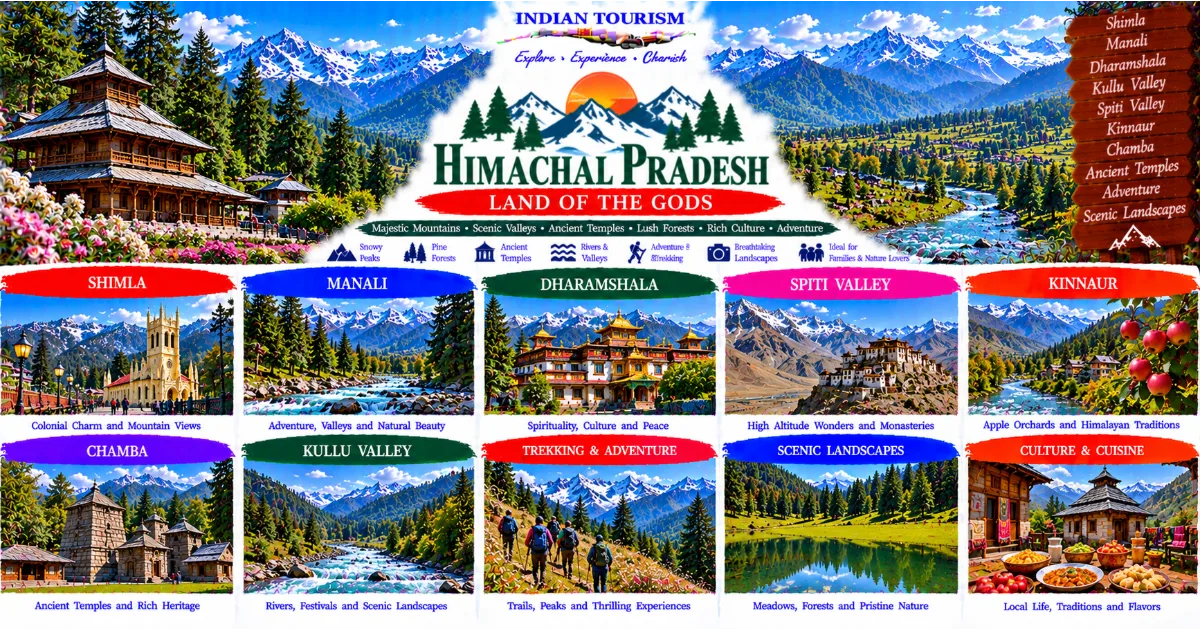
Welcome to the Land of the Gods
Himachal Pradesh is one of India's most captivating travel destinations, a Himalayan state where snow-covered mountains rise above green valleys, rivers carve their way through deep gorges, ancient temples preserve centuries of devotion, and small mountain villages continue to follow traditions shaped by their natural surroundings. Located in northern India, Himachal Pradesh attracts travellers looking for peaceful holidays, adventurous experiences, spiritual journeys, cultural exploration, romantic escapes and opportunities to experience the extraordinary beauty of the Himalayas. From the popular hill stations of Shimla and Manali to the remote landscapes of Spiti Valley, every region offers a distinct atmosphere, making the state far more diverse than its reputation as a winter and summer holiday destination might suggest.
The name Himachal is derived from Sanskrit words associated with snow and mountains, an appropriate description for a state whose identity is inseparable from the Himalayan landscape. Its geography ranges from relatively warm foothills near the plains of northern India to high-altitude deserts and mountain passes where winter conditions can be severe. This dramatic variation influences everything from local architecture and clothing to agriculture, festivals, cuisine and travel experiences. A journey through Himachal Pradesh can take visitors from pine-covered hills and colonial-era promenades to apple orchards, alpine meadows, Buddhist monasteries, glacial rivers and isolated settlements surrounded by barren mountains.
The state is also known as Dev Bhoomi, or the Land of the Gods, because of its rich religious heritage and the importance of local deities in community life. Hindu temples dedicated to Shiva, Vishnu, Durga and other deities stand alongside Buddhist monasteries that preserve centuries-old spiritual traditions. Sacred lakes, mountain shrines, pilgrimage routes and village temples are woven into the cultural landscape. Yet Himachal Pradesh is not defined by religion alone. Its traditional crafts, folk music, dance forms, seasonal fairs, farming practices and regional cuisines reveal the resourcefulness of communities that have adapted to challenging mountain environments over generations.
For travellers, the greatest attraction of Himachal Pradesh lies in the variety of experiences available within one state. Visitors can enjoy leisurely walks through historic towns, hike to remote villages, explore high mountain deserts, discover centuries-old architecture, taste traditional dishes, observe local festivals or simply spend a few days surrounded by forests and mountain views. Whether the journey lasts a weekend or several weeks, the state offers numerous ways to create a meaningful travel experience.
Understanding Himachal Pradesh and Its Geographic Diversity
Himachal Pradesh is bordered by Jammu and Kashmir and Ladakh to the north, Punjab to the west, Haryana to the southwest, Uttarakhand to the southeast and Tibet, an autonomous region of China, to the east. Its location places it within a major Himalayan transition zone where geography, climate and culture change significantly across relatively short distances. The state capital is Shimla, while Dharamshala serves as the winter capital of the state government.
The landscape can broadly be understood through its foothills, lower and middle Himalayan ranges, and higher mountain regions. The lower areas have a comparatively mild climate and support a mixture of agriculture, forests and settlements connected to the northern plains. As the elevation increases, the scenery changes to pine forests, oak woodlands, terraced fields, apple-growing regions and popular hill stations. Higher still, visitors encounter glaciers, alpine meadows, snow-covered passes and landscapes shaped by colder and drier conditions.
The districts of Kangra, Kullu, Mandi, Shimla, Kinnaur, Chamba, Lahaul and Spiti, Solan, Sirmaur, Bilaspur, Hamirpur and Una contribute to the state's geographical and cultural variety. Each district has its own attractions, local traditions and travel possibilities. Kangra is associated with its valley, tea gardens, temples and Buddhist heritage. Kullu is known for its mountain scenery, traditional settlements and access to high-altitude routes. Shimla combines colonial history with modern urban life, while Kinnaur introduces travellers to a landscape where Himalayan Hindu traditions and Tibetan cultural influences meet. Lahaul and Spiti offer some of the most striking high-altitude scenery in the region.
This geographical diversity means that choosing a destination should involve more than identifying the most famous hill station. A family seeking comfortable sightseeing may prefer a well-connected town with established accommodation. A trekker might be more interested in a mountain valley or a village that serves as the starting point for a walking route. Travellers interested in architecture and religious history may want to explore temple towns and monasteries. Those looking for solitude may prefer quieter destinations, although remote travel requires additional planning and respect for local conditions.
Shimla: Colonial Heritage and Himalayan Charm
Shimla is one of India's best-known hill stations and has a distinctive history connected with the British colonial period. It served as the summer capital of British India, when officials travelled to the mountains to escape the heat of the plains. The legacy of that era remains visible in its historic buildings, churches, railway heritage, promenades and carefully preserved architectural landmarks.
The Ridge is among Shimla's most recognisable public spaces. It offers broad views of surrounding mountains and provides a setting for community gatherings, cultural events and seasonal celebrations. Nearby, Mall Road is known for its shops, cafés, restaurants and walking areas. Visitors can explore the town at a relaxed pace, pausing to admire historic façades, enjoy local food or watch the changing light across the hills.
Christ Church, with its prominent position near the Ridge, is one of the most recognisable landmarks in the town. The Viceregal Lodge, now associated with the Indian Institute of Advanced Study, offers insight into the political history of the colonial period. The Kalka-Shimla Railway is another major attraction. Its mountain route, bridges, tunnels and narrow-gauge trains demonstrate the engineering effort required to connect the plains with the Himalayan hill station.
Shimla is suitable for families, couples, history enthusiasts and travellers who prefer a combination of sightseeing and comfortable accommodation. The surrounding region also provides opportunities to explore forested areas, orchards and smaller settlements. Kufri is a popular excursion destination, particularly among visitors interested in mountain views and seasonal snow experiences. However, weather conditions and crowd levels can change considerably during holidays, so advance planning is useful.
The town's popularity also brings challenges. Traffic congestion, pressure on water resources, construction and the impact of large tourist crowds can affect the experience. Travellers can help reduce their impact by using public transport where practical, avoiding littering, respecting local neighbourhoods and choosing accommodation that follows responsible water and waste practices.
Manali and the Beauty of the Kullu Valley
Manali is another major gateway to Himachal Pradesh's mountain landscape. Located in the Kullu Valley, it combines riverside scenery, forested slopes, traditional settlements and access to high-altitude destinations. The town appeals to honeymooners, families, adventure travellers and visitors who want to experience the mountains without giving up access to established tourist facilities.
Old Manali has a different character from the busier commercial areas. Its narrow lanes, cafés, guesthouses and traditional buildings attract travellers who enjoy walking and exploring local neighbourhoods. The nearby Hadimba Devi Temple stands within a forested setting and is known for its distinctive wooden architecture. The temple reflects the region's religious traditions and demonstrates how sacred structures can be closely connected to their natural surroundings.
The Manu Temple, the Vashisht area and the banks of the Beas River provide further opportunities for sightseeing. Travellers interested in local culture can explore markets, sample regional dishes and observe traditional architecture. The surrounding mountains offer routes for hiking, cycling and other outdoor activities, although the suitability of individual activities depends on weather, season and the availability of qualified local operators.
Solang Valley is widely associated with adventure tourism and seasonal recreational activities. Snow and ice conditions influence what is possible at different times of the year. The road towards Rohtang Pass and the wider Lahaul region also attracts visitors, but high mountain access is controlled by weather, road conditions and applicable permits or transport arrangements. Travellers should never assume that a high-altitude route will be open simply because it appears on a map or in an old itinerary.
Manali is particularly attractive during the warmer months, when many visitors seek relief from the heat of the plains. Winter brings snow to surrounding areas and creates a different mountain atmosphere, but cold temperatures, icy roads and weather disruptions require preparation. Anyone planning trekking, skiing or high-altitude excursions should use appropriate equipment and follow professional guidance.
Dharamshala and McLeod Ganj: Spirituality, Culture and Mountain Views
Dharamshala, situated in the Kangra district, is known for its mountain scenery, Tibetan cultural heritage and association with the Tibetan spiritual community. The nearby settlement of McLeod Ganj has become an internationally recognised destination for travellers interested in Buddhism, meditation, Tibetan history, cultural exchange and mountain walks.
The presence of the Dalai Lama and the Tibetan community has contributed to the area's distinctive cultural identity. Visitors can learn about Tibetan traditions through monasteries, cultural institutions, handicraft shops, museums and local food. The Tsuglagkhang Complex is an important spiritual centre, while the Namgyal Monastery is associated with Tibetan Buddhist practice and learning. Visitors should remember that these are living religious spaces rather than ordinary tourist attractions. Quiet behaviour, respectful clothing and attention to photography rules help maintain their sanctity.
McLeod Ganj also provides access to hiking routes and viewpoints around the Dhauladhar mountain range. Triund is a well-known trekking destination that rewards suitable visitors with broad views of the mountains and surrounding valleys. However, the route should not be treated as a casual walk in every season. Weather can change quickly, and hikers need suitable footwear, drinking water, warm clothing and reliable information about trail conditions.
Dharamshala offers a slower experience than some of the state's busiest tourist centres. Travellers can spend time in cafés, attend permitted cultural activities, explore local markets or simply observe the changing clouds over the mountains. The region is also known for cricket, with the Himachal Pradesh Cricket Association Stadium set against a striking mountain backdrop.
Visitors should plan their trip with cultural sensitivity. Tibetan communities have complex histories and ongoing political circumstances, so conversations about their heritage deserve care and respect. Buying locally made crafts, supporting responsible businesses and learning about the community through reputable cultural institutions can help make a visit more meaningful.
Spiti Valley: A High-Altitude World of Monasteries and Stark Landscapes
Spiti Valley presents a striking contrast to the greener hill stations of Himachal Pradesh. Located in the high-altitude region of Lahaul and Spiti district, it is characterised by barren mountains, deep river valleys, small settlements and Buddhist monasteries that appear almost inseparable from the landscape. The region receives relatively little precipitation compared with many other Himalayan areas, creating a terrain that resembles a cold desert.
The valley attracts travellers seeking dramatic scenery, cultural exploration, photography and remote journeys. Its settlements, including Kaza and nearby villages, provide access to monasteries, ancient religious art, traditional homes and panoramic mountain viewpoints. Key Monastery is one of the region's most recognisable landmarks. Situated above the Spiti River, it has served as an important centre of Tibetan Buddhist learning and religious life. Tabo Monastery is another significant site, known for its historical importance and artistic heritage.
Villages such as Langza, Hikkim and Komic are frequently included in travel itineraries because of their high-altitude settings, traditional architecture and distinctive surroundings. Their appeal is not simply their elevation. They offer a glimpse into communities that have developed ways of living in a region where winters are harsh, agricultural seasons are short and essential supplies can be difficult to transport.
Travelling in Spiti requires more preparation than visiting an established hill station. Roads may be rough, mobile connectivity can be limited, and distances between services can be substantial. High altitude may cause headaches, nausea, dizziness, unusual fatigue or breathlessness. Visitors should allow time to acclimatise, avoid rushing to higher elevations, remain hydrated and seek medical advice before travel if they have health concerns. Severe symptoms require prompt attention and descent where appropriate.
Seasonal access is another important consideration. Road conditions, snow, landslides and local advisories can affect travel plans. It is essential to check current conditions before departure rather than relying exclusively on old travel blogs or fixed itineraries. Visitors should also minimise waste, conserve water and respect monastery rules, village customs and restrictions around fragile landscapes.
Kinnaur: Apple Orchards, Sacred Landscapes and Himalayan Traditions
Kinnaur is one of Himachal Pradesh's most distinctive regions, combining dramatic mountain scenery with agricultural settlements and a rich cultural heritage. Located in the eastern part of the state, it includes deep valleys, river landscapes, forested slopes and high mountain terrain. Its position near the Tibetan cultural region has influenced architecture, religious practices, traditional art and everyday life.
The district is especially known for its apple orchards. In suitable seasons, the landscape around villages becomes a patchwork of cultivated slopes, fruit trees and mountain backdrops. Agriculture remains an important part of local life, and visitors may gain a better understanding of the region by observing how farming, seasonal labour and transport shape the rhythm of village communities.
Kalpa is a popular destination for mountain views, especially of the Kinner Kailash range. Its setting makes it attractive to photographers and travellers who prefer a peaceful mountain environment. Sangla Valley, with its villages, river scenery and traditional wooden architecture, offers another perspective on Kinnaur. Chitkul, often described as one of the last inhabited villages near the Indo-Tibetan border in this region, draws visitors for its remote setting and striking landscapes. Access conditions and restrictions can change, so travellers should confirm current rules before visiting.
The region also contains important religious sites and local sacred landscapes. Kinnaur's traditions are not uniform across every village, and customs may differ from one community to another. Visitors should approach temples and village shrines respectfully, follow local instructions and ask before photographing people or private property.
Kinnaur is especially rewarding for travellers who enjoy slow journeys. Rather than treating each village as a quick photo stop, visitors can spend time learning about local architecture, food, crafts and farming. Buying local products where available and choosing community-based accommodation can support livelihoods while helping travellers connect more closely with the region.
Chamba and the Heritage of the Western Himalayas
Chamba offers a different dimension of Himachal Pradesh's tourism landscape through its historic temples, traditional arts, mountain scenery and long cultural history. Situated in the western part of the state, the town and its surrounding region preserve architectural and artistic traditions that distinguish them from the more commercially developed hill stations.
The Lakshmi Narayan Temple complex is among Chamba's most important heritage landmarks. Its temples demonstrate the significance of religious architecture in the development of the town. The Bhuri Singh Museum provides opportunities to learn about regional history, art and cultural traditions. Chamba is also associated with its distinctive embroidered handkerchiefs, known as Chamba rumal, an art form recognised for its detailed needlework and visual storytelling.
The wider district includes mountain settlements, forested areas and routes towards scenic valleys. Dalhousie, located in the same district, has its own colonial-era character and is known for its views, walking routes and access to the surrounding hills. Khajjiar is another popular destination, celebrated for its meadow, forest setting and mountain atmosphere. Its popularity can result in crowded conditions during peak holiday periods, so travellers seeking quiet surroundings may prefer early mornings or less busy travel dates.
Chamba is a valuable destination for people who want to understand Himachal Pradesh beyond its best-known adventure centres. Its heritage sites, crafts and religious traditions provide a connection to the cultural history of the western Himalayas. A thoughtful visit involves spending time in the town, exploring its historic core and learning about the communities responsible for maintaining its traditions.
Mandi: Temples, Rivers and Cultural Connections
Mandi is often described as an important cultural and religious centre of Himachal Pradesh. Its historic temples, river setting and traditional markets give it a distinctive place in the state's heritage. Unlike destinations whose identities are primarily shaped by mountain sports or resort tourism, Mandi offers visitors a closer look at the relationship between religious institutions, local communities and regional trade.
The town is associated with numerous temples, including the Bhootnath Temple, which plays an important role in local religious life. Mandi's architecture and sacred sites reveal the influence of regional traditions that developed over centuries. The town is particularly notable during major religious festivals, when processions, rituals and community gatherings bring its cultural landscape to life.
Mandi can also serve as a practical base for exploring surrounding areas. The district includes reservoirs, forested slopes, smaller settlements and routes leading towards other parts of Himachal Pradesh. Rewalsar, a sacred lake associated with Hindu, Buddhist and Sikh traditions, is one of the region's important pilgrimage destinations. Its religious diversity offers a reminder that the Himalayas have long been a meeting point for different spiritual traditions.
Travellers interested in local culture should explore Mandi at a measured pace. Visiting temples, walking through markets and sampling regional food can provide a richer experience than rushing through the town on the way to another destination. As with other religious sites, visitors should respect worshippers, observe photography restrictions and follow local guidance.
Kullu Valley: Festivals, Forests and Traditional Life
The Kullu Valley is renowned for its natural beauty, agricultural landscapes and strong cultural identity. The Beas River flows through the valley, while forested slopes and surrounding mountains provide a dramatic setting for villages, temples and orchards. The region has long been an important centre of settlement and trade, and its traditions remain visible in festivals, handicrafts, clothing and local architecture.
Kullu Dussehra is one of the region's most distinctive cultural events. Unlike the celebrations commonly associated with the conclusion of Dussehra elsewhere in India, the Kullu festival follows its own traditions and brings together local deities, processions, music and community gatherings. The event attracts visitors who want to witness the cultural life of the valley, but travellers should remember that it is a religious and community occasion, not merely a performance organised for tourists.
The valley also offers opportunities to explore traditional villages and local crafts. Kullu shawls are among its best-known products, and visitors can learn about weaving and purchase locally made textiles from established shops or artisans. Responsible purchasing helps preserve traditional skills and can provide economic support to local producers.
Outdoor experiences range from riverside walks and sightseeing to trekking routes and visits to nearby mountain settlements. The suitability of particular activities depends on season, weather and the availability of trained guides. Travellers should avoid entering rivers during unsafe conditions and should use authorised operators for adventure activities.
Kullu's appeal comes from the balance between accessible tourism and cultural depth. Visitors can enjoy mountain scenery while also learning how communities celebrate festivals, maintain craft traditions and adapt to changing economic conditions. A respectful journey recognises the valley as a living region rather than simply a backdrop for photographs.
Temples, Monasteries and Sacred Journeys
Religious tourism is an important part of Himachal Pradesh's identity. The state's sacred geography includes major Hindu temples, village shrines, Buddhist monasteries, pilgrimage routes and lakes associated with religious traditions. These places attract devotees throughout the year and also interest travellers who want to understand the spiritual history of the Himalayas.
The Jwalamukhi Temple, Chintpurni Temple, Naina Devi Temple and Baijnath Temple are among the important Hindu pilgrimage destinations in the state. Each has its own religious significance, traditions and patterns of worship. During major festivals, pilgrimage sites can become extremely busy, making advance planning and patience essential.
Buddhist heritage is especially visible in regions such as Spiti, Lahaul and parts of Kangra. Monasteries preserve religious teachings, artistic traditions, manuscripts and community practices. Some institutions welcome visitors at designated times, while others may limit access during ceremonies or periods of religious activity. Travellers should follow posted rules and local instructions.
Sacred lakes and mountain routes also play a role in local beliefs. Rewalsar is important to several religious traditions, while other lakes and high-altitude sites are associated with local deities or pilgrimage practices. Their cultural significance may not always be obvious to visitors, which makes learning about local beliefs an important part of responsible travel.
A spiritual journey through Himachal Pradesh does not need to involve visiting the largest number of shrines. It can be more rewarding to spend time understanding one or two places, listening to local explanations and observing the relationship between faith and community life. Respectful conduct, modest clothing where appropriate and sensitivity around photography help ensure that tourism does not disrupt religious practice.
Adventure Tourism: Trekking, Camping and Mountain Exploration
Himachal Pradesh is one of India's major destinations for outdoor adventure. Its mountain ranges, forests, valleys and rivers provide settings for trekking, camping, mountain biking, skiing, paragliding and other activities. However, the state's dramatic terrain also creates risks, and visitors should choose activities according to their experience, physical condition and the prevailing weather.
Trekking routes vary greatly in difficulty. Some are relatively short walks near established hill stations, while others involve high passes, long days of walking, steep ascents and remote campsites. Treks in the Kullu region, around Dharamshala and in parts of the higher Himalayas attract different kinds of travellers. Before choosing a route, visitors should understand its elevation, distance, expected duration, water availability and emergency options.
Camping offers opportunities to experience mountain environments more closely, but it requires responsible planning. Campers should use permitted sites, avoid disturbing wildlife, carry waste back with them and prevent fires in vulnerable forest areas. Washing directly in streams with detergents or leaving food waste near campsites can damage the environment and attract animals.
Paragliding is associated with destinations such as Bir Billing, which has gained recognition among adventure enthusiasts. Anyone interested in flying should select a reputable operator that uses qualified pilots, suitable equipment and clear safety procedures. Weather conditions can change rapidly in mountain environments, and an activity should be postponed when conditions are unsuitable.
Winter sports and snow activities require particular care. Snow-covered slopes can conceal hazards, and avalanche risk may exist in some mountain areas. Travellers should follow official advisories, avoid restricted terrain and seek professional instruction when necessary. Photographs and social media videos should never be treated as reliable indicators of current safety conditions.
The best adventure holiday is not the one that involves the greatest number of activities. It is one that matches the traveller's abilities, respects the mountain environment and allows sufficient time for rest, acclimatisation and unexpected changes.
The Cuisine of Himachal Pradesh
Food is an essential part of the Himachal Pradesh travel experience. The state's cuisine reflects its agricultural traditions, climate, local ingredients and community practices. Recipes vary across districts and households, and dishes served in one valley may differ from those found in another.
Dham is among the most recognised traditional meals associated with Himachal Pradesh. It is commonly prepared for festivals, weddings and other special occasions, with menus varying by region and community. The meal may include rice, lentils, curd-based preparations and other dishes prepared according to local traditions. Its importance lies not only in its ingredients but also in the community practices surrounding its preparation and service.
Siddu is another well-known regional food, particularly associated with parts of the state where wheat-based preparations are common. It is a steamed bread that may be served with ghee, chutney or other accompaniments. Babru, a stuffed bread preparation, is also popular in certain areas. Chha Gosht, a meat dish prepared with regional spices and a yoghurt-based gravy, is associated with the culinary traditions of the state.
Mountain regions also offer simple meals based on locally available ingredients. Rice, wheat, lentils, seasonal vegetables, dairy products and preserved foods play important roles in many households. In higher and colder areas, food traditions are shaped by the need to make the most of short growing seasons and limited access to fresh produce during winter.
Travellers should be open to regional variations rather than expecting every dish to taste the same across the state. Local eateries can provide a useful introduction to everyday food, while traditional meals at homestays may offer a more personal insight into regional cooking. Visitors with allergies or dietary requirements should communicate them clearly, especially in smaller establishments where ingredients and preparation methods may differ from those in large restaurants.
Festivals, Folk Music and Local Traditions
Himachal Pradesh's cultural calendar includes religious fairs, harvest celebrations, seasonal festivals, temple gatherings and community events. These occasions provide opportunities to observe traditional dress, music, dance, local crafts and the role of regional deities in community life.
Kullu Dussehra is one of the most prominent festivals, but many other local celebrations are important to individual districts and villages. Seasonal fairs often bring together people from surrounding settlements and may include markets, performances, religious processions and traditional food. Their character can vary substantially from one place to another.
Folk music and dance are closely linked to community celebrations. Traditional instruments, regional costumes and group performances preserve local identities while adapting to changing circumstances. In some areas, craft traditions such as weaving, embroidery, woodwork and metalwork continue to provide both cultural value and income.
Visitors should remember that not every festival is designed primarily for tourists. Some ceremonies may be private or governed by local rules. Asking permission before taking photographs, avoiding interference with processions and following the directions of organisers are simple ways to show respect. Purchasing crafts directly from artisans, where possible, can also support the continuation of traditional skills.
Cultural exploration becomes more rewarding when travellers make time to understand the meaning of what they see. A festival is not merely a colourful event, and a traditional costume is not simply a photographic subject. Both may carry stories about history, faith, community relationships and the continuity of local life.
Best Time to Visit Himachal Pradesh
The best time to visit Himachal Pradesh depends on the region, the purpose of the trip and the kind of weather a traveller prefers. Because elevation varies significantly, there is no single season that is ideal for every destination.
Spring, generally from March through April, brings changing temperatures, flowering trees and fresh greenery to many lower and middle mountain areas. It can be a pleasant time for sightseeing, cultural exploration and walks, although higher areas may still experience snow and cold conditions.
Summer, broadly from May through June, is a popular period for travellers escaping the heat of the plains. Shimla, Manali, Dharamshala and several other hill stations receive many visitors. This season is also important for certain trekking routes, but popular destinations can become crowded and accommodation prices may rise during school holidays.
The monsoon period, usually extending from July into September, brings rain to many parts of Himachal Pradesh. The landscape can become lush and dramatic, but heavy rainfall can also cause landslides, road closures, flash floods and travel disruptions. Travellers should monitor weather forecasts and official advisories, avoid unstable slopes and remain flexible with itineraries. The fact that a destination looks beautiful in photographs during the monsoon does not mean that every route is safe.
Autumn, particularly September and October when conditions are favourable, can offer clear mountain views, comfortable daytime temperatures and opportunities for photography. The exact experience varies according to elevation and rainfall. Some higher-altitude routes become increasingly difficult as temperatures fall.
Winter, from December through February in many regions, attracts visitors interested in snow and winter landscapes. Shimla, Manali and certain other destinations may experience snowfall, although snow is never guaranteed on a particular travel date. Higher regions can face severe cold, road closures and limited services. Spiti and other remote areas require especially careful winter planning.
Before booking, travellers should identify their preferred activities, check current road and weather conditions, and confirm the availability of accommodation and transport. Seasonal planning is particularly important for high-altitude journeys.
How to Plan a Himachal Pradesh Trip
A successful trip to Himachal Pradesh begins with realistic expectations about travel time. Mountain roads are often winding, and a journey that appears short on a map can take several hours. Weather, traffic, roadworks and local restrictions may affect arrival times. It is better to plan fewer destinations and explore them properly than to spend the entire holiday moving between towns.
For a first visit, travellers may choose a single region such as Shimla and its surroundings, the Kullu Valley, or Dharamshala and Kangra. This approach reduces long transfers and provides more time for sightseeing, local food and rest. Visitors with a longer holiday can combine several regions, provided they allow sufficient time for travel and seasonal uncertainties.
Transport options include road journeys, buses, taxis and the railway connections serving selected parts of the state. The Kalka-Shimla Railway offers a distinctive way to reach Shimla, while road transport connects most major tourist centres. Remote destinations may have limited services, so travellers should arrange transport in advance and confirm the practical details with local providers.
Accommodation ranges from hotels and resorts to guesthouses, hostels and homestays. The best choice depends on budget, location, accessibility and the desired experience. A homestay can provide insight into local life, while a centrally located hotel may be more convenient for short sightseeing trips. During peak periods and major festivals, advance reservations are advisable.
Packing should reflect the destination and season. Even during warmer months, mountain evenings can be cold. Layered clothing, comfortable walking shoes, rain protection, sun protection and any required medication are useful for many trips. High-altitude destinations may require additional equipment and careful acclimatisation.
Travellers should keep identification documents accessible, understand local transport arrangements and maintain some flexibility in their schedules. Mobile connectivity varies across the state, particularly in remote valleys. Downloading essential travel information for offline use and informing someone about plans for remote excursions can improve preparedness.
Responsible Tourism and Protecting the Himalayas
Himachal Pradesh's natural beauty is also a fragile environmental resource. Mountain ecosystems are sensitive to changes in land use, waste disposal, water consumption and visitor pressure. Responsible tourism is essential if future generations are to enjoy the forests, rivers, villages and high-altitude landscapes that make the state special.
Waste management is one of the simplest areas where travellers can make a difference. Plastic bottles, food wrappers and disposable packaging can accumulate at viewpoints, trekking routes and roadside stops. Visitors should carry reusable water bottles where safe drinking water is available, use designated waste facilities and take rubbish away from remote areas when necessary.
Water conservation is particularly important in mountain towns that experience seasonal shortages. Travellers can reduce unnecessary water use, choose accommodation with responsible practices and avoid treating rivers and streams as places for washing with chemical products. Clean water is essential to local communities, agriculture and wildlife.
Responsible travel also involves respecting local residents. Visitors should avoid entering private property without permission, photographing people without consent or creating noise near homes and religious sites. Purchasing local products and using local guides can support livelihoods, especially in smaller settlements where tourism provides an important source of income.
Wildlife should be observed from a safe distance. Feeding animals, disturbing birds, damaging vegetation and leaving food waste in forests can have harmful consequences. Visitors should follow rules in protected areas and avoid activities that place animals or people at risk.
The Himalayas are not an unlimited playground. They are home to communities, wildlife and ecosystems that depend on careful management. Travelling thoughtfully helps preserve the very qualities that draw people to Himachal Pradesh.
Who Should Visit Himachal Pradesh?
Himachal Pradesh offers something for many different kinds of travellers. Families can enjoy accessible hill stations, scenic drives, gardens, heritage attractions and relaxed sightseeing. Couples may prefer quiet mountain accommodation, forest walks, riverside views and romantic settings in destinations such as Manali, Shimla and selected valley villages.
Adventure enthusiasts can explore trekking routes, mountain biking, paragliding and seasonal snow activities, provided they choose suitable operators and follow safety guidance. History enthusiasts can explore colonial architecture, temples, museums and traditional settlements. Religious travellers can plan pilgrimages to major Hindu shrines and Buddhist monasteries, while cultural travellers can discover regional food, crafts, music and festivals.
Photographers are drawn to the contrast between green valleys, snow-covered peaks, wooden villages, monasteries and high-altitude deserts. Nature lovers may prefer forest walks, birdwatching and less crowded destinations where local regulations permit such activities. Travellers who enjoy slow holidays can spend several days in one valley, getting to know its markets, walking routes and community life.
The state also rewards people who travel without a rigid checklist. A conversation with a local shopkeeper, a traditional meal in a small restaurant, an unexpected view from a mountain road or a visit to a village temple may become more memorable than a hurried stop at a famous viewpoint.
Conclusion: A Journey Through the Many Faces of Himachal Pradesh
Himachal Pradesh is much more than a collection of popular hill stations. It is a region of remarkable contrasts, where colonial heritage coexists with ancient temples, Buddhist monasteries stand above high-altitude valleys, apple orchards flourish on mountain slopes and traditional villages preserve customs shaped by centuries of life in the Himalayas. Its forests, rivers, snow-covered peaks and remote deserts offer extraordinary natural diversity, while its festivals, cuisine, crafts and religious traditions reveal the richness of its cultural heritage.
A journey through the state can be peaceful or adventurous, deeply spiritual or focused on history, centred on family holidays or built around long mountain treks. The experience depends on the places chosen, the season of travel and the time devoted to understanding each destination. Rather than trying to see everything in a single trip, travellers can explore one region at a time and discover how dramatically the landscape and culture change from one valley to another.
Planning responsibly is essential. Mountain weather can be unpredictable, road conditions can change, and remote destinations require preparation. Respect for local communities and careful attention to the environment help ensure that tourism remains beneficial to both visitors and residents.
For anyone wishing to discover the Himalayan side of India, Himachal Pradesh offers a journey filled with natural beauty, cultural depth and opportunities for genuine exploration. From the historic streets of Shimla to the quiet villages of Kinnaur, from the spiritual atmosphere of Dharamshala to the stark beauty of Spiti Valley, every region tells a different story about life in the mountains.
This article introduces the state as the starting point for our Himachal Pradesh tourism series. In the posts that follow, we will explore its destinations individually, examining their attractions, history, local culture, best visiting seasons, travel experiences and practical planning considerations. Together, these guides will help travellers build a more informed and rewarding journey through the Land of the Gods.
#HimachalPradesh #HimachalTourism #ExploreHimachal #IndianTourism #IncredibleIndia #Himalayas #Shimla #Manali #Dharamshala #SpitiValley #Kinnaur #KulluValley #Chamba #MountainTravel #ResponsibleTourism
