
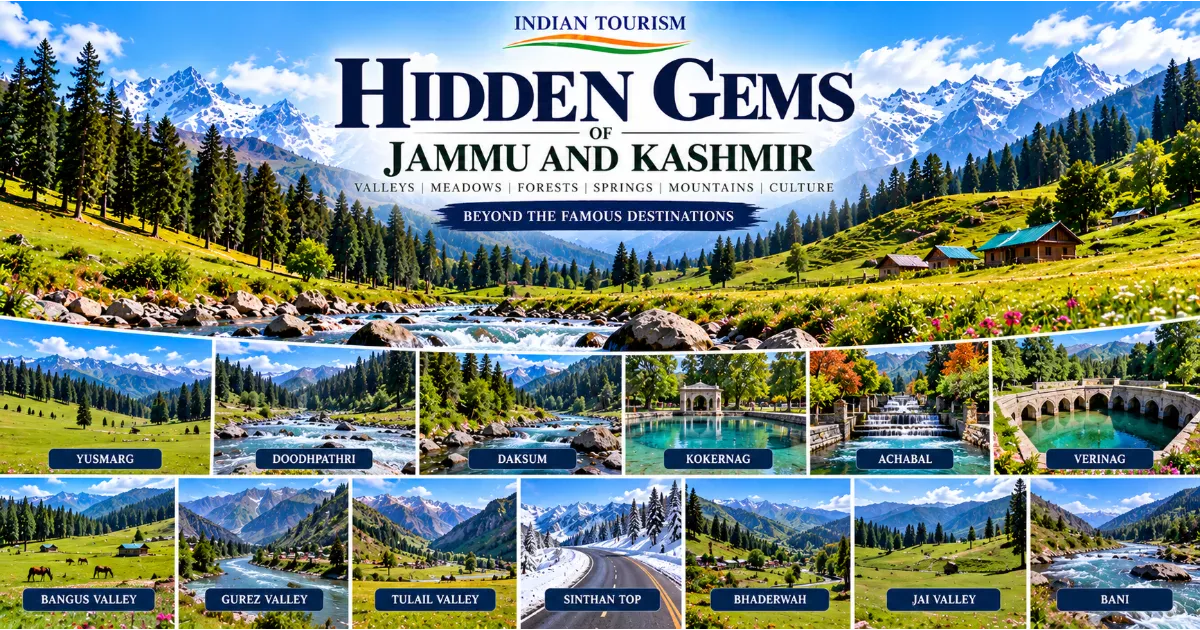
A Different Side of Jammu and Kashmir
Jammu and Kashmir is famous for its spectacular mountains, shimmering lakes, snow-covered peaks and beautiful valleys. Destinations such as Srinagar, Gulmarg, Pahalgam, Sonamarg and Vaishno Devi attract travellers from across India and around the world. Yet beyond these well-known places lies another side of the region, one filled with peaceful meadows, forest-covered hills, clear streams, traditional villages and landscapes that often receive less attention in mainstream travel itineraries.
These lesser-known destinations offer a different way to experience the region. Instead of spending most of a holiday in crowded tourist centres, visitors can explore quiet valleys, discover rural traditions, walk through green pastures and experience the slower rhythm of mountain life. Some places are ideal for gentle day trips, while others require more planning, longer drives or assistance from local guides.
Among the destinations worth discovering are Yusmarg, Doodhpathri, Daksum, Kokernag, Achabal, Verinag, Bangus Valley, Gurez Valley, Bhaderwah, Bani and the scenic surroundings of Sinthan Top. Each has its own character. Some are known for open meadows and forests, others for springs, rivers, mountain passes or distinctive cultural landscapes.
The phrase "hidden gem" should not suggest that these places are unknown to local residents. Many have long been part of the lives, livelihoods and traditions of the communities who live nearby. They may be less familiar to visitors arriving on standard tourist circuits, but they are important places in their own right.
Exploring them responsibly requires a little more preparation than visiting a major tourist centre. Public transport may be limited in some areas, accommodation options can be fewer, mobile connectivity may vary, and road conditions can change with the weather. Certain valleys and high-altitude destinations may also be subject to security arrangements or access restrictions. Visitors should always check current official guidance before travelling.
This guide explores some of the most appealing lesser-known destinations across Jammu and Kashmir, explaining what makes each place special, how travellers can plan a visit and why protecting these landscapes matters. Whether you prefer peaceful meadows, forest walks, traditional villages or scenic mountain drives, these destinations reveal the remarkable diversity of the region.
1. Yusmarg: A Peaceful Meadow Surrounded by Mountains
Yusmarg is one of the most appealing destinations for travellers seeking open landscapes and a quieter atmosphere in the Kashmir Valley. Located in the Budgam district, southwest of Srinagar, it is known for its broad meadows, surrounding forests and mountain views. The journey from Srinagar gradually leads visitors away from the busy city and towards a landscape characterised by green slopes, tree-lined roads and open pastureland.
The name Yusmarg is often associated with the meaning "meadow of Jesus" in popular accounts, although explanations of place names can vary and should be treated with care. Whatever its linguistic origin, the destination has developed a reputation as a peaceful natural retreat.
The meadow is especially attractive during the warmer months, when the grass becomes green and the surrounding slopes provide a beautiful backdrop. Visitors can walk across suitable open areas, enjoy a picnic where permitted or simply spend time observing the landscape. The wide views and relatively relaxed atmosphere make Yusmarg suitable for travellers who prefer nature over busy commercial attractions.
The surrounding forests add another dimension to the experience. Trees provide shade, while the changing light creates opportunities for photography. Visitors may also encounter horses and local service providers offering rides in designated areas. Such activities should be arranged through responsible local operators, with clear information about routes, prices and safety.
Yusmarg is not simply a place for photographs. It is also connected with rural livelihoods and the seasonal movement of people and livestock. Visitors should respect grazing areas, avoid disturbing animals and ask before photographing local residents.
The best time to visit is generally during the warmer months, when roads and outdoor conditions are more suitable for sightseeing. Spring and summer can bring attractive greenery, while autumn offers a different palette of colours. Winter conditions may affect access and facilities, so travellers should verify the current situation before setting out.
Yusmarg is a rewarding option for visitors who want a peaceful day trip from Srinagar. Those who wish to explore more extensively should check local guidance about walking routes, weather and the availability of facilities before venturing away from the main meadow.
2. Doodhpathri: The Valley of Milk
Doodhpathri, located in the Budgam district, is one of the Kashmir Valley's best-known emerging nature destinations. Its name is commonly translated as "Valley of Milk." Local stories associate the name with the appearance of the flowing water, which can look pale and foamy as it moves over stones in certain conditions. The exact origin of the name belongs to local tradition, but the association with flowing water has become part of the destination's identity.
Doodhpathri is known for its green meadows, gentle slopes, surrounding forests and streams. During the warmer months, the landscape can appear especially vivid, with open grassland framed by wooded hills. The combination of water, greenery and mountain scenery makes it attractive to families, photographers and travellers who want to spend time outdoors.
The journey towards Doodhpathri is an important part of the experience. The landscape gradually changes as the road leaves busier settlements and enters a more rural environment. Visitors should allow enough time for the journey and avoid assuming that the drive will be quick simply because the distance appears manageable.
At the destination, travellers can enjoy the scenery from accessible areas and take short walks where conditions permit. The stream and meadow environment is especially appealing for photography, but visitors should remain cautious near water. Stones can be slippery, water levels can change and apparently shallow sections may still be unsafe.
Doodhpathri has become more popular in recent years, and visitor numbers can increase during holidays. Facilities and access arrangements may change as tourism develops. Before travelling, confirm the current road conditions, parking arrangements, local transport rules and any restrictions on activities.
Visitors should also remember that the meadows and streams form part of a wider natural environment. Avoid leaving plastic waste, disturbing grazing animals or damaging vegetation. If using a local horse-riding service, agree on the route and fare before starting.
Doodhpathri is ideal for travellers who want to enjoy the natural scenery of Kashmir without following exactly the same itinerary as every first-time visitor. It offers a beautiful reminder that some of the region's greatest attractions are its open spaces, quiet watercourses and changing mountain light.
3. Daksum: Forests, Streams and Mountain Serenity
Daksum is a scenic destination in the Anantnag district of Kashmir, situated along a mountain route associated with the journey towards the Sinthan region. It is known for its forests, fresh mountain air, streams and green surroundings. Compared with the busiest tourist centres, Daksum often offers a quieter experience focused on the natural environment.
The landscape is shaped by wooded slopes and mountain streams. The sound of flowing water, the shade of the trees and the relatively peaceful setting make it appealing to travellers who enjoy slow exploration. Rather than rushing between attractions, visitors can spend time appreciating the forest, taking photographs and enjoying the mountain atmosphere.
Daksum is also relevant to travellers interested in the wider geography of southern Kashmir. The surrounding region connects valleys, settlements and mountain routes, creating a landscape that changes with elevation and season. The vegetation, weather and views can differ considerably between lower forested areas and higher roads.
The destination can be particularly attractive during spring and summer, when greenery is prominent and outdoor conditions may be more comfortable. Autumn offers a different visual experience, while colder months can bring difficult road conditions in higher areas.
Visitors should not assume that every forest path is a formal tourist trail. Ask locally which routes are accessible and whether a guide is advisable. Travellers should stay on suitable paths, avoid entering unfamiliar woodland alone and carry enough water and appropriate clothing.
Because Daksum is a forested mountain destination, weather and road conditions deserve particular attention. Rain can make surfaces slippery, and fog may reduce visibility. Before undertaking a longer drive towards higher elevations, check current local advice and ensure that the return journey can be completed safely.
Daksum is a good choice for visitors who value quiet scenery and natural surroundings more than shopping, nightlife or large visitor facilities. It offers a different perspective on Kashmir, one defined by forest, water and the peaceful rhythm of the mountains.
4. Kokernag: A Garden Town Known for Its Springs
Kokernag, in the Anantnag district, is known for its natural springs, gardens and green surroundings. It offers a combination of water features and landscaped spaces that make it distinct from destinations whose main attractions are high mountains or wide meadows.
The area is particularly associated with its spring water and the gardens developed around the site. The spring complex is a major local attraction and forms part of the region's broader heritage of water sources, orchards and garden landscapes. Water has long played an important role in settlement, agriculture and recreation across Kashmir, and Kokernag provides a useful example of that relationship.
Visitors can explore the accessible garden areas, enjoy the sound of flowing water and take photographs of the surrounding greenery. The atmosphere is often more structured than that of an open mountain meadow, with landscaped spaces providing a comfortable setting for families and visitors who prefer gentle sightseeing.
The destination can be visited as part of a wider journey through southern Kashmir, combined with places such as Achabal, Verinag or Daksum if travel time permits. Each destination offers a different landscape, so a multi-stop itinerary can provide a more complete picture of the region.
The best experience depends on the season and the current condition of the gardens. Spring and summer can bring abundant greenery, while autumn may offer different colours and a quieter atmosphere. Travellers should check current opening arrangements and local conditions before planning a visit.
Visitors should respect the gardens, use designated paths and avoid littering near water sources. Natural springs and managed gardens are valuable environmental and community resources, not simply tourist backdrops.
Kokernag is an excellent option for travellers who enjoy gardens, springs and relaxed outdoor experiences. It demonstrates that Kashmir's natural beauty is not limited to dramatic mountain peaks. Water, plants and carefully maintained landscapes can be equally memorable.
5. Achabal: A Historic Garden in the Kashmir Valley
Achabal is another important garden destination in southern Kashmir. Located in the Anantnag district, it is associated with a historic garden landscape that reflects the region's long tradition of garden design, water management and royal patronage.
The garden is known for its water channels, trees and landscaped setting. Water flows through the garden environment, creating a sense of order and tranquillity. The arrangement of greenery and water reflects a wider tradition of gardens in Kashmir, where landscape design has often combined natural features with carefully planned spaces for relaxation and reflection.
Achabal provides a useful contrast to the open meadows of Yusmarg and Doodhpathri. Here, the visitor experience centres on a designed landscape rather than a broad natural pasture. Visitors can walk along permitted paths, appreciate the garden's layout and observe the relationship between water, plants and architecture.
The history of Kashmir's gardens is connected with different periods of regional and imperial influence. Gardens served as places of recreation, retreat and aesthetic expression. Their design often reflected an appreciation for symmetry, water movement, shade and views of the surrounding landscape.
Visitors interested in history and architecture may find Achabal particularly rewarding because it offers an opportunity to experience a historic landscape rather than only read about it. It also works well as part of a day exploring southern Kashmir's gardens and natural springs.
Before visiting, check the current opening arrangements, entry requirements and any restoration or maintenance work that may affect access. Respect the plants and water features, avoid walking in restricted areas and dispose of rubbish responsibly.
Achabal is especially suitable for travellers who enjoy combining nature with cultural heritage. It reveals another layer of Kashmir's identity, where landscape and design have been brought together over generations.
6. Verinag: The Source of the Jhelum and a Historic Garden
Verinag is a historically significant destination in the Anantnag district, best known for its spring and the surrounding garden complex. The spring is traditionally identified as the source of the Jhelum River, one of the most important rivers associated with Kashmir.
The water emerges from the ground into a carefully constructed basin surrounded by stonework and greenery. The setting combines a natural water source with a historic architectural environment, making Verinag both a scenic and culturally important place.
The Jhelum has played a major role in the history and geography of Kashmir. It has influenced settlement, agriculture, transport and the development of towns across the valley. Visiting Verinag offers an opportunity to connect the river's wider significance with its source landscape.
The garden surrounding the spring reflects a tradition of planned outdoor spaces in Kashmir. Visitors can explore the permitted areas, observe the water and appreciate the architectural details. The experience is generally more relaxed than a demanding mountain excursion, making it suitable for families and travellers interested in history.
Verinag can be included in a route through southern Kashmir, along with Achabal and Kokernag. Planning the order of visits around opening hours, driving times and weather can help make the day more comfortable.
Visitors should avoid entering restricted water areas or disturbing the spring environment. Water sources require protection, and responsible tourism includes keeping the site clean and respecting conservation measures.
Verinag demonstrates how a single natural feature can hold geographical, historical and cultural importance. It is not merely a place to take photographs. It offers a connection to the river system that has helped shape life across the Kashmir Valley.
7. Bangus Valley: A Vast Landscape in North Kashmir
Bangus Valley is one of the most striking natural landscapes associated with north Kashmir. Located in the Kupwara region, it is known for broad meadows, forested slopes and mountain scenery. The valley's open terrain creates a sense of scale that differs from the more developed tourist areas around Srinagar and Gulmarg.
The landscape is often described in terms of its extensive grasslands and surrounding forests. Depending on the season, visitors may encounter green pastures, flowering plants and views of the mountains beyond. The setting can appeal to travellers interested in nature, photography and rural landscapes.
Bangus is also an area where travel planning requires particular care. Access, road conditions, security arrangements and local permissions may vary. Visitors should not rely solely on old travel blogs or social media posts when deciding whether a trip is possible. Confirm the current situation with official local sources and follow any restrictions.
Because the valley is less developed for mass tourism than some well-known destinations, facilities may be limited. Travellers should arrange transport carefully, carry essential supplies and avoid assuming that food, fuel, accommodation or mobile connectivity will be available wherever needed.
A responsible visit should be planned with respect for local communities and the natural environment. The grasslands and forests support ecological processes and local livelihoods. Visitors should avoid leaving waste, disturbing livestock or entering restricted areas.
Bangus Valley may appeal most to experienced travellers who are comfortable with flexible schedules and who understand the additional preparation required for less-developed destinations. It can offer an extraordinary landscape, but the quality of the visit depends on current access and careful planning.
8. Gurez Valley: Remote Mountain Beauty and Cultural Heritage
Gurez Valley, in north Kashmir, is one of the region's most distinctive destinations. Surrounded by high mountains and shaped by the Kishanganga River, the valley offers dramatic scenery and a cultural character that differs from the central Kashmir tourist circuit.
The valley is associated with the Dardic heritage of the region, including the Dard-Shin communities and the Shina language. Local traditions, architecture, clothing, food and everyday life reflect a history shaped by geography and connections across mountain regions.
The landscape is among Gurez's greatest attractions. The river moves through a broad valley framed by steep slopes and distant peaks. Villages sit within the mountain environment, and the changing weather can transform the views from clear and bright to misty and dramatic.
Dawar is an important settlement and a common base for visitors exploring the valley. From there, travellers can learn about local life, enjoy the scenery and plan visits to suitable nearby areas according to current access conditions.
Gurez requires more planning than a short trip to a major tourist centre. The road journey can be lengthy, and access may be affected by weather, seasonal conditions or security arrangements. Visitors should check current official guidance before travelling and confirm whether any permits or other requirements apply to their specific route and date.
Accommodation and services may be more limited than in Srinagar. Travellers should arrange essential details in advance, including transport, food, overnight stays and communication plans. It is wise to carry necessary medication and avoid depending entirely on mobile connectivity.
The valley is especially rewarding for visitors who want to understand the relationship between mountain geography and local culture. Responsible tourism means respecting residents' privacy, asking permission before taking close-up photographs and supporting local businesses where possible.
Gurez is not a destination to approach casually or without preparation. When access is permitted and conditions are suitable, however, it can provide one of the most memorable experiences in the wider region.
9. Tulail Valley: A Quieter Extension of Gurez
Tulail Valley lies beyond the main Gurez area and is known for its remote mountain scenery, villages and river landscapes. It offers a quieter environment for travellers who want to understand the wider geography and culture of the region.
The valley contains small settlements surrounded by mountains and natural terrain. The scale of the landscape, the relatively sparse development and the presence of traditional village life give it a distinctive atmosphere.
Tulail's remoteness is part of its appeal, but it also creates practical challenges. Roads may be affected by weather, facilities can be limited and travel times may be longer than expected. Visitors should not assume that a destination is easy to reach simply because it appears close to another place on a map.
Access arrangements and security guidance should be checked carefully before planning a visit. Travellers should use reliable local information, confirm transport availability and avoid entering restricted areas.
Visitors who are able to travel there should approach the valley with respect for local life. Ask permission before photographing residents or private property, avoid disturbing agricultural activities and support local services when available.
Because facilities may be limited, a visit should be planned around practical needs rather than spontaneous assumptions. Carry essential medication, suitable clothing and enough supplies for the expected journey. Ensure that the return plan is realistic and that someone knows the intended itinerary.
Tulail is best suited to travellers who appreciate quiet landscapes and are prepared for a more demanding trip. It shows another side of Kashmir, where mountain communities and their surroundings remain central to the travel experience.
10. Sinthan Top: A Scenic Mountain Pass
Sinthan Top is a high mountain pass associated with the route between the Kashmir Valley and the Jammu region. It is known for sweeping views, winding mountain roads and a landscape that changes significantly with elevation.
The journey towards the pass can be a major part of the experience. Roads climb through forested slopes and open mountain terrain, offering different perspectives as travellers gain altitude. On clear days, the surrounding peaks and ridges can create impressive views.
Because Sinthan Top is at a high elevation, weather can be unpredictable. Conditions may change rapidly, and snow, rain, fog or strong winds can affect visibility and road safety. Travellers should check current road conditions before setting out and should not assume that the pass is accessible throughout the year.
The area can be particularly attractive to photographers, but it is important to remain in safe places when stopping. Narrow mountain roads may have limited parking, and vehicles should never be left where they obstruct traffic or emergency access.
Visitors should bring warm clothing even when the weather is pleasant at lower elevations. The temperature at the pass can be much colder than in nearby towns, and exposure can become uncomfortable quickly.
Sinthan Top can be combined with a wider journey through Daksum and surrounding areas when conditions and available time permit. However, travellers should avoid attempting a long mountain route late in the day or relying on an inflexible timetable.
The pass offers a powerful reminder of the scale and variety of the Himalayan landscape. It is best experienced with patience, careful preparation and respect for the conditions.
11. Bhaderwah: The Mini Kashmir of Jammu
Bhaderwah is a scenic town in the Doda district of the Jammu region. Often described as the "Mini Kashmir" of Jammu because of its green valleys, forests, meadows and mountain scenery, it offers a different kind of mountain holiday from the destinations commonly associated with the Kashmir Valley.
The surrounding landscape includes forested slopes, open grasslands, rivers and villages. The area is particularly attractive during warmer months, when greenery becomes prominent and outdoor conditions may be suitable for exploring the countryside.
Bhaderwah also has its own cultural identity. Local traditions, regional food, festivals and village life contribute to the experience. Visitors who spend time beyond the main commercial areas may gain a better understanding of how people live and work in the mountain environment.
The town can serve as a base for exploring nearby natural areas, although individual excursions require separate planning. Road conditions, weather and travel times should be checked before setting out. Some routes may involve winding mountain roads or limited facilities.
Bhaderwah is a useful destination for travellers who want to explore the Jammu region beyond Jammu city, Katra and Patnitop. It offers an opportunity to experience another set of landscapes and discover a place that is important to local residents as well as visitors.
As with other less-developed mountain destinations, responsible tourism is essential. Avoid littering, respect private land and seek local advice before entering unfamiliar areas. If participating in outdoor activities, use authorised providers and follow safety instructions.
Bhaderwah demonstrates that the Jammu region has a rich variety of natural attractions of its own. Its valleys and forests deserve recognition alongside the more widely publicised landscapes of Kashmir.
12. Jai Valley: Open Meadows Near Bhaderwah
Jai Valley is a scenic area associated with Bhaderwah and is known for its open meadows, surrounding hills and peaceful mountain environment. It is an appealing destination for visitors who want to experience the countryside and spend time outdoors.
The valley's open spaces create a contrast with the forests and built-up areas around nearby towns. Depending on the season, the landscape may feature green grasslands, wildflowers and mountain views. Visitors can enjoy photography, gentle walks and time in the open air where conditions permit.
Jai Valley is also connected with local pastoral and rural life. Visitors should remember that meadows may be used for grazing or other community activities. Respect designated areas and avoid disturbing livestock or damaging vegetation.
The best time to visit depends on the road conditions and the type of experience desired. Warmer months are often more suitable for green landscapes and outdoor exploration, while colder weather may limit access and facilities.
Travellers should confirm current transport arrangements and ask locally about suitable places to visit. Not every open area is a developed tourist site, and facilities may be limited. Carry essential supplies and plan the return journey before setting out.
Jai Valley is well suited to visitors who value a relaxed pace and natural scenery. It offers an opportunity to spend time away from crowded attractions and appreciate the quieter side of the Jammu mountains.
13. Bani: A Green Mountain Destination in the Jammu Region
Bani is a town and surrounding area in the Kathua district of Jammu and Kashmir. It is associated with green mountain scenery, forests, streams and rural landscapes. For travellers exploring the less familiar parts of the Jammu region, Bani can provide a different perspective from the more established hill stations.
The surrounding area includes varied terrain, with roads connecting settlements across mountain slopes and valleys. The landscape changes according to elevation and season, creating opportunities for scenic drives and nature-based travel.
Bani's appeal lies partly in its relative distance from the busiest tourist circuits. Visitors may find a more everyday atmosphere, with local markets, village life and landscapes that have not been developed exclusively around tourism.
Because facilities can be more limited than in major destinations, planning is important. Travellers should confirm accommodation, food options, transport and road conditions before departure. A private vehicle or a prearranged transport plan may be useful, depending on the itinerary.
Weather should also be considered. Rain can affect mountain roads, while colder months may bring conditions that require warm clothing and flexible travel plans.
Visitors should approach the area with respect for local communities. Buy from local businesses where practical, ask before photographing people and avoid leaving rubbish in natural spaces.
Bani offers an opportunity to explore the breadth of Jammu and Kashmir's geography. It is a reminder that the region contains many landscapes and communities beyond the destinations most often featured in travel advertisements.
14. The Historic Gardens of Kashmir's Countryside
While Srinagar is famous for its major Mughal gardens, the wider Kashmir Valley contains other garden landscapes that are worth exploring. Achabal, Kokernag and Verinag are especially interesting because they combine natural water sources, historic design and regional heritage.
These gardens offer a different kind of sightseeing from mountain treks and meadow walks. Visitors can explore landscaped spaces, observe the movement of water and appreciate the relationship between architecture and nature.
The tradition of gardens in Kashmir reflects the region's long history of landscape design. Water channels, terraces, trees and views have been used to create places for recreation and contemplation. These spaces also reveal how people have shaped natural environments to suit cultural and aesthetic purposes.
A garden-focused itinerary can be especially suitable for families, older visitors and travellers who prefer gentle walks. The distances within the sites are generally more manageable than a mountain hike, although accessibility varies and should be checked in advance.
Spring and summer often provide attractive greenery, while autumn may bring a different palette of colours. Visitors should confirm current opening hours and any restoration work that could affect access.
Responsible behaviour is important in these historic landscapes. Avoid stepping into restricted areas, damaging plants or leaving waste near water features. Gardens are part of the region's cultural heritage and require continued care.
Exploring these sites together can provide a deeper understanding of Kashmir's landscape traditions. They show how natural beauty and human design have influenced one another over centuries.
15. Village Life and Traditional Culture Across Jammu and Kashmir
Some of the most meaningful travel experiences in Jammu and Kashmir come from observing everyday life in villages and small towns. The region's culture is expressed not only through monuments and festivals but also through food, farming, handicrafts, language, architecture and family traditions.
Rural life varies considerably between the Kashmir Valley, the Jammu hills and more remote mountain regions. Climate, elevation, local history and available resources influence how communities build homes, cultivate land and organise daily routines.
In some areas, agriculture and horticulture are central to livelihoods. Orchards, fields and grazing land form part of the landscape, while seasonal work shapes the rhythm of community life. In other areas, trade, services, crafts and tourism provide important sources of income.
Visitors should approach local communities with curiosity and respect. Ask permission before entering private property or taking photographs of people. A village is not an open-air museum, and residents should not be expected to participate in a tourist's experience simply because visitors have arrived.
Local food can provide an introduction to regional culture. A conversation with a shopkeeper or host may reveal which dishes are commonly prepared at home, what ingredients are seasonal and how local customs differ from those in other parts of India.
Handicrafts and locally made products can also connect travellers with traditional skills. When buying an item, ask about its origin and method of production if this information matters to you. Supporting genuine local work can help sustain livelihoods, although visitors should avoid assuming that every product sold in a tourist area is handmade.
Cultural tourism is most rewarding when it is based on mutual respect. Listen more than you speak, avoid intrusive questions and recognise that local traditions are diverse and continue to evolve.
16. Seasonal Beauty: How These Hidden Gems Change Throughout the Year
The lesser-known destinations of Jammu and Kashmir look different in every season. Understanding these changes helps travellers choose places that match their interests and plan more safely.
Spring
Spring brings renewed greenery to many lower and middle-elevation areas. Gardens begin to flourish, meadows become more colourful and the landscape gradually changes after winter. Destinations such as Yusmarg, Doodhpathri, Achabal and Kokernag can be appealing during suitable spring conditions.
However, weather can still be unpredictable. Higher mountain routes may remain cold or inaccessible, and rain can affect travel times. Visitors should check the forecast before setting out.
Summer
Summer is often a convenient period for exploring many meadows and forest destinations. Green landscapes, longer daylight hours and relatively comfortable conditions in the hills can support outdoor activities.
This is also a popular travel season, so accommodation and transport may be in greater demand. Travellers should book important arrangements early and avoid assuming that less famous destinations will always be quiet.
Autumn
Autumn can bring attractive colours to forests, gardens and agricultural landscapes. The air may become cooler, and some destinations can feel more peaceful after the busiest summer period.
The season is suitable for photography and cultural sightseeing, although daylight becomes shorter and higher mountain areas can become cold. Visitors should plan the return journey accordingly.
Winter
Winter can transform the region, bringing cold weather and snowfall to some destinations. High-altitude locations such as Sinthan Top and parts of the Gurez region may face significant access challenges.
Visitors should not travel based solely on the expectation of snow. Road conditions, security arrangements and weather warnings must be checked carefully. Appropriate clothing, suitable vehicles and flexible schedules are essential.
The most suitable season depends on the destination and the purpose of the trip. A garden visit, a meadow walk and a high mountain drive have different requirements, so it is better to plan each location individually rather than assume that one season suits the entire region equally.
17. How to Plan a Hidden-Gems Trip Across Jammu and Kashmir
A trip covering several lesser-known destinations requires more preparation than a short visit to Srinagar or Gulmarg. The places are spread across different districts, and some are separated by mountain roads that take considerable time to travel.
Begin by choosing a small group of destinations that fit together geographically. For example, visitors exploring southern Kashmir may consider Achabal, Kokernag, Verinag and Daksum, subject to current conditions and the time available. Yusmarg and Doodhpathri can be considered for separate excursions from the Srinagar area.
Travellers interested in north Kashmir may investigate Gurez or Bangus, but these destinations require more careful checking of access and security arrangements. Do not assume that a route is open or that a permit is unnecessary simply because another traveller visited previously.
In the Jammu region, Bhaderwah, Jai Valley, Bani and Patnitop can be considered according to the starting point and available days. Distances and road conditions should be evaluated before committing to a multi-stop itinerary.
Accommodation should be arranged before entering areas where options are limited. Confirm whether meals are available, whether the property can be reached in the expected weather and whether the return transport plan is realistic.
Carry essential medication, suitable clothing, water and basic supplies. Mobile connectivity may vary, so save important details offline and inform someone about your itinerary when travelling to remote locations.
Use reliable local drivers or guides when appropriate. A knowledgeable local professional can help with route conditions, cultural context and practical arrangements, but visitors should still verify that services are authorised and suitable.
Most importantly, avoid trying to visit too many destinations in a short period. A relaxed itinerary allows time to appreciate the scenery and reduces the pressure to travel on unfamiliar mountain roads after dark.
18. Safety, Permissions and Responsible Travel
Safety planning is especially important when visiting destinations that are less developed for tourism. Roads may be narrow, facilities limited and weather unpredictable. Some areas may also have access restrictions or security-related requirements.
Before travelling, check official advisories and local information about road conditions, permits, opening arrangements and any restrictions that apply to the specific destination. This is particularly important for areas near sensitive borders or remote mountain regions.
Do not enter restricted areas, cross barriers or rely on unofficial assurances that a closed route is safe. If access is prohibited or conditions are considered unsafe, change the itinerary.
Mountain weather can change quickly. Carry clothing appropriate for rain and cold, even when conditions are pleasant at the start of the day. Avoid walking close to unstable edges, entering fast-flowing streams or attempting difficult routes without suitable experience.
For forest walks, use recognised paths and ask locally about trail conditions. In remote areas, do not depend entirely on mobile connectivity. Carry essential medication and ensure that the group understands the return route.
Responsible tourism also includes respect for local communities and the environment. Dispose of rubbish properly, avoid disturbing wildlife and do not damage vegetation. Ask before photographing residents, and be mindful of private land and agricultural activity.
When participating in adventure activities, use authorised operators and check safety equipment, instructions and weather conditions. If an activity seems poorly managed, it is better to decline than to accept unnecessary risks.
Good preparation does not reduce the sense of discovery. It allows visitors to explore with confidence while protecting themselves, local residents and the places they have come to enjoy.
19. Supporting Local Communities Through Tourism
Tourism can provide important opportunities for people living in rural and mountain areas. Visitors create demand for accommodation, transport, food, guiding, crafts and other services. When tourism is managed responsibly, some of this spending can support local livelihoods and encourage the preservation of cultural and natural heritage.
Travellers can contribute by choosing reliable local businesses where appropriate. Staying in locally operated accommodation, eating at community restaurants and hiring authorised local guides can help distribute tourism income beyond large commercial centres.
Buying regional products can also be meaningful, particularly when visitors understand their origin and the work involved in making them. Asking questions about a craft or food product can help distinguish locally produced goods from mass-produced souvenirs.
Respectful behaviour is equally important. Local residents should not have to tolerate litter, intrusive photography or disruption simply because their area attracts visitors. Travellers should follow local rules and remember that community life continues long after tourists leave.
It is also important to recognise that tourism brings challenges. Increased traffic, waste, pressure on water supplies and unplanned construction can damage the qualities that attract visitors. Responsible travel involves supporting businesses while also encouraging practices that protect the environment.
Visitors can help by reducing waste, respecting designated paths and choosing activities that fit the local setting. Where possible, ask service providers about environmental practices and support those who demonstrate care for the destination.
The long-term success of tourism depends on maintaining a fair relationship between visitors, businesses, communities and the natural environment. Hidden gems remain special when the people who live there benefit from tourism without losing control over their surroundings.
20. A Suggested Seven-Day Itinerary for Discovering Lesser-Known Destinations
A seven-day journey can introduce travellers to several different landscapes, but it should not attempt to cover every destination in this guide. The following outline is an example of how a trip might be organised, subject to current access, transport and weather conditions.
On the first day, arrive in Srinagar and settle into your accommodation. Use the day to rest, explore the city if time permits and confirm transport for the coming excursions.
On the second day, consider a visit to Yusmarg. Spend time in the meadows and enjoy a gentle walk where conditions permit. Return to Srinagar with enough daylight and time for the road journey.
On the third day, explore Doodhpathri, allowing time to enjoy the streams and surrounding greenery. Avoid rushing the visit, and check the weather before setting out.
On the fourth day, travel towards southern Kashmir and explore a selection of garden destinations such as Achabal, Kokernag and Verinag. The order should be chosen according to opening hours, road conditions and the available time. Depending on the itinerary, an overnight stay in the region may be more comfortable than returning to Srinagar late in the day.
On the fifth day, consider Daksum and the surrounding forest landscape if road conditions and travel time permit. Keep the schedule flexible, particularly if planning to continue towards higher elevations.
On the sixth day, choose between a further exploration of southern Kashmir or a different destination that can be reached safely within the time available. Do not attempt to add Gurez or Bangus without separately checking the substantial travel and access requirements.
On the seventh day, return to Srinagar or continue towards your next destination according to your confirmed transport arrangements.
This itinerary focuses on a limited part of the region. Travellers who want to explore Gurez, Tulail, Bhaderwah, Bani or other distant destinations should plan a separate trip rather than attempting to fit them into the same week.
The purpose of the itinerary is to demonstrate the value of grouping destinations by location. A slower journey can provide more meaningful experiences than a schedule dominated by long drives.
Conclusion: Discover the Quiet Beauty of Jammu and Kashmir
Jammu and Kashmir is far more diverse than any single travel photograph can show. Its famous lakes, snow-covered mountains and celebrated valleys are only part of the story. Across the region, lesser-known destinations reveal green meadows, forested hills, natural springs, historic gardens, remote valleys and communities whose traditions are closely connected with the land.
Yusmarg and Doodhpathri offer open landscapes and flowing water. Daksum brings visitors into a forested mountain environment, while Kokernag, Achabal and Verinag reveal the importance of springs, gardens and historic landscape design. Bangus, Gurez and Tulail offer striking mountain scenery but require careful preparation and current access checks. In the Jammu region, Bhaderwah, Jai Valley and Bani provide another perspective on the area's natural beauty.
These destinations are rewarding because they encourage visitors to slow down, explore thoughtfully and appreciate places beyond the standard tourist route. They also remind us that a destination's value is not measured by its popularity on social media. A quiet meadow, a village road or a historic spring can be just as memorable as a famous viewpoint.
Travel responsibly, respect local communities, check official guidance and allow enough time for mountain journeys. The best experiences often come when the itinerary leaves room for changing weather, unexpected discoveries and moments of quiet appreciation.
Jammu and Kashmir's hidden gems are not merely places to visit. They are landscapes and communities to understand, respect and help preserve.
Discover the lesser-known side of Jammu and Kashmir, where every valley has a story, every meadow offers a new perspective and every journey brings you closer to the region's remarkable natural and cultural heritage.
#IndianTourism #JammuAndKashmir #HiddenGemsOfKashmir #Yusmarg #Doodhpathri #Daksum #Kokernag #Achabal #Verinag #BangusValley #GurezValley #TulailValley #SinthanTop #Bhaderwah #JaiValley #Bani #ExploreKashmir #ExploreJammu #TravelIndia #NatureTourism #ResponsibleTourism

