
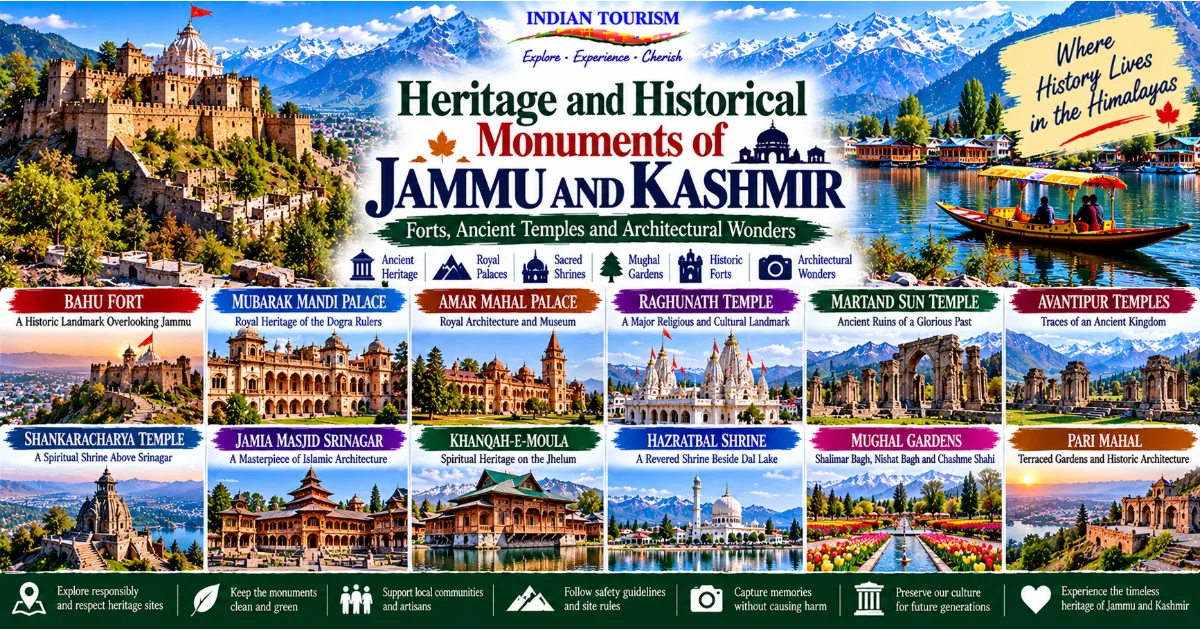
Discovering the History Behind the Himalayan Landscape
Jammu and Kashmir is widely admired for its snow-covered mountains, green valleys, sparkling lakes and picturesque towns. Yet the region's identity extends far beyond its natural beauty. Across its cities, villages, hills and valleys stand historic forts, ancient temples, sacred shrines, royal gardens and architectural landmarks that preserve the memories of different periods in its history. These monuments reveal how kingdoms developed, religious traditions evolved, trade connected distant regions and artistic influences shaped the cultural landscape of the Himalayas.
Historical tourism in Jammu and Kashmir offers travellers an opportunity to explore the stories behind the destinations they visit. A fort overlooking a city can explain the importance of defence and political authority. An ancient temple can reveal the craftsmanship and religious imagination of an earlier civilisation. A historic mosque or shrine can demonstrate the role of spirituality, scholarship and community life. Royal gardens can illustrate how architecture and landscape design were combined to create places of leisure and reflection.
The region's heritage is diverse. Jammu has historic forts, temples and palace architecture associated with the Dogra rulers and earlier political traditions. Kashmir contains remarkable temple remains, Islamic architecture, traditional wooden structures and gardens developed during different historical periods. Srinagar, in particular, offers a layered urban landscape where religious sites, old neighbourhoods, waterways and traditional houses reflect centuries of cultural change.
Heritage tourism is most rewarding when visitors look beyond the appearance of a building and explore the historical context that gives it meaning. Understanding who built a monument, why it was constructed, how it was used and what has survived over time can turn a short visit into a memorable learning experience.
This guide explores important historical monuments and heritage destinations across Jammu and Kashmir, with practical advice for planning visits, appreciating architecture and helping preserve the region's cultural treasures.
Bahu Fort: A Historic Landmark Overlooking Jammu
Bahu Fort is one of Jammu city's best-known historical landmarks. Situated on elevated ground overlooking the Tawi River, the fort occupies a position that highlights the strategic importance of the surrounding landscape. Its location offers a view across parts of Jammu and illustrates why elevated sites were valuable for defence, administration and the observation of movement through the region.
The fort is traditionally associated with Raja Bahu Lochan, a figure remembered in local historical tradition. Over time, the structure has been modified and maintained under different rulers. Its present appearance reflects the fact that historic forts are rarely frozen in one period. They often contain layers of construction, repair and adaptation shaped by changing political circumstances.
Inside the fort complex is the Bawey Wali Mata Temple, which makes the site both a historical destination and an active religious centre. The temple attracts devotees throughout the year, and the combination of fort architecture and religious significance gives the location a distinctive cultural character.
Visitors can explore the fort's setting, observe its architectural features and learn about its role in Jammu's history. The nearby Bagh-e-Bahu area provides additional opportunities to appreciate the landscape around the Tawi River. Travellers should check current opening arrangements and access rules before visiting, particularly during major festivals when crowds may increase.
Bahu Fort is a useful starting point for understanding the heritage of Jammu because it connects political history, defensive architecture, religious practice and the development of the modern city. It also demonstrates how historic monuments can remain relevant to local communities rather than serving only as reminders of the past.
Mubarak Mandi Palace: The Architectural Legacy of the Dogra Rulers
Mubarak Mandi Palace in Jammu is an important heritage complex associated with the former rulers of the princely state of Jammu and Kashmir. Located in the historic part of Jammu city, the palace complex developed over an extended period and incorporates different architectural influences.
The complex served as a royal residence and administrative centre. Its buildings reflect the needs of a ruling household that also conducted political and official affairs. Courtyards, halls, balconies and interconnected structures demonstrate how royal architecture was designed to accommodate ceremonies, governance, domestic life and interactions with visitors.
One of the most interesting aspects of Mubarak Mandi is its mixture of architectural styles. Elements associated with traditional regional construction appear alongside influences from other architectural traditions. This combination reflects the changing tastes and political connections of the rulers who developed the complex.
The palace is not simply a single building. It is a group of structures that together preserve the memory of a former royal establishment. Understanding the complex requires attention to its different sections and the ways they were used. Visitors interested in architectural history can observe how the arrangement of rooms, open spaces and decorative details reflects the organisation of royal life.
The condition and accessibility of individual parts of the complex may vary because heritage restoration and conservation are ongoing concerns. Travellers should verify which areas are open to visitors and follow any restrictions established to protect the structures.
Mubarak Mandi offers an opportunity to explore the political and cultural history of Jammu beyond its religious landmarks. A visit can be combined with other heritage sites in the city, creating an itinerary that reveals how royal authority, religious institutions and urban life developed alongside one another.
Amar Mahal Palace: Royal Architecture and Museum Heritage
Amar Mahal Palace is another important architectural landmark in Jammu. Associated with the former royal family, the palace occupies a prominent position overlooking the Tawi River and the surrounding landscape. Its appearance differs from that of many traditional regional forts and temples, making it an interesting addition to a heritage itinerary.
The palace was designed in a European architectural style, reflecting the influence of architectural preferences that circulated among princely households during the modern period. Its distinctive exterior, towers and roofline give it a character that contrasts with the region's older stone and religious structures.
Today, Amar Mahal is associated with a museum and cultural collections that help visitors understand the artistic interests and historical environment of the former royal establishment. Museum displays can provide context through paintings, objects, photographs and other materials connected with regional history and culture. The availability of particular exhibitions and collections should be checked before travelling.
The palace's elevated setting also makes it a rewarding place to consider the relationship between architecture and landscape. Its location allows visitors to appreciate how royal residences were positioned to command views and create a sense of distinction from the surrounding urban environment.
A visit to Amar Mahal can be especially useful for travellers interested in the transition from traditional princely architecture to modern influences. It also provides a different perspective on Jammu's heritage by highlighting the role of museums in preserving objects and memories that might otherwise remain inaccessible to the public.
Visitors should allow sufficient time to explore the museum at a comfortable pace. Reading the information accompanying displays can make the experience more informative than simply photographing the building's exterior.
Raghunath Temple: A Major Religious and Architectural Landmark
Raghunath Temple is one of Jammu's most significant religious landmarks. Located in the city, the temple complex is dedicated primarily to Lord Rama and forms an important part of the region's Hindu religious heritage.
The complex is associated with Maharaja Gulab Singh and the Dogra rulers, who contributed to its development during the nineteenth century. Its establishment reflects the importance of religious patronage in the political and cultural life of the period. Temples were not only places of worship but also institutions that could support scholarship, community gatherings and the preservation of religious traditions.
Raghunath Temple contains multiple shrines and religious spaces. The complex is therefore more extensive than a single sanctum, and its layout reflects the importance of different forms of worship within the wider Hindu tradition. Devotees visit to offer prayers, participate in religious observances and seek blessings.
The temple's location in central Jammu makes it accessible to visitors exploring the city's markets and other historical attractions. However, as an active place of worship, it has rules that visitors must follow. Security procedures, photography restrictions and access arrangements may change, so travellers should check current instructions before entering.
The surrounding urban environment also contributes to the experience. Markets, traditional shops and streets near the temple demonstrate how religious landmarks can influence the development of commercial and social life. Pilgrimage visitors have supported local businesses for generations, while residents continue to use the surrounding area for everyday activities.
Raghunath Temple illustrates how heritage can remain a living part of a city. Its importance lies not only in architecture or historical patronage but also in the continuing religious practices that connect present-day communities with earlier generations.
Ranbireshwar Temple: Sacred Architecture in Jammu
Ranbireshwar Temple is another important religious landmark in Jammu. Dedicated to Lord Shiva, the temple is associated with Maharaja Ranbir Singh and reflects the development of religious architecture under the Dogra rulers.
The temple is known for its Shiva lingams, which form a central element of its religious identity. Its interior arrangement supports worship and devotional activity, while its location within the city makes it accessible to residents and pilgrims.
For visitors interested in religious architecture, Ranbireshwar Temple provides an opportunity to observe how temple design supports ritual practice. The arrangement of sacred objects, worship areas and circulation spaces is closely connected with the needs of devotees rather than simply with visual display.
The temple also helps explain the importance of royal patronage in the development of Jammu's religious landscape. Rulers frequently supported the construction and maintenance of temples, shrines and other religious institutions. Such patronage could express personal devotion, reinforce relationships with communities and contribute to the public identity of a ruling dynasty.
Visitors should approach the temple respectfully and follow the guidance of staff and worshippers. During major religious observances, the number of devotees may increase, and additional time may be required for entry and movement through the complex.
Ranbireshwar Temple can be included in a wider exploration of Jammu's religious heritage, alongside Raghunath Temple and Bahu Fort. Together, these destinations demonstrate the close relationship between faith, architecture and urban development in the Jammu region.
Martand Sun Temple: The Ruins of an Ancient Architectural Masterpiece
The Martand Sun Temple, located near Anantnag in Kashmir, is one of the region's most important historical monuments. Dedicated to the Sun deity, the temple is generally associated with the reign of Lalitaditya Muktapida of the Karkota dynasty in the eighth century.
Although the complex survives primarily as ruins, its scale and architectural arrangement reveal the ambition of its builders. The remains include a central temple structure and a large surrounding courtyard framed by rows of smaller architectural spaces. The layout suggests that the site was designed as a substantial religious complex rather than a modest local shrine.
The temple's position on elevated ground provides views across the surrounding landscape. The relationship between the monument and its setting contributes to its appeal for visitors interested in architecture, archaeology and the history of Kashmir.
Martand is especially valuable because it preserves evidence of an important period in the region's architectural development. Stonework, the arrangement of the courtyard and surviving structural details offer clues about the craftsmanship and building traditions of the time. Researchers and historians use such evidence to understand the political, religious and cultural environment in which the monument was created.
The ruins should be approached with an awareness of their vulnerability. Visitors should avoid climbing on fragile structures, removing stones or leaving rubbish. Even small acts of damage can contribute to the gradual deterioration of historic remains.
Martand Sun Temple is not simply a photogenic ruin. It represents an important chapter in Kashmir's early history and provides an opportunity to consider how religious institutions, royal patronage and architectural innovation shaped the region.
For travellers, the site can be combined with other destinations in the Anantnag area, subject to road conditions and current access arrangements. Allowing time to walk carefully around the permitted areas makes it easier to appreciate the overall design.
Avantipur Temple Ruins: Traces of an Ancient Kingdom
The Avantipur temple complexes, located in the Kashmir Valley, preserve important evidence of the region's early medieval architecture. They are commonly associated with Avantivarman, the founder of the Utpala dynasty, who ruled during the ninth century.
The remains at Avantipur include temple structures and architectural fragments that reveal the scale and organisation of earlier religious complexes. Although much of the original construction has not survived intact, the surviving stonework provides valuable evidence of historical building techniques and artistic traditions.
The ruins demonstrate the importance of religious patronage in the development of early Kashmir. Temples required skilled labour, materials, planning and support from those with the resources to commission major structures. Their construction was therefore connected with wider political and economic systems as well as religious belief.
Visitors interested in archaeology can observe the relationship between the central temple remains and the surrounding spaces. Decorative elements and structural fragments help illustrate how builders combined practical engineering with artistic expression.
Avantipur is also a useful reminder that the history of Kashmir cannot be understood through modern boundaries alone. The region has long been connected with broader networks of trade, religious scholarship and cultural exchange across the Himalayas and the Indian subcontinent.
Because the ruins are vulnerable, visitors should remain within permitted areas and follow conservation instructions. It is important not to touch or disturb fragile fragments unnecessarily.
A visit to Avantipur can complement a journey through the wider Kashmir Valley, particularly for travellers who want to explore ancient history rather than concentrate exclusively on lakes, gardens and mountain scenery.
Shankaracharya Temple: A Historic Shrine Above Srinagar
Shankaracharya Temple stands on a hill overlooking Srinagar and is one of the city's most recognisable religious landmarks. Dedicated to Lord Shiva, it occupies a commanding position that connects the built environment with the surrounding natural landscape.
The hill's elevated location has made it important in the religious and historical geography of Srinagar. From suitable viewpoints, visitors can see parts of the city and Dal Lake, providing a perspective that is different from the lakeside views experienced at lower elevations.
The temple is associated with long-standing religious traditions, although interpretations of its earliest history and construction have developed through historical scholarship and local tradition. Its significance today comes from both its religious role and its place within the wider heritage of Kashmir.
Reaching the temple involves road travel and a climb by steps. Visitors should be prepared for security procedures and possible restrictions concerning vehicles, belongings and photography. Current rules should be confirmed before departure because access arrangements can change.
The temple's elevated position also makes it important to consider weather and physical ability. Visitors should wear suitable footwear, carry water when appropriate and allow enough time to complete the visit without rushing.
Shankaracharya Temple can be combined with other destinations in Srinagar, but travellers should recognise that it is an active place of worship. The scenery may be impressive, yet the spiritual purpose of the site deserves equal attention.
The temple demonstrates how sacred places in Kashmir are often closely connected with natural features such as hills, rivers and lakes. This relationship between landscape and religion is one of the most distinctive aspects of the region's heritage.
Jamia Masjid Srinagar: A Landmark of Islamic Architecture
Jamia Masjid, located in the historic Nowhatta area of Srinagar, is one of Kashmir's most important mosques. Its large courtyard, distinctive wooden architecture and rows of pillars give it a character that differs from many monumental mosques elsewhere in India.
The mosque's history extends over several centuries, with construction and reconstruction associated with different rulers and historical periods. Its present form reflects the influence of regional building traditions and the practical requirements of a major place of congregational worship.
The use of timber and the organisation of the prayer space reflect adaptation to local materials and environmental conditions. Traditional wooden architecture is an important part of Kashmir's built heritage, and Jamia Masjid provides a striking example of how structural design can respond to regional conditions while serving religious purposes.
The mosque has long been a centre of worship and community life. Its location within Srinagar's older urban fabric connects it with historic markets, neighbourhood streets and other cultural landmarks. Exploring the surrounding area can help visitors understand how religious institutions formed part of the everyday structure of the city.
Visitors should be particularly attentive to prayer times and local guidance. The mosque is an active religious institution, and access may be affected by worship, security arrangements or special occasions. Modest clothing, quiet behaviour and respect for worshippers are essential.
Jamia Masjid offers an opportunity to understand the Islamic architectural and cultural heritage of Kashmir. Its importance extends beyond its physical structure to include the community traditions and religious practices that continue to give the building meaning.
Khanqah-e-Moula: Spiritual Heritage Along the Jhelum River
Khanqah-e-Moula, also known as Shah-e-Hamadan Mosque, is a major religious and historical landmark in Srinagar. Situated near the Jhelum River in the old city, it is associated with Mir Sayyid Ali Hamadani, a prominent Persian scholar and spiritual figure whose influence is remembered in Kashmir's religious history.
The building is notable for its traditional wooden architecture and richly decorated exterior. Its form reflects the adaptation of regional craftsmanship to religious architecture, creating a structure that differs from stone-built monuments and large domed mosques.
The khanqah's importance is closely connected with the spread and development of Islamic spiritual traditions in Kashmir. Religious institutions of this kind have served as places of worship, learning, community gathering and spiritual instruction. Their influence has extended into literature, craftsmanship, social life and cultural memory.
The surrounding old city is also an important part of the experience. Narrow streets, traditional buildings, shops and riverfront views reveal how Srinagar developed around waterways and neighbourhood networks. Travellers who explore these areas with a knowledgeable guide may gain a richer understanding of the city's architectural and social history.
As an active religious site, Khanqah-e-Moula requires respectful conduct. Visitors should follow current access rules, avoid disturbing prayer and ask permission before taking photographs of individuals. The building should be appreciated as a living centre of faith rather than treated solely as a historical object.
For travellers interested in architecture, the khanqah offers a valuable opportunity to study traditional Kashmiri timber construction. For those interested in cultural history, it illustrates the role of religious scholarship and spiritual institutions in shaping the region.
Hazratbal Shrine: Religious Heritage Beside Dal Lake
Hazratbal Shrine is among the most revered Islamic religious sites in Kashmir. Located on the western shore of Dal Lake, it is associated with a sacred relic believed by devotees to be connected with Prophet Muhammad.
The shrine's white exterior and lakeside setting create a distinctive architectural and visual presence. The mountains, water and surrounding settlement form an important part of its setting, but the shrine's central importance lies in its religious significance.
Hazratbal attracts worshippers throughout the year, with particularly large gatherings during important religious occasions. These gatherings reflect the shrine's place in the spiritual life of Kashmir and its importance to families and communities across the region.
The surrounding area has also developed as a destination for visitors exploring Srinagar. However, tourism should not interfere with worship or community activities. Visitors should observe clothing expectations, respect prayer times and follow the instructions of shrine staff.
Photography rules may vary according to the area and occasion. Travellers should ask before photographing people and should avoid interrupting religious activities to obtain pictures.
Hazratbal can be included in a wider Srinagar heritage itinerary alongside Shankaracharya Temple, Jamia Masjid and Khanqah-e-Moula. Together, these destinations reveal different dimensions of the region's religious architecture and demonstrate the diversity of its cultural history.
Pari Mahal: Terraced Gardens and Historic Architecture
Pari Mahal is a historic terraced garden complex situated on the Zabarwan hills above Srinagar. Its elevated position offers broad views across the surrounding landscape, including parts of Dal Lake and the city.
The complex is associated with the Mughal period and is traditionally linked with Dara Shikoh, the eldest son of Emperor Shah Jahan. Its architectural form combines terraces, retaining walls and garden spaces in a setting that demonstrates the relationship between Mughal landscape design and the natural topography of Kashmir.
Unlike a conventional palace, Pari Mahal is best understood through the interaction between its built structures and its gardens. The terraces create a sequence of spaces that lead visitors through the site while offering changing views of the landscape.
The complex has also been associated with scholarly and educational activities in historical accounts. Its location and layout make it an interesting place for considering how gardens served purposes beyond recreation, including contemplation, learning and the expression of royal patronage.
Visitors should allow time to explore the terraces carefully and should follow current access arrangements. Steps and uneven surfaces may make some sections difficult for people with limited mobility. Comfortable footwear is recommended.
Pari Mahal is especially appealing to travellers interested in historical gardens and architectural landscapes. Its elevated setting makes it a natural addition to a heritage-focused visit to Srinagar, particularly when combined with other Mughal-era gardens.
Mughal Gardens: Shalimar Bagh, Nishat Bagh and Chashme Shahi
The Mughal gardens of Srinagar are among the region's most celebrated heritage attractions. Shalimar Bagh, Nishat Bagh and Chashme Shahi reflect the Mughal interest in combining water, terraces, planting and architecture to create ordered landscapes.
Shalimar Bagh was developed under Emperor Jahangir and is associated with the Mughal court's appreciation of Kashmir's climate and scenery. Its terraces, water channels and garden spaces were designed to create a structured landscape that could be experienced through movement and changing views.
Nishat Bagh, situated beside Dal Lake, is known for its terraced arrangement and mountain backdrop. Its design demonstrates how the slope of the land can be incorporated into a garden's organisation. The terraces offer different perspectives across the lake and surrounding hills.
Chashme Shahi is a smaller garden associated with a natural spring and the Mughal tradition of developing carefully designed spaces around water sources. Its compact layout provides a different experience from the larger gardens while preserving the central relationship between architecture, water and landscape.
These gardens are more than attractive places for photographs. They reflect ideas about royal leisure, landscape control, horticulture and the cultural importance of water. Their design also demonstrates how gardens can express political power and artistic taste.
The gardens change with the seasons. Spring brings fresh growth, summer offers lush planting and autumn introduces warmer colours. Visitors should check current opening hours and access arrangements before travelling.
Responsible behaviour is important because garden structures, water systems and plants require ongoing maintenance. Travellers should remain on permitted paths, avoid damaging flower beds and dispose of rubbish properly.
Traditional Kashmiri Houses and Old Srinagar's Architectural Heritage
Some of the most revealing examples of Kashmir's architectural heritage are not monumental palaces or large religious buildings. They are the traditional houses, neighbourhood streets and timber structures that form the fabric of older settlements.
Traditional Kashmiri buildings have often used timber and masonry in ways adapted to the local climate and available materials. In older urban areas, closely spaced houses and narrow streets reflect the historical organisation of neighbourhoods around trade, religious institutions and waterways.
Wooden balconies, carved details, projecting upper floors and traditional roof forms contribute to the visual character of historic Srinagar. These features reflect both craftsmanship and practical responses to environmental conditions. Building traditions developed over time through the knowledge of local artisans and the needs of households living in a region with cold winters and seasonal weather changes.
Exploring the old city with a knowledgeable local guide can reveal details that visitors might otherwise overlook. A guide may explain how a neighbourhood developed, how traditional homes were organised and how craft skills influenced architectural decoration.
However, residential heritage requires sensitivity. Many historic buildings remain private homes or active businesses. Travellers should not enter courtyards, photograph residents through windows or treat private streets as open-air museums without considering local privacy.
Supporting responsible heritage walks and local craft businesses can help preserve traditional skills and encourage appreciation of older neighbourhoods. Conservation is most effective when it respects the needs of people who continue to live and work in historic buildings.
Best Time to Explore Historical Monuments in Jammu and Kashmir
The best time for heritage tourism depends on the destination, weather conditions and the type of experience a traveller wants. Spring and autumn are often comfortable seasons for exploring many outdoor monuments, gardens and urban heritage sites.
Spring brings fresh vegetation and flowering gardens to Srinagar. It is particularly attractive for visitors interested in Mughal gardens and the wider cultural landscape. However, weather can change, and occasional rain may affect outdoor plans.
Summer generally offers longer daylight hours and convenient conditions for many sightseeing activities. Popular destinations can be busy during holiday periods, so starting early and booking accommodation in advance can improve the experience.
Autumn brings changing colours to the Kashmir Valley and can be especially rewarding for visitors who want to combine heritage exploration with photography and landscape appreciation. Cooler mornings and evenings make layered clothing useful.
Winter can create a different atmosphere, particularly in Srinagar and the Jammu region, but snow, ice and cold temperatures may affect road travel and access to certain sites. Visitors should check weather forecasts and current transport conditions before departure.
Many religious monuments have their own schedules, prayer times, security requirements or restrictions. These factors should be considered alongside the season. The most suitable itinerary is one that combines realistic travel times with enough opportunity to appreciate each destination.
How to Plan a Heritage Tour of Jammu and Kashmir
A successful heritage tour begins with choosing a manageable group of destinations. Jammu city offers several important monuments within a relatively compact area, including Bahu Fort, Mubarak Mandi Palace, Amar Mahal Palace, Raghunath Temple and Ranbireshwar Temple. Travellers can explore these sites over one or two days, depending on opening arrangements and the time spent at each location.
Srinagar offers a different set of experiences, including Shankaracharya Temple, Hazratbal Shrine, Jamia Masjid, Khanqah-e-Moula, Pari Mahal and the Mughal gardens. A separate day can be useful for exploring the historic old city, while another can focus on gardens and elevated viewpoints.
The ancient temple remains near Anantnag and Avantipur require additional travel planning. Visitors should account for road conditions and verify access arrangements before setting out. These destinations are particularly rewarding for travellers interested in archaeology and early Kashmir history.
A local guide can add considerable value to a heritage tour. Good guides explain historical context, distinguish established evidence from local tradition and help visitors understand the relationship between a monument and its surrounding community.
Travellers should also consider accessibility. Some historic buildings contain steep stairs, uneven surfaces or limited facilities. People with mobility requirements should confirm access conditions in advance rather than assume that every monument is fully accessible.
Carrying drinking water, comfortable footwear, a light jacket and any necessary medicines can make a day of heritage exploration easier. Visitors should also allow time for rest and meals, particularly when combining several locations.
Responsible Heritage Tourism and Monument Preservation
Historical monuments are vulnerable to weather, pollution, overcrowding and careless visitor behaviour. Stone structures can deteriorate, timber buildings can be affected by moisture and fire, and gardens require careful maintenance to preserve their original design.
Visitors can contribute to conservation by following site rules, staying on designated paths and avoiding contact with fragile surfaces. Carving names into stone, removing fragments, climbing restricted structures or leaving rubbish can cause lasting damage.
Religious sites deserve particular sensitivity because they may be active centres of worship. Visitors should observe local customs, dress appropriately and avoid disrupting ceremonies. Photography should follow the rules established by the site authorities.
Supporting local guides, artisans and responsible tourism businesses can help ensure that heritage tourism benefits surrounding communities. Buying genuine regional crafts and choosing locally operated services where practical can contribute to livelihoods connected with cultural preservation.
Travellers should also avoid spreading unverified historical claims. Monument histories can include a mixture of archaeological evidence, written records and local traditions. A responsible approach recognises these differences rather than presenting every legend as established fact.
Preservation is a shared responsibility. Governments, conservation professionals, local residents and visitors all influence the future of the region's historic buildings and cultural landscapes. By behaving respectfully, travellers can help ensure that these monuments remain meaningful for future generations.
Conclusion: A Journey Through the Living History of Jammu and Kashmir
The historical monuments of Jammu and Kashmir reveal a region shaped by ancient kingdoms, religious traditions, royal patronage, craftsmanship and cultural exchange. Bahu Fort and the palaces of Jammu preserve memories of political authority and royal life. Raghunath Temple and Ranbireshwar Temple demonstrate the continuing importance of religious institutions. Martand Sun Temple and the ruins at Avantipur offer evidence of early architectural achievements, while Shankaracharya Temple connects sacred architecture with the landscape of Srinagar.
Jamia Masjid, Khanqah-e-Moula and Hazratbal Shrine illustrate the depth of Kashmir's Islamic heritage. Pari Mahal and the Mughal gardens demonstrate how landscape design became an important part of the region's cultural identity. Traditional houses and old neighbourhoods reveal the everyday architectural knowledge that has shaped communities for generations.
These places are not merely monuments to photograph. They are records of human activity, faith, artistic ambition and changing social life. Some continue to serve their original religious purpose, while others survive as archaeological remains or museums. Each contributes to a fuller understanding of the region's past.
For travellers, heritage tourism offers an opportunity to combine sightseeing with learning. Choosing suitable destinations, allowing time to explore, listening to local guides and respecting religious and conservation rules can make the experience more rewarding.
Jammu and Kashmir's historical heritage deserves the same attention as its celebrated natural scenery. By exploring its forts, temples, shrines, gardens and traditional neighbourhoods responsibly, visitors can discover a deeper story of the Himalayas and help preserve the cultural treasures that connect the present with the past.
#IndianTourism #JammuAndKashmir #HistoricalMonuments #KashmirHeritage #JammuHeritage #MartandSunTemple #MubarakMandi #BahuFort #MughalGardens #SrinagarHeritage #IndianHistory #CulturalTourism #HeritageTravel #ExploreIndia
