
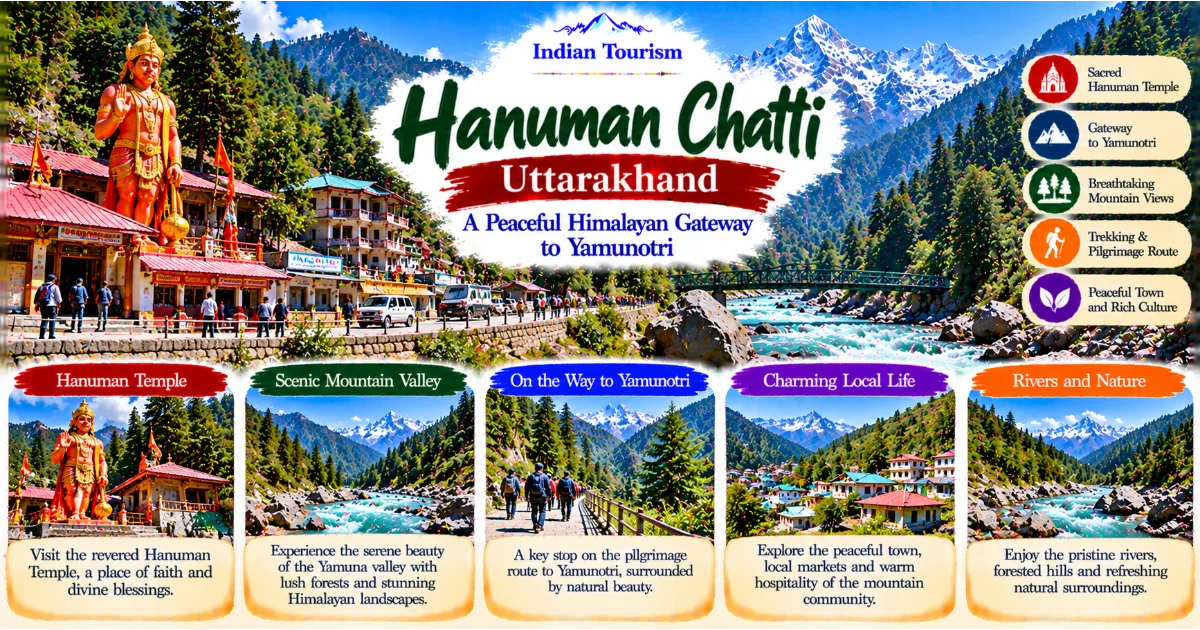
Discovering the Quiet Beauty of Hanuman Chatti
Hidden among the magnificent mountains of Uttarakhand, Hanuman Chatti is a small Himalayan destination that offers travellers an opportunity to experience the quieter side of the Garhwal Himalayas. Surrounded by forested slopes, mountain streams, traditional settlements, and dramatic valleys, this peaceful destination provides a refreshing contrast to the crowded tourist centres that dominate many travel itineraries. It is a place where the landscape becomes the main attraction, where the sound of flowing water accompanies the journey, and where the mountains invite visitors to slow down and appreciate their surroundings.
Hanuman Chatti is particularly important for travellers exploring the Yamunotri region. Situated along the route to Yamunotri, one of the four sacred sites of the Char Dham pilgrimage, the settlement has traditionally served as a significant stop for pilgrims and mountain travellers. Its location makes it useful for understanding the geography of the upper Yamuna valley, the traditional pilgrimage routes of Uttarakhand, and the relationship between mountain communities and religious travel.
However, Hanuman Chatti should not be viewed only as a place to pass through on the way to a temple. The surrounding landscape has its own appeal. The mountains, river valleys, changing weather, and rural atmosphere make it an interesting destination for travellers who appreciate nature, local culture, and journeys through the Himalayan countryside.
For visitors planning a trip to Uttarkashi district, Hanuman Chatti can become part of a broader journey through Barkot, Yamunotri, and the surrounding mountain settlements. It is especially suitable for travellers who prefer exploring destinations with a strong connection to their natural environment rather than limiting their journeys to well-known sightseeing attractions.
Understanding the Location and Geography of Hanuman Chatti
Hanuman Chatti lies in the Yamuna valley of Uttarkashi district in Uttarakhand. The wider region is characterised by steep mountain slopes, narrow valleys, rivers, forests, and settlements that have developed around the natural routes connecting different parts of the Garhwal Himalayas. The landscape changes considerably as travellers move from the lower valleys towards the higher Himalayan areas.
The settlement occupies a strategically important position along the route leading towards Yamunotri. Historically, travellers used this route to reach the sacred temple and other destinations in the upper valley. Although modern road access has transformed parts of the journey, the surrounding geography continues to influence how people travel, where settlements develop, and which areas remain accessible during different seasons.
The natural environment around Hanuman Chatti is shaped by the interaction between mountain terrain and flowing water. Streams descend from higher elevations, rivers move through narrow channels, and vegetation changes according to altitude, sunlight, and local moisture conditions. During the monsoon, the landscape becomes greener, while colder months can bring a more subdued appearance and challenging travel conditions.
The mountains also influence the weather. Conditions can change quickly, particularly when clouds gather over the higher slopes. Sunshine in one part of the valley does not always guarantee clear weather farther along the route. Travellers should therefore remain flexible and avoid planning their journeys around assumptions that mountain conditions will remain constant throughout the day.
Hanuman Chatti is a useful destination for understanding how Himalayan settlements are connected to their surroundings. Its importance comes not from a large collection of monuments or commercial attractions but from its position within a living mountain landscape.
Why Hanuman Chatti Deserves a Place on Your Uttarakhand Travel List
Many travellers discover Hanuman Chatti while planning a pilgrimage to Yamunotri. They may initially consider it only a convenient stop before continuing their journey. Yet the settlement offers a broader perspective on the region and deserves attention from visitors interested in mountain geography, traditional travel routes, and the everyday life of the Himalayas.
One of its greatest attractions is its comparatively simple atmosphere. Unlike destinations that have developed extensive commercial infrastructure around sightseeing, Hanuman Chatti retains the character of a small mountain settlement. The experience depends largely on the surrounding landscape, the journey through the valley, and the opportunity to observe how people live in a challenging geographical environment.
The destination is also useful for travellers who want to understand the Yamunotri pilgrimage beyond the final temple visit. Religious journeys are shaped by roads, accommodation, resting places, weather, local services, and the physical effort required to reach sacred locations. Hanuman Chatti forms part of this larger network and helps visitors appreciate the journey as a whole.
Nature enthusiasts may enjoy the changing mountain scenery, while photographers can find opportunities to capture valley views, flowing water, forested slopes, and village life. Travellers who enjoy slow tourism can spend time observing the surroundings rather than following a tightly packed schedule.
Hanuman Chatti can also be included in an itinerary that explores Barkot and other settlements along the Yamunotri route. This approach allows visitors to experience several aspects of Uttarakhand in one journey, from busy pilgrimage centres to quieter villages and mountain roads.
The destination is particularly rewarding for people who value the journey itself. In the Himalayas, the spaces between major attractions often reveal the region's most memorable qualities.
The Religious Significance of Hanuman Chatti
The name Hanuman Chatti reflects the strong connection between the region and Hindu religious traditions. Hanuman, a central figure in the Ramayana, is widely revered for his devotion to Lord Rama, courage, strength, humility, and willingness to serve others. Across India, places associated with Hanuman attract pilgrims seeking spiritual reassurance, protection, and inspiration.
The name of the settlement places it within this broader cultural landscape. As with many Himalayan locations, local religious identity is closely connected to the routes travelled by pilgrims and the traditions maintained by communities living near sacred destinations.
Hanuman Chatti is also associated with the wider pilgrimage journey towards Yamunotri. Yamunotri is one of the four traditional Char Dham pilgrimage destinations in Uttarakhand, alongside Gangotri, Kedarnath, and Badrinath. The pilgrimage is deeply connected to the sacred geography of the Himalayas, where rivers, mountains, temples, and natural springs are understood through religious stories and traditions.
For many pilgrims, reaching Yamunotri represents more than visiting a temple. It is an opportunity to undertake a journey that combines devotion, physical effort, and reflection. Stops along the route become part of that experience. They provide opportunities to rest, prepare for the next stage, meet other pilgrims, and appreciate the landscape through which the pilgrimage passes.
Visitors should approach the religious character of the area with respect. Local temples, shrines, and places of worship may have customs concerning footwear, photography, behaviour, and offerings. Travellers should observe posted instructions and follow the guidance of local residents or temple authorities.
Even for visitors who do not undertake the pilgrimage for religious reasons, learning about the traditions associated with Hanuman Chatti can provide a deeper understanding of Uttarakhand's cultural identity.
Exploring the Natural Landscape Around Hanuman Chatti
The natural landscape is one of the strongest reasons to include Hanuman Chatti in a Himalayan itinerary. The surrounding valley combines rugged terrain with patches of vegetation, river channels, and small settlements. The scenery changes with the seasons, offering different experiences depending on when travellers visit.
The mountain slopes create a dramatic backdrop. Some appear green during warmer months, while higher or more exposed areas may look rocky and austere. The combination of elevation, sunlight, clouds, and shadows creates constantly changing views. Early mornings can offer particularly attractive conditions when the air is clear and the mountains are illuminated by the rising sun.
Water is another defining feature of the region. Mountain streams and rivers shape the valley and contribute to its soundscape. The movement of water, the presence of rocks along riverbanks, and the contrast between flowing channels and steep slopes create opportunities for photography and quiet observation.
The area also offers a glimpse of Himalayan vegetation. Plant life varies according to altitude, exposure, and local climate. Lower and more sheltered slopes may support denser vegetation, while exposed areas can have thinner plant cover. Seasonal changes influence the appearance of the landscape, particularly during spring and the monsoon.
Travellers should remember that the natural beauty of a mountain region does not make every location safe for unrestricted exploration. Riverbanks may be unstable, rocks can become slippery, and steep slopes can present hazards. Visitors should remain on established routes and avoid approaching fast-flowing water unnecessarily.
The most rewarding way to experience the landscape is often through patient observation. Rather than attempting to reach every viewpoint, spend time appreciating the valley, watching the weather change, and noticing the details that make the Himalayan environment distinctive.
Hanuman Chatti and the Yamunotri Pilgrimage Route
The relationship between Hanuman Chatti and Yamunotri is central to understanding the settlement's importance. Yamunotri is one of the most significant pilgrimage destinations in Uttarakhand and attracts devotees from across India during its annual pilgrimage season.
For generations, reaching Yamunotri involved travelling through difficult mountain terrain. Pilgrims depended on traditional routes, resting places, local guides, and assistance from communities familiar with the landscape. These journeys required physical preparation and an understanding of the limitations imposed by weather and geography.
Modern roads have changed the way visitors reach different points along the route, but the mountain environment continues to influence travel. Road conditions, rainfall, landslides, traffic, and seasonal closures can affect journeys. The availability of local transport and accommodation may also change according to pilgrimage demand.
Hanuman Chatti forms part of this broader travel corridor. Visitors passing through can use the opportunity to learn about the route, understand the distances involved, and appreciate the practical challenges faced by pilgrims.
It is important to distinguish Hanuman Chatti from Janki Chatti, which is commonly used as the roadhead for the final trek to Yamunotri. Travellers should confirm current route arrangements before departure because transport access and local operating conditions can change. The final approach to Yamunotri generally involves a substantial uphill journey, and visitors should prepare according to their fitness, available time, and prevailing conditions.
Pilgrims should not assume that a short stop at Hanuman Chatti means the remainder of the journey will be easy. Altitude, steep terrain, cold weather, and physical exertion can affect people differently. Taking sufficient rest, carrying water, and allowing adequate time are important parts of responsible pilgrimage planning.
For visitors interested in the cultural and geographical dimensions of travel, the Yamunotri route offers a valuable opportunity to see how pilgrimage traditions continue to shape life in the Garhwal Himalayas.
Best Things to Experience in Hanuman Chatti
Enjoying the Mountain Scenery
One of the simplest and most rewarding experiences in Hanuman Chatti is spending time observing the surrounding mountains. The landscape does not require an elaborate sightseeing plan. A quiet walk through accessible parts of the settlement or time spent at a safe viewpoint can provide an opportunity to appreciate the scale and beauty of the valley.
The scenery is particularly appealing to travellers who enjoy places where natural features dominate the environment. Mountain ridges, river channels, forested areas, and scattered buildings create a landscape that feels closely connected to its geographical setting.
Visitors should choose safe locations and avoid wandering onto steep or unmarked trails. Local advice is valuable because apparently accessible paths may lead towards unstable ground or areas that become difficult to cross after rainfall.
Observing Local Mountain Life
Small Himalayan settlements offer insights into how people adapt to their environment. The location of houses, the use of available land, the movement of local transport, and the rhythm of daily activities all reflect the practical realities of mountain living.
Hanuman Chatti can provide opportunities to observe these everyday details. Visitors may see local residents travelling between settlements, preparing for work, operating small businesses, or assisting pilgrims moving along the route.
These observations should be approached respectfully. Travellers should not treat private homes or ordinary daily activities as tourist attractions without permission. Asking before photographing people and supporting local businesses are simple ways to ensure that tourism benefits the community.
Experiencing the Pilgrimage Atmosphere
During the Yamunotri pilgrimage season, the wider region takes on a distinctive atmosphere. Pilgrims travel in groups, transport services become more active, and local businesses respond to increased demand.
Hanuman Chatti's place within the route gives visitors a chance to observe the practical side of pilgrimage. The experience may include seeing families preparing for the next stage, travellers taking rest breaks, and local workers helping visitors navigate the mountain environment.
The atmosphere changes according to the season and the number of pilgrims travelling through the area. Visitors seeking a quieter experience may prefer to avoid the busiest periods, while those interested in religious travel may appreciate the energy of the pilgrimage season.
Photography and Nature Observation
Photography is another activity suited to Hanuman Chatti. The valley provides opportunities to capture mountain scenery, water, vegetation, roads, buildings, and the changing light of the Himalayas.
Wide-angle photographs can help communicate the scale of the landscape, while closer compositions may focus on textures such as river stones, leaves, wooden structures, or the contrast between sunlight and shadow.
Early morning and late afternoon can offer attractive natural light. However, weather conditions are unpredictable, so photographers should protect their equipment from rain and avoid standing in unsafe locations to obtain a particular composition.
Taking a Slow Travel Break
Hanuman Chatti can be valuable simply as a place to pause. Travellers often attempt to cover as many attractions as possible, especially during short holidays. This approach can make a mountain journey tiring and leave little time to appreciate the surroundings.
A slower itinerary allows visitors to enjoy the valley, rest after a long drive, and prepare for the next stage of the journey. It also reduces the pressure to travel when conditions are unfavourable.
For people exploring the Yamunotri region, the ability to travel at a comfortable pace is an important part of a safer and more satisfying experience.
The Best Time to Visit Hanuman Chatti
The best time to visit Hanuman Chatti depends on the purpose of the trip, the weather, and the accessibility of the surrounding routes. Because the destination lies in a Himalayan valley, seasonal conditions can influence transport, accommodation, walking opportunities, and the overall travel experience.
Spring: March to April
Spring brings gradual changes to the mountain landscape. Temperatures begin to rise compared with the coldest winter months, although mornings and evenings can remain chilly. Lower slopes may show fresh vegetation, and the changing light can make the surrounding scenery attractive for photography.
Visitors planning a spring trip should verify road conditions and the current pilgrimage schedule. The higher parts of the route may remain affected by winter weather, and not every destination in the wider Yamunotri region will necessarily be accessible at the same time.
Spring is a reasonable period for travellers who want to explore the lower valley and experience the transition from winter to warmer weather.
Early Summer: May to June
May and June are important months for pilgrimage travel in the region. The weather is often more suitable for road journeys than during the winter, although conditions remain variable. The wider Yamunotri route can become busier as pilgrims begin travelling in greater numbers.
The mountain landscape may appear vibrant, and longer daylight hours can make travel planning easier. However, increased visitor numbers can also affect road traffic, accommodation availability, and waiting times at busy points along the route.
Travellers should reserve accommodation where possible and avoid assuming that all services will be available without advance planning.
Monsoon: July to September
The monsoon season brings increased rainfall to Uttarakhand. The valley can become lush and green, but heavy rain may also create serious travel difficulties. Landslides, falling rocks, road damage, swollen streams, and poor visibility are important risks in mountain areas.
A monsoon visit requires careful attention to weather forecasts and local travel advisories. Travellers should be prepared to change or postpone their plans if authorities advise against travel or if road conditions become unsafe.
Although the landscape can be beautiful during this period, the monsoon is not automatically the best season for a relaxed mountain holiday. Safety should take priority over maintaining a fixed itinerary.
Autumn: October to November
Autumn often brings clearer skies after the monsoon, although temperatures begin to fall as winter approaches. The mountain scenery can appear especially sharp when visibility is good, making this a rewarding period for travellers interested in landscape photography and peaceful surroundings.
The pilgrimage calendar and local service schedules must still be checked. Some facilities may reduce their operations as visitor numbers decline, and conditions can become cold, particularly at night.
Visitors should carry warm clothing and confirm transport arrangements before travelling.
Winter: December to February
Winter can bring severe cold and snow to parts of the upper Himalayan region. Roads and trails may become difficult or inaccessible, and services can be limited. The exact conditions depend on elevation, recent weather, and local infrastructure.
Winter travel should not be planned solely on the assumption that the destination will be accessible. Travellers need to check current road conditions, local advisories, accommodation availability, and the status of the Yamunotri route before departure.
For most visitors seeking a straightforward sightseeing experience, the more accessible months are generally easier to plan around. Winter is better suited to travellers who understand Himalayan conditions and can adapt to changes.
How to Reach Hanuman Chatti
Reaching Hanuman Chatti requires planning because the destination is located in a mountainous part of Uttarakhand. The route generally involves travelling through the lower Himalayan towns before continuing towards Barkot and the Yamunotri valley.
By Road
Road travel is the main way to reach Hanuman Chatti. Visitors commonly approach the region through Dehradun, Mussoorie, Nainital-side connections where relevant to their broader itinerary, or other accessible towns depending on their starting point. The precise route should be selected according to road conditions, distance, and the location from which the journey begins.
Travellers coming from Dehradun or Rishikesh should expect a long mountain drive. The journey involves winding roads, changes in elevation, and sections where average speeds are lower than on highways. Traffic, weather, roadworks, and landslides can increase travel time.
Barkot is an important reference point for visitors exploring the Yamunotri region. From there, travellers continue along the relevant route towards Hanuman Chatti, subject to current road access and local conditions.
It is advisable to begin long mountain journeys early in the day and avoid unnecessary driving after dark. Drivers should be familiar with hill roads, maintain safe speeds, and allow extra time for breaks.
By Train
Hanuman Chatti does not have its own railway station. Travellers arriving by train can use rail connections to accessible cities such as Dehradun or other suitable railway hubs, depending on their origin and the onward route they choose.
From the railway station, the remaining journey is completed by road. Visitors should check the latest train schedules and onward transport options before travelling, particularly during busy pilgrimage periods.
By Air
The nearest major airport commonly used by travellers heading towards the Yamunotri region is Jolly Grant Airport near Dehradun. From the airport, visitors need to continue by road through the mountain routes towards the destination.
Air travel can reduce the time required to reach Uttarakhand from distant cities, but it does not remove the need for a substantial road journey. Travellers should plan their arrival time carefully and avoid arranging an unrealistic same-day itinerary that leaves no room for delays.
Hiring a Local Taxi
Hiring a taxi can be a practical option for families, small groups, and visitors who prefer not to drive in the mountains. Local drivers often have experience with the roads, seasonal traffic, and common travel challenges.
Before beginning the journey, confirm the fare, route, expected travel time, luggage arrangements, and whether the driver will wait during sightseeing stops. If the itinerary includes Yamunotri, clarify the permitted vehicle access points and the arrangements required for the final approach.
Accommodation and Food in the Hanuman Chatti Region
Accommodation options in small Himalayan settlements are usually more limited than in major tourist towns. Travellers should not assume that Hanuman Chatti will offer the same variety of hotels, restaurants, and services available in larger destinations.
Depending on the season, visitors may find basic guesthouses, small lodges, or other simple accommodation in the wider route area. Availability and operating schedules can change, particularly outside the main pilgrimage period.
Travellers who prefer more choice may consider staying in a larger settlement along the route and visiting Hanuman Chatti as part of a day journey. Barkot is often a useful base for planning travel around the Yamunotri region, but the best overnight stop depends on the itinerary and current conditions.
Booking ahead is advisable during periods of high pilgrimage demand. Visitors should confirm whether rooms have heating, hot water, attached bathrooms, reliable electricity, and suitable arrangements for older travellers or children.
Food options may focus on straightforward meals rather than extensive restaurant menus. Travellers can expect that basic Indian dishes and simple refreshments may be available in the wider region, although the exact choices depend on local businesses and the season.
It is sensible to carry essential snacks and drinking water for long journeys. Visitors should use safe drinking water, keep personal medicines available, and avoid leaving food waste along the route.
Supporting locally operated accommodation and food businesses can help tourism contribute directly to the regional economy. At the same time, travellers should maintain realistic expectations and recognise that operating a business in a remote mountain environment involves logistical challenges.
Local Culture and the Everyday Life of the Garhwal Himalayas
Hanuman Chatti belongs to a region where mountain geography has influenced settlement patterns, livelihoods, traditions, and social relationships for generations. Understanding local culture requires looking beyond religious landmarks to the everyday realities of life in the Himalayas.
The Garhwal region has a strong tradition of pilgrimage, local festivals, folk music, oral storytelling, and community-based religious practices. These traditions are shaped by local histories and the natural environment. Mountains and rivers frequently appear in religious narratives, while seasonal changes influence agricultural work, travel, and community activities.
The movement of pilgrims also contributes to the local economy. Transport operators, shopkeepers, accommodation providers, food vendors, and other service workers may depend partly on the pilgrimage season. Visitor numbers can therefore influence income opportunities and the availability of local services.
Life in a mountain settlement also involves practical challenges. Steep terrain limits the amount of land available for construction and agriculture. Weather can interrupt transport, and access to goods and services may be more complicated than in urban areas. Residents often have to organise daily activities around these geographical realities.
Visitors can show appreciation for local culture by treating residents respectfully, purchasing goods from local businesses, and learning about the region without making assumptions about people's lives. Photography should be undertaken with permission, particularly when it involves individuals, private homes, or religious ceremonies.
Responsible tourism is not limited to avoiding litter. It also involves recognising that a destination is a living place where people work, study, worship, and raise families. Travellers who respect this reality are more likely to have meaningful interactions and leave a positive impression.
Photography Guide: Capturing Hanuman Chatti
Hanuman Chatti can be an appealing destination for photographers who enjoy mountain scenery and documentary-style travel photography. The valley offers a combination of natural forms and human activity, allowing visitors to create a visual record of both the landscape and the settlement.
Wide landscape compositions can capture the relationship between the river, mountains, roads, and buildings. Photographs taken from safe roadside viewpoints may help communicate the scale of the surrounding terrain.
Morning light can reveal details on mountain slopes, while late afternoon light may create contrasting areas of sunlight and shadow. Cloud formations can add atmosphere, although heavy cloud cover may reduce visibility. Weather conditions should always guide photography plans.
A documentary approach can be particularly rewarding. Instead of photographing only scenic views, visitors can record details such as traditional building materials, local shops, road signs, bridges, and the everyday movement of people through the valley. Such images can help tell a fuller story about the destination.
Travellers should avoid stepping into traffic, standing near unstable road edges, or approaching riverbanks for photographs. Drone use may be subject to local rules, security restrictions, and other permissions, so visitors should verify the applicable regulations before operating one.
The best travel photographs are not necessarily the most dramatic. A quiet view of the valley, a changing sky, or a carefully composed image of the surrounding landscape can preserve the feeling of a place more effectively than an unsafe attempt to capture an unusual angle.
A Suggested One-Day Itinerary for Hanuman Chatti
A one-day visit can be included in a broader journey through Barkot and the Yamunotri region. The exact schedule should be adapted to road conditions, the season, and whether the primary purpose is sightseeing or pilgrimage.
Begin the day early from your overnight base. Allow sufficient time for the mountain drive and avoid rushing through the route. If travelling from Barkot, check the current road situation before departure and confirm whether any restrictions affect access to Hanuman Chatti.
After reaching the settlement, spend time observing the landscape and exploring accessible areas. A short walk may provide opportunities to appreciate the valley, photograph the mountains, and observe local activity. Keep the visit flexible rather than attempting to cover too many locations in a limited period.
Take a break at a suitable local establishment if services are available. Use the opportunity to rest and prepare for the next stage of the journey. If you are continuing towards Yamunotri, make sure you understand the remaining travel arrangements and the time required for the trek from the applicable roadhead.
Visitors who are not undertaking the pilgrimage can use the remainder of the day to explore the surrounding route, subject to access and time. Avoid adding distant attractions simply to make the itinerary appear fuller. Mountain roads can be slow, and a relaxed schedule is usually more practical.
Begin the return journey with enough daylight remaining. If the weather deteriorates or local authorities advise against travel, change the plan rather than attempting to complete the itinerary regardless of conditions.
A Two-Day Travel Plan for the Yamunotri Region
Travellers with two days can explore the region more comfortably by using a suitable overnight base and allocating sufficient time for the journey.
On the first day, travel towards Barkot and the surrounding Yamuna valley. Depending on the starting point, the drive may occupy much of the day. Use the remaining time to settle into the accommodation, check local conditions, and prepare for the following day's plans.
On the second day, visit Hanuman Chatti as part of the route exploration or continue towards the Yamunotri pilgrimage trail if that is the main purpose of the trip. The itinerary should reflect current access arrangements, the fitness of the travellers, and the weather forecast.
If the objective is to visit Yamunotri, allow substantial time for the final journey, walking, rest, and the return. Do not treat the temple visit as a short stop that can always be completed within a fixed number of hours. Crowds and weather may affect the schedule.
A two-day plan should also include contingency time. If the road is blocked or the weather becomes unsafe, the ability to delay travel can prevent unnecessary risk.
Practical Travel Tips for Hanuman Chatti
Preparation is important when visiting any Himalayan destination, especially one located along a mountain pilgrimage route. The most useful advice is often simple: check current conditions, travel at a comfortable pace, and carry the essentials required for changing weather.
Carry clothing that can be layered. Even when daytime temperatures feel comfortable, mornings and evenings may be cold. A waterproof jacket, warm layer, comfortable footwear, and a small day bag can make the journey easier.
Keep personal medicines and any necessary prescriptions accessible. Travellers with medical conditions should consider whether the altitude, exertion, and distance from major medical facilities are suitable for them. Families travelling with older adults or children should plan additional rest stops and avoid overly ambitious schedules.
Carry drinking water and basic snacks, especially if travelling outside the busiest season when fewer shops may be open. Keep waste in a bag until it can be disposed of properly.
Check road and weather updates before departure. During the monsoon and winter, conditions can change quickly. Local authorities and reliable local operators are often better sources of immediate travel information than assumptions based on general seasonal patterns.
Keep some cash available because digital payment services may not work consistently in every remote location. Mobile connectivity can also vary, so do not rely entirely on a continuous internet connection for navigation or communication.
If travelling with a hired driver, agree on the itinerary and expected return time before setting out. Avoid pressuring the driver to travel faster than conditions permit.
Finally, remember that the purpose of a mountain journey is not to reach every location as quickly as possible. A well-planned trip should prioritise safety, comfort, and the opportunity to appreciate the region.
Responsible Tourism in Hanuman Chatti
The natural beauty of Hanuman Chatti depends on the health of the surrounding environment and the ability of local communities to manage tourism responsibly. Visitors can help protect the area through a few consistent practices.
Do not leave plastic bottles, food wrappers, disposable plates, or other waste behind. Waste collection and disposal can be difficult in remote mountain locations, and litter can affect rivers, wildlife, and the visual quality of the landscape.
Avoid throwing anything into streams or rivers. Watercourses are part of the wider ecological system and may be used by communities downstream. Even small amounts of discarded material can contribute to a larger environmental problem when many visitors behave carelessly.
Respect local religious customs. Do not disturb rituals, enter restricted areas, or photograph worshippers without permission. If a location has specific rules, follow them even when they differ from the practices familiar to you.
Support local businesses when practical. Choosing locally operated accommodation, purchasing refreshments from small shops, and using local services can help tourism income reach the people who live in the region.
Stay on established paths and avoid damaging vegetation. Do not disturb animals or attempt to feed wildlife. Mountain ecosystems can be sensitive to repeated disturbance, especially in areas where human activity is concentrated around roads and settlements.
Responsible travel also means recognising when not to proceed. If a road is closed, a trail is unsafe, or authorities advise against movement, postpone the journey. Protecting the environment and respecting local safety decisions are more important than completing a sightseeing checklist.
Who Should Visit Hanuman Chatti?
Hanuman Chatti can appeal to several kinds of travellers, although the experience is best suited to people who value natural scenery and a slower approach to tourism.
Pilgrims travelling towards Yamunotri may find the destination useful as part of their broader route. It provides context for understanding the geography and logistics of the pilgrimage.
Nature lovers may appreciate the mountain valley, flowing water, changing light, and quieter atmosphere. The destination does not require a packed programme of activities to be rewarding.
Photographers can use the surrounding landscape to create images of Himalayan scenery and everyday mountain life. Visitors who enjoy documenting rural places may find the settlement especially interesting.
Families can consider including Hanuman Chatti in a wider itinerary, provided that the journey is planned around the needs and comfort of every member. Long drives, winding roads, and changing weather should be taken into account.
Solo travellers may also appreciate the opportunity to explore the region independently, but they should share their plans with someone they trust, check transport arrangements, and avoid unfamiliar trails without reliable local guidance.
Hanuman Chatti may be less suitable for travellers seeking luxury resorts, extensive nightlife, shopping districts, or a wide range of organised adventure activities. Its appeal lies primarily in its location, cultural associations, and mountain atmosphere.
Final Thoughts: Finding Meaning in the Journey
Hanuman Chatti represents an important aspect of travel in Uttarakhand: the value of places that are connected to larger destinations but possess their own geographical and cultural identity. Its role along the route to Yamunotri gives it historical and practical significance, while the surrounding mountains and river valley provide a distinctive Himalayan setting.
For pilgrims, the settlement forms part of a journey shaped by faith, physical effort, and the sacred geography of the Garhwal Himalayas. For nature lovers, it offers an opportunity to experience the mountain landscape at a quieter pace. For photographers and cultural travellers, it provides a glimpse of the relationship between local communities, pilgrimage, and the environment.
A visit to Hanuman Chatti does not need to be complicated. With sensible planning, respect for local traditions, and an awareness of seasonal conditions, travellers can include it in a meaningful exploration of the Yamunotri region.
The most rewarding approach is to look beyond the destination's role as a stop along the road. Observe the mountains, appreciate the changing landscape, learn about the pilgrimage route, and recognise the everyday life that continues in this Himalayan valley.
Uttarakhand's beauty is not limited to its famous temples, crowded hill stations, or dramatic viewpoints. It is also found in the small settlements that connect these places, in the rivers that shape the valleys, and in the journeys that bring people into the mountains. Hanuman Chatti is one such place, offering a reminder that sometimes the most meaningful part of travel is not simply reaching the destination, but understanding the landscape and people encountered along the way.
#HanumanChatti #UttarakhandTourism #IndianTourism #Yamunotri #GarhwalHimalayas #HimalayanTravel #UttarakhandTravel #CharDhamYatra #MountainDestinations #NatureTravel #ResponsibleTourism #ExploreIndia #TravelIndia #HimalayanCulture
