
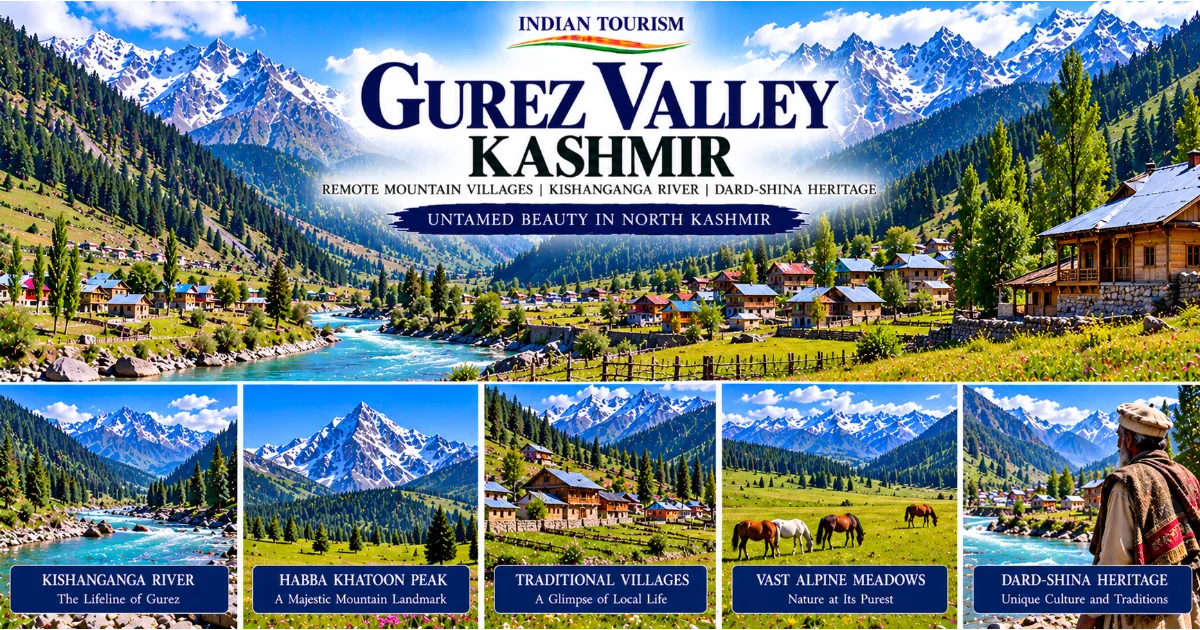
Exploring One of Kashmir's Most Distinctive Mountain Valleys
Far from the busy streets of Srinagar and the familiar tourist centres of Gulmarg and Pahalgam lies Gurez Valley, a remarkable mountain region in northern Kashmir. Surrounded by rugged peaks and shaped by the Kishanganga River, Gurez offers a combination of dramatic scenery, traditional settlements, alpine landscapes and a distinctive cultural identity.
Gurez is particularly appealing to travellers who want to explore a different side of Kashmir. Instead of focusing on lakeside promenades, large gardens or established resort facilities, a journey through Gurez introduces visitors to mountain villages, riverbanks, traditional homes and landscapes that change dramatically with the seasons.
The valley is also important for its cultural heritage. The Dard-Shina communities of the region maintain traditions connected with language, music, food and everyday life in the mountains. Dawar, one of the principal settlements in Gurez, provides a useful base for exploring the surrounding area and understanding the relationship between the valley's communities and their environment.
However, Gurez is not an ordinary short excursion. Its remote location, mountain roads, seasonal weather and proximity to a sensitive border region mean that travellers must plan carefully. Road access can be affected by snowfall and other conditions, while specific locations may have additional access requirements. Current local guidance should always take priority over older travel descriptions.
This guide explores Gurez Valley's geography, landscapes, villages, cultural heritage, seasonal attractions, photography opportunities and practical travel arrangements. It also explains how visitors can experience the region respectfully while supporting local communities and protecting its natural environment.
1. Where Is Gurez Valley Located?
Gurez Valley lies in the northern part of the Kashmir region, within the Bandipora district of Jammu and Kashmir. It is surrounded by the mountains of the western Himalayas and is closely associated with the Kishanganga River, which flows through the valley.
The landscape is shaped by high mountain slopes, narrow river corridors, cultivated patches and settlements positioned along accessible areas of the valley. These geographical features influence transport, agriculture and the distribution of villages.
Gurez is often described as one of Kashmir's more remote destinations because reaching it generally requires a substantial road journey from the Srinagar area. The route traditionally involves travelling through the mountain region around Razdan Pass, although the condition and accessibility of the route vary according to season and weather.
Because the road crosses high terrain, journey times should not be estimated solely from the distance shown on a map. Mountain bends, road conditions, traffic and temporary restrictions can all influence the time required.
The valley's proximity to the Line of Control makes it especially important to follow current official guidance. Visitors should verify whether travel is permitted along their intended route and whether any identification or other requirements apply. Some areas may be restricted, and travellers should never attempt to enter controlled locations without authorisation.
Gurez's geographical setting is central to its appeal. Its remoteness has helped preserve a distinctive atmosphere, but it also means that visitors must be prepared for limited services and changing travel conditions.
2. The Kishanganga River: The Lifeline of Gurez
The Kishanganga River is one of the defining features of Gurez Valley. Its flowing waters connect the settlements and landscapes of the region, creating a striking contrast with the surrounding mountains.
The river's presence influences the appearance and organisation of the valley. Settlements and cultivated areas are often associated with accessible land near the river corridor, while mountain slopes rise steeply on either side. The combination of water, greenery and rugged terrain creates many of the views that make Gurez memorable.
For visitors, the river provides opportunities for photography and quiet observation. Its appearance changes with the weather, season and water flow. On a clear day, the surrounding mountains may be reflected in calmer sections, while faster-moving water creates patterns around rocks and bends.
However, the river should be treated with caution. Water levels and currents can change, and cold mountain water can be dangerous even when the weather feels warm. Visitors should avoid entering the river without suitable facilities and qualified supervision. They should also remain away from unstable banks and follow local safety advice.
The river is important beyond its visual appeal. Water resources support the surrounding environment and contribute to local livelihoods. The wider river system also has ecological significance, so pollution and careless waste disposal can affect both nature and the people who depend on it.
Travellers should never leave plastic bottles, food packaging or other waste along the riverbanks. They should avoid washing items in sensitive water areas and respect any local rules governing access.
The Kishanganga is best appreciated as part of the living landscape of Gurez. Its beauty, ecological value and relationship with the settlements around it make it central to understanding the valley.
3. Dawar: The Main Settlement of Gurez Valley
Dawar is one of the principal settlements in Gurez Valley and serves as an important base for visitors exploring the region. It provides a useful point from which to understand the valley's settlement pattern, local services and surrounding mountain landscape.
Unlike a major tourist city, Dawar has a more rural character. Its streets, homes and everyday activities reflect the needs of a community living in a mountain environment. Visitors may encounter local shops, transport services and accommodation options, although availability should be confirmed before travel.
Dawar is also a practical starting point for learning about the surrounding villages and landscapes. Local residents and knowledgeable guides may help visitors understand which destinations are accessible, how weather affects travel and what cultural considerations are important.
The settlement's relationship with the surrounding mountains is a major part of its appeal. Views change with the time of day, and the valley's scenery can look very different under clear skies, passing clouds or seasonal snowfall.
Visitors should approach Dawar as a living community rather than simply a sightseeing stop. Residential areas should be explored respectfully, and photography of people or private property should be undertaken only with permission.
Travellers should also avoid assuming that every expected service will be available at all times. Because the valley is remote, it is sensible to arrange accommodation, meals and transport in advance where possible.
Spending time in Dawar can help visitors understand the rhythm of life in Gurez. It offers a valuable balance between access to local facilities and proximity to the natural landscapes that define the region.
4. The Mountain Scenery of Gurez
The mountains surrounding Gurez Valley create one of its most distinctive visual features. Rugged ridges, steep slopes and distant peaks form a dramatic backdrop to the river and settlements below.
The appearance of these mountains changes throughout the year. Snow may remain on higher elevations even when lower areas are green, while clouds and shifting light can alter the character of the landscape within minutes.
Travellers who enjoy photography will find opportunities to capture both wide panoramas and smaller details. The contrast between rocky slopes, green patches, river water and traditional buildings gives the scenery considerable variety.
The mountains also influence daily life. They affect road access, seasonal movement, vegetation and the location of settlements. Routes that appear straightforward on a map may involve steep gradients, narrow roads or exposure to changing weather.
Visitors should not attempt unfamiliar mountain routes without appropriate local advice. Even relatively short walks can become difficult when ground conditions are wet or when temperatures fall unexpectedly.
Suitable footwear, warm layers and rain protection are useful for outdoor exploration. Travellers should also carry sufficient drinking water and allow extra time when moving between locations.
The mountains of Gurez are not simply a background for photographs. They form the physical environment within which the valley's communities live and work. Understanding this relationship adds depth to the experience of visiting the region.
5. Habba Khatoon Peak: A Landmark of Gurez
Habba Khatoon Peak is one of the most recognisable natural landmarks associated with Gurez Valley. Its distinctive shape rises above the surrounding landscape, creating a prominent feature that is often included in photographs and descriptions of the region.
The peak is named after Habba Khatoon, the celebrated Kashmiri poet associated with the history and cultural memory of the region. Her story is an important part of Kashmir's literary heritage, and the mountain's name helps connect the natural landscape with regional traditions.
The peak's appearance changes according to weather and light. On clear days, its outline can be sharply visible, while clouds and mist may partially obscure it. Seasonal snow can create a different visual character from the warmer months.
Many visitors appreciate the mountain from accessible viewpoints around the valley rather than attempting a difficult climb. This is often the more appropriate choice for travellers who want to enjoy the scenery without specialised equipment or mountaineering experience.
Any attempt to approach higher slopes should be based on reliable local guidance and a realistic assessment of conditions. Mountain terrain can be hazardous, and a prominent viewpoint should not be mistaken for an invitation to climb without preparation.
Photography is especially rewarding when the peak is viewed in relation to the river, meadows or surrounding settlements. These wider compositions communicate the role of the mountain in the valley's landscape.
Habba Khatoon Peak illustrates how natural landmarks can become part of cultural identity. It is valued not only for its physical appearance but also for its association with poetry, memory and the wider history of Kashmir.
6. Dard-Shina Culture and the Identity of Gurez
Gurez has a distinctive cultural identity associated with the Dard-Shina communities of the region. Their language, oral traditions, music, food and community practices contribute to the valley's character and distinguish it from other parts of Kashmir.
The Shina language belongs to a wider linguistic tradition found in parts of the western Himalayan region. Language is an important carrier of local history because it preserves expressions, stories and knowledge passed between generations.
Visitors interested in culture should seek opportunities to learn from knowledgeable residents and local guides. Conversations about local traditions, seasonal activities and the history of settlements can provide a more meaningful experience than simply photographing the landscape.
Cultural traditions should not be treated as fixed or identical across every household. Individual families and villages may have different practices, and contemporary life continues to change. Travellers should avoid assuming that one person's account represents every member of the community.
Music and oral storytelling are important elements of many mountain cultures. Where visitors encounter performances or cultural gatherings, they should follow local expectations and ask permission before recording people.
Food is another way to understand regional identity. Household cooking reflects available ingredients, family traditions and the conditions of mountain life. Visitors staying in local accommodation may have opportunities to experience regional dishes, depending on the services offered.
Respectful cultural tourism should benefit the people who share their knowledge. Visitors can support legitimate local guides and businesses, while recognising that residents are under no obligation to provide access to private spaces or personal traditions.
Gurez's cultural heritage is an essential part of its appeal. Appreciating it requires curiosity, patience and respect for the people whose traditions continue to shape the valley.
7. Traditional Homes and Village Architecture
The villages of Gurez reflect the practical requirements of life in a mountain environment. Traditional buildings have been shaped by local materials, weather conditions, available resources and the needs of households.
The appearance of homes can vary between settlements and according to the age of the building. Some structures reflect older construction traditions, while others incorporate more modern materials and designs.
Traditional architecture should be understood as a response to local conditions rather than simply as a decorative style. Roof design, wall construction, room arrangement and the relationship between a home and its surroundings can all reflect practical concerns such as cold weather, storage and daily household activities.
Visitors may find village architecture especially interesting when viewed in relation to the landscape. Homes positioned near fields or along the river corridor demonstrate how settlements have developed around available land and access routes.
However, private homes are not public attractions. Travellers should not enter courtyards or photograph interiors without permission. Respect for privacy is particularly important in small communities where visitors may be immediately visible to residents.
Local guides can help explain architectural features without intruding on household life. Where traditional buildings are accessible through a legitimate heritage or community visit, travellers should follow the host's instructions.
The built environment of Gurez continues to evolve. It would be misleading to present the valley as if its communities had remained unchanged over time. Modern needs, education, transport and economic opportunities all influence how people live.
Understanding traditional architecture is therefore part of understanding the wider community. It reveals how people have adapted to their environment while continuing to respond to changing circumstances.
8. Wildlife and the Natural Environment
The mountain landscapes around Gurez contain a range of habitats influenced by elevation, vegetation and seasonal conditions. Forests, meadows, river corridors and rocky slopes can support different forms of plant and animal life.
Visitors interested in nature should approach wildlife observation with patience. Animals may be difficult to see, and their presence can vary by season and habitat. The absence of visible wildlife during a short visit does not mean that the environment lacks ecological value.
Birdwatching may be rewarding where conditions and access permit. Travellers should observe birds from a distance and avoid disturbing nests or using methods that cause unnecessary stress.
Wildlife photography should prioritise animal welfare. Visitors should not feed animals, approach them closely or attempt to attract them for photographs.
The ecological condition of mountain environments can be affected by litter, uncontrolled vehicle movement, disturbance and poorly managed camping. These impacts may be particularly concerning in places where visitor facilities are limited.
Travellers should remain on authorised routes, carry their waste away and follow local guidance about protected or sensitive areas. They should also avoid collecting plants, disturbing natural features or removing stones and other materials.
Because Gurez is a sensitive region, visitors should rely on current local guidance when considering access to natural areas. Some locations may have restrictions for environmental or security reasons.
Protecting the valley's natural environment is important for both biodiversity and local communities. Responsible visitors recognise that the landscape is a shared resource whose value extends beyond tourism.
9. Seasonal Beauty: When to Visit Gurez Valley
Gurez Valley offers different experiences throughout the year, but access conditions can vary considerably. The most suitable season depends on the kind of scenery a traveller wants to experience and the level of travel flexibility available.
Spring: Fresh Growth and Changing Landscapes
Spring brings gradual changes to the valley as temperatures rise and vegetation begins to grow. Lower areas may show fresh greenery while higher slopes remain affected by winter conditions.
Weather can still be unpredictable, and road access may depend on snow clearance and local conditions. Travellers should confirm whether the intended route is open before making firm arrangements.
Summer: The Main Season for Exploring the Valley
Summer is generally the most practical period for many visitors because conditions are often more suitable for road travel and outdoor exploration. The valley's green landscapes, river scenery and mountain views can be particularly attractive.
Accommodation and transport should still be arranged carefully. Remote destinations may have fewer services than established tourist towns, and the availability of facilities can vary.
Visitors should carry warm clothing even during summer because temperatures may fall in the evening or when the weather changes.
Autumn: Cooler Air and Changing Colours
Autumn brings cooler conditions and seasonal changes in vegetation. The landscape may appear different from its summer form, creating new opportunities for photography and relaxed sightseeing.
Travellers should check forecasts and local access information because conditions can become less predictable as winter approaches.
Winter: Snow and Restricted Access
Winter can bring heavy snowfall and difficult road conditions. Access through high mountain routes may be restricted or unavailable for periods of time.
Visitors should not attempt winter travel without reliable current guidance. Remote locations may have limited services, and delays can create safety concerns.
For most conventional sightseeing trips, the warmer travel season is generally more practical. The key is to verify actual conditions rather than relying on a fixed calendar assumption.
10. Photography in Gurez Valley
Gurez offers opportunities for landscape photography, village scenes, river views and images of the surrounding mountains. Its visual appeal comes from the relationship between these elements rather than from one single viewpoint.
Wide-angle photography can communicate the scale of the valley, especially when the river, mountain slopes and settlements appear in the same frame. Closer compositions can reveal details such as traditional buildings, agricultural land and seasonal vegetation.
Habba Khatoon Peak is a popular subject because of its distinctive shape and association with the valley. The surrounding landscape provides several ways to photograph the mountain, depending on access and the weather.
The light can change quickly in mountain environments. Clear skies, passing clouds and mist can all create different effects, so photographers should allow time to observe conditions rather than expecting the same view throughout the day.
Respect for local communities is essential. Visitors should ask before taking close-up photographs of people and should never enter private homes or courtyards to obtain an image without permission.
Photographers should also avoid restricted areas and should not use drones unless all applicable permissions and regulations have been checked.
Safety should take priority over composition. Unstable riverbanks, steep slopes and narrow roads are not appropriate places to stop simply for a photograph.
The strongest travel photographs often communicate the relationship between landscape and everyday life. In Gurez, this means looking beyond dramatic mountains to include the river, settlements and the human presence that gives the valley its identity.
11. Local Food and Hospitality
Food is an important part of experiencing the wider culture of Kashmir, and visitors to Gurez may encounter regional dishes through local accommodation, eateries or household hospitality where arrangements permit.
The food available in a particular location depends on the season, supply arrangements and the services offered. Travellers should not assume that every village has the same menu or that all traditional dishes are available at every establishment.
Visitors interested in local cuisine can ask their hosts or a knowledgeable guide about regional food traditions. This can provide insight into the ingredients, cooking methods and household customs associated with the area.
Kashmiri cuisine includes a variety of rice dishes, breads, vegetables, meat preparations and traditional beverages. However, it is important to distinguish the broader cuisine of Kashmir from the specific food traditions of every community in Gurez.
Travellers should communicate dietary requirements clearly and confirm ingredients when necessary. Anyone with allergies should avoid relying on assumptions about a dish's preparation.
Hospitality can be an important part of travel, but it should be approached respectfully. Visitors should not assume that private households are open to tourists or expect residents to provide meals without prior arrangements.
Where legitimate local businesses are available, supporting them can help distribute tourism income within the community. Fair payment and respectful behaviour contribute to a positive relationship between visitors and residents.
Food experiences are most rewarding when they are approached with curiosity and appreciation for local circumstances.
12. How to Reach Gurez Valley
Reaching Gurez generally involves road travel from the Srinagar area through the mountain region towards Bandipora and onward through the route serving the valley. The exact route and journey time should be confirmed using current local information.
Razdan Pass is traditionally associated with the road journey into Gurez. Because the route crosses high terrain, weather and seasonal conditions can strongly influence accessibility.
Visitors should not rely only on an online map's estimated journey time. Mountain roads, bends, traffic, roadwork and temporary restrictions can all affect the trip.
A suitable vehicle and an experienced driver familiar with the route can make the journey more manageable. Travellers should confirm the arrangements before departure and avoid attempting difficult mountain driving without appropriate experience.
Road access can be affected by snowfall and other adverse weather, particularly during colder months. Travellers should check the latest official guidance before setting out and should be prepared to postpone the journey if conditions are unsuitable.
Because Gurez is close to a sensitive border region, access requirements may apply. Visitors should verify any permissions, identification requirements and local restrictions relevant to their intended route.
It is wise to allow extra time and avoid a schedule that depends on reaching the destination at an exact hour. Delays are possible, and safety should take priority over completing an itinerary.
The road journey is part of the experience, but it should be approached with preparation and respect for the conditions.
13. Accommodation and Travel Facilities
Accommodation in Gurez may be more limited than in major tourist centres such as Srinagar or Gulmarg. Visitors should confirm available options before travelling, especially if they intend to stay overnight.
Dawar can serve as a practical base, depending on the services available during the visit. Travellers may find local accommodation options, but facilities, meal arrangements and standards can vary.
Visitors should ask about heating, water availability, meals, transport and the distance to the locations they wish to explore. Those travelling with children, older family members or people with accessibility requirements should make these checks particularly carefully.
Food and other supplies may not be available everywhere, so it is sensible to plan ahead. Travellers should carry essential personal items and avoid relying on last-minute purchases in remote locations.
Mobile connectivity can vary across the valley. Visitors should keep important travel information available offline where possible and should not assume that online navigation will work continuously.
A longer stay can provide more time to experience the valley's scenery, but the itinerary should remain flexible. Weather and road conditions may affect plans, and visitors should avoid scheduling several remote excursions in a single day.
Travellers should also confirm the current operating status of accommodation and transport providers rather than relying on older listings.
Good preparation makes it easier to enjoy the region without placing unnecessary pressure on local services or creating avoidable difficulties.
14. A Suggested Three-Day Gurez Valley Itinerary
A three-day visit can provide a useful framework for exploring Gurez, provided that access is confirmed and the journey is suitable for the planned dates. The following outline should be adapted to current local conditions.
Day One: The Road Journey and Arrival in Dawar
Begin with a road journey from the chosen starting point after confirming that the route is open and suitable for travel. Allow sufficient time for mountain driving and possible delays.
After arriving in Dawar, settle into the accommodation and take time to understand the surrounding area. If conditions and daylight permit, enjoy a relaxed walk in an authorised area and observe the relationship between the settlement, river and mountains.
Avoid planning demanding activities on the day of arrival. The road journey may be long, and rest is important before further exploration.
Day Two: River Scenery and Mountain Views
Use the second day to explore accessible parts of the valley. Depending on local guidance, visitors may be able to enjoy river views, village scenery and viewpoints from which Habba Khatoon Peak is visible.
A knowledgeable local guide can help identify suitable locations and explain the cultural context of the landscape.
Visitors should avoid entering restricted areas or approaching the river in unsafe conditions. If weather changes, choose a shorter outing rather than attempting to complete every planned stop.
Day Three: Local Experiences and Return Journey
Spend the final morning enjoying the accessible scenery around the accommodation or exploring a permitted village area.
If local services are available, consider learning about regional traditions through a legitimate guide or community business. Be respectful of privacy and avoid treating private household life as a tourist attraction.
Begin the return journey with enough time to account for road conditions and delays. Do not extend the morning itinerary so far that the drive becomes rushed.
This is a general planning framework rather than a guarantee that particular attractions will be accessible. Visitors should use current local guidance to determine the final itinerary.
15. Safety and Practical Advice for Travellers
Gurez is a remote mountain destination, so careful preparation is essential.
Weather should be checked before departure and monitored during the visit. Conditions can change rapidly, and cold temperatures or rain may affect comfort and road safety.
Travellers should carry identification and confirm any required travel documents or permissions. They should follow official guidance concerning restricted areas and avoid entering controlled locations without authorisation.
Road journeys require patience. Drivers should maintain safe speeds, follow local instructions and avoid unfamiliar mountain routes after dark whenever possible.
Visitors should be cautious near the Kishanganga River. Strong currents and cold water can create hazards even where the river appears calm. Unauthorised swimming or river crossings should be avoided.
Outdoor walks should be chosen according to ability and local conditions. Visitors should use suitable footwear and avoid setting out on unfamiliar routes without appropriate guidance.
Because connectivity may be limited in some areas, travellers should keep important information available offline and inform a trusted person of their plans where appropriate.
Visitors should also plan for basic needs, including drinking water, warm clothing and essential personal supplies. Those with medical or accessibility requirements should make arrangements before leaving major towns.
If access is restricted or conditions become unsafe, changing the itinerary is the responsible decision. The purpose of the trip is to experience the valley, not to overcome every obstacle.
16. Responsible Tourism in Gurez Valley
Responsible tourism is especially important in Gurez because its natural landscape and local communities are central to its appeal.
Visitors should carry away all rubbish and avoid leaving plastic or food waste along riverbanks, meadows and roadsides. Waste management can be more difficult in remote locations, making personal responsibility particularly important.
Local customs and community privacy should be respected. Travellers should ask permission before photographing people, avoid entering private property and follow instructions at religious or community sites.
Tourism can provide opportunities for local guides, transport providers, accommodation owners and other businesses. Where legitimate options are available, supporting them can help spread the benefits of travel.
However, visitors should not assume that every remote village is prepared to receive large numbers of tourists. The pace and scale of tourism should reflect local facilities, environmental conditions and community preferences.
Natural habitats should be treated carefully. Visitors should remain on authorised routes, avoid disturbing wildlife and refrain from collecting plants or other natural materials.
Content creators should describe access conditions accurately. A photograph showing a beautiful landscape should not encourage people to ignore local restrictions or assume that every area is freely accessible.
Responsible tourism is ultimately about recognising that Gurez is both a destination and a home. Protecting its environment and respecting its residents help preserve the qualities that make the valley special.
Conclusion: Experiencing the Natural and Cultural Heritage of Gurez
Gurez Valley offers a distinctive combination of mountain scenery, river landscapes, traditional settlements and cultural heritage. The Kishanganga River provides a central feature of the landscape, while Dawar offers an important base for understanding the valley's communities and everyday life.
Habba Khatoon Peak adds a recognisable natural landmark and a connection with Kashmir's literary memory. The wider landscape of forests, meadows and mountains provides opportunities for photography, nature observation and a slower style of travel.
The valley's remoteness is part of its appeal, but it also demands careful planning. Visitors should confirm road access, check current local guidance, arrange suitable transport and understand any permissions or restrictions that apply.
Cultural experiences are most meaningful when approached with respect. Learning about the Dard-Shina heritage, local architecture and regional traditions can deepen a visit, while supporting legitimate local businesses can help ensure that tourism benefits nearby communities.
The natural environment also deserves protection. Visitors should avoid littering, respect wildlife and follow local instructions about sensitive areas.
Gurez is not simply another mountain destination to add to a checklist. It is a landscape where geography, culture and community life are closely connected. Travelling thoughtfully allows visitors to appreciate that relationship while helping preserve the valley for future generations.
#IndianTourism #JammuAndKashmir #GurezValley #KashmirTourism #ExploreKashmir #NorthKashmir #Bandipora #Dawar #KishangangaRiver #HabbaKhatoonPeak #DardShinaCulture #MountainVillages #HimalayanLandscapes #OffbeatKashmir #HiddenGemsOfKashmir #NatureTourism #CulturalTourism #ResponsibleTourism #SustainableTravel #ExploreIndia

