
A Hidden Cultural Treasure in the Himalayas
Himachal Pradesh is home to some of India's most remarkable mountain landscapes, from green valleys and dense forests to barren high-altitude deserts shaped by wind, snow and time. While destinations such as Shimla, Manali and Dharamshala attract large numbers of visitors, the remote valleys of Spiti offer a very different experience. Here, the mountains rise above ancient villages, Buddhist monasteries preserve centuries-old traditions, and traditional houses stand against a landscape that can appear almost otherworldly. Among these distinctive settlements is Gue Village, a small Himalayan village known for its cultural heritage, striking surroundings and an unusual historical discovery that has attracted visitors from across India and beyond.
Gue lies in the Spiti region of Himachal Pradesh, close to the international border with Tibet. Its remote setting has helped preserve a distinctive cultural atmosphere, shaped by Buddhist traditions, mountain agriculture and the challenges of living at high altitude. The village is not a conventional hill station with shopping streets, large hotels and organised entertainment. Its appeal lies in its history, religious heritage, traditional architecture and the opportunity to experience a quieter side of the Himalayas.
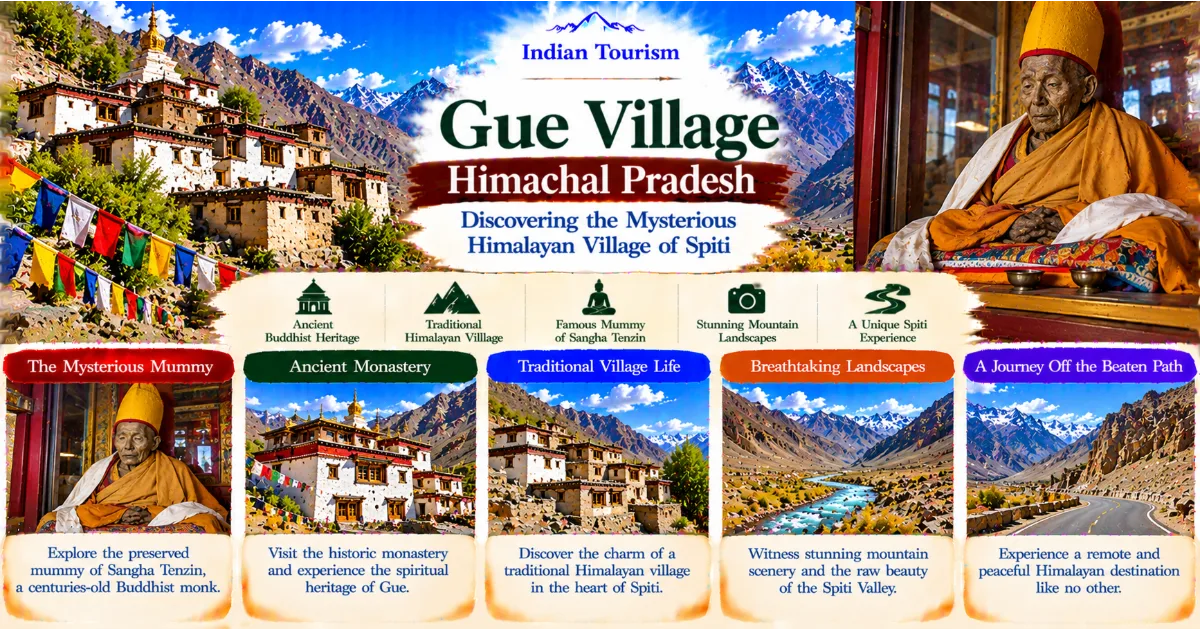
The most widely recognised attraction associated with Gue is the mummy of a Buddhist monk preserved in a small structure near the village. The discovery has generated considerable curiosity because of the unusual preservation of the body and the stories associated with the monk. The remains are commonly linked with a monk known as Sangha Tenzin, believed to have lived several centuries ago. Although popular accounts sometimes describe the preservation in dramatic terms, visitors should distinguish between established historical information, local traditions and explanations that have not been conclusively verified.
Beyond this unusual attraction, Gue is a living Himalayan settlement with its own rhythms and traditions. The village reflects the wider cultural character of Spiti, where Buddhist religious practices, community relationships and adaptation to a difficult environment remain important parts of everyday life. The surrounding mountains and dry valleys create a dramatic setting for exploring the region's cultural landscape.
A visit to Gue is most rewarding when it forms part of a wider journey through Spiti Valley. Travellers can combine the village with other destinations known for monasteries, traditional settlements and high-altitude scenery. The experience encourages visitors to look beyond famous viewpoints and understand how history, faith and geography have shaped life in this remote part of Himachal Pradesh.
Where Is Gue Village Located?
Gue Village is situated in the Spiti region of Himachal Pradesh, within the high-altitude landscape of the western Himalayas. It lies in a remote area near the India-Tibet border and is accessed by road through the mountainous terrain of the wider Spiti region.
Spiti is often described as a cold desert because of its limited rainfall, sparse vegetation and dramatic temperature differences. The surrounding mountains create a landscape of rocky slopes, deep valleys and open terrain where water and fertile land are valuable resources. Settlements have traditionally developed in places where the geography permits cultivation and provides access to water.
Gue reflects these environmental conditions. The village is surrounded by rugged mountain scenery, and the settlement's traditional buildings form a small human presence within a much larger landscape. The contrast between the village and the barren mountains is one of the distinctive visual features of this part of Spiti.
The region's elevation affects nearly every aspect of travel. Visitors may experience strong sunlight during the day, cold temperatures in the evening and rapid changes in weather. Travellers arriving from lower elevations should allow time to acclimatise and avoid strenuous activity immediately after reaching high-altitude areas.
Gue is also relatively remote compared with major tourist centres. Facilities may be limited, and travellers should not assume that accommodation, restaurants, fuel or medical services will be available within the village itself. Planning a visit as part of a broader Spiti itinerary is generally more practical than treating Gue as a destination with extensive tourist infrastructure.
The village's location gives it a special character. It offers a chance to explore a part of Himachal Pradesh where traditional communities continue to live in close relationship with the landscape, while the mountains provide a dramatic backdrop to both everyday life and historical landmarks.
The Story Behind the Mummy of Gue
The mummy associated with Gue Village is the principal reason many travellers first hear about this remote settlement. The preserved body is commonly identified as that of Sangha Tenzin, a Buddhist monk believed to have lived several centuries ago. Its unusual state of preservation has led to interest among historians, religious visitors and travellers fascinated by unexplained historical discoveries.
The remains are displayed in a small structure associated with the village. The site has become a distinctive destination within Spiti because preserved human remains are uncommon attractions in the region's tourism landscape. Visitors often arrive with questions about the monk's identity, the age of the remains and the circumstances that led to their preservation.
Popular descriptions sometimes state that the monk deliberately mummified himself through an extreme religious practice. Other accounts suggest that environmental conditions may have contributed to the body's preservation. Without comprehensive, publicly available scientific evidence establishing every detail, it is important not to present a single explanation as unquestionably proven.
The high-altitude environment of Spiti is characterised by cold temperatures, dry air and low humidity during parts of the year. Such conditions can influence the decomposition of organic material. However, the precise processes involved in preserving a particular body depend on multiple factors, including burial or exposure conditions, temperature, moisture and the treatment of the remains.
The monk's story also occupies a place within local narratives and popular interpretations of Buddhist religious life. These stories contribute to the site's cultural significance, but they should be understood in the context of traditions and historical uncertainty rather than treated as substitutes for documented research.
For visitors, the mummy is best approached as a subject of historical and cultural interest. It invites questions about religious practice, preservation, local memory and the ways unusual discoveries become part of a region's identity.
Visitors should behave respectfully at the site. Human remains deserve dignity, and the location should not be treated as a place for jokes, intrusive photography or sensational behaviour. Observing local rules and following any restrictions around the display helps protect the dignity of the remains and the interests of the community.
Who Was Sangha Tenzin?
Sangha Tenzin is the name commonly associated with the preserved monk of Gue. Accounts of his life connect him with Buddhist religious practice in the Himalayan region, although many details of his biography are not firmly established in widely accessible historical documentation.
The monk's identity has become closely linked with the village because the preserved remains represent an unusual physical connection with the region's religious past. Visitors interested in the story often want to know when he lived, how he died and why his body was preserved.
Some popular accounts associate him with an ascetic religious practice in which a monk attempted to preserve his body through a process involving extreme fasting. Such descriptions should be approached cautiously unless supported by reliable historical or scientific evidence. The exact circumstances of his death and preservation should not be assumed solely from repeated retellings.
The broader context is important. Buddhism has a long history in Himalayan regions, and monastic communities have played significant roles in education, ritual practice, artistic traditions and the preservation of religious knowledge. Individual monks may become important figures in local memory because of their spiritual reputations, their relationship with a monastery or unusual events associated with their lives.
In Gue, the preserved remains have become a focal point for interest in the village's Buddhist heritage. The story illustrates how religious memory and physical evidence can become intertwined, even when some historical details remain uncertain.
Visitors can appreciate the cultural importance of Sangha Tenzin's story without requiring every question to have a definitive answer. Responsible historical interpretation recognises the distinction between what is documented, what is believed locally and what remains unknown.
The most meaningful approach is to regard the monk as part of the wider history of religious life in Spiti, while continuing to respect the uncertainty surrounding the precise details of his life and death.
The Buddhist Heritage of Spiti Valley
Gue's cultural identity cannot be separated from the Buddhist traditions that have shaped Spiti for generations. The region's monasteries, prayer spaces, religious festivals and community practices form an important part of its historical and contemporary character.
Buddhism spread through different Himalayan regions over many centuries, creating networks of religious institutions and cultural exchange. Spiti's proximity to Tibet helped establish strong connections with Tibetan Buddhist traditions, which remain visible in religious architecture, ritual practices and local artistic expression.
Monasteries in Spiti have historically served multiple purposes. They provide spaces for prayer and meditation, preserve religious texts and images, and support the transmission of knowledge between generations. In many settlements, monasteries also function as important community institutions where religious observances bring people together.
The cultural landscape includes prayer flags, mani walls, chortens and sacred images. These features are not merely decorative elements for visitors. They reflect religious beliefs and practices that continue to hold meaning for local communities.
Gue offers an opportunity to understand this wider cultural setting. The mummy attracts attention because it is unusual, but the village's significance extends beyond a single attraction. Its relationship with Buddhist heritage provides a broader context for understanding the values and traditions that have shaped life in Spiti.
Visitors exploring the region should approach monasteries and religious sites with respect. Appropriate behaviour may include removing footwear where requested, walking in designated directions around sacred structures and refraining from touching religious objects.
Photography rules can vary between sites, and permission should be sought when uncertain. During religious ceremonies, visitors should avoid interrupting proceedings or moving into restricted areas.
Learning about the Buddhist heritage of Spiti helps transform a visit from simple sightseeing into a more meaningful cultural experience. It also encourages travellers to recognise that religious traditions remain a living part of the region rather than a relic of the past.
Traditional Architecture and Village Life in Gue
Traditional settlements in Spiti reflect generations of adaptation to a high-altitude environment where building materials, weather and access to resources influence architectural design. Houses are generally constructed to provide shelter from cold winters, strong winds and large seasonal temperature changes.
Traditional buildings in the region often make use of locally available materials, including earth, stone and timber where available. Their construction reflects practical knowledge developed through experience with the environment. Thick walls can help moderate indoor temperatures, while compact building forms reduce exposure to harsh weather.
Gue's village setting provides an opportunity to observe the relationship between homes, agricultural land and the surrounding mountains. Buildings are part of a working settlement rather than a purpose-built tourist attraction. Their arrangement reflects the needs of residents and the limitations imposed by the terrain.
Agriculture has historically played an important role in Spiti's economy. The growing season is short, and cultivation depends on suitable land, water availability and careful seasonal planning. Barley, peas and other crops adapted to local conditions are important in the wider region.
Household life also reflects seasonal changes. Warmer months provide opportunities for agricultural work, construction and travel, while winter brings colder conditions and different patterns of daily activity. Modern transport, education and employment have changed many aspects of village life, but the environment continues to influence local routines.
Visitors should remember that the village is a private residential space. Houses, courtyards and agricultural fields should not be entered without permission. Photography should be respectful, particularly when residents are engaged in daily activities.
Observing traditional architecture can help travellers understand how communities have adapted to their surroundings. It also highlights the relationship between local knowledge and environmental conditions, which remains an important part of Spiti's cultural heritage.
The Landscape Surrounding Gue
The landscape around Gue is one of the defining features of the village experience. Spiti's mountains create a striking environment of rocky ridges, open valleys and sparsely vegetated slopes. The terrain appears different from the green forests and meadows associated with many other parts of Himachal Pradesh.
The region's cold-desert character is partly shaped by its position in the rain shadow of the Himalayas. Moisture from the monsoon is limited, leaving much of the landscape dry for large parts of the year. This creates a distinctive combination of high mountains, clear skies and rugged terrain.
Colours change according to season and lighting. The mountains may appear grey, brown or golden under the sun, while snow can cover higher elevations. Shadows moving across the slopes create dramatic contrasts, particularly during early morning and late afternoon.
The sparse vegetation also reveals the relationship between climate and settlement. Cultivated areas tend to be concentrated where water and suitable soil are available, creating green patches within a predominantly dry landscape.
Photography enthusiasts may appreciate the contrasts between traditional village buildings and the mountains beyond. However, safe access should always take priority over finding a dramatic viewpoint. Visitors should avoid unstable slopes, unmarked tracks and road edges where stopping would create a hazard.
The surrounding landscape is not only visually impressive but also central to understanding the lives of local residents. Water management, agricultural practices, transport and building design all reflect the constraints and opportunities created by the environment.
Exploring Gue with an appreciation of this relationship helps visitors see the village as part of a larger ecological and cultural system rather than as an isolated tourist attraction.
Best Time to Visit Gue Village
The best time to visit Gue depends on road access, weather conditions and the wider itinerary through Spiti Valley. Because the village lies in a high-altitude region, seasonal differences can significantly affect the journey.
Summer: The Most Practical Season
Summer is generally the most practical period for exploring Spiti. Road access is often more reliable than during the coldest months, and daytime conditions can be suitable for village visits and outdoor sightseeing.
The landscape may show cultivated green patches around settlements, creating a contrast with the surrounding dry mountains. Visitors can explore the village, learn about its history and combine the visit with other cultural destinations in the region.
Even during summer, nights can be cold, and sudden weather changes are possible. Travellers should carry warm clothing and check road conditions before beginning the journey.
Early Autumn: Clear Mountain Views
Early autumn can offer attractive conditions for photography and sightseeing. The air may be clear, and the changing light can highlight the details of the surrounding mountains.
Temperatures begin to fall as winter approaches, particularly after sunset. Travellers should confirm accommodation and transport arrangements and avoid relying on assumptions about road access.
Spring: Variable Conditions
Spring is a transition period in the Himalayas. Snow clearance, weather and road conditions vary from year to year, and some routes may remain difficult to access.
Travellers considering a spring visit should check reliable local and official information before departure. Flexibility is important because conditions can change quickly.
Winter: A Challenging Time for Travel
Winter brings severe cold and the possibility of snow and road disruption in high-altitude parts of Himachal Pradesh. Some services may be unavailable, and journeys can become more difficult.
A winter visit should only be planned after careful consideration of current access, accommodation and safety arrangements. Travellers should not assume that the village or its attractions will be accessible throughout the season.
For most visitors, the warmer travel season offers the best balance of accessibility and comfort. The precise dates should be chosen according to current road conditions rather than a fixed calendar alone.
How to Reach Gue Village
Reaching Gue requires planning because the village lies in a remote part of Spiti. The most suitable route depends on the starting point, season and condition of the mountain roads.
From Shimla and the Kinnaur Route
One way to reach Spiti is through the Kinnaur region. Travellers may journey from Shimla towards Reckong Peo and continue through the mountain settlements that connect with the wider Spiti region.
This route passes through dramatic mountain terrain and offers opportunities to observe the gradual transition into the cold-desert landscape. Travel times can be long because of winding roads, roadwork and local conditions.
Travellers should confirm the condition of the route before departure and avoid planning long mountain drives late into the evening.
From Manali and the Atal Tunnel Route
Another route into the wider Spiti region begins from Manali and proceeds through the Atal Tunnel towards Lahaul. Depending on seasonal conditions and the intended destination, travellers may continue towards routes connecting with Spiti.
Access to high mountain roads can vary considerably, particularly where snow and weather affect the route. The route through Manali should not be assumed to be open for the entire year.
Before choosing this approach, travellers should verify which roads are open and whether the planned journey is suitable for their vehicle and schedule.
From Kaza
Kaza is the principal town and a common base for exploring Spiti Valley. Travellers can plan a visit to Gue as part of a regional itinerary, subject to road conditions and local transport availability.
A locally arranged taxi may offer flexibility for reaching smaller settlements. Visitors should agree on the route, expected waiting time and return arrangements before beginning the trip.
Public Transport and Private Vehicles
Public transport may operate along some parts of the wider regional road network, but schedules and availability can be limited. Travellers should confirm current services rather than assume that convenient connections will be available.
Private vehicles provide greater flexibility, but driving in remote mountain areas requires experience and careful preparation. Drivers should check fuel availability, road conditions and weather forecasts before travelling.
Organised Tours
Organised tours can be useful for visitors unfamiliar with the region. A tour operator may assist with transport, accommodation and itinerary planning.
Before booking, confirm whether Gue is included, how much time is allocated to the village and whether the visit includes other destinations. Travellers should also ask how the operator handles road closures or unexpected weather.
Places to Visit Near Gue
Gue can be included in a wider journey through Spiti Valley, where historic monasteries, traditional villages and dramatic landscapes provide a varied travel experience.
Tabo
Tabo is one of the most important cultural destinations in Spiti. Its monastery is widely recognised for its historical significance and traditional Buddhist art. The complex provides insight into the development of Buddhist religious institutions in the western Himalayas.
Visitors interested in history and architecture can spend time learning about the monastery's heritage and the wider cultural landscape of the village.
Dhankar
Dhankar is known for its dramatic setting above the confluence of the Spiti and Pin rivers. The historic monastery and old settlement occupy a striking position within the mountains.
Visitors should take care when exploring paths and viewpoints, particularly where terrain is steep or exposed. Access to specific areas may be affected by weather and local conditions.
Kaza
Kaza serves as a practical base for exploring many parts of Spiti. It provides more services than smaller villages and can be useful for arranging accommodation, meals and transport.
Travellers can use Kaza to plan day trips and gather current information about road access and local conditions.
Langza
Langza is known for its mountain setting, traditional settlement and distinctive high-altitude landscape. The village is often included in itineraries focused on Spiti's cultural and natural attractions.
Visitors should respect local land and avoid disturbing fossils or other geological material. Collecting protected or culturally significant objects is inappropriate.
Komic
Komic is a high-altitude village associated with traditional settlement patterns and Buddhist heritage. Its remote setting offers insight into the challenges of living in the high Himalayas.
Travellers should allow time for acclimatisation before visiting high-altitude destinations and should not rush between villages.
Hikkim
Hikkim is widely known among travellers for its post office, which has become a popular stop on regional itineraries. The village also offers mountain scenery and a glimpse of life in a remote settlement.
Opening arrangements and available services may vary, so visitors should confirm details before travelling specifically for a particular attraction.
Pin Valley
Pin Valley offers a different landscape within the wider Spiti region, with dramatic mountains, river scenery and traditional villages. It is also associated with distinctive wildlife and protected natural areas.
Visitors should follow local conservation guidance and avoid disturbing wildlife or leaving waste behind.
Combining Gue with these destinations allows travellers to experience different aspects of Spiti's cultural heritage and landscape without treating any single attraction as the entire story of the region.
Photography Opportunities in Gue
Gue offers opportunities for cultural and landscape photography, particularly for visitors interested in traditional architecture and the relationship between a village and its mountain environment.
The village's buildings provide visual contrasts with the surrounding rocky terrain. Travellers can photograph the settlement from suitable public areas, paying attention to how the houses, roads and cultivated land fit into the landscape.
The preserved monk is a sensitive subject. Visitors should follow all rules governing photography at the site and avoid taking pictures if photography is prohibited. Human remains should be treated with dignity rather than used for sensational or disrespectful content.
Morning and late afternoon may offer attractive light for landscape photography, although the best conditions depend on cloud cover and the season. Visitors should avoid standing in dangerous locations or blocking roads to capture a photograph.
Portrait photography should always be undertaken with permission. Residents are not tourist attractions, and visitors should not assume that people want to be photographed.
A thoughtful approach to photography can help document the cultural and natural character of Gue while respecting the privacy of its residents and the significance of its religious heritage.
Local Food and Culinary Traditions of Spiti
Food in Spiti reflects the region's climate, agricultural conditions and cultural connections with neighbouring Himalayan areas. Traditional cooking has developed around ingredients that can be cultivated, stored or transported in a region where winters are long and the growing season is short.
Barley has historically been an important crop in parts of the region, while peas and other vegetables contribute to local diets where growing conditions permit. Foods influenced by Tibetan and wider Himalayan traditions are also found in the region.
Thukpa, a noodle soup, and momos are familiar dishes in many Himalayan destinations, including parts of Himachal Pradesh. However, the availability of specific dishes varies by village and establishment. Visitors should not assume that Gue itself will have a restaurant or a wide range of food options.
Travellers should arrange meals around confirmed services in larger settlements where necessary. Carrying suitable snacks and drinking water is sensible, especially when visiting remote areas.
Trying regional food can provide insight into how communities adapt their diets to climate and available ingredients. Visitors can ask about local dishes when suitable opportunities arise, while recognising that residents may not have time to explain or demonstrate their cooking traditions.
Food is one part of a broader cultural experience that includes architecture, religion, agriculture and community life. Approaching it with curiosity and respect helps travellers gain a more complete understanding of Spiti.
Responsible Tourism in Gue
Responsible tourism is especially important in remote villages where infrastructure is limited and cultural traditions remain closely connected with daily life. Visitors can help protect Gue's heritage by treating the village as a living community rather than an attraction created solely for tourism.
The site associated with the mummy should be approached respectfully. Visitors should follow instructions about entry, photography and behaviour. The preserved remains have historical and cultural significance and should not be treated as an object for jokes or intrusive conduct.
Waste management is another important responsibility. Carry rubbish until appropriate disposal facilities are available, and never leave plastic packaging, bottles or food waste in the village or surrounding landscape.
Visitors should respect private property and avoid entering homes, courtyards or agricultural areas without permission. Photography of residents should be undertaken only after seeking consent.
Water is a valuable resource in Spiti's dry environment. Travellers should use water responsibly and avoid polluting streams or irrigation channels.
Supporting legitimate local businesses can help tourism contribute to the regional economy. However, travellers should not assume that every village has commercial facilities or that residents are obliged to provide services.
Respectful travel also requires flexibility. Religious sites may be closed at certain times, weather may disrupt journeys and local priorities may differ from visitor expectations. Accepting these realities is part of travelling responsibly.
Accommodation and Facilities
Gue is a small settlement, so visitors should not expect the same range of accommodation and services found in larger tourist towns. Facilities may vary by season, and travellers should confirm availability before planning an overnight stay.
Kaza and other larger settlements in Spiti may provide more practical options for accommodation, meals and transport. Choosing a suitable base can make it easier to explore Gue and other destinations without relying on limited village facilities.
Before booking accommodation, travellers should ask about room availability, meals, heating, sanitation and transport arrangements. Even during summer, nights can be cold at high altitude.
Visitors should also consider access to medical services, fuel and emergency assistance. It is sensible to carry personal medication and essential supplies rather than assuming that every item will be available locally.
Mobile connectivity and internet access may be inconsistent. Downloading offline maps, keeping important information accessible and informing someone of the planned itinerary can improve preparedness.
If suitable accommodation cannot be confirmed in Gue, a day visit from another settlement may be more practical. This allows travellers to explore the village while avoiding unnecessary uncertainty about overnight facilities.
A Suggested Three-Day Itinerary Including Gue
Day One: Arrive in Spiti and Acclimatise
Arrive in a suitable base such as Kaza, depending on the route and current travel conditions. Keep the first day relatively relaxed, particularly if you have recently travelled from a lower elevation.
Spend time settling into the accommodation, drinking water regularly and observing how your body responds to the altitude. Avoid strenuous activity if you feel unwell.
Use the day to confirm transport arrangements and gather current information about road access to Gue and nearby destinations.
Day Two: Explore Gue Village
Begin the journey after checking weather and road conditions. Travel to Gue using a reliable local transport arrangement or a suitable private vehicle.
Explore the village respectfully and visit the site associated with the preserved monk if it is open. Follow all local rules, particularly regarding photography and access.
Allow time to observe the settlement and surrounding landscape rather than rushing through the village. Return to the planned base with sufficient daylight and time for unexpected delays.
Day Three: Discover Spiti's Cultural Heritage
Depending on road conditions and your interests, consider visiting Tabo, Dhankar or another suitable destination in the region.
Tabo may appeal to visitors interested in Buddhist art and monastic history, while Dhankar offers a dramatic setting and a different perspective on Spiti's cultural landscape.
Avoid trying to include too many destinations in one day. Mountain travel can take longer than expected, and a relaxed itinerary allows more time for cultural exploration.
This itinerary is a planning framework rather than a guarantee of travel times or site access. Confirm current conditions and adjust the route according to weather, health and local advice.
Is Gue Suitable for Families and First-Time Visitors?
Gue can be a rewarding destination for families and first-time visitors who are interested in Himalayan culture and history. The preserved monk offers a distinctive point of historical curiosity, while the village and surrounding landscape provide opportunities to learn about life in a remote mountain region.
However, the journey requires preparation. High altitude, cold weather, long road journeys and limited facilities may be challenging for some travellers. Families with young children should plan adequate rest and avoid rushing through the itinerary.
First-time visitors to Spiti should familiarise themselves with altitude-related precautions and consider spending time acclimatising before visiting higher destinations. Anyone who develops concerning symptoms should stop ascending and seek appropriate medical advice.
Children can learn about cultural heritage through respectful observation and age-appropriate explanations. Parents should explain why religious sites and human remains deserve respectful treatment.
Visitors who require extensive medical support, specialised accommodation or predictable transport arrangements should assess the suitability of the journey carefully before departure.
For prepared travellers, Gue can provide a valuable introduction to the cultural diversity of the Himalayas. The key is to balance curiosity with realistic expectations and responsible planning.
Health and Safety Advice for Travellers
High altitude is one of the most important considerations when visiting Spiti. Travellers arriving from lower elevations should allow time to acclimatise and avoid strenuous activity immediately after reaching high-altitude areas.
Symptoms of altitude illness may include headache, nausea, dizziness and unusual fatigue. Severe or worsening symptoms, confusion, difficulty walking normally or breathlessness at rest require urgent medical attention and may require descent to a lower elevation.
People with relevant medical conditions should consult a qualified healthcare professional before planning high-altitude travel. Being physically fit does not eliminate the risk of altitude illness.
Mountain weather can change rapidly. Carry warm layers, suitable footwear, sun protection and rain or snow protection appropriate to the season. Strong sunlight can be intense at high altitude, even when the air feels cold.
Road conditions should be checked before every significant journey. Landslides, snow, roadwork and other hazards can affect travel. Avoid unnecessary night driving and follow local instructions.
Carry drinking water, food, personal medication and essential emergency supplies. Mobile connectivity may be unreliable, so do not rely entirely on internet access for navigation or emergency communication.
The most important safety principle is flexibility. If weather, health or road conditions make the planned journey unsafe, postpone the visit or change the itinerary.
Budget Planning for a Visit to Gue
The total cost of visiting Gue depends on your starting point, travel method, group size, accommodation choices and the number of days spent exploring Spiti.
Transport can represent a significant portion of the budget because journeys involve long distances and mountain roads. Private vehicles offer flexibility, while locally arranged taxis or organised tours may reduce the need to manage route planning independently.
Accommodation costs depend on the chosen base and the season. Larger settlements may offer more options than small villages, but availability and prices should be confirmed before departure.
Food expenses vary according to where travellers eat and the availability of services along the route. Carrying suitable snacks can be useful during long journeys.
A contingency budget is important because weather and road conditions can cause delays or require changes to accommodation and transport plans.
Travellers should also consider the value of allowing enough time for acclimatisation. A rushed itinerary may appear cheaper on paper but can create unnecessary stress and reduce the quality of the experience.
Planning a realistic budget helps visitors explore Gue and the wider Spiti region comfortably while supporting legitimate local services where available.
Common Mistakes to Avoid When Visiting Gue
One common mistake is assuming that the village has extensive tourist infrastructure. Gue is remote, and accommodation, food and transport arrangements should be checked in advance.
Another mistake is treating the mummy as a sensational curiosity without acknowledging its human and cultural significance. Visitors should follow local rules and behave respectfully at the site.
Travellers should also avoid repeating popular claims about the monk as established fact when reliable evidence is limited. The story is fascinating, but responsible interpretation recognises the distinction between historical documentation, local traditions and unverified explanations.
Ignoring altitude precautions can create serious problems. Visitors should acclimatise appropriately and avoid continuing to higher elevations if symptoms of altitude illness develop.
Unrealistic driving schedules are another frequent problem. Mountain roads require patience, and weather or roadwork can increase journey times considerably.
Visitors should not enter private property, photograph residents without permission or leave rubbish behind. These actions can damage relationships with local communities and undermine responsible tourism.
Finally, travellers should avoid assuming that a destination will be accessible simply because it appears on a map or in an older travel itinerary. Current road and weather information should guide the final decision.
Why Gue Deserves a Place on Your Himachal Pradesh Travel List
Gue offers a different perspective on Himachal Pradesh. Instead of the busy markets and commercial attractions of major hill stations, the village provides a quieter setting shaped by traditional settlement patterns, Buddhist heritage and the dramatic landscape of Spiti.
The preserved monk is an unusual attraction that naturally draws attention, but it is only one part of the village's story. Gue also provides an opportunity to consider the history of Buddhist communities, the role of religious institutions and the challenges of living in a high-altitude environment.
For culture enthusiasts, the village offers a distinctive subject for learning and reflection. For photographers, its traditional buildings and rugged surroundings create striking visual contrasts. For slow travellers, the quiet setting provides an opportunity to explore at a measured pace.
Gue is not necessarily the right destination for travellers who expect extensive facilities or a highly commercial tourist experience. Its appeal depends on curiosity, preparation and an appreciation of remote mountain communities.
When included in a wider Spiti itinerary, the village can become part of a meaningful journey through one of the most distinctive cultural landscapes in Himachal Pradesh.
Conclusion: Discovering the History and Mystery of Gue Village
Gue Village stands out among the destinations of Himachal Pradesh because of its unusual historical attraction, Buddhist heritage and remote Himalayan setting. Its association with the preserved monk Sangha Tenzin has attracted widespread interest, while the wider village offers a deeper view of life in Spiti.
The story of the mummy remains fascinating, but it should be approached with care. Some details about the monk's life and the preservation of his body are uncertain, and popular explanations should not automatically be treated as proven historical facts.
Beyond this mystery, Gue reflects the cultural richness of the western Himalayas. Traditional architecture, religious practices and the relationship between settlement and landscape provide insight into the lives of communities that have adapted to demanding environmental conditions.
A visit requires thoughtful preparation. Travellers should check road access, arrange suitable transport and accommodation, take altitude precautions and respect local rules. Responsible behaviour helps preserve both the dignity of the historical site and the character of the village.
For those willing to travel beyond the familiar tourist centres, Gue offers a memorable opportunity to explore the cultural and historical diversity of Himachal Pradesh. It is a reminder that the Himalayas are not defined only by their mountains, but also by the communities, traditions and stories that have developed within them.
#IndianTourism #HimachalPradesh #GueVillage #SpitiValley #HimalayanHeritage #BuddhistCulture #SanghaTenzin #ExploreSpiti #HimalayanVillages #CulturalTourism #MountainTravel #ExploreIndia
