
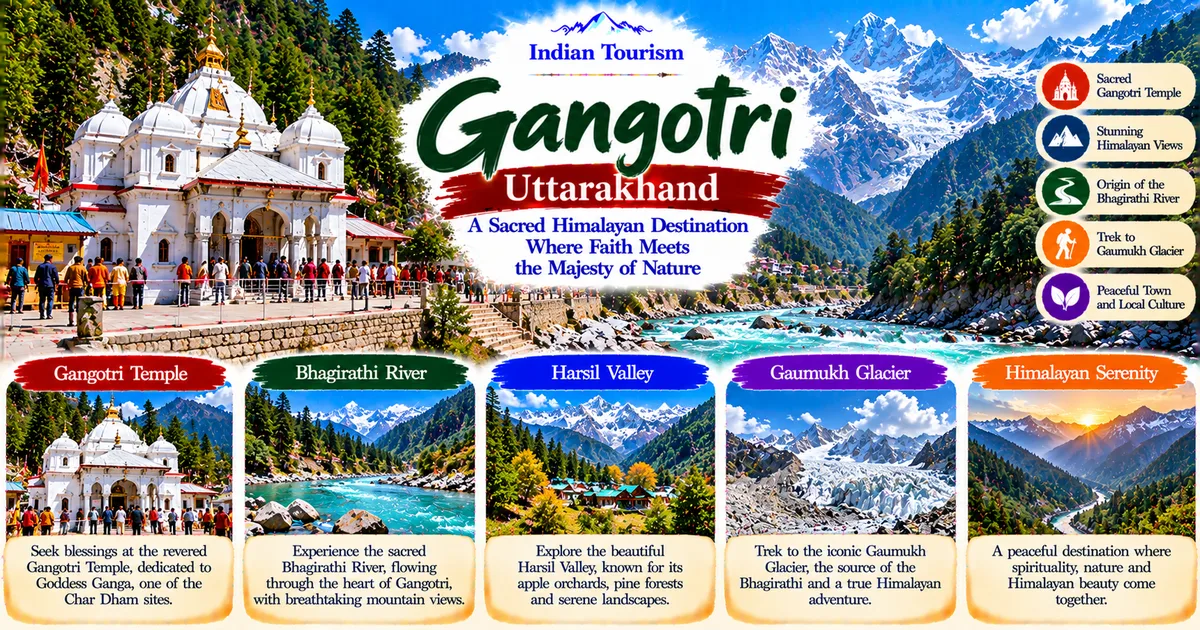
Discovering Gangotri, the Sacred Gateway to the Ganga
High in the Garhwal Himalayas of Uttarakhand lies Gangotri, a destination where spiritual devotion, dramatic mountain landscapes, ancient traditions, and the raw beauty of nature come together. Known as one of the four sacred sites of the Char Dham pilgrimage in Uttarakhand, Gangotri holds a special place in Hindu religious life. It is closely associated with the origin of the River Ganga, one of the most revered rivers in India, and attracts pilgrims, nature lovers, photographers, trekkers, and travellers seeking a deeper connection with the Himalayas.
Gangotri is more than a temple town. It is a landscape shaped by towering mountains, dense forests, rushing rivers, cold mountain winds, and centuries of spiritual traditions. The sound of the Bhagirathi River flowing beside the settlement creates a constant natural rhythm, while the surrounding peaks remind visitors of the immense scale of the Himalayan wilderness. For pilgrims, the destination represents devotion and purification. For travellers, it offers an opportunity to experience one of the most remarkable mountain regions in northern India.
The journey to Gangotri is itself an important part of the experience. Roads climb through mountain valleys, pass forests and settlements, and follow the river towards increasingly rugged terrain. Along the way, travellers encounter changing landscapes, traditional Garhwali culture, mountain agriculture, and views that reveal the scale and beauty of the Himalayas. By the time visitors reach Gangotri, the journey has already introduced them to the distinctive character of this region.
Gangotri is also the traditional starting point for the trek towards Gaumukh, the glacial source of the Bhagirathi River, which is the principal headstream of the Ganga. The glacier lies beyond the temple town and requires additional planning, physical preparation, and the necessary permissions. It should not be confused with the temple itself, which is accessible by road during the pilgrimage season.
Whether you are planning a religious pilgrimage, a Himalayan road trip, or a carefully prepared trekking adventure, Gangotri offers a meaningful combination of spirituality, culture, and natural beauty.
Understanding the Geography and Location of Gangotri
Gangotri is situated in Uttarkashi district in the Garhwal region of Uttarakhand. Located at approximately 3,100 metres above sea level, the settlement stands in a high Himalayan valley surrounded by forested slopes, rocky mountains, and the fast-flowing Bhagirathi River. Its elevation gives it a markedly different climate from the plains of northern India, with cool summers, cold nights, and severe winter conditions.
The town occupies a strategic position along the traditional pilgrimage route leading towards the upper reaches of the Bhagirathi valley. The surrounding mountains form part of a landscape shaped by glaciers, snowmelt, erosion, and the movement of rivers through deep valleys. The terrain becomes progressively more rugged as travellers move beyond Gangotri towards Gaumukh and the higher Himalayan peaks.
Gangotri lies approximately 100 kilometres by road from Uttarkashi, although the actual journey time depends on road conditions, traffic, weather, and seasonal restrictions. The route follows mountain roads where sharp bends, steep slopes, and narrow sections require careful driving. Landslides, road maintenance, heavy rainfall, and snowfall can affect travel, especially during the monsoon and winter periods.
The broader region contains several important natural and cultural landmarks. Harsil is known for its mountain scenery, orchards, forests, and traditional settlements. Dharali lies nearby and provides another perspective on life in the upper Bhagirathi valley. Further along the route, Gangotri National Park protects extensive areas of Himalayan wilderness, including important habitats for high-altitude wildlife.
The geography of Gangotri explains much of its appeal. It is remote enough to provide a sense of entering the mountains, yet it remains accessible by road during the main pilgrimage season. This balance allows visitors to experience a high-altitude Himalayan environment without necessarily undertaking a demanding trek.
However, the elevation should never be underestimated. Visitors arriving directly from the plains may notice that walking feels more tiring, particularly during the first day. Spending time adjusting to the altitude, staying hydrated, avoiding excessive exertion, and allowing sufficient rest can make the visit more comfortable.
The Sacred Significance of the River Ganga
The spiritual importance of Gangotri is inseparable from the River Ganga. Across India, the Ganga is associated with purification, devotion, life, and liberation. Its waters hold significance in religious ceremonies, household traditions, festivals, and the final rites performed for departed family members. For countless devotees, the river represents a sacred connection between the earthly world and the divine.
In Hindu tradition, the descent of the Ganga from heaven is connected with King Bhagiratha, whose devotion and determination are believed to have brought the celestial river to Earth. According to the traditional account, Bhagiratha performed intense penance to obtain the river's descent so that the souls of his ancestors could attain liberation. The force of the descending river was so immense that Lord Shiva received the waters in his matted hair before allowing them to flow towards the Earth.
This story gives the river its profound religious meaning and connects the name Bhagirathi with the narrative of its earthly arrival. Gangotri is regarded as a central location in this sacred geography because of its association with the river's descent and the Himalayan landscape from which its waters emerge.
The physical geography is more complex than the religious story alone suggests. The Bhagirathi begins in the glacial region near Gaumukh, while the Ganga is conventionally recognised as beginning at Devprayag, where the Bhagirathi meets the Alaknanda. From Devprayag, the united river is known as the Ganga.
These distinctions make the journey through Uttarakhand particularly interesting. Visitors can experience different stages of the river system, from its high-altitude glacial environment near Gangotri to the major confluence at Devprayag. Each location has its own geographical character and religious significance.
For pilgrims, Gangotri is a place to offer prayers, participate in rituals, and reflect on the importance of the river in Hindu tradition. For visitors who approach the destination from a cultural or environmental perspective, it also provides an opportunity to understand how a river can shape the spiritual identity, settlement patterns, economy, and daily life of a region.
The Ganga is also an essential source of water for millions of people. Its ecological health depends on Himalayan glaciers, snowmelt, rainfall, river habitats, and responsible management throughout its course. Respecting the river at Gangotri therefore involves more than religious observance. It also means protecting its natural surroundings and avoiding practices that contribute to pollution.
The Gangotri Temple: Architecture, Worship, and Tradition
The Gangotri Temple is the principal religious landmark of the settlement. Dedicated to Goddess Ganga, it attracts pilgrims from different parts of India, particularly during the annual Char Dham pilgrimage season. Its setting beside the Bhagirathi River, with mountains rising around the valley, makes the temple a striking combination of sacred architecture and natural scenery.
The temple is traditionally associated with the Gorkha general Amar Singh Thapa, who is credited with establishing the shrine in the early nineteenth century. The present structure is a relatively modest white temple, built in a style that suits its Himalayan setting. Its appearance is simple compared with many large temples in India's plains, but its religious importance is considerable.
Pilgrims generally visit the shrine to offer prayers, seek blessings, and participate in worship dedicated to Goddess Ganga. The temple area can become particularly busy during major pilgrimage periods, religious festivals, and auspicious days. Early morning and evening can offer different experiences of the place, with changing light on the surrounding mountains and the sound of the river remaining a constant presence.
The temple's seasonal operation is closely linked to the region's weather. Heavy snowfall and winter conditions make Gangotri difficult to access, so the shrine traditionally closes for the winter and the deity is moved to Mukhba village, where worship continues during the colder months. The temple reopens in spring according to the traditional calendar and official arrangements.
Because opening and closing dates vary from year to year, visitors should verify the current schedule before travelling. It is particularly important to check official pilgrimage announcements if your journey depends on attending a specific ceremony or visiting during the first or last days of the season.
The temple is not simply an architectural attraction. It is an active place of worship, and visitors should behave accordingly. Modest clothing, respectful conduct, and awareness of local customs help preserve the dignity of the site. Photography may be restricted in certain areas, so visitors should follow instructions displayed at the temple and guidance provided by temple authorities.
Even travellers who do not follow Hindu religious traditions can appreciate the temple as a living expression of regional history, faith, and cultural continuity. Its importance comes not only from its physical structure but also from the generations of pilgrims who have made the journey to worship here.
The Char Dham Pilgrimage and Gangotri's Place in It
Gangotri forms one of the four destinations in Uttarakhand's Char Dham pilgrimage, alongside Yamunotri, Kedarnath, and Badrinath. Together, these sites create one of the most important pilgrimage circuits in Hinduism. The journey is traditionally associated with devotion, spiritual discipline, and visits to sacred places situated in the Himalayan region.
Each destination has its own religious identity. Yamunotri is associated with the River Yamuna, Gangotri with the River Ganga, Kedarnath with Lord Shiva, and Badrinath with Lord Vishnu. Travelling between these places involves crossing mountain valleys, passing through settlements, and experiencing the changing geography of Uttarakhand.
Gangotri occupies a distinctive place in the circuit because of its close association with water, purification, and the sacred origin narratives of the Ganga. For many pilgrims, visiting the temple is an important personal and family milestone. Some travel with elderly relatives, while others undertake the journey as part of a long-established religious tradition.
The pilgrimage also contributes significantly to the local economy. Hotels, guesthouses, restaurants, transport operators, guides, porters, shops, and other services depend on the seasonal arrival of visitors. During the main pilgrimage period, the town becomes a meeting point for travellers from different regions, languages, and backgrounds.
However, the popularity of the Char Dham circuit creates challenges. Roads can become crowded, accommodation may fill quickly, and mountain infrastructure must accommodate large numbers of people within a relatively short season. Weather-related disruptions can affect the entire journey, sometimes requiring travellers to change their plans at short notice.
A responsible pilgrimage therefore requires patience and preparation. Travellers should avoid rushing between destinations, allow time for possible delays, and follow official instructions regarding registration, transport, road closures, and safety. Those travelling with older people or young children should consider the physical demands of mountain journeys and plan rest stops accordingly.
The spiritual purpose of the pilgrimage is not diminished by taking practical precautions. In fact, travelling with patience, respect for local communities, and concern for the environment reflects the values of care and responsibility that are central to many religious traditions.
Best Time to Visit Gangotri
Choosing the right season is one of the most important decisions when planning a trip to Gangotri. The destination experiences substantial seasonal changes because of its elevation, mountain geography, snowfall, and monsoon conditions.
Summer: May to June
Late spring and early summer generally mark the beginning of the main travel season. The temple reopens according to the religious calendar, roads gradually become accessible, and pilgrims begin arriving in larger numbers. During this period, the weather is often more suitable for sightseeing and pilgrimage than during the colder months.
Daytime temperatures can be cool to pleasantly mild, but nights remain cold. Visitors should bring warm clothing even if they are travelling from a hot part of India. A jacket, thermal layers, gloves, and comfortable walking shoes can make a significant difference, especially during early morning visits.
May and June can be busy because many families plan travel during school holidays. Accommodation should be reserved in advance when possible, particularly for weekends and major religious dates.
This season is also attractive for travellers who want to see the surrounding mountains before the monsoon becomes established. However, weather can still change quickly, and occasional snowfall or road disruption is possible in the higher reaches.
Monsoon: July to August
The monsoon season introduces a different set of challenges. Rainfall can increase the risk of landslides, falling rocks, road damage, and delays along mountain routes. River levels may rise, and visibility can deteriorate during periods of heavy cloud and rain.
The landscape becomes greener in many areas, but the potential travel difficulties mean that monsoon journeys require additional caution. A trip that appears straightforward on a map may take considerably longer because of road restrictions or weather-related interruptions.
Travellers who must visit during this period should monitor local weather forecasts, follow district administration advisories, and maintain flexibility in their schedules. It is unwise to plan a tight itinerary that depends on reaching several destinations on consecutive days without any buffer time.
For many leisure travellers, the monsoon is not the easiest season for a first visit to Gangotri. Those who choose it should prioritise safety rather than attempting to maintain a fixed timetable.
Autumn: September to October
September and October are often appealing months for visitors who want clear mountain views and cooler conditions. Following the monsoon, the landscape may appear refreshed, and periods of improved visibility can reveal the surrounding peaks more clearly.
Early autumn can be especially attractive for photography, nature walks, and scenic road journeys. However, weather conditions vary from year to year, and occasional rain, cold spells, or early snowfall can affect travel.
October can bring colder nights and a stronger sense that winter is approaching. Visitors should check the temple's scheduled closing date before travelling late in the season. The exact date is determined according to religious tradition and annual arrangements, so it should not be assumed to remain the same every year.
Winter: November to April
Winter brings severe cold and heavy snowfall to the Gangotri region. The temple remains closed during this period, and road access to the settlement is generally unavailable or restricted under winter conditions. This is not the normal season for a conventional visit to the temple.
Visitors interested in winter mountain scenery should understand that the experience is very different from travelling during the pilgrimage season. Access arrangements, road conditions, accommodation, and emergency services may be limited. Travellers should not attempt to reach the area without current, reliable information and appropriate local guidance.
For most first-time visitors, the period from May to June or September to early October is the more practical choice, subject to the annual temple schedule and prevailing conditions.
How to Reach Gangotri
Reaching Gangotri involves a combination of air, rail, and road travel. Because the settlement is located deep in the Himalayas, the final part of the journey must be completed by road when the route is open.
By Air
The nearest commonly used airport for reaching the Uttarkashi region is Jolly Grant Airport near Dehradun. Travellers arriving by air can continue towards Rishikesh, Uttarkashi, and Gangotri by road. The total journey is long because of the mountain terrain, so it is sensible to divide the trip if time permits.
Flights may be affected by weather, and travellers should leave sufficient time between air arrivals and onward mountain transport. Booking a flight that lands shortly before a planned long road journey can create unnecessary pressure if there are delays.
By Train
Rishikesh and Dehradun are commonly used rail access points for journeys towards Gangotri. From either location, travellers can arrange taxis, shared transport where available, or other road connections towards Uttarkashi and the upper Bhagirathi valley.
Rail travel can be a practical option for visitors coming from Delhi and other major cities. However, the railway journey represents only the beginning of the trip. The road section through the mountains requires additional time and careful planning.
By Road
Gangotri is connected to Uttarkashi by a mountain road that continues through Harsil and other settlements in the upper valley. Visitors can travel by private car, taxi, or available public and shared transport services, depending on the season and local arrangements.
The road journey is scenic but demanding. Sharp turns, steep gradients, narrow sections, and changing weather require cautious driving. Drivers unfamiliar with Himalayan roads should avoid aggressive overtaking and should not attempt to continue when visibility or road conditions become unsafe.
Public transport availability can vary, especially during the shoulder season and periods of disruption. Travellers who depend on buses or shared vehicles should confirm departure times and onward connections locally rather than relying on assumptions based on previous years.
A practical itinerary includes an overnight stop in Uttarkashi or another suitable settlement if necessary. This can reduce fatigue and provide a buffer against delays. It also allows travellers to adjust gradually to the higher altitude.
Exploring Harsil on the Way to Gangotri
Harsil is one of the most attractive places along the route to Gangotri. Situated in the upper Bhagirathi valley, it is known for its forested surroundings, mountain views, apple orchards, and relatively peaceful atmosphere. For many travellers, Harsil is more than a transit point. It is a destination worth exploring in its own right.
The landscape around Harsil combines river scenery, wooded slopes, traditional villages, and distant mountain views. The region's orchards provide a distinctive character during the growing season, while changes in temperature and foliage transform the valley throughout the year.
Harsil is particularly appealing to travellers who prefer quiet mountain environments over heavily commercialised hill stations. Visitors can spend time walking through accessible village areas, observing local life, enjoying the scenery, and learning about the cultural traditions of the upper Garhwal region.
The settlement also offers an opportunity to slow down before continuing towards Gangotri. Instead of completing the entire journey in a hurry, travellers can spend a night in the area and continue the next day. This approach is helpful for families, photographers, and anyone who wants to experience the region beyond its most famous temple.
Visitors should remember that Harsil and its surrounding settlements are living communities, not merely scenic backdrops. Photography should be respectful, private property should not be entered without permission, and local customs should be observed. Travellers should also avoid littering orchards, roadsides, riverbanks, and forest paths.
The broader area has experienced natural hazards, including landslides and damaging floods in the past. Current local conditions should therefore guide travel decisions. Visitors should not assume that a road, riverside area, or accommodation option is safe simply because it was accessible during an earlier visit.
Dharali and the Traditional Settlements of the Upper Valley
Dharali lies in the upper Bhagirathi valley near Harsil and is part of the broader cultural landscape surrounding Gangotri. The village and its surroundings provide insight into the traditional settlements of the Himalayan region, where agriculture, local trade, religious customs, and mountain geography have shaped everyday life.
Traditional mountain villages often develop around the resources available to them. Access to water, cultivable land, forest products, road connections, and seasonal trade all influence the pattern of settlement. In the upper valley, steep slopes and a short growing season place limits on agriculture, while changing weather conditions affect transport and access to markets.
Travellers exploring the area should approach village visits with curiosity and respect. A short walk through a settlement can reveal architectural details, local farming practices, traditional food, and the rhythms of daily life. However, visitors should not assume that every lane or courtyard is open to tourists, and photographs of residents should be taken only with their consent.
Dharali can also serve as a reminder that the Himalayan environment is dynamic. Mountain communities face risks from intense rainfall, landslides, river flooding, and other natural hazards. These risks make responsible land use, resilient infrastructure, early warning systems, and careful development important issues for the entire region.
Tourism can provide livelihoods, but it also brings pressure on roads, water supplies, waste systems, and local infrastructure. Travellers can contribute positively by choosing locally operated accommodation where suitable, purchasing regional products, minimising waste, and respecting restrictions introduced for safety.
The value of visiting such settlements lies not in treating them as untouched places frozen in time, but in recognising them as communities with their own histories, aspirations, challenges, and traditions.
Gaumukh Glacier: The Trek Towards the Source of the Bhagirathi
For travellers interested in Himalayan trekking, Gaumukh is one of the most significant destinations associated with Gangotri. Located beyond the temple town, Gaumukh marks the snout of the Gangotri Glacier and is traditionally regarded as the glacial source of the Bhagirathi River.
The name Gaumukh is commonly translated as the mouth of a cow, reflecting the traditional description of the glacier's snout. The glacier itself forms part of a much larger high-altitude landscape shaped by ice, rock, snow, and meltwater. Its appearance changes over time as the glacier retreats and advances in response to climatic and environmental conditions.
Reaching Gaumukh requires a trek from Gangotri along a route that passes through rugged Himalayan terrain. The trail is physically demanding in places, and its condition can vary according to weather, seasonal maintenance, landslides, and other factors. The distance is substantial enough that travellers should not treat it as a casual walk from the temple.
The trek requires appropriate permits and compliance with the current rules governing access to the area. Requirements can change, so visitors should verify the latest arrangements with the relevant forest authorities before travelling. Daily entry limits, registration procedures, and route restrictions may apply.
Preparation should include suitable footwear, warm clothing, rain protection, drinking water, food, and a realistic assessment of physical fitness. A local guide may be useful, particularly for visitors unfamiliar with high-altitude terrain. Travellers should also be prepared for sudden weather changes and should never continue simply because they have invested time in reaching a particular point.
Altitude is an important consideration. The trail climbs into a high mountain environment where reduced oxygen availability can cause symptoms even in otherwise healthy individuals. Headache, nausea, unusual fatigue, dizziness, and breathlessness may indicate altitude-related illness. Severe or worsening symptoms require stopping the ascent and seeking appropriate assistance. Confusion, difficulty walking, or breathlessness at rest are urgent warning signs.
The glacier environment is also fragile. Visitors should remain on permitted trails, avoid disturbing wildlife, carry out their waste, and follow all local instructions. Removing rocks, damaging vegetation, leaving food waste, or approaching dangerous ice formations can harm the environment and place people at risk.
Gaumukh offers an extraordinary opportunity to understand the physical landscape behind the river's sacred identity. However, the experience is most rewarding when approached with preparation, humility, and respect for the power of the mountains.
Gangotri National Park: A Wilderness of Glaciers, Forests, and High Mountains
Gangotri National Park protects a large area of Himalayan wilderness in Uttarakhand. Its landscape includes forests, alpine meadows, rocky slopes, glaciers, river valleys, and high mountain terrain. The park is important for biodiversity conservation and for maintaining the ecological processes that sustain the upper Bhagirathi basin.
The vegetation changes with elevation. Lower and middle sections may contain forests of conifers and other Himalayan trees, while higher areas transition into alpine vegetation and increasingly barren terrain. Beyond the vegetation zones, snow, ice, exposed rock, and glacial landscapes dominate much of the environment.
The park provides habitat for wildlife adapted to cold mountain conditions. Species associated with the wider region include the snow leopard, Himalayan tahr, musk deer, and various high-altitude birds. Seeing these animals is never guaranteed, and visitors should not approach wildlife or attempt to attract it with food.
The ecological value of the park extends beyond its wildlife. Mountain forests help stabilise slopes, regulate water movement, store carbon, and support diverse plant and animal communities. Glaciers and snowfields influence the timing and volume of water entering the river system. These natural processes are important for communities and ecosystems far downstream.
Tourism must be managed carefully in such an environment. Increased visitor numbers can contribute to waste, trail erosion, pressure on water resources, and disturbance to wildlife. The cumulative effect of small careless actions can become significant when repeated by thousands of people.
Visitors can help protect the area by following permit conditions, staying on established routes, carrying reusable bottles, taking rubbish back with them, and avoiding loud behaviour in sensitive areas. Campfires should never be started where prohibited, and travellers should not remove plants or other natural materials.
Gangotri National Park demonstrates that the Himalayan landscape is not simply a collection of scenic viewpoints. It is a complex ecological system that supports life, influences regional water supplies, and deserves long-term protection.
Local Culture, Traditions, and the People of the Region
Gangotri and the surrounding upper Bhagirathi valley form part of the broader Garhwali cultural region. Local identity has been shaped by mountain geography, religious traditions, seasonal agriculture, trade routes, and the challenges of living in a high-altitude environment.
The people of Uttarakhand have developed customs and practical knowledge suited to the mountains. Traditional food, clothing, house construction, agricultural practices, and community celebrations reflect the relationship between daily life and the local landscape. In areas where winters are severe, seasonal movement and careful preparation for colder weather have long been important aspects of life.
Religious traditions play a visible role in the region. Temples, local deities, pilgrimage routes, seasonal ceremonies, and village festivals connect communities with their histories and shared beliefs. The annual movement of the Gangotri deity to Mukhba for winter worship illustrates how religious practice adapts to the environmental realities of the mountains.
Visitors may encounter traditional Garhwali dishes, including preparations based on lentils, grains, local vegetables, and seasonal ingredients. Food availability varies according to the settlement and season, but trying locally prepared meals can provide a meaningful connection with the region's culture.
Hospitality is an important part of many mountain communities, but travellers should not assume that residents are always available to provide services or explanations. A respectful approach, a willingness to learn, and an appreciation for local customs help create positive interactions.
Language also forms part of the cultural experience. Hindi is widely understood in tourist-facing settings, while Garhwali and other local languages are part of the region's linguistic heritage. Learning a few simple greetings or polite expressions can make everyday interactions more pleasant.
Tourism can support cultural preservation when it creates opportunities for local businesses and encourages appreciation of regional traditions. It becomes less beneficial when communities are reduced to attractions or when outside commercial interests displace local livelihoods. Travellers can make more responsible choices by buying local products, using legitimate local services, and respecting the privacy of residents.
Food to Try During a Gangotri Trip
Food is an important part of travel in Uttarakhand, and a visit to Gangotri offers opportunities to experience simple meals suited to mountain conditions. The food available in the temple town is influenced by pilgrimage demand, the seasonal nature of tourism, and the practical limits of transporting supplies to a remote settlement.
Common meals may include rice, dal, vegetables, chapati, and other familiar North Indian preparations. During the busy season, eateries cater to pilgrims and travellers who need warm, filling meals before continuing their journeys. Availability varies, so visitors should not expect every dish to be offered at every establishment.
Regional Garhwali cuisine includes a variety of traditional preparations made with lentils, pulses, grains, and locally available ingredients. Dishes associated with the wider region include chainsoo, a preparation based on roasted black gram, and mandua roti, a flatbread made from finger millet. These foods are more likely to be encountered in suitable establishments elsewhere in Uttarakhand than in every small eatery at Gangotri itself.
Seasonal vegetables and simple home-style meals can be particularly satisfying in the cold mountain climate. Travellers should choose food that is freshly prepared and served hot, especially when staying at high altitude. Those with dietary restrictions should communicate their requirements clearly before ordering.
Hydration is important, but visitors should rely on safe drinking water rather than assuming that clear-looking water from a stream is safe. Carrying a reusable bottle and arranging safe refills can reduce plastic waste. Water purification methods may be useful for trekking, provided they are appropriate for the water source and used correctly.
Because supplies can be limited, food prices and menu choices may differ from those in larger towns. Visitors should carry small snacks for long road journeys and treks, while ensuring that packaging and waste are not left behind.
Where to Stay in Gangotri
Accommodation in Gangotri is primarily seasonal, reflecting the annual pilgrimage calendar and the difficult winter conditions. During the main travel period, visitors may find guesthouses, lodges, hotels, and other basic accommodation options in the town and nearby settlements.
The best choice depends on the purpose of the trip. Pilgrims who want easy access to the temple may prefer accommodation within walking distance of the shrine. Travellers seeking a quieter setting may consider staying in the wider region, subject to road access and the availability of suitable facilities.
Accommodation standards vary. Some establishments offer relatively simple rooms with basic amenities, while others provide more comfortable facilities. Heating, hot water, electricity, and mobile connectivity may not be as reliable as in major cities, especially during periods of heavy demand or adverse weather.
Advance booking is advisable during peak pilgrimage dates, school holidays, and popular travel periods. Visitors should confirm the location, facilities, cancellation arrangements, meal options, and check-in time before making a reservation.
Travellers visiting with older relatives or young children should pay particular attention to room access, stairs, toilet facilities, and the availability of warm bedding. Those with mobility limitations should ask specific questions about the physical layout rather than assuming that every property is easy to access.
An alternative is to stay in Uttarkashi or another suitable settlement along the route and make the onward journey according to local conditions. This may provide more accommodation choices and greater flexibility, although it also increases the time required for the trip.
Visitors should remember that seasonal mountain destinations operate under constraints that differ from those of large cities. Respecting check-in arrangements, avoiding unnecessary waste, conserving water, and treating local staff fairly help support a positive travel experience.
A Suggested Three-Day Gangotri Itinerary
A three-day itinerary can provide a balanced introduction to Gangotri and the surrounding valley, provided road conditions and seasonal access permit the journey.
Day One: Travel to Uttarkashi or Harsil
Begin the journey from Dehradun, Rishikesh, or another suitable starting point. Because the route involves mountain driving, avoid trying to cover too much ground in a single day. Depending on the departure point and road conditions, an overnight stop in Uttarkashi or Harsil may be practical.
Use the first day to settle into the mountain environment. Take time for a relaxed walk if conditions allow, eat a proper meal, and get sufficient rest. Travellers arriving from low elevations should avoid unnecessary exertion.
Day Two: Visit Gangotri Temple
Continue towards Gangotri after confirming that the road is open and conditions are suitable. Once you arrive, visit the temple, observe the local religious traditions, and spend time near the designated riverfront areas where access is permitted.
Allow enough time for worship, meals, and rest. Rather than treating the destination as a quick stop, take the opportunity to experience the mountain surroundings and understand the significance of the Bhagirathi River.
If time and conditions permit, explore accessible areas around the settlement without straying onto restricted or unsafe terrain. Keep the afternoon flexible in case of weather changes or delays.
Return to your chosen overnight accommodation according to road conditions and the time available. If you plan to stay in Gangotri, confirm in advance that your accommodation is operating during your dates.
Day Three: Explore Harsil and Return
Spend the morning exploring Harsil or another suitable settlement along the route. The region's forests, orchards, and mountain scenery provide a quieter contrast to the temple area.
Visitors interested in local culture can look for regional food, traditional products, and opportunities to learn about the upper valley. Keep village visits respectful and avoid entering private property without permission.
Begin the return journey with enough time to accommodate traffic, roadwork, and unexpected delays. If you are connecting to a train or flight, allow a generous buffer rather than relying on an optimistic travel estimate.
This itinerary is intended for a conventional visit to Gangotri. Gaumukh requires additional days, permits, physical preparation, and suitable trekking arrangements. It should be planned separately rather than added casually to a short temple visit.
Photography in Gangotri: Capturing the Mountains and River
Gangotri offers a range of photographic subjects, from the temple and riverfront to forested valleys, mountain roads, and distant peaks. The quality of light changes rapidly in the Himalayas, making the destination appealing to photographers who enjoy observing the relationship between weather, landscape, and human activity.
Early morning can provide soft light and a quieter atmosphere around the temple, although conditions depend on cloud cover and visitor numbers. Later in the day, changing sunlight may reveal different textures on the surrounding mountains. Overcast weather can also produce interesting images of the river, forest, and architecture.
The Bhagirathi River is an important subject, but photographers should remain within designated safe areas. Riverbanks can be slippery, currents may be powerful, and water levels can change. No photograph is worth approaching an unstable edge or entering a restricted area.
When photographing religious ceremonies, respect the privacy and preferences of worshippers. Some people may welcome photographs, while others may prefer not to be photographed. Ask permission where appropriate and follow temple rules.
Landscape photographers should carry clothing suitable for cold and changing weather. Batteries can lose charge more quickly in low temperatures, and mist or rain can affect camera equipment. A protective bag and a simple cleaning cloth are useful additions to a travel kit.
Responsible photography also involves avoiding damage to the environment. Do not trample vegetation to reach a viewpoint, move stones to create a composition, or leave litter behind. Drones may be subject to legal, security, wildlife, or local restrictions, so they should not be flown without confirming the applicable rules.
The best photographs often come from patience rather than rushing between viewpoints. Spending time observing the changing light, the river, and the movement of clouds can produce images that communicate the distinctive atmosphere of Gangotri.
Adventure Activities Around Gangotri
Gangotri is an important base for certain forms of Himalayan adventure, particularly trekking and nature exploration. The region attracts people who want to experience high-altitude landscapes, glacial valleys, and mountain environments that differ greatly from India's urban centres.
The trek to Gaumukh is the best-known trekking route directly associated with the destination. More ambitious mountaineering routes exist in the broader region, but these require specialised knowledge, technical preparation, official permissions, and experienced support. They are not appropriate for casual visitors without the necessary training.
Short walks around accessible areas can provide opportunities to enjoy the mountain scenery without undertaking a major expedition. However, even seemingly easy paths may involve uneven ground, loose stones, steep slopes, and sudden weather changes. Suitable footwear and awareness of local conditions remain essential.
Birdwatching and nature observation may also interest visitors. The upper Himalayan environment supports a range of bird species and other wildlife, but sightings depend on season, habitat, weather, and luck. Visitors should use binoculars where helpful and avoid approaching animals.
Adventure tourism should be approached with a realistic understanding of risk. Weather in the mountains can change quickly, communications may be unreliable, and rescue operations can take time. Travellers should share their plans with responsible local contacts, carry appropriate supplies, and follow official guidance.
It is important to distinguish physical challenge from unnecessary danger. A responsible trekker knows when to turn back, while a responsible visitor recognises that restricted areas and poor weather are reasons to change plans rather than invitations to take risks.
Environmental Challenges and Responsible Tourism
Gangotri's natural beauty is closely connected with environmental systems that are increasingly vulnerable to human pressure and climate change. Himalayan glaciers, forests, rivers, and mountain slopes respond to changing temperatures, rainfall patterns, land use, and infrastructure development.
The Gangotri Glacier has been studied extensively because of its importance to the upper Ganga river system. Like many Himalayan glaciers, it has experienced long-term changes in its extent and behaviour. The relationship between glacier retreat, regional climate, snow accumulation, and river flow is complex, and no single observation explains all future water conditions.
For visitors, the broader lesson is that the Himalayan landscape is not static. The river, glacier, forests, and slopes are parts of a connected system that supports both local communities and populations far downstream.
Tourism can place additional pressure on this environment. Plastic bottles, food packaging, poorly managed sewage, vehicle emissions, trail erosion, and construction can degrade the quality of the visitor experience and damage local ecosystems. The concentration of large numbers of pilgrims within a short season makes waste management particularly important.
Travellers can reduce their impact through practical choices. Carry a reusable water bottle, avoid unnecessary single-use packaging, use designated waste facilities, and take personal rubbish back to an appropriate disposal point when necessary. Do not throw offerings, plastic, food waste, or other materials into the river.
Respecting local rules is equally important. If an area is closed because of landslides, flooding, wildlife protection, or trail damage, visitors should not attempt to bypass the restriction. Temporary closures are often introduced to reduce risk and protect fragile terrain.
Water conservation matters in mountain settlements where supplies and infrastructure may be limited. Use water thoughtfully, avoid wasting electricity, and choose accommodation providers that demonstrate responsible practices where possible.
The wider principle is simple: Gangotri should remain a place where future generations can experience both its spiritual significance and its ecological value. Responsible travel helps ensure that tourism supports rather than undermines that goal.
Practical Travel Tips for First-Time Visitors
A successful trip to Gangotri begins with realistic expectations. The destination is a high-altitude Himalayan settlement, not a conventional hill station with predictable weather and uninterrupted access. Planning should account for cold conditions, limited services, and the possibility of travel disruption.
Check the temple opening schedule before booking transport. If your visit depends on the shrine being open, confirm the current dates through official announcements. The pilgrimage calendar changes each year, and weather conditions can affect practical access.
Carry warm clothing even during summer. A thermal layer, fleece or woollen sweater, wind-resistant jacket, and comfortable trousers are useful. A rain jacket can provide protection from unexpected showers, while sturdy walking shoes help on uneven roads and paths.
Keep essential medicines and personal supplies with you. Visitors who have known medical conditions should discuss high-altitude travel with a qualified healthcare professional before departure. Anyone who develops concerning symptoms after ascending should not dismiss them as ordinary tiredness.
Maintain flexibility in the itinerary. Mountain roads can be delayed or closed because of landslides, falling rocks, heavy rainfall, snowfall, or maintenance. Avoid making plans that depend on reaching an airport or railway station immediately after a long mountain journey.
Carry some cash because digital payment facilities and mobile networks may not work consistently everywhere. At the same time, avoid carrying more cash than necessary and keep valuables secure.
Mobile connectivity varies across the region. Do not assume that every network will provide a reliable signal throughout the journey. Download essential travel information for offline use and inform family members about your itinerary when travelling into areas with limited connectivity.
Respect religious customs at the temple and avoid blocking access for worshippers. Follow instructions about footwear, photography, ceremonies, and restricted areas.
Finally, remember that high altitude can affect visitors who are otherwise fit. Walk at a comfortable pace, rest when needed, drink safe water, and avoid excessive exertion immediately after arrival. The purpose of the journey is to experience Gangotri, not to complete every activity as quickly as possible.
Who Should Visit Gangotri?
Gangotri appeals to a wide range of travellers, but the experience differs according to personal interests and physical abilities.
For religious pilgrims, the destination offers an opportunity to visit the Gangotri Temple, participate in worship, and connect with the sacred traditions associated with the Ganga. Families who have long wished to complete the Char Dham circuit may find the journey especially meaningful.
For nature lovers, Gangotri provides access to dramatic mountain scenery, forested valleys, river landscapes, and the wider environment of the upper Bhagirathi basin. The changing weather and high-altitude setting make it particularly attractive to travellers who appreciate natural landscapes.
Photographers can explore the relationship between the temple, river, mountains, and local settlements. Those interested in culture can learn about Garhwali traditions, pilgrimage practices, and the challenges of life in a remote Himalayan region.
Experienced trekkers may use Gangotri as a starting point for the Gaumukh trek, provided they obtain the required permissions and prepare appropriately. However, the trekking experience should be treated separately from a conventional pilgrimage because it involves greater physical demands and environmental risks.
Gangotri may be less suitable for travellers seeking nightlife, luxury shopping, large entertainment complexes, or consistently warm weather. Services are seasonal, and the main appeal lies in spirituality, landscape, and the experience of being in the Himalayas.
Visitors with limited mobility can still consider the temple town, but they should investigate road access, accommodation layouts, walking distances, and the facilities available on their travel dates. The high altitude and uneven terrain may create difficulties for some people.
Ultimately, Gangotri is most rewarding for those who approach it with patience, curiosity, and respect for the mountains and the communities that live there.
Conclusion: A Journey into the Spiritual and Natural Heart of Uttarakhand
Gangotri is one of the most significant destinations in Uttarakhand because it brings together religious devotion, Himalayan geography, cultural heritage, and environmental importance. The Gangotri Temple gives the settlement its spiritual identity, while the Bhagirathi River and surrounding mountains create a landscape that leaves a lasting impression on visitors.
The destination also opens a window into the wider upper Himalayan region. Places such as Harsil and Dharali reveal the character of mountain settlements, while Gangotri National Park demonstrates the ecological value of forests, glaciers, and high-altitude habitats. For those prepared for a longer and more demanding journey, the trek towards Gaumukh offers a closer encounter with the glacial landscape associated with the river's origin.
A visit to Gangotri should be planned with care. Seasonal temple dates, road conditions, weather forecasts, accommodation, altitude, and travel time all deserve attention. The mountains do not always follow a fixed timetable, and a flexible itinerary is often the best approach.
More importantly, travellers should recognise that Gangotri is both a sacred destination and a living Himalayan environment. Respecting religious traditions, supporting local communities, minimising waste, and following safety instructions help preserve its value.
Whether you arrive as a pilgrim, a photographer, a nature enthusiast, or an adventurous traveller, Gangotri offers an opportunity to experience a remarkable part of India's mountain heritage. Its river, temple, and towering landscape invite visitors to slow down, reflect, and appreciate the powerful connection between nature, culture, and faith.
#IndianTourism #Gangotri #GangotriTemple #UttarakhandTourism #GarhwalHimalayas #CharDhamYatra #HimalayanTravel #BhagirathiRiver #GaumukhGlacier #GangotriNationalPark #SpiritualIndia #IncredibleIndia #HimalayanTrekking #ResponsibleTourism #ExploreUttarakhand
