
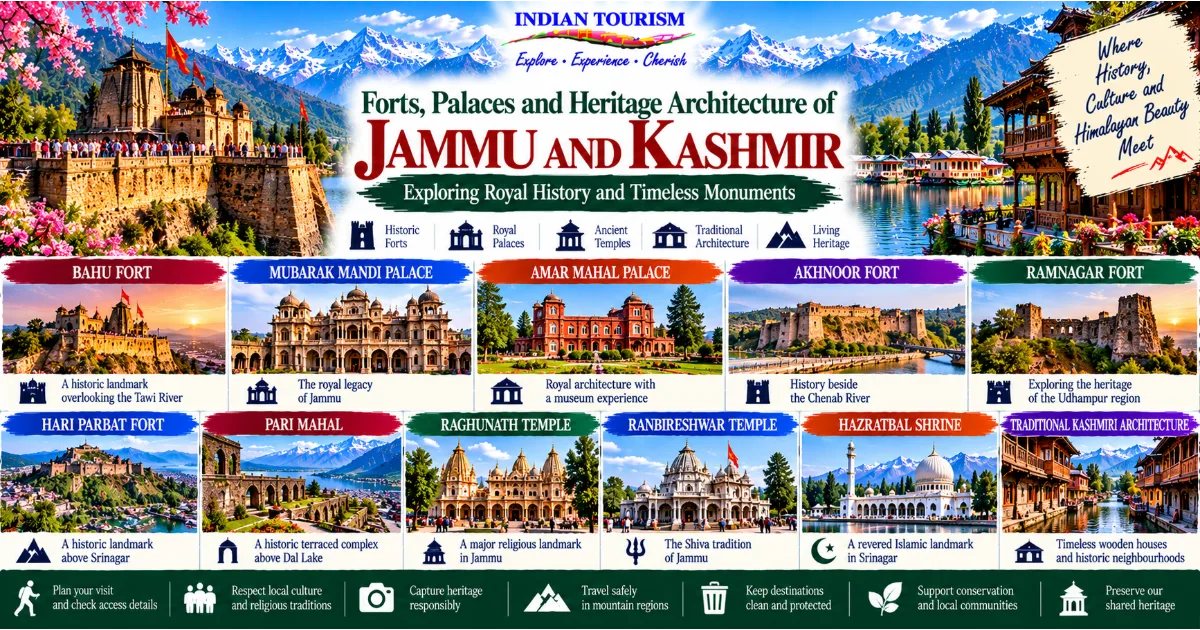
Discovering the Architectural Heritage of Jammu and Kashmir
Jammu and Kashmir is renowned for its Himalayan landscapes, peaceful lakes, colourful gardens and historic religious destinations. Beyond these natural attractions lies another fascinating dimension of the region: its forts, palaces, royal residences and traditional buildings. These structures preserve stories of rulers, kingdoms, military strategy, artistic traditions and cultural exchange that shaped the region over many centuries.
The architecture of Jammu and Kashmir reflects its geographical diversity and complex history. Jammu's historic forts and palaces reveal connections with regional kingdoms and the Dogra rulers, while the Kashmir Valley offers a different architectural experience through traditional wooden buildings, historic neighbourhoods, religious structures and monuments associated with successive periods of political and cultural development.
Some monuments were constructed primarily for defence, using elevated positions, strong walls and commanding views of surrounding valleys. Others were created as royal residences, administrative centres or places for ceremonial gatherings. Religious buildings developed their own architectural traditions, often combining local construction methods with influences from different cultural regions.
Exploring these sites allows travellers to understand how architecture responds to geography. Mountain slopes influenced the location of forts, river valleys supported settlements and trade, while locally available timber and other materials shaped traditional buildings. The result is a varied architectural landscape that cannot be understood through a single style or historical period.
This guide explores important forts, palaces and heritage structures across Jammu and Kashmir. It explains their historical significance, the experiences visitors can expect and practical ways to plan a journey through the region's architectural heritage.
Bahu Fort: A Historic Landmark Overlooking the Tawi River
Bahu Fort is one of the most recognisable historical landmarks in Jammu. Located on elevated ground overlooking the Tawi River, the fort occupies a strategic position associated with the history and development of the city. Its setting provides views of the surrounding landscape and illustrates why hilltop locations were valuable for defensive structures.
The fort is traditionally associated with Raja Bahu Lochan, a figure remembered in regional accounts of Jammu's early history. Its present appearance reflects subsequent historical development and maintenance rather than a single uninterrupted construction period. As with many old forts in India, stories about its origins form part of local tradition, while the structure itself represents a longer history of military and religious use.
Within the fort complex is the Bawey Wali Mata Temple, an important religious destination dedicated to the Divine Mother. The temple attracts devotees throughout the year and becomes particularly busy during major Navratri celebrations. This combination of fortification and religious activity makes Bahu Fort distinctive among Jammu's heritage attractions.
Visitors can appreciate the fort's architectural character, elevated position and relationship with the river landscape. The surrounding area offers opportunities to understand how historical settlements developed around defensive positions and important waterways. The views also provide a perspective on the growth of modern Jammu beyond its older historic areas.
Bahu Fort can be combined with other attractions in Jammu, including Mubarak Mandi Palace and the city's important temples. Travellers should check current opening arrangements, access rules and religious-site restrictions before visiting. During festivals, crowds and traffic may affect the experience.
The fort is more than an old defensive structure. It remains part of the city's living cultural landscape, connecting historical memory, religious practice and the everyday life of Jammu.
Mubarak Mandi Palace: The Royal Legacy of Jammu
Mubarak Mandi Palace is one of the most important heritage complexes in Jammu. Historically associated with the Dogra rulers, the palace served as a royal residence and administrative centre. Its architecture reflects the changing needs and tastes of the ruling establishment over an extended period.
Rather than being a single building constructed according to one uniform design, Mubarak Mandi developed as a complex of structures. Different sections reflect different architectural influences, construction phases and functions. The result is a varied collection of courtyards, façades, halls and other spaces that reveal the evolution of a royal establishment.
The palace complex provides insight into the political history of Jammu. Royal residences were not simply private homes. They could contain spaces for administration, official gatherings, ceremonies and the management of a kingdom. The organisation of such complexes often reflected distinctions between public and private activities, as well as the practical requirements of governance.
Architectural details are an important part of the visitor experience. Arches, balconies, decorative elements and changes in building materials can reveal how different sections were designed and modified. Visitors interested in architectural history should pay attention to the relationships between buildings rather than focusing only on the most visually striking façade.
Mubarak Mandi has also faced challenges common to historic structures, including the need for conservation, maintenance and sensitive restoration. Heritage complexes can be vulnerable to weather, ageing materials and the pressures of urban development. Their long-term survival depends on careful management and public awareness.
Access to individual buildings and courtyards may vary according to conservation work and administrative arrangements. Travellers should confirm which areas are open before making a special journey. Visitors should not enter closed sections or climb on damaged structures.
For those interested in Jammu's royal history, Mubarak Mandi Palace offers an opportunity to understand how political authority, architecture and urban development were connected during the Dogra period.
Amar Mahal Palace: Royal Architecture and Cultural Collections
Amar Mahal Palace is a distinctive landmark in Jammu, known for its palace architecture and elevated setting. Its appearance differs from the older defensive forts of the region, reflecting a later phase of royal residential architecture and changing preferences among princely households.
The palace is associated with Maharaja Amar Singh and the Dogra royal family. Its architectural character has drawn comparisons with European palace styles, creating an interesting contrast with other historic buildings in Jammu. The use of red-toned exterior materials, prominent architectural features and landscaped surroundings gives the structure a distinctive visual identity.
Today, Amar Mahal is associated with a museum setting that contributes to its cultural significance. Museums housed in historic buildings can help visitors understand not only the architecture itself but also the artistic and social world connected with the people who once lived there.
Art collections, historic objects and interpretive displays can provide insight into the region's artistic traditions and royal heritage. The availability of individual galleries and exhibitions may change, so visitors should check current museum arrangements before travelling.
The palace's elevated position can also provide views across the surrounding landscape. Its setting offers opportunities to appreciate architectural details and the relationship between a historic building and its environment. Visitors should follow the museum's rules governing photography and the protection of displayed objects.
Amar Mahal Palace is particularly suitable for travellers who enjoy combining architecture with cultural history. Rather than treating the palace as a building to photograph from outside, visitors can gain a richer experience by learning about its historical context and the collections associated with it.
The palace demonstrates how heritage buildings can find continuing cultural value through museums, conservation and public education. Its role today connects the architectural legacy of Jammu's royal past with the region's contemporary cultural life.
Akhnoor Fort: History Beside the Chenab River
Akhnoor Fort stands near the Chenab River in the town of Akhnoor, to the west of Jammu city. Its location reflects the strategic importance of river corridors in the history of settlements, trade and military movement across the region.
The fort is associated with the Dogra period and is an important heritage landmark in the wider Jammu area. Its position near the river helps explain the value of controlling elevated ground and important routes. Rivers could support movement and settlement, but they could also create natural obstacles that influenced defensive planning.
Akhnoor's wider historical importance extends beyond the fort alone. The surrounding region has archaeological and historical associations that connect it with older patterns of settlement. Visitors interested in regional history may find it rewarding to explore the town's heritage in addition to viewing the fort itself.
The architecture of a fort should be understood in relation to its practical function. Walls, gateways, elevated positions and enclosed spaces were designed to manage access and provide protection. Even where sections have deteriorated or changed over time, the overall arrangement can offer clues about the site's defensive purpose.
The river landscape provides an additional dimension to the visit. Photographers may find opportunities to capture the relationship between the fort and the Chenab, while travellers interested in history can consider how geography influenced the development of settlements and political boundaries.
Access conditions, conservation work and the availability of interpretation can change. Visitors should check current arrangements and avoid entering unsafe or restricted sections. Historic masonry can become unstable, and climbing on walls can cause damage.
Akhnoor Fort is a useful destination for travellers seeking to explore heritage beyond Jammu's central tourist circuit. It offers a reminder that the region's history was shaped not only by mountain valleys but also by river crossings, trade routes and strategically located towns.
Ramnagar Fort: Exploring the Heritage of the Udhampur Region
Ramnagar Fort, located in the Udhampur region of Jammu and Kashmir, is an important heritage site associated with the area's historical rulers. It offers visitors another perspective on regional architecture beyond the larger royal complexes of Jammu city.
The fort and palace structures reflect the historical importance of local centres of power. Across the Himalayan foothills, smaller kingdoms and administrative territories often maintained fortified residences that combined domestic, ceremonial and defensive functions. Such buildings reveal how authority operated at a regional level rather than only through major royal capitals.
The surviving architectural features include elements that help visitors understand the arrangement of the complex. Gateways, courtyards, walls and other spaces can offer clues about the activities once carried out there, although the precise interpretation of individual sections depends on historical evidence and conservation records.
Ramnagar Fort is particularly valuable for visitors interested in the diversity of regional heritage. While major palaces can dominate public attention, smaller forts and historic residences are also important for understanding the wider network of political and cultural centres.
The surrounding town adds context to the visit. Heritage structures are rarely isolated from the communities that grew around them, and the relationship between a fort and its settlement can reveal patterns of trade, administration and everyday life.
Travellers should verify the current opening arrangements and condition of the site before planning a visit. Facilities may be more limited than at major tourist attractions, and transport arrangements should be confirmed in advance.
A visit to Ramnagar Fort can be especially rewarding for travellers who enjoy less familiar historical destinations. It provides an opportunity to appreciate the range of architectural forms that developed across Jammu's towns and foothill regions.
Hari Parbat Fort: A Historic Landmark Above Srinagar
Hari Parbat is a prominent hill in Srinagar associated with fortifications and several religious landmarks. Its elevated position makes it an important feature of the city's landscape and a valuable destination for travellers interested in the relationship between architecture, religion and urban history.
The fortification on Hari Parbat is associated with different periods of political development in Kashmir. The hill's strategic location offered commanding views of the surrounding city and made it suitable for defensive purposes. The visible structures reflect a layered history rather than a single construction event.
The wider Hari Parbat area is culturally significant because religious sites associated with different traditions are located on or around the hill. This creates an opportunity to explore how a single landscape can hold different meanings for communities over time.
The fort's walls and elevated setting provide a contrast with Srinagar's lakeside architecture and Mughal gardens. Travellers can consider how defensive structures were positioned to oversee settlements, routes and surrounding terrain.
Access to the fort and the hill may be affected by security arrangements, conservation work or other restrictions. Visitors should verify current permissions before travelling and follow all instructions from the relevant authorities. It is particularly important not to assume that every part of a fortification is open to the public.
Photographers should also be cautious about using equipment near restricted or sensitive areas. Respect for access rules is more important than obtaining a particular view.
Hari Parbat is a valuable destination for those who want to understand Srinagar's historical geography. Its importance lies in the relationship between the fortification, the city and the religious traditions that have developed around the hill.
Pari Mahal: A Historic Terraced Complex Above Dal Lake
Pari Mahal is a historic terraced complex located on the Zabarwan hills above Srinagar. Its stone structures, elevated platforms and views across Dal Lake make it one of the region's distinctive heritage attractions.
Associated with the Mughal period and traditionally linked with Dara Shikoh, Pari Mahal reflects a different architectural purpose from a conventional military fort. Its terraces and structures form a planned complex that follows the slope of the hillside, creating a series of spaces connected by changes in elevation.
The arrangement demonstrates how architecture can respond to natural terrain. Retaining walls support the terraces, while openings and platforms frame views of the surrounding landscape. The complex's design combines the practical challenges of building on a slope with the aesthetic possibilities created by its elevated position.
Pari Mahal is often appreciated for its panoramic views, but the site also deserves attention as a historical structure. Its walls, layout and relationship with the hillside offer insight into the architectural practices of its period.
Visitors can explore the permitted areas and observe the way the terraces connect. Comfortable footwear is advisable because steps and uneven surfaces may be present. People with mobility concerns should check accessibility before visiting.
The complex can be combined with Chashme Shahi and other attractions overlooking Dal Lake. However, visitors should allow time to appreciate the site itself rather than treating it only as a viewpoint.
As a heritage site, Pari Mahal requires respectful use. Visitors should avoid climbing on fragile walls, leaving rubbish or entering closed areas. Conservation and responsible tourism help ensure that its architectural features remain available to future generations.
Traditional Kashmiri Architecture: Wooden Houses and Historic Neighbourhoods
The architectural heritage of Jammu and Kashmir extends far beyond forts and palaces. Traditional houses, neighbourhood buildings and older commercial structures provide an important record of how people adapted to the region's climate, available materials and patterns of community life.
In the Kashmir Valley, timber has historically played an important role in building construction. Traditional structures may feature carved wooden balconies, projecting windows, decorative façades and roof forms suited to local conditions. The details vary according to the age of the building, its location and the resources available when it was constructed.
Older neighbourhoods in Srinagar preserve examples of this architectural character. Narrow streets and closely spaced buildings reflect the way urban communities developed around markets, religious institutions and waterways. Walking through these areas can reveal architectural details that might be missed during a journey focused only on major monuments.
Traditional construction techniques were shaped partly by the need to respond to cold winters, seasonal rainfall and local seismic conditions. Different building methods evolved to manage these challenges, although individual structures vary in their design and performance.
Timber buildings can be vulnerable to fire, moisture, decay and the pressures of modern development. Preserving them requires both technical expertise and community participation. Conservation should recognise the needs of residents who continue to use historic buildings rather than treating entire neighbourhoods as static museum exhibits.
Visitors should remember that many old houses are private homes. Photographing a façade from a public place may be appropriate, but entering courtyards or photographing residents without permission is not. Narrow lanes may also be active routes for local transport and everyday activities, so visitors should avoid blocking access.
Traditional architecture offers a more intimate understanding of Kashmir's cultural history. It reveals how design was woven into daily life and how local craftsmanship shaped the character of settlements over generations.
Wooden Mosques and Shrines: Architecture Shaped by Regional Craftsmanship
Religious architecture in Kashmir provides some of the clearest examples of the region's distinctive use of timber and traditional craftsmanship. Wooden mosques, shrines and khanqahs often combine structural practicality with decorative detail, creating buildings that differ from many stone temples and forts elsewhere in northern India.
Khanqah-e-Moula in Srinagar is a notable example of traditional wooden religious architecture. Its form reflects regional building traditions and the importance of skilled carpentry in the development of historic religious structures.
Wooden buildings can contain elaborate roof forms, carved details and carefully joined structural elements. The decorative work may communicate religious meaning, local identity or the preferences of particular patrons and craftspeople. The construction techniques also demonstrate the importance of specialised knowledge passed between generations.
Such buildings should be understood as active religious spaces rather than simply architectural attractions. Their continued use gives them cultural significance beyond their appearance, and the needs of worshippers must be considered in any conservation or visitor arrangement.
Other historic religious structures across Jammu and Kashmir reflect different combinations of materials and design traditions. Stone temples, timber shrines and later buildings all contribute to the architectural diversity of the region.
Visitors should follow the rules of each religious site, including requirements relating to footwear, clothing and photography. Some interiors may be closed to visitors or subject to specific restrictions.
Traditional religious architecture also highlights the importance of conservation. Timber is vulnerable to environmental damage, and historic buildings require regular maintenance. Responsible tourism can support awareness of these structures, but visitors should avoid touching fragile decorative elements or entering areas that are closed for restoration.
Exploring these buildings offers a way to understand the relationship between faith, local materials and regional craftsmanship. It also demonstrates that architectural heritage remains a living tradition when communities continue to use and care for their sacred spaces.
The Architecture of Jammu: Temples, Courtyards and Urban Heritage
Jammu's historic architecture reflects the region's religious diversity, royal history and development as a major urban centre. Temples, palace complexes, forts and older commercial buildings reveal different aspects of the city's past.
Raghunath Temple and Ranbireshwar Temple are important religious landmarks, while Bahu Fort combines a historic defensive site with a living place of worship. Mubarak Mandi Palace provides insight into the administrative and residential architecture associated with the Dogra rulers.
These structures should be understood within their urban setting. Streets, markets and neighbourhoods developed around major religious and administrative centres, creating relationships between architecture and everyday life. A visit to a historic building can therefore become an opportunity to explore the surrounding city as well.
Architectural details may include courtyards, gateways, columns, arches, carved elements and decorative surfaces. Each feature should be considered in relation to the building's function and historical period rather than assumed to represent a single uniform style.
The city's climate and geography also influence the visitor experience. Jammu can become very hot during summer, making early morning or late afternoon visits more comfortable for outdoor exploration. Travellers should carry water and plan rest periods when visiting several sites in one day.
Some historic buildings remain active religious spaces, while others are museums, protected monuments or partially accessible complexes. Entry arrangements and photography rules can differ, so visitors should check current information before travelling.
A thoughtful heritage itinerary allows time for observation and learning. Instead of visiting many monuments quickly, travellers may benefit from exploring a smaller number of sites with a guide who can explain their history and architectural features.
Conservation Challenges and the Importance of Heritage Protection
Historic forts and palaces are vulnerable to the effects of time, weather, structural movement, vegetation and changing patterns of land use. In Jammu and Kashmir, conservation can be especially challenging because the region includes mountain environments, heavy seasonal weather in some areas and buildings constructed using diverse materials.
Stone structures can experience erosion, cracking and damage to mortar joints. Timber buildings may be affected by moisture, insects, fire and deterioration. Decorative surfaces and historic interiors can be damaged through inappropriate cleaning, unregulated access or neglect.
Conservation requires careful assessment of the structure, the materials used and the historical changes that have taken place. Repairs should preserve important features and avoid replacing original materials unnecessarily. The correct approach depends on the condition and significance of each building.
Historic buildings also remain connected to local communities. Some are active religious sites, while others continue to serve residential, administrative or cultural purposes. Conservation efforts are most effective when they recognise these living relationships and involve relevant communities.
Visitors can contribute to heritage protection by following site rules, avoiding graffiti, not removing fragments or objects and keeping away from fragile structures. Even apparently minor actions can cause damage when repeated by large numbers of visitors.
Supporting legitimate heritage tourism can also create incentives for conservation. Guided visits, museums and educational programmes help communicate the importance of historical buildings and can encourage continued public interest.
Preserving forts and palaces is not simply about maintaining attractive scenery. These structures provide evidence of architectural knowledge, political history and cultural exchange. Their protection helps future generations understand the many influences that shaped Jammu and Kashmir.
Planning a Heritage Architecture Tour
A successful architecture tour begins by grouping destinations according to location. In Jammu city, visitors can consider Bahu Fort, Mubarak Mandi Palace, Amar Mahal Palace and important temples within a broader itinerary. Akhnoor Fort can be explored separately, while Ramnagar Fort requires additional travel planning according to current road and access conditions.
In Srinagar, Hari Parbat and Pari Mahal provide opportunities to explore historic structures within the urban and lakeside landscape. Traditional neighbourhoods and wooden religious buildings offer additional architectural experiences for travellers interested in regional craftsmanship.
The best itinerary depends on available time, transport and the opening arrangements of individual sites. Some buildings may be undergoing restoration or may have limited public access. Confirming these details in advance reduces the risk of unnecessary travel.
A local guide can be particularly useful at historic complexes. The appearance of a fort or palace may not reveal its full history, and a knowledgeable guide can explain construction phases, architectural features and the wider political context.
Visitors should wear comfortable footwear because historic sites often contain uneven paths, steps and courtyards. Carry water and dress according to the season, especially when exploring outdoor ruins or elevated locations.
Photography equipment should be used only where permitted. Tripods, drones and commercial photography may be subject to additional restrictions. Visitors should avoid entering closed sections to obtain a better angle.
Finally, allow enough time to experience the surroundings. Architecture becomes more meaningful when understood as part of a landscape and community rather than as an isolated building.
Conclusion: Exploring the Historic Soul of Jammu and Kashmir
The forts, palaces and heritage architecture of Jammu and Kashmir reveal a rich historical landscape shaped by regional kingdoms, royal patronage, religious traditions and local craftsmanship. Bahu Fort and Akhnoor Fort demonstrate the strategic importance of elevated locations and river corridors, while Mubarak Mandi Palace and Amar Mahal Palace offer insight into the architectural world of Jammu's royal history.
Ramnagar Fort extends this story to the region's smaller historical centres, and Hari Parbat reveals the relationship between fortification, religion and the development of Srinagar. Pari Mahal demonstrates how architecture can adapt to hillside terrain, while traditional Kashmiri houses and wooden religious buildings preserve the skills and materials that shaped everyday life.
These destinations provide more than opportunities for sightseeing and photography. They allow visitors to understand how people built, governed, worshipped and lived within the region's changing historical circumstances. Their architecture reflects the interaction of geography, resources, artistic traditions and community needs.
A meaningful heritage journey requires preparation and respect. Travellers should check access arrangements, follow conservation rules, behave appropriately at religious sites and recognise that many historic buildings remain part of living communities. Supporting responsible heritage tourism helps preserve these places for future generations.
Jammu and Kashmir's architectural heritage is an essential part of its identity. By exploring its forts, palaces and historic neighbourhoods with curiosity and care, visitors can discover a deeper story of the Himalayas, one that connects stone walls, wooden façades, royal residences and sacred spaces with the people who continue to give them meaning.
#IndianTourism #JammuAndKashmir #JammuHeritage #KashmirHeritage #HistoricForts #RoyalPalaces #BahuFort #MubarakMandiPalace #AmarMahalPalace #AkhnoorFort #RamnagarFort #HariParbat #PariMahal #KashmiriArchitecture #DograHistory #HeritageTourism #IndianHistory #ExploreIndia
