
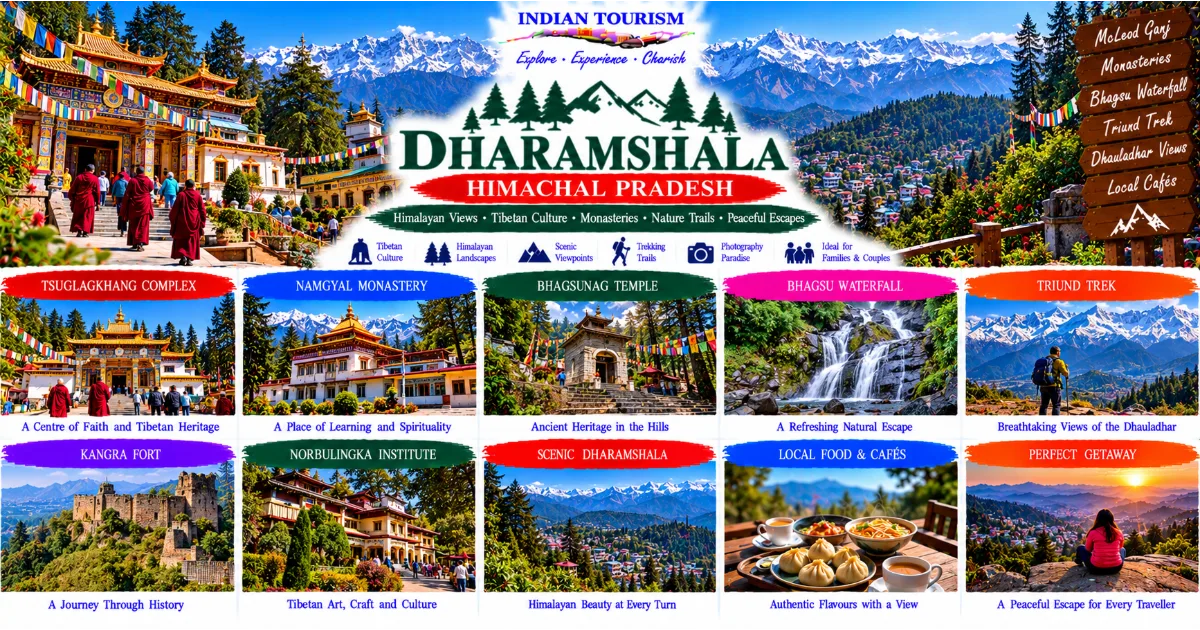
Discovering Dharamshala, Where Himalayan Beauty Meets Tibetan Heritage
Dharamshala is one of the most distinctive travel destinations in Himachal Pradesh, combining dramatic Himalayan scenery, spiritual traditions, Tibetan cultural heritage and opportunities for outdoor exploration. Located in the Kangra district, the town attracts travellers interested in mountain landscapes, monasteries, cultural experiences, local food and peaceful surroundings. Its character differs from many conventional hill stations because its appeal comes not only from its scenery but also from the living cultures and communities that shape everyday life.
Dharamshala is widely associated with McLeod Ganj, a neighbouring settlement that has become an important centre of Tibetan culture and Buddhism. The presence of Tibetan institutions, monasteries, cultural centres and traditional handicraft shops gives the area a distinctive atmosphere. Visitors can learn about Tibetan history, observe religious practices respectfully and explore the relationship between Himalayan communities and their spiritual traditions.
The surrounding landscape adds another dimension to the experience. The Dhauladhar mountain range rises above the region, creating striking views when weather conditions permit. Forests, valleys, streams and walking routes provide opportunities for nature lovers, photographers and travellers who enjoy spending time outdoors. The landscape changes dramatically with the seasons, from green hills during warmer months to snow-covered peaks in winter.
Dharamshala also offers several ways to experience the region at different levels of activity. Visitors can explore monasteries and museums, walk through local markets, enjoy cafés and regional food, visit cricket grounds and temples, or undertake longer outdoor excursions with appropriate preparation. Nearby destinations such as Kangra, Palampur and Bir Billing can extend the journey for travellers with additional time.
The destination is particularly suitable for travellers who want a combination of culture and nature rather than a holiday focused exclusively on shopping or commercial entertainment. Families can explore accessible cultural attractions, couples can enjoy scenic surroundings, and solo travellers can discover the region through its walking routes, cafés and community spaces.
This guide explores Dharamshala's main attractions, Tibetan cultural heritage, mountain scenery, food, accommodation, nearby destinations and practical travel advice. It also explains how visitors can respect local traditions and protect the natural environment while enjoying one of the most culturally distinctive destinations in Himachal Pradesh.
Understanding Dharamshala's Geography and Landscape
Dharamshala lies in the Kangra district of Himachal Pradesh, on the southern slopes of the Dhauladhar range. Its position between the lower Himalayan foothills and the higher mountains creates a varied landscape of valleys, forested slopes, streams and settlements.
The wider destination includes different neighbourhoods and nearby settlements, each with its own character. Lower Dharamshala serves as an important commercial and administrative centre, while McLeod Ganj is known for Tibetan cultural institutions, monasteries, cafés and tourist accommodation. Other areas provide access to walking routes, temples and viewpoints.
The elevation varies considerably across the wider area. This affects temperature, vegetation, walking conditions and the time needed to travel between attractions. A route that appears short on a map may involve a steep climb or a slow journey along winding roads.
The Dhauladhar mountains are one of the defining features of the landscape. Their rocky ridges and high peaks provide a dramatic backdrop, particularly when clouds clear after rain. However, visibility depends on weather conditions, and mountain views should not be assumed on every day of a visit.
The region also contains forests and watercourses that contribute to its ecological importance. Visitors may encounter pine and deodar trees in suitable areas, along with other vegetation associated with the local climate and elevation.
Dharamshala is a living region rather than an isolated tourist resort. Residential neighbourhoods, educational institutions, religious establishments and local businesses share the landscape with hotels and attractions. Visitors should respect private property and local customs.
Weather can change quickly, especially during the monsoon and in the higher mountain areas. Rain may make trails slippery, while fog can reduce visibility. Winter brings cold conditions and may affect access to some routes. Checking local weather information and road conditions before travelling is essential.
Understanding the geography helps visitors plan realistic itineraries. Rather than attempting to cover every attraction in a single day, travellers can group nearby places together and leave time to enjoy the mountain environment.
McLeod Ganj: The Cultural Heart of Dharamshala
McLeod Ganj is one of the most recognisable parts of the Dharamshala region. It is closely associated with Tibetan culture, Buddhist institutions, handicrafts, cafés and a distinctive international community of visitors and residents.
The settlement developed into an important centre of Tibetan life after the arrival of the Dalai Lama and Tibetan communities in India in the twentieth century. Over time, religious institutions, educational organisations, cultural centres and businesses helped establish McLeod Ganj as a place where Tibetan traditions continue to be practised and shared.
Visitors can explore its streets, browse shops selling handicrafts and textiles, and discover restaurants serving Tibetan and Himalayan food. The settlement also offers access to monasteries and cultural institutions that provide insight into Buddhist philosophy and Tibetan history.
McLeod Ganj can become busy during holidays, weekends and popular travel periods. Its narrow streets may experience traffic congestion, and accommodation demand can increase. Visitors should allow additional time for movement and consider walking where practical.
The area is also a residential community. Travellers should respect local people, religious customs and private spaces. Photography inside religious institutions may be restricted, and visitors should ask permission before photographing individuals.
McLeod Ganj is particularly rewarding for travellers who want to learn rather than simply observe. Reading introductory material about Tibetan culture before visiting monasteries or cultural centres can help visitors appreciate the significance of what they see.
The settlement provides a meaningful contrast with the more commercial areas of Dharamshala. Its combination of spiritual institutions, cultural traditions and mountain surroundings makes it one of the most distinctive places to explore in Himachal Pradesh.
Tsuglagkhang Complex: A Major Tibetan Buddhist Centre
The Tsuglagkhang Complex is one of the most important cultural and religious sites in McLeod Ganj. It is associated with the Dalai Lama and serves as a significant centre of Tibetan Buddhist practice and community life.
The complex includes religious spaces and facilities connected with Tibetan Buddhist traditions. Visitors may encounter prayer wheels, Buddhist imagery and areas used for meditation, prayer and religious gatherings. The atmosphere can be reflective, particularly when visitors approach the site quietly and respectfully.
The complex is more than a tourist attraction. It holds deep religious significance for Tibetan Buddhists and forms part of a wider cultural and spiritual tradition. Visitors should therefore follow all instructions concerning entry, footwear, photography and behaviour.
Depending on the schedule, the complex may host teachings or other religious activities. Public access arrangements can vary, and visitors should confirm current information before planning their visit around a particular event.
A visit provides an opportunity to learn about Buddhist practices and the role of religious institutions in Tibetan cultural life. Travellers who are unfamiliar with the traditions may find it useful to observe how people use the space rather than treating every feature as a photographic subject.
Silence or quiet conversation is appropriate in areas intended for prayer and reflection. Visitors should avoid interrupting worshippers and should not enter restricted areas.
The complex can be a meaningful stop for people interested in religion, philosophy, cultural history or the Tibetan community in India. Its significance extends beyond architecture, offering insight into a living spiritual tradition.
Namgyal Monastery: Learning About Tibetan Buddhist Traditions
Namgyal Monastery is closely associated with the Dalai Lama and Tibetan Buddhist learning. It is an important religious institution in the Dharamshala region and contributes to the area's cultural identity.
Monastic life involves study, ritual practice, meditation and the preservation of religious teachings. Visitors who explore the monastery respectfully may gain an appreciation of the discipline and traditions that shape Tibetan Buddhist institutions.
The experience may differ according to the day, religious calendar and access arrangements. Some areas may be restricted, and visitors should follow all instructions from monastery staff or local authorities.
Visitors should dress modestly and behave respectfully. Photography may be restricted in particular areas, and permission should be sought before photographing monks or other individuals.
A monastery visit can provide an opportunity to learn about the importance of Buddhist philosophy, ritual and community life. Travellers should avoid assuming that every activity is intended for public observation.
The surrounding mountain setting adds to the atmosphere, although weather can influence the views and the comfort of walking around the area.
For visitors interested in Tibetan culture, Namgyal Monastery offers an important perspective on the institutions that preserve religious knowledge and traditions. It is best approached with curiosity, patience and respect rather than as a quick sightseeing stop.
Bhagsunag Temple: Spiritual Heritage in a Mountain Setting
Bhagsunag Temple is a well-known religious attraction in the Dharamshala region, associated with Lord Shiva and local traditions. Its location near McLeod Ganj makes it a common stop for visitors exploring the area's cultural and natural attractions.
The temple attracts devotees throughout the year, with activity increasing during important religious occasions. The surrounding settlement also provides access to cafés, accommodation and routes towards nearby natural attractions.
Visitors should respect the temple's religious significance and follow local instructions concerning footwear, clothing, offerings and photography. During busy periods, the area may become crowded, so travellers should allow sufficient time.
The temple is associated with local legends and religious traditions that form part of the cultural landscape of Himachal Pradesh. Visitors interested in these stories can learn more through local interpretation and respectful conversations with knowledgeable residents.
The surrounding area provides opportunities to appreciate the mountain environment. However, visitors should not assume that every path is easy or accessible. Some routes involve slopes and uneven surfaces.
Bhagsunag Temple is often combined with an excursion towards Bhagsu Waterfall, but the walking conditions and suitability of the route depend on weather and individual fitness. Rain can make paths slippery, and visitors should avoid climbing on wet rocks.
A visit to Bhagsunag Temple can provide both a cultural experience and a starting point for exploring the surrounding landscape. It illustrates how religious sites and natural attractions often form connected parts of the tourism experience in Himachal Pradesh.
Bhagsu Waterfall: A Popular Natural Attraction
Bhagsu Waterfall is one of the best-known natural attractions near McLeod Ganj. The waterfall is reached by a walking route from the Bhagsunag area, and the journey provides opportunities to appreciate the surrounding hills and vegetation.
The appearance of the waterfall varies with rainfall and season. During wetter periods, the flow may be stronger, while conditions can differ during drier months. Visitors should not assume that the waterfall will look the same throughout the year.
The route may involve steps, slopes and uneven surfaces. Comfortable footwear with a good grip is important, particularly after rain. Visitors should allow enough time for the return journey and avoid attempting the walk in poor weather.
The rocks around waterfalls can be extremely slippery. Visitors should remain in safe areas, follow local instructions and avoid climbing onto wet rocks or entering fast-moving water. Water levels and currents can change quickly.
The area can become crowded during weekends and holidays. Starting earlier in the day may provide a more comfortable experience, although weather and local access conditions should always guide the decision.
Visitors should carry drinking water and dispose of rubbish responsibly. Plastic packaging and food waste should never be left along the trail or near the water.
Bhagsu Waterfall is appealing to nature lovers, photographers and travellers who enjoy a short outdoor excursion. Its value lies in the combination of the walk, the surrounding landscape and the opportunity to experience a natural feature close to a well-known cultural centre.
Triund Trek: A Gateway to Himalayan Adventure
Triund is one of the most popular trekking destinations associated with Dharamshala. The route leads towards an elevated ridge offering views of the Dhauladhar mountains on one side and the Kangra Valley on the other when weather conditions are favourable.
The trek attracts visitors who want to experience the Himalayan landscape more directly than is possible from the town. The journey involves uphill walking and can be physically demanding, depending on the starting point, route conditions and the traveler's fitness.
Triund should not be treated as a casual stroll without preparation. Visitors should assess their fitness, check current trail conditions and carry suitable footwear, water, food and clothing. Weather can change quickly in the mountains, and temperatures may fall considerably at higher elevations.
Travellers should confirm current access arrangements, any permit requirements and the availability of local guides or organised services before setting out. Rules and conditions may change with the season.
The route should be planned with enough time to return safely. Starting late can create difficulties, particularly when daylight is limited or weather conditions deteriorate. Visitors should avoid continuing if conditions become unsafe.
Camping arrangements and overnight stays are subject to local regulations and availability. Travellers should not assume that camping is permitted everywhere or that facilities will always be available.
Responsible trekking includes staying on established paths, carrying rubbish back and avoiding damage to vegetation. Visitors should respect wildlife and avoid excessive noise.
Triund can be a memorable experience for prepared travellers, but safety and environmental care should take priority over reaching a particular viewpoint. Visitors who prefer a gentler outing can enjoy shorter walks in the lower hills.
Dal Lake: A Quiet Stop Among the Trees
Dal Lake near McLeod Ganj is a small lake surrounded by trees and associated with the local landscape and religious traditions. It provides a quieter stop for visitors exploring the area beyond the busiest streets.
The lake's appearance and water levels may vary according to season and local conditions. Travellers should approach it with realistic expectations rather than assuming it will resemble the much larger Dal Lake in Kashmir.
The surrounding area can provide opportunities for a short walk and photography. Visitors may also encounter religious activity or local gatherings depending on the day and season.
The lake is not necessarily a major attraction in terms of size, but its value lies in its setting and its place within the wider Dharamshala landscape. It can be included as a brief stop during an excursion to nearby places.
Visitors should avoid littering and should not disturb the surrounding vegetation or wildlife. If local rules restrict access to particular areas, those instructions should be followed.
The visit is best combined with other attractions in the region rather than treated as a full-day destination. Travellers can enjoy the quieter surroundings while allowing time for nearby cultural landmarks and scenic walks.
Dal Lake demonstrates that a destination's appeal can include small natural spaces as well as famous mountain viewpoints and major religious institutions.
Kangra Fort: Exploring the Region's Historic Past
Kangra Fort is one of the most significant historical attractions in the wider Dharamshala region. Located in the Kangra Valley, the fort reflects the area's long history of regional kingdoms, strategic importance and changing political control.
The fort's position above the surrounding landscape illustrates why elevated sites were important for defence and administration. Its walls, gateways and remaining structures provide insight into the history of the region and the development of fortifications in northern India.
Visitors interested in history should allow enough time to explore the site and appreciate its setting. The terrain may involve steps, slopes and uneven surfaces, so comfortable footwear is recommended.
The fort's history includes periods of regional rule, conflict and changes in political power. Travellers may find it useful to learn about the broader history of the Kangra region before visiting, as this provides context for the structures and the fort's strategic location.
Access arrangements, entry fees and opening times should be confirmed before travelling. Conditions at historical sites can change, and visitors should follow any restrictions designed to protect the remaining structures.
Photography can be rewarding, particularly where the surrounding valley is visible. Visitors should avoid climbing on fragile walls or entering restricted areas.
Kangra Fort provides a useful contrast with Dharamshala's Buddhist institutions and natural attractions. It adds a historical dimension to a regional itinerary and helps visitors understand the diverse cultural influences that have shaped Himachal Pradesh.
Norbulingka Institute: Tibetan Art, Craft and Cultural Preservation
Norbulingka Institute, located in the wider Dharamshala area, is an important centre associated with the preservation of Tibetan art and cultural traditions. It provides visitors with opportunities to learn about traditional crafts, artistic techniques and the transmission of cultural knowledge.
The institute is known for its focus on Tibetan art forms and craftsmanship. Visitors may encounter examples of traditional painting, woodwork, sculpture, textile work and other artistic practices, depending on current access and activities.
The institute's work highlights the relationship between artistic skill and cultural identity. Traditional crafts often involve detailed techniques passed from one generation to another, and their preservation helps maintain cultural knowledge in a changing world.
Visitors should confirm current opening arrangements and whether particular workshops or demonstrations are available. Activities may vary, and not every workshop is necessarily open to general visitors.
Respect for the working environment is important. Travellers should follow photography rules and avoid interrupting artisans while they work. Purchasing authentic products through legitimate channels can support the continuation of traditional skills.
The institute offers an experience different from visiting a monastery. While monasteries focus on religious practice and learning, a cultural institute can help visitors understand the artistic and material traditions that form part of Tibetan heritage.
For travellers interested in culture, craftsmanship and heritage preservation, Norbulingka Institute can be one of the most meaningful stops in the Dharamshala region.
Kangra Valley and the Dhauladhar Mountain Views
The Dhauladhar range forms a dramatic backdrop to Dharamshala and contributes significantly to the area's tourism appeal. Its steep ridges and high peaks create a striking contrast with the lower hills and valley settlements.
The Kangra Valley stretches below the mountains and includes agricultural land, villages, rivers and towns. Its landscape reflects the relationship between mountain geography and human settlement, with communities adapting their livelihoods and transport routes to the terrain.
Views of the Dhauladhar range depend heavily on weather conditions. Clear mornings may offer impressive visibility, while clouds, mist and rain can obscure the peaks. Visitors should be flexible when planning photography or scenic stops.
The changing light across the mountains can create attractive photographic opportunities. However, visitors should use safe viewpoints and avoid stopping vehicles in dangerous locations.
The wider valley also contains cultural and historical attractions, including temples, forts and traditional settlements. Travellers who have additional time can explore these places as part of a broader Kangra itinerary.
Nature enthusiasts should remember that mountain ecosystems are sensitive. Visitors should remain on permitted paths, avoid littering and respect wildlife and vegetation.
The Dhauladhar range is not only a scenic backdrop but also an important part of the region's environmental and cultural identity. Its presence shapes the climate, tourism activities and everyday experience of Dharamshala.
Tibetan Culture, Handicrafts and Local Shopping
Dharamshala and McLeod Ganj provide opportunities to explore Tibetan handicrafts, textiles, books, artwork and other cultural products. The variety of items reflects the presence of Tibetan communities and the importance of traditional crafts in the region.
Visitors may find prayer flags, handmade items, clothing, decorative objects and books related to Tibetan history and Buddhist traditions. Product quality and origin vary, so travellers should ask questions and buy from legitimate businesses.
Shopping can be a way to support local artisans and businesses, particularly when visitors choose authentic products and understand how they are made. Some traditional crafts require considerable skill and time, making them valuable examples of cultural knowledge.
Visitors should be cautious when buying expensive or antique items and should ask for information about their origin. Products made from protected wildlife or materials whose source is unclear should be avoided.
The markets can become crowded during peak tourist periods. Travellers should keep personal belongings secure and allow enough time to browse without rushing.
Respectful interaction matters. Visitors should ask permission before photographing shopkeepers, artisans or their workspaces. Not every person working in a shop wishes to be photographed.
Shopping should complement the wider cultural experience rather than replace it. Learning about the traditions behind a craft can make a purchase more meaningful and help visitors appreciate the cultural significance of the items they encounter.
Best Time to Visit Dharamshala
Dharamshala can be visited throughout much of the year, but the best time depends on the activities planned and the visitor's preferences.
Spring offers fresh vegetation and may provide pleasant conditions for sightseeing, cultural visits and shorter walks. The mountain scenery can be especially attractive when the weather is clear, although visibility varies.
Summer is a popular season for visitors seeking relief from the heat of the plains. The town, surrounding forests and nearby cultural attractions can make Dharamshala a comfortable base for a holiday. Popular travel periods may bring crowds and higher accommodation demand.
The monsoon brings greener landscapes but also creates challenges. Heavy rain may affect roads, make walking routes slippery and reduce visibility. Visitors planning outdoor excursions should check local forecasts and trail conditions.
Autumn can offer cooler weather and opportunities for sightseeing and walking. It may be suitable for travellers who prefer outdoor exploration without the heavier rainfall associated with the monsoon.
Winter brings cold conditions, particularly in the higher areas and during mornings and evenings. Snow may be visible on higher parts of the Dhauladhar range when weather conditions permit, but snowfall in the town itself is not guaranteed. Visitors should carry warm clothing and check the forecast before setting out.
Trekkers should plan according to the current trail conditions and avoid assuming that a route is safe simply because it is popular. Local guidance and official advisories should take priority.
The best time to visit is the period that matches the intended experience. Cultural sightseeing can be enjoyed across much of the year, while trekking and other outdoor activities require greater attention to weather and route conditions.
How to Reach Dharamshala
Dharamshala is accessible by road and air, while rail travellers generally use stations serving the wider Kangra region or the plains before continuing by road.
By Road
Road travel is one of the main ways to reach Dharamshala. Visitors can use private vehicles, taxis or available bus services from cities and towns in northern India.
The journey passes through varying terrain, and travel times depend on the starting point, traffic and weather. Mountain roads may include sharp bends and steep sections, so drivers should proceed carefully.
Travellers should confirm the exact location of their accommodation because Dharamshala and McLeod Ganj are different areas within the wider destination. The final transfer may involve additional road travel.
By Air
Kangra Airport, also known as Gaggal Airport, serves the Dharamshala region, subject to current flight availability. Travellers should confirm the operating schedule and available connections before booking.
An onward road transfer is required from the airport to the town or McLeod Ganj. Journey time depends on traffic, weather and the final destination.
By Rail
Dharamshala does not have a major broad-gauge railway station in the central town. Travellers can use rail connections serving the wider region and continue by road.
Pathankot and stations serving the Kangra Valley may be relevant depending on the chosen route and available services. Travellers should confirm current train schedules and plan onward transport before departure.
The narrow-gauge Kangra Valley railway is associated with the wider region and may appeal to railway enthusiasts, but it should not be assumed to provide the most direct connection to every Dharamshala attraction.
Getting Around Dharamshala and McLeod Ganj
The wider Dharamshala area includes settlements at different elevations, so transport planning is important. The distance between lower Dharamshala and McLeod Ganj can involve a significant climb by road.
Taxis and local transport services can be useful for moving between attractions. Visitors should confirm fares and waiting charges before beginning a journey, particularly when planning multiple stops.
Walking is suitable for exploring some central areas, but the terrain can be steep and roads may have limited pedestrian space. Comfortable footwear is essential.
Some attractions require additional walking, including routes to waterfalls, monasteries and trekking starting points. Visitors should assess the route and weather before setting out.
Families and travellers with mobility limitations should consider gradients, steps, parking locations and accessibility before choosing activities. Not every attraction is equally accessible.
A flexible itinerary helps visitors manage traffic and changing weather. Grouping nearby places together can reduce unnecessary travel and leave more time for cultural exploration.
Where to Stay in Dharamshala
Accommodation in Dharamshala ranges from budget guesthouses and homestays to hotels, resorts and properties with mountain views. The best option depends on budget, transport preferences and the activities planned.
Visitors interested in Tibetan culture may prefer to stay in or near McLeod Ganj, where monasteries, cafés, cultural institutions and markets are relatively convenient to reach. Travellers seeking a quieter atmosphere may consider accommodation outside the busiest areas.
Lower Dharamshala may be useful for visitors who want access to commercial services and transport connections. Those planning trekking excursions should consider how they will reach the starting point and whether early transport is available.
Visitors should confirm the exact location of their accommodation before booking. A property advertised as being in Dharamshala may be some distance from McLeod Ganj or another attraction.
Heating, hot water, parking and meal availability should be checked, especially during winter. Facilities vary between properties, and visitors should confirm what is included in the quoted price.
Homestays can provide a more personal experience and opportunities to learn about local food and everyday life. Guests should communicate arrival times and dietary requirements clearly.
Booking ahead is advisable during popular holidays, festival periods and peak summer travel. Visitors should review cancellation policies, additional charges and transport arrangements before confirming a reservation.
Food and Local Dining in Dharamshala
Dharamshala offers a varied food scene influenced by Tibetan, Himachali, North Indian and international culinary traditions. This diversity is one of the pleasures of exploring McLeod Ganj and the wider town.
Tibetan dishes are particularly associated with the region. Travellers may find momos, thukpa and other noodle-based preparations in local restaurants. Recipes and ingredients vary between establishments, and visitors can ask about the preparation before ordering.
Momos are dumplings that may be filled with vegetables or other ingredients, while thukpa is a noodle soup that is especially welcome in cooler weather. These dishes reflect the influence of Tibetan culinary traditions in the region.
Visitors interested in Himachali food can ask about local dishes such as siddu, a wheat-based preparation associated with parts of the state. Dham is a festive meal tradition found in different regional forms, although availability varies and not every restaurant serves it.
McLeod Ganj also has cafés offering baked goods, tea, coffee and international dishes. Travellers can choose between casual eateries and restaurants with views of the surrounding hills.
Visitors should check menu prices before ordering and communicate dietary restrictions or food allergies clearly. Those planning longer walks or treks should carry drinking water and suitable snacks.
Food packaging should be disposed of responsibly. Visitors should never leave rubbish on walking routes, near waterfalls or at scenic viewpoints.
Dining is an important part of Dharamshala's cultural experience. Trying regional and Tibetan dishes can help visitors appreciate the influence of different communities on the area's everyday life.
Nearby Palampur: Tea Gardens and Mountain Views
Palampur is a popular destination in the wider Kangra region, known for its tea gardens, mountain scenery and relaxed atmosphere. It can be combined with Dharamshala for travellers who have additional time.
The area's tea plantations provide a distinctive landscape of cultivated greenery against the backdrop of the Dhauladhar range. Visitors can appreciate the scenery from permitted public areas and may find opportunities to learn about tea production where tours or visitor arrangements are available.
Palampur offers a different experience from Dharamshala. While Dharamshala is closely associated with Tibetan culture and monasteries, Palampur is particularly known for tea cultivation and the surrounding countryside.
Travellers should confirm current access arrangements before visiting tea estates or production facilities. Private agricultural properties are working places, and visitors should not enter without permission.
The road journey should be planned according to current conditions and the available time. Travellers should avoid trying to combine too many distant attractions in one day.
Palampur can be an appealing addition for visitors interested in agriculture, scenic drives and a quieter mountain setting. It broadens the experience of the Kangra region beyond Dharamshala's cultural landmarks.
Nearby Bir Billing: Paragliding and Adventure Tourism
Bir Billing is a well-known destination in Himachal Pradesh associated with paragliding and mountain adventure. It can be considered by travellers who want to extend their journey beyond Dharamshala and explore a different side of the region.
Bir is associated with Tibetan culture and monasteries, while Billing is known as a launching area for paragliding. The wider destination attracts adventure enthusiasts, photographers and visitors interested in mountain landscapes.
Paragliding depends on weather, wind conditions, operator arrangements and applicable safety rules. Visitors should choose qualified operators, confirm what is included in the price and follow all instructions.
Travellers should not assume that flights will operate on a particular day. Weather can change quickly, and cancellations may be necessary for safety.
Those who prefer not to participate in adventure activities can enjoy the surrounding scenery, explore permitted walking routes or visit cultural attractions in the wider area.
The journey from Dharamshala should be planned carefully, particularly if visitors intend to return the same day. Allowing additional time makes the experience more comfortable.
Bir Billing adds an adventure dimension to a broader Himachal Pradesh itinerary, complementing Dharamshala's cultural heritage and mountain scenery.
A Suggested Three-Day Dharamshala Itinerary
A three-day visit provides enough time to explore the main cultural attractions and enjoy some of the surrounding natural landscape without rushing.
On the first day, arrive and settle into the accommodation. Explore McLeod Ganj and visit the Tsuglagkhang Complex or another accessible cultural attraction, subject to current opening arrangements. Spend time learning about Tibetan traditions and exploring the local markets.
On the second day, visit Bhagsunag Temple and consider walking towards Bhagsu Waterfall if weather and trail conditions are suitable. Allow enough time for the return journey and avoid climbing on slippery rocks. Later, explore other accessible areas of McLeod Ganj or enjoy a relaxed meal at a local restaurant.
On the third day, choose an excursion according to your interests. Visitors interested in history may consider Kangra Fort, while nature enthusiasts may prefer a suitable short walk or scenic drive. Travellers with appropriate fitness and preparation may consider a guided trekking experience, subject to current conditions.
Triund should only be attempted with suitable preparation, enough daylight and reliable information about the route. Visitors should not begin a demanding trek late in the day or continue when weather conditions become unsafe.
Those with additional time can consider Palampur or Bir Billing, although these destinations may require more travel time than a short local excursion.
Families should include rest breaks and avoid an overly demanding schedule. Visitors with mobility limitations should check accessibility before choosing activities.
The itinerary should remain flexible because weather, traffic and access arrangements may change. A relaxed approach allows visitors to enjoy both the cultural and natural sides of Dharamshala.
Responsible Tourism in Dharamshala
Dharamshala's forests, mountain trails, religious institutions and cultural communities are central to its appeal. Responsible tourism helps protect these resources while supporting local livelihoods.
Visitors should dispose of waste properly and carry rubbish until suitable facilities are available. Plastic bottles, food packaging and other waste should never be left on trekking routes, near waterfalls or at scenic viewpoints.
Religious sites should be treated respectfully. Travellers should follow local instructions concerning footwear, clothing, photography and access to restricted areas. Monasteries and temples are active religious spaces, not simply tourist attractions.
Visitors should ask permission before photographing individuals, artisans or religious activities. Respecting privacy is particularly important in residential neighbourhoods and places of worship.
Outdoor activities should be undertaken responsibly. Visitors should remain on permitted trails, check weather conditions and avoid disturbing wildlife. Trekkers should carry their rubbish back and follow local guidance.
Supporting local accommodation providers, restaurants, artisans and guides can help tourism contribute to the regional economy. Visitors should pay agreed prices and treat workers respectfully.
Mountain roads require careful driving, especially during rain, fog and winter conditions. Travellers should follow official advisories and avoid unsafe journeys.
Responsible tourism also means respecting the cultural diversity of the region. Visitors should approach Tibetan and Himachali traditions with curiosity and consideration rather than making assumptions about religious practices or local customs.
By protecting the environment and respecting local communities, travellers can help ensure that Dharamshala remains a welcoming destination for future generations.
Is Dharamshala Suitable for Families, Couples and Solo Travellers?
Dharamshala can suit a wide range of travellers because it offers a combination of cultural attractions, natural scenery, food experiences and outdoor activities.
Families may enjoy the monasteries, cultural institutions, local markets and accessible scenic areas. Parents should consider walking distances, steps and weather conditions when planning activities with children.
Couples may appreciate the mountain views, quiet cafés, forest surroundings and accommodation options that offer a peaceful atmosphere. A relaxed itinerary combining cultural exploration with nature can make the visit especially enjoyable.
Solo travellers may find opportunities to learn about Tibetan culture, explore local cafés and join organised activities where appropriate. Visitors should still plan transport and walking routes carefully, particularly when exploring unfamiliar areas.
History and culture enthusiasts can visit religious institutions and heritage sites, while nature lovers can explore the surrounding hills and consider trekking routes suitable for their fitness.
Adventure travellers may use Dharamshala as a base for longer excursions, but activities such as trekking and paragliding require appropriate preparation and qualified guidance.
Visitors with mobility limitations should check access arrangements, slopes and steps before planning a visit. Some mountain attractions are less accessible than central cultural sites.
Dharamshala's greatest strength is its diversity. It offers opportunities to experience culture, history and nature within one regional destination, making it suitable for travellers who value meaningful exploration over a packed commercial itinerary.
Conclusion: Why Dharamshala Deserves a Place on Your Himachal Pradesh Travel List
Dharamshala is one of the most culturally distinctive destinations in Himachal Pradesh, combining the dramatic landscape of the Dhauladhar mountains with Tibetan heritage, Buddhist institutions, religious landmarks and opportunities for outdoor exploration.
McLeod Ganj provides a window into Tibetan cultural life, while the Tsuglagkhang Complex and Namgyal Monastery offer opportunities to learn about Buddhist traditions. Norbulingka Institute highlights the importance of preserving Tibetan art and craftsmanship, adding another dimension to the cultural experience.
Natural attractions such as Bhagsu Waterfall, the surrounding forests and the views across the Kangra Valley provide opportunities to enjoy the landscape. Triund offers a trekking experience for suitably prepared travellers, while Kangra Fort introduces the area's historic past.
Nearby Palampur and Bir Billing can extend the journey with tea gardens, countryside scenery and adventure activities. These destinations provide additional variety for visitors who have more time to explore the region.
The best time to visit depends on personal interests and current conditions. Spring, summer and autumn can be suitable for cultural sightseeing and outdoor exploration, while winter brings colder weather in the hills. Trekkers should always check current route conditions and forecasts before setting out.
Good planning makes the visit more comfortable. Confirm opening arrangements for cultural attractions, choose accommodation according to the itinerary and allow sufficient time for travel between different elevations.
Responsible tourism is essential. Visitors should respect religious traditions, protect the forests, avoid littering and support local businesses where appropriate.
For the Indian Tourism series, Dharamshala demonstrates how a destination can combine natural beauty with living cultural traditions. It offers an opportunity to learn, reflect and experience the Himalayas through the people and institutions that give the region its distinctive identity.
Whether you visit for Tibetan culture, mountain scenery, religious heritage, local cuisine or outdoor adventure, Dharamshala offers a meaningful way to discover the cultural and natural richness of Himachal Pradesh.
#IndianTourism #HimachalPradesh #Dharamshala #DharamshalaTourism #McLeodGanj #TibetanCulture #TsuglagkhangComplex #NamgyalMonastery #NorbulingkaInstitute #BhagsuWaterfall #BhagsunagTemple #TriundTrek #DhauladharRange #KangraValley #KangraFort #Palampur #BirBilling #HimalayanTravel #ResponsibleTourism #ExploreIndia
