
Where Ancient Spirituality Meets the Rugged Himalayas
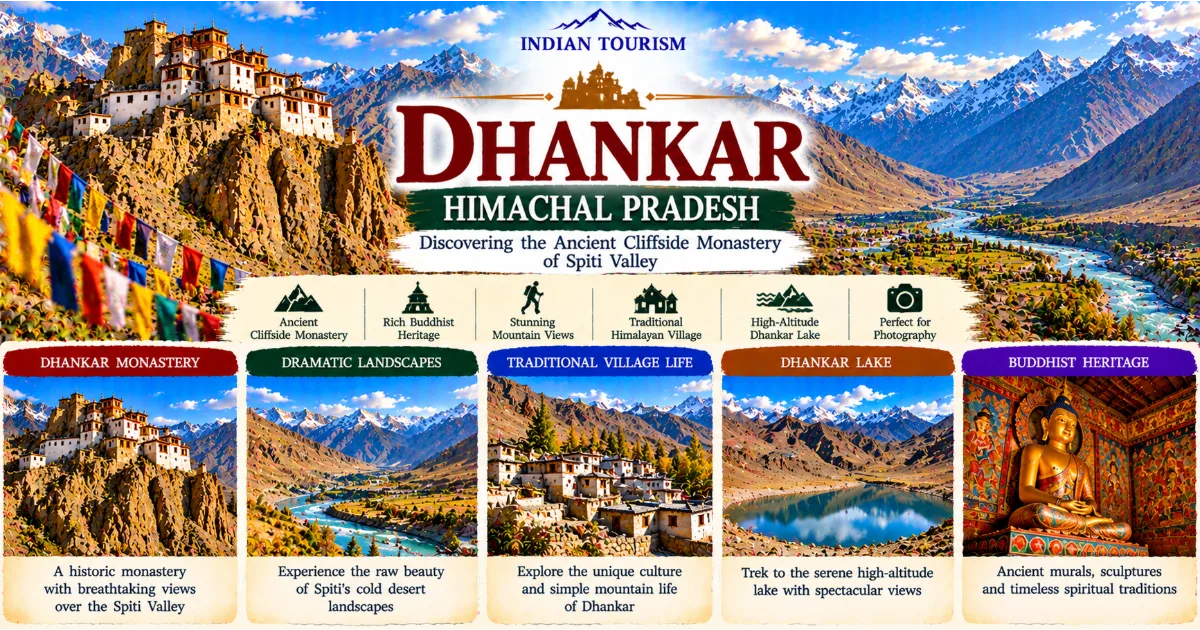
Himachal Pradesh is a land of extraordinary contrasts. Its western regions are known for green valleys, pine forests and popular hill stations, while its eastern mountains reveal a dramatic world of rocky cliffs, high-altitude settlements and ancient religious traditions. Among the most fascinating destinations in this rugged landscape is Dhankar, a historic village in the Spiti Valley of Himachal Pradesh. Known for its remarkable cliffside monastery, traditional mountain settlement and breathtaking views over the surrounding valleys, Dhankar offers an unforgettable experience for travellers interested in Himalayan heritage, Buddhist culture and natural beauty.
Located in the Lahaul and Spiti district, Dhankar occupies a dramatic position above the confluence of the Spiti and Pin river valleys. The settlement is surrounded by mountains shaped by wind, water and geological forces over countless generations. Its buildings appear closely connected to the landscape, with traditional structures occupying available ground along steep slopes. The combination of ancient architecture and rugged scenery gives Dhankar a distinctive character that differs from the forested hill stations commonly associated with Himachal Pradesh.
The most important landmark is Dhankar Monastery, a historic Buddhist institution associated with the religious and cultural development of Spiti. Its setting is particularly striking, with buildings positioned against steep terrain and overlooking the surrounding valley. The monastery reflects the relationship between spiritual life and geography in the Himalayan region, where religious institutions often developed in places that offered both isolation and a commanding presence within the landscape.
Dhankar is also known for its nearby high-altitude lake, traditional village life and connections with other important destinations in Spiti. Visitors can combine the village with Tabo, Kaza and Pin Valley to gain a broader understanding of the region's natural and cultural diversity.
For travellers seeking a meaningful journey through Himachal Pradesh, Dhankar offers much more than a scenic viewpoint. It provides an opportunity to explore ancient religious heritage, understand the challenges of high-altitude living and experience a landscape that rewards patience and careful observation. A thoughtful visit, planned around weather conditions and local guidance, can reveal why Dhankar remains one of the most memorable destinations in the Spiti Valley.
Understanding Dhankar and Its Geographical Setting
Where Is Dhankar Located?
Dhankar is situated in the Spiti region of the Lahaul and Spiti district in Himachal Pradesh. It lies above the valley formed by the Spiti River and near the area where the Pin River joins the wider river system. Its elevated location provides sweeping views across the surrounding mountains and river valleys.
The settlement forms part of the cold desert environment of Spiti. Unlike the wetter Himalayan slopes found in other parts of Himachal Pradesh, this region receives relatively little precipitation because major mountain ranges intercept much of the moisture carried by monsoon winds. As a result, the landscape is dominated by exposed rock, dry slopes, sparse vegetation and cultivated areas concentrated around available water sources.
The geography of Dhankar has influenced its settlement pattern and historical importance. Steep terrain limits the amount of flat land available for construction and agriculture, while the elevated position creates a strong visual connection between the village and the surrounding valley.
Travellers approaching Dhankar encounter a landscape that changes gradually from river corridors and open slopes to rocky ridges and mountain settlements. The journey itself can be an important part of the experience, revealing the relationship between natural geography and human habitation.
Because Dhankar is located in a remote mountain region, visitors should confirm road conditions before departure. Weather, landslides, road maintenance and seasonal restrictions can affect access. Travel times should be planned conservatively, with additional time allowed for unexpected delays.
The Cold Desert Environment of Spiti
Spiti is one of the most distinctive geographical regions in Himachal Pradesh. Its cold desert environment is characterised by limited rainfall, substantial temperature variation and sparse vegetation. The landscape often appears almost sculptural, with layers of exposed rock and steep mountain faces displaying a variety of colours and textures.
Although the environment may appear harsh, communities have lived in this region for generations. Settlements developed in locations where water, cultivable land and transport routes made habitation possible. Traditional agricultural practices reflect the short growing season and the need to manage resources carefully.
The dry environment also influences architecture. Homes and other buildings often use locally available materials and construction methods suited to the climate. The design and arrangement of traditional settlements reflect the need to protect against cold weather while making practical use of limited land.
Visitors should understand that this landscape is environmentally fragile. Vegetation may grow slowly, and careless activity can damage surfaces that take a long time to recover. Responsible travel includes avoiding litter, respecting cultivated land and staying on established paths whenever possible.
Dhankar's dramatic appearance is inseparable from this cold desert environment. Its monastery and village seem to emerge naturally from the surrounding mountains, creating a setting in which architecture, spirituality and geography are closely connected.
Dhankar Monastery: A Historic Buddhist Landmark
The Historical Importance of Dhankar Monastery
Dhankar Monastery is one of the best-known religious landmarks in Spiti Valley. Its history is closely connected with the spread and development of Tibetan Buddhism across the western Himalayas. For generations, monasteries have served as centres of religious learning, worship, community life and cultural preservation in this region.
Dhankar has traditionally held an important place within the religious landscape of Spiti. The monastery's elevated position and distinctive architecture have made it a recognisable landmark, while its historical associations connect it with the wider development of Buddhist institutions in the Himalayas.
The monastery is often described as a former centre of regional religious and administrative importance. Historical accounts associate Dhankar with the traditional political organisation of Spiti, although individual details of its past should be understood through reliable historical research rather than assumptions based solely on its appearance.
Its significance extends beyond its age. The monastery represents the role religious institutions played in maintaining cultural continuity across remote mountain communities. Through teaching, ritual, artistic activity and the preservation of religious knowledge, monasteries helped connect local settlements with wider Buddhist traditions.
For visitors, this history gives the site a meaning that goes beyond its spectacular setting. Exploring Dhankar becomes an opportunity to understand how religious institutions developed in response to the cultural and geographical conditions of the Himalayan region.
The Monastery's Cliffside Setting
One of the most striking features of Dhankar Monastery is its position above the surrounding valley. The buildings appear to occupy a narrow and elevated section of the landscape, creating a dramatic relationship between the architecture and the steep mountain terrain.
The setting reflects the importance of geography in the development of Himalayan religious sites. Elevated locations could provide a degree of isolation suited to spiritual practice while also creating a strong presence within the surrounding landscape. The physical challenge of reaching such places may have further contributed to their sense of separation from ordinary village life.
From safe and permitted viewpoints, visitors can observe how the monastery's buildings relate to the surrounding ridges and valleys. The contrast between the pale walls, earthy mountain slopes and distant river landscape can be especially striking in clear weather.
However, the cliffside setting requires caution. Visitors should not climb unstable walls, approach exposed edges or cross barriers to obtain photographs. The terrain can be dangerous, particularly when wet, icy or affected by strong winds.
The beauty of Dhankar is best appreciated from safe locations where visitors can observe the architecture and landscape without taking unnecessary risks.
Architecture and Religious Spaces
Dhankar Monastery reflects the architectural traditions associated with Buddhist institutions in the Himalayan region. Its buildings developed in response to the available terrain, local construction materials and the practical needs of religious life.
Traditional monastic architecture often includes spaces for prayer, teaching, ritual and the preservation of religious objects. The arrangement of these spaces helps support the daily activities of the monastic community.
The monastery's appearance should not be interpreted as the product of a single construction period. Like many historic religious complexes, it has developed over time and may contain elements reflecting different phases of construction, repair and adaptation.
Visitors should follow local guidance when exploring the complex. Some spaces may be restricted, and photography rules can vary between rooms and religious areas. Historic structures and artistic features require careful treatment, so touching walls, moving objects or disturbing religious items should be avoided.
The monastery is not simply an architectural attraction. It remains part of a living cultural tradition, and respectful behaviour is essential to preserving its spiritual significance.
Buddhist Culture and Religious Traditions in Spiti
The Role of Monasteries in Himalayan Communities
Monasteries have played an important role in the social and cultural life of Spiti. Beyond serving as places of worship, they have historically supported education, the transmission of religious teachings and the preservation of artistic traditions.
Monks study religious texts, participate in ceremonies and maintain practices that connect present-day communities with earlier generations. Religious festivals and other events may bring together residents from surrounding villages, strengthening relationships between settlements and religious institutions.
Dhankar Monastery is part of this broader cultural landscape. Its importance lies not only in its historical buildings but also in the traditions and community connections associated with the site.
Visitors who want to understand the monastery should approach it with an interest in the people and practices that sustain it. A quiet visit, respectful observation and attention to local instructions can provide a more meaningful experience than treating the complex as a place for photography alone.
Tibetan Buddhist Influence
Spiti shares strong historical and cultural connections with Tibetan Buddhist traditions. These connections can be seen in religious architecture, artistic styles, prayer practices and the role of monasteries within village life.
The region's location helped facilitate cultural exchange across the western Himalayas. Religious teachings, artistic methods and institutional traditions travelled through networks of teachers, students, patrons and local communities.
However, Himalayan Buddhism is not a single uniform tradition. Local practices and historical experiences vary across regions and institutions. Visitors should therefore avoid assuming that every monastery follows identical customs or has the same historical background.
Learning about these differences can make a journey through Spiti more rewarding. Dhankar, Tabo and Key Monastery each offer opportunities to understand different aspects of the region's religious heritage and the role Buddhist institutions have played in preserving it.
Respectful Conduct at Religious Sites
Visitors should remember that monasteries are active religious spaces. Appropriate behaviour includes speaking quietly, dressing respectfully and following instructions from monks or caretakers.
Ask before taking photographs, particularly inside prayer rooms or near religious ceremonies. Some areas may prohibit photography entirely, while others may allow it under specific conditions.
Do not touch sacred objects or enter restricted areas. Follow any instructions concerning footwear and movement through the complex. If a religious activity is taking place, observe from a respectful distance rather than interrupting it.
These simple practices help protect the monastery and support a positive relationship between visitors and the local community.
Dhankar Village: Traditional Life in the Mountains
Exploring the Settlement
Dhankar village offers a glimpse into the traditional settlement patterns of Spiti. The buildings occupy a rugged landscape where the availability of flat land is limited and the terrain influences the arrangement of homes, paths and cultivated spaces.
Traditional houses in the region often reflect the use of locally available materials and practical construction methods suited to cold winters. The appearance of individual buildings varies according to age, purpose and the needs of their occupants.
Walking through accessible parts of the village allows visitors to observe how people have adapted to the mountain environment. The relationship between houses, agricultural plots and the surrounding slopes reveals the importance of making efficient use of available land.
Visitors should remain respectful of private property. Residential buildings are homes, not open tourist exhibits, and photographs should be taken only in ways that respect residents' privacy.
Agriculture and Seasonal Life
Agriculture is important to many communities across Spiti. The short growing season means that farming activities must be carefully planned around the available period of favourable weather.
Cultivated fields are often concentrated in areas where water can be accessed and distributed. Crops must be suited to local conditions, and agricultural work follows seasonal patterns that differ from those in warmer parts of India.
The landscape around Dhankar can change considerably through the year. During the growing season, cultivated areas may add patches of green to the surrounding dry terrain. As temperatures fall, the agricultural landscape becomes quieter and preparations for winter become more important.
Visitors can gain a deeper understanding of village life by observing these seasonal changes and supporting local businesses where appropriate. However, fields and orchards should never be entered without permission, and agricultural work should not be interrupted for photographs.
Dhankar Lake: A High-Altitude Natural Attraction
Discovering the Lake Above the Village
Dhankar Lake is one of the natural attractions associated with the area. Located at a higher elevation above the village, it is often included in itineraries for travellers interested in walking and mountain scenery.
The lake provides a contrast to the historic monastery and settlement below. Its surroundings offer a more open mountain environment where visitors can appreciate the scale of the terrain and the quiet atmosphere of the high-altitude landscape.
The journey to the lake requires planning. The route can involve a sustained uphill walk, and the difficulty depends on the condition of the path, the weather and the visitor's fitness and acclimatisation.
Travellers should confirm the current route and conditions locally before setting out. It is important to allow enough daylight for the return journey and to avoid attempting the walk when visibility, snow or other conditions make it unsafe.
Preparing for the Walk
The altitude makes Dhankar Lake more demanding than a casual walk through a lowland park. Visitors arriving from lower elevations should allow time to acclimatise before attempting strenuous activity.
Wear footwear with good grip, carry water and bring warm clothing even when the weather appears pleasant at the starting point. Conditions at higher elevations can differ from those in the village, and strong winds or sudden weather changes can make the walk more difficult.
Avoid continuing if you feel unwell, unusually breathless or severely fatigued. Altitude-related symptoms should be taken seriously, and visitors experiencing concerning symptoms should seek appropriate medical guidance.
Travellers should also carry all rubbish back with them and avoid disturbing the vegetation or wildlife around the lake. The natural environment is part of the attraction and should be left as undisturbed as possible.
Responsible Enjoyment of the Lake
High-altitude lakes can be environmentally sensitive. Visitors should avoid washing with soaps or detergents in the water, leaving food waste nearby or damaging the surrounding terrain.
Swimming may be unsafe because of low water temperatures and the conditions of the lake. Travellers should not enter the water without reliable local guidance and a clear understanding of the risks.
Stay on established paths where possible and follow any restrictions intended to protect the area. If weather conditions deteriorate, returning to a safe location is more important than completing the planned walk.
A responsible visit allows travellers to appreciate the landscape while protecting the natural environment for future visitors and local communities.
Scenic Viewpoints and Photography in Dhankar
The Valley from Above
Dhankar's elevated position provides impressive views across the surrounding landscape. From safe viewpoints, visitors may be able to observe the river valleys, mountain slopes and scattered settlements that define the region.
The landscape is particularly attractive when sunlight creates contrasts between illuminated ridges and shaded valleys. The colours can shift from warm brown and gold to grey and muted purple as the day progresses.
Photographers may find that a wide composition communicates the scale of the terrain, while closer images reveal details of traditional buildings and the monastery's relationship with the cliffs.
The weather determines how much of the surrounding landscape is visible. Clouds, haze or snowfall can change the atmosphere, and clear views cannot be guaranteed. Visitors should treat photography as part of the experience rather than the sole reason for travelling.
Photographing Historic Architecture
The monastery's architecture offers opportunities to capture the contrast between human construction and the rugged mountain environment. Its position on the slopes makes the surrounding terrain an important part of the composition.
Photographers should avoid climbing on walls, entering restricted spaces or standing near unstable edges. A photograph is never worth risking a serious fall or damaging a historic structure.
Ask before photographing people, religious ceremonies or indoor spaces. Follow any restrictions imposed by the monastery's caretakers and avoid using equipment in ways that obstruct other visitors or residents.
A respectful approach to photography helps preserve the character of the site and ensures that other people can enjoy their visit.
Nearby Destinations to Explore from Dhankar
Tabo Monastery
Tabo Monastery is one of the most important Buddhist heritage sites in Spiti and makes a valuable addition to a journey focused on Dhankar. Traditionally dated to 996 CE, it is renowned for its historic religious buildings, murals and sculptures.
The monastery offers a different architectural and cultural experience from Dhankar. Its historic complex preserves important examples of Buddhist art and reflects the long-standing role of religious institutions in the region.
Visitors interested in Himalayan history may find it rewarding to explore both monasteries and consider how their settings, architecture and artistic traditions differ.
Travel between the two destinations should be planned according to current road conditions. Allow enough time to explore each site respectfully rather than attempting to rush through them in a single day.
Kaza
Kaza is an important town and practical base for exploring Spiti Valley. It offers access to accommodation, food, local services and transport arrangements that may be more limited in smaller settlements.
A stay in Kaza can help travellers organise excursions to nearby villages and monasteries. The town also provides an opportunity to learn about the everyday life of the region beyond its major heritage sites.
Visitors should check current road conditions and avoid planning an itinerary that involves excessive driving in a single day. Mountain travel can be slow, and unexpected delays are common.
Kaza and Dhankar offer complementary experiences. Kaza provides a regional centre, while Dhankar focuses attention on historic religious heritage and the dramatic landscape surrounding a traditional mountain settlement.
Pin Valley
Pin Valley is known for its rugged scenery, cold desert environment and distinctive high-altitude habitats. The region includes Pin Valley National Park, which protects important wildlife and ecological features.
Visitors can explore the wider valley when conditions and access arrangements permit. However, remote travel requires careful planning, and some areas may be difficult to reach during certain seasons.
Wildlife sightings should never be guaranteed or treated as an expectation. Travellers should avoid disturbing animals, leaving waste or entering restricted habitats.
Including Pin Valley in a broader Spiti itinerary can provide a useful contrast with Dhankar's architectural and religious attractions, allowing visitors to appreciate the natural diversity of the region.
Tabo and the Wider Spiti Heritage Route
Travellers with additional time can create a heritage-focused journey linking Dhankar, Tabo, Kaza and other accessible destinations in Spiti. Such a route offers opportunities to explore different monasteries, traditional villages and mountain landscapes.
The itinerary should be planned around road conditions, accommodation availability and the time required for acclimatisation. It is better to visit fewer places comfortably than to attempt an unrealistic schedule.
Local guidance can be particularly useful when deciding which destinations are accessible and how much time should be allowed for travel. Conditions can change, so plans should remain flexible.
Best Time to Visit Dhankar
Summer: The Main Travel Season
Summer is generally the most practical period for visiting Dhankar and exploring the wider Spiti region. Road access is often more favourable than during the coldest months, and longer daylight hours allow more time for sightseeing.
Visitors may find a wider range of accommodation and transport services during the main travel season. However, popular periods can bring more visitors, so booking in advance is sensible.
Even in summer, temperatures can fall sharply after sunset. Warm clothing remains important, and travellers should allow time to acclimatise before attempting strenuous walks.
Autumn: Clear Views and Cooler Weather
Autumn can provide excellent conditions for photography and cultural exploration. The landscape may appear especially clear, and the lower angle of the sunlight can create striking contrasts across the mountains.
Temperatures decline as winter approaches, and services may begin to operate on a reduced basis. Travellers should confirm accommodation and transport availability before departure.
Road conditions can become more challenging later in the season, particularly if snowfall or severe weather affects higher routes. Flexible planning is essential.
Winter: Severe Cold and Limited Access
Winter in Spiti can be extremely cold. Snowfall, icy roads and difficult travel conditions may affect access to Dhankar and nearby destinations.
Although local residents continue their lives through the winter, tourist facilities and transport arrangements may be limited. Visitors considering a winter journey should confirm heating, accommodation, food and road conditions in advance.
Winter travel requires suitable equipment, experience and careful judgement. Travellers should not attempt exposed routes or high-altitude walks when weather conditions are unsafe.
Monsoon and Road Safety
Spiti lies in a rain-shadow region, but routes leading into the valley can still be affected by heavy rainfall, landslides and rockfalls. Weather conditions may differ significantly between lower mountain roads and the dry landscape around Dhankar.
Check the entire route before departure and follow official advisories. Do not assume that a road is safe simply because the destination itself appears dry.
If conditions deteriorate, postponing the journey is the responsible choice. No sightseeing experience is worth taking unnecessary risks on mountain roads.
How to Reach Dhankar
By Road from Kaza
Dhankar is commonly visited as part of a road journey through Spiti Valley, with Kaza serving as an important regional base. Travellers can investigate local taxi services or other suitable transport options for the journey.
Travel time depends on road conditions, traffic, weather and the precise starting point. Mountain distances can take longer to cover than expected, particularly when road maintenance or other disruptions occur.
Confirm the route and return arrangements before departure. If travelling independently, make sure the vehicle is suitable for mountain roads and that the driver is comfortable with the terrain.
By Road from Tabo
Travellers exploring Tabo and Dhankar as part of the same itinerary should plan the journey according to the available time and current road conditions.
The route provides opportunities to experience the landscape of Spiti, but it should not be rushed. Allow time for safe stops and avoid stopping at blind corners or narrow sections where vehicles may be obstructed.
If using a local taxi, agree on the intended stops and return arrangements in advance. This is especially important when visiting more than one destination in a day.
Public Transport and Local Arrangements
Public transport options in Spiti can vary by season and route. Travellers should check current schedules and confirm where services depart and arrive before making accommodation arrangements.
Local taxis may provide greater flexibility for visiting monasteries and villages, although availability and costs vary. It is useful to arrange transport in advance rather than assuming that a vehicle will be available at short notice.
Because services may be limited, visitors should carry essential supplies and allow extra time for delays. Good planning makes the experience more comfortable and reduces the risk of being stranded by unexpected changes.
Where to Stay Near Dhankar
Accommodation in the Village and Nearby Settlements
Accommodation options in and around Dhankar may include guesthouses and homestays, although facilities and availability vary by season. Visitors should confirm the exact location, heating arrangements, meal options and transport access before booking.
A homestay can offer insight into local life and provide an opportunity to experience regional hospitality. Guests should respect household routines and understand that amenities may be simpler than those available in major tourist centres.
During colder periods, confirm that the property remains open and that heating arrangements are suitable. Reliable food and access to transport may be more important than luxury features in a remote mountain setting.
Staying in Kaza or Tabo
Some travellers may prefer to stay in Kaza or Tabo and visit Dhankar as part of a wider itinerary. These settlements can provide alternative accommodation options, depending on the season and the services available.
Staying in one base for several nights may reduce the need to change accommodation frequently. However, the best arrangement depends on the intended route, available transport and current road conditions.
Travellers should avoid planning a long excursion immediately before a demanding onward journey. Allow enough time for rest, meals and any unexpected delays.
Local Food and Cultural Experiences
Food in Dhankar and the wider Spiti region reflects the practical demands of high-altitude living and the cultural traditions of the Himalayan region. Visitors may find familiar Indian dishes alongside meals influenced by Tibetan and local mountain practices.
Depending on the establishment, options may include thukpa, momos, noodles, rice, lentils and seasonal vegetables. The range of dishes can be limited in smaller settlements, particularly outside the main travel season.
Food provides an opportunity to learn about the relationship between local ingredients, climate and household traditions. Warm meals can be especially welcome after a day spent exploring the monastery or walking through the surrounding landscape.
Travellers with dietary restrictions should ask about ingredients and preparation methods before ordering. Carrying a few suitable snacks can be useful during longer excursions.
Visitors should follow local advice about drinking water and avoid leaving food packaging or other waste behind. Supporting local eateries and accommodation providers can help tourism contribute to the regional economy.
Responsible Tourism and Safety in Dhankar
Protecting the Monastery and Historic Buildings
Dhankar Monastery is a historic religious site that requires careful preservation. Visitors should avoid touching fragile surfaces, scratching walls, moving objects or entering restricted areas.
Follow all instructions from caretakers and respect rules regarding photography. If a room is closed or a particular area is restricted, do not attempt to enter.
Historic structures are vulnerable to weathering and human activity. Careful visitor behaviour helps protect the monastery's heritage for future generations.
Respecting Local Communities
Dhankar is a living settlement, and residents should not be treated as part of a tourist display. Ask permission before photographing people or entering private property, and avoid disturbing agricultural work.
Speak quietly near religious spaces and follow local instructions. Purchasing locally available goods and using local services where appropriate can help support the community.
Responsible tourism is based on respect rather than simply the number of places visited. Taking time to understand the region's traditions makes the experience more rewarding.
Preparing for High-Altitude Conditions
High altitude can affect visitors differently, even those who are physically fit. Allow time to acclimatise before attempting strenuous activity, particularly if arriving from a much lower elevation.
Carry suitable clothing, water and essential supplies. Weather can change quickly, and temperatures may fall sharply after sunset.
Anyone experiencing severe or worsening symptoms associated with altitude should seek medical attention promptly. Avoid continuing to higher elevations or attempting strenuous walks while unwell.
Protecting the Natural Environment
The cold desert environment is fragile, and vegetation may recover slowly from damage. Visitors should remain on established paths where possible, carry waste back to appropriate disposal points and avoid disturbing wildlife.
Do not remove rocks, fossils or other natural objects from sensitive areas. Water should be used thoughtfully, and visitors should avoid polluting streams or other water sources.
By travelling responsibly, visitors can help protect the landscape and support the communities that maintain it.
A Suggested Three-Day Dhankar Itinerary
Day One: Arrival and Village Exploration
Arrive in Dhankar or the surrounding area and settle into your accommodation. Keep the first day flexible because mountain road journeys may take longer than expected.
Once rested, explore accessible parts of the village and observe the relationship between the traditional settlement and the surrounding cliffs. Avoid strenuous activity if you have recently arrived from a lower altitude.
Use the evening to confirm local conditions and plan the next day's visit to the monastery.
Day Two: Dhankar Monastery and Lake
Spend the morning exploring Dhankar Monastery, allowing time to appreciate its architecture, religious importance and dramatic setting. Follow all local instructions and respect restrictions concerning photography and access.
If you are acclimatised, physically prepared and conditions are suitable, consider the walk towards Dhankar Lake. Confirm the route locally, carry suitable supplies and allow enough daylight for the return journey.
If weather or health conditions are unfavourable, skip the walk and enjoy the village and nearby viewpoints instead.
Day Three: Nearby Heritage and Departure
Depending on the route and available time, consider travelling towards Tabo or another accessible destination in Spiti. Confirm current road conditions and transport arrangements before setting out.
If the road situation is uncertain, spend the morning exploring Dhankar at a slower pace rather than attempting a difficult journey.
Before departure, check the onward route and allow extra time for delays. A flexible itinerary is essential in a remote mountain region.
Conclusion: Why Dhankar Deserves a Place on Your Himachal Pradesh Travel List
Dhankar is one of the most distinctive destinations in Spiti Valley, combining a historic Buddhist monastery, a traditional mountain settlement and a dramatic landscape of cliffs, ridges and river valleys. Its elevated setting creates a memorable visual experience, while its religious heritage provides a deeper understanding of the cultural history of the western Himalayas.
The monastery is the centrepiece of the destination, but the village and surrounding environment are equally important. Traditional buildings, cultivated fields and the nearby high-altitude lake reveal how communities have adapted to the cold desert conditions of Spiti.
For travellers interested in history, architecture, Buddhist culture and natural scenery, Dhankar offers an experience that goes beyond conventional sightseeing. It encourages visitors to slow down, observe the landscape and understand the relationship between geography, faith and everyday life.
Careful preparation is essential. The remote location, high altitude and changing weather require visitors to check road conditions, allow time for acclimatisation and follow local guidance. Respectful behaviour at the monastery and in the village helps protect the cultural heritage that makes the destination special.
A journey to Dhankar can become a memorable part of a wider exploration of Spiti, especially when combined with Tabo, Kaza and other accessible destinations. Rather than rushing between places, travellers should allow enough time to appreciate each location on its own terms.
For anyone seeking to discover the historical and spiritual richness of Himachal Pradesh, Dhankar offers a compelling journey into the heart of the Himalayas, where ancient traditions and extraordinary landscapes come together.
#IndianTourism #HimachalPradesh #Dhankar #DhankarMonastery #SpitiValley #BuddhistHeritage #HimalayanCulture #DhankarLake #LahaulAndSpiti #ExploreHimachal #MountainTravel #CulturalTourism #HeritageTravel #TravelIndia #ResponsibleTourism
