
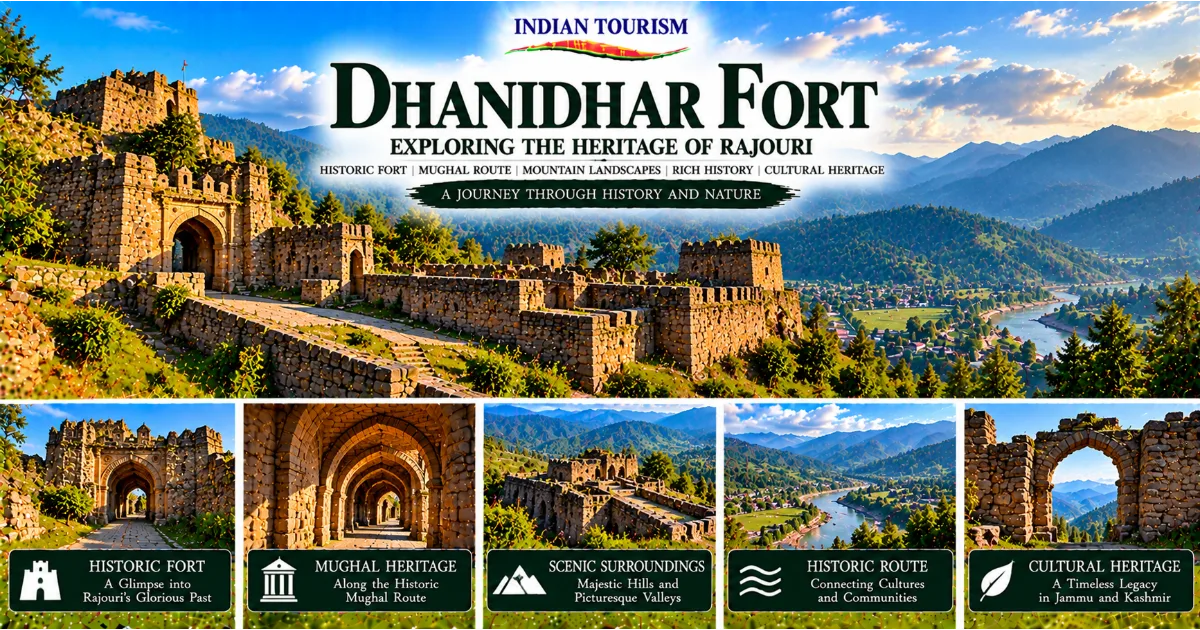
Dhanidhar Fort offers a glimpse into the historic landscape of Rajouri, a region in Jammu and Kashmir where mountain geography, local traditions and centuries of movement have shaped a distinctive cultural identity. Set amid the hills and valleys of the Pir Panjal region, the fort is a reminder that the history of Jammu and Kashmir extends well beyond its celebrated gardens, lakes and high mountain resorts. Its heritage belongs to a wider story of regional kingdoms, strategic routes, frontier settlements and the communities that lived along them.
For travellers interested in historic architecture and destinations away from the most familiar tourist circuits, Dhanidhar Fort provides an opportunity to explore Rajouri through a heritage-focused journey. The experience is different from visiting a busy urban monument or a heavily developed tourist attraction. Here, the landscape itself becomes part of the story. The surrounding hills, the settlement patterns of the region and the routes connecting Jammu with the Kashmir Valley help visitors understand why fortified places held importance in the past.
A visit to Dhanidhar Fort is best approached with curiosity and respect. Rather than expecting a fully developed tourist complex, visitors should think of it as a heritage destination that deserves careful exploration, responsible photography and an appreciation of the history associated with Rajouri. The fort can also form part of a broader journey through the district, connecting historical places with local food, village life, natural scenery and the cultural diversity of the Jammu region.
1. Understanding Dhanidhar Fort and Its Historical Setting
Dhanidhar Fort is associated with Rajouri, a historically significant district in the Jammu region of the Union Territory of Jammu and Kashmir. The wider area has long occupied an important position between the plains of Jammu and the mountainous approaches leading towards the Kashmir Valley. Its terrain includes hills, valleys, streams and mountain passes, creating a landscape in which routes between settlements were influenced by both natural geography and seasonal conditions.
In earlier periods, control over routes and settlements could carry considerable political and economic importance. Travellers, traders, officials, soldiers and local communities depended on pathways that crossed difficult terrain. A fortified structure in such a setting was not simply a building made of stone. It could represent authority, security, administration and the ability to maintain a presence in a strategically important area.
The history of Dhanidhar Fort should be understood within this broader regional context. Rajouri's past includes periods of local rule, changing political relationships and the influence of larger powers that sought to maintain control over territories in the northwestern Himalayas. However, the exact details of a monument's construction, its original functions and the chronology of its use require reliable historical documentation. Visitors should avoid assuming that every surviving wall or architectural feature belongs to a single period.
This distinction matters because historical monuments frequently change over time. A structure may be built under one authority, modified by another and reused by later communities. Repairs, rebuilding, conflict and natural weathering can all alter the appearance of a fort. The visible remains are therefore part of a longer process rather than a perfectly preserved snapshot of one historical moment.
For travellers, this makes Dhanidhar Fort an interesting place to approach through observation. The surviving architecture, its relationship with the surrounding terrain and its position within the wider Rajouri landscape can help frame questions about how people organised settlements and protected important locations in earlier centuries.
2. Rajouri: A Region Shaped by Mountains and Movement
The wider setting helps explain the importance of historic sites across the district.
Rajouri is located in the western part of the Jammu region and is closely connected to the mountain geography of the Pir Panjal range. Its landscapes differ from the open plains farther south and from the higher alpine environments associated with parts of the Kashmir Valley. The district includes inhabited valleys, forested slopes, agricultural areas and roads that wind through changing elevations.
This geography has influenced how people travelled, traded and settled in the region. In mountainous areas, a short distance on a map may translate into a demanding journey because of steep gradients, narrow roads and winding routes. Rivers and streams can shape settlement locations, while passes provide natural corridors through otherwise difficult terrain. Communities that understood these conditions developed ways of adapting their homes, agricultural practices and travel patterns to local circumstances.
Rajouri's position also connects it to a wider network of historical movement. Routes through the surrounding mountains linked settlements and helped people move between different parts of the region. These connections carried more than goods. They also supported the exchange of languages, food traditions, craft techniques, religious practices and political ideas.
The history of such regions is rarely simple. Local rulers and communities could maintain their own identities while interacting with larger kingdoms and empires. The importance of a particular place might rise or decline as political boundaries changed, new routes developed or military priorities shifted. A fort that once held strategic value might later become less important as transportation and administration changed.
Dhanidhar Fort can therefore be considered part of the wider heritage of Rajouri rather than an isolated structure. Exploring the district alongside the fort gives visitors a better sense of the relationship between historical architecture and the landscape that shaped it.
3. Why Forts Were Important in the Mountain Regions
Forts have played many roles throughout South Asian history. Some were designed primarily for defence, while others served as administrative centres, residences, observation points or symbols of political authority. Their form depended on the terrain, the resources available to builders and the purpose for which they were constructed.
In a mountainous setting, a fortified site could take advantage of natural slopes and elevated ground. A position with a broad view of surrounding approaches might help people observe movement through the landscape. Steep terrain could make direct access difficult, while strong walls and controlled entrances could provide additional protection. Yet not every fort had the same design, and a structure's precise purpose should not be inferred from its name alone.
The practical requirements of fort life were also more complicated than simply building walls. A functioning fortified settlement might need access to water, food storage, accommodation and paths for people and supplies. Its occupants would depend on nearby communities and agricultural areas. If the site was used during periods of conflict, maintaining provisions and communication could be as important as the strength of the defences.
A fort could also communicate power. Large walls, gateways and prominent placement made authority visible to people approaching the settlement. Such structures might serve as reminders of who controlled an area, where decisions were made or which authority was responsible for maintaining order.
At Dhanidhar Fort, visitors can use these general principles to think about the wider historical role of fortified architecture. These ideas provide context, but they should not be mistaken for verified claims about every activity that took place at this particular site. Establishing the fort's original purpose and chronology requires site-specific historical evidence.
Understanding forts in this way enriches a visit. Instead of looking only at a wall or doorway, travellers begin to consider why a building was placed where it was, how people might have reached it and what practical challenges its occupants faced.
4. Architecture and the Experience of Exploring the Fort
The architectural value of a historic fort lies not only in its most impressive features but also in the way its parts relate to one another. Entrances, walls, elevated sections, courtyards and connecting paths can reveal how a structure was organised. Even when some features have disappeared, the surviving remains may still offer clues about the original layout.
When exploring Dhanidhar Fort, visitors should pay attention to the relationship between the structure and the surrounding land. Notice whether the approach follows a natural slope, whether the ground changes elevation near the site and how the fort relates visually to nearby settlements or hills. These observations can help visitors understand the practical considerations involved in selecting a location for a fortified structure.
Stonework is another feature worth observing carefully. Historic masonry often reflects the materials available locally, the skills of the builders and the techniques used during construction. The size and arrangement of stones, the condition of joints and the appearance of repaired sections may all offer clues about a building's history. However, assigning a specific date or architectural style based on appearance alone can be misleading. Similar construction techniques sometimes continued across different periods, and later repairs may resemble earlier work.
Entrances deserve particular attention because they often represent the point at which movement into a fortified area was controlled. Depending on the structure, an entrance might have been designed to restrict access, guide visitors along a particular route or create a defensible approach. Other architectural elements may have served everyday needs rather than military purposes.
It is also important to remember that a ruin is not an unfinished tourist attraction. Its weathered appearance is part of its history, and its remaining fabric can be fragile. Climbing on unstable walls, removing stones or attempting to enter unsafe spaces can cause damage and put visitors at risk. A careful visit allows the monument to be appreciated without placing its preservation in danger.
5. Dhanidhar Fort and the Cultural Heritage of Rajouri
Rajouri's heritage includes more than historic buildings. The district's cultural identity has developed through interactions among communities, landscapes, languages, religious traditions and patterns of everyday life. Its history is reflected in local architecture, food, clothing, festivals, oral traditions and the ways people use the surrounding land.
A heritage journey through Rajouri can help visitors understand how these elements exist alongside one another. Historic sites offer a physical connection to the past, while local markets and neighbourhoods reveal how traditions continue to evolve. The region should not be understood solely through the perspective of military history. Agriculture, family networks, seasonal movement, craftsmanship and trade have also shaped life here.
The presence of a fort within this wider cultural landscape provides an opportunity to think about the relationship between political power and ordinary people. Fortified places were built and maintained by people with specialised skills, but their existence also depended on the surrounding population. Workers, builders, suppliers, farmers and travellers formed part of the broader environment in which historic structures operated.
The stories associated with a monument may also survive in local memory. Residents sometimes preserve accounts about old buildings, former rulers, unusual events or changes in the landscape. Such accounts can be valuable parts of community heritage, although oral traditions and documented historical evidence may differ in their details. Listening respectfully to local accounts while recognising the distinction between tradition and verified chronology is a thoughtful way to approach historical travel.
Visitors should avoid treating local communities as background scenery for photographs. Ask permission before photographing individuals, particularly children and people engaged in religious or private activities. Supporting local businesses, purchasing locally made products and treating residents with courtesy can make tourism more beneficial to the area.
Dhanidhar Fort becomes more meaningful when considered as part of a living region, where history is connected to present-day life rather than confined to the remains of an old structure.
6. The Natural Landscape Around Rajouri
The landscape around Rajouri adds another dimension to a visit to Dhanidhar Fort. The district's hills, valleys, cultivated areas and forested slopes create changing views throughout the year. Depending on the location and season, travellers may encounter clear mountain horizons, green hillsides, cloud-covered ridges or landscapes shaped by monsoon rainfall.
For visitors accustomed to destinations dominated by a single major attraction, Rajouri offers a different style of travel. The appeal often comes from the combination of scenery, regional history and everyday life. A heritage stop can become part of a wider journey through the district, with time set aside to appreciate the landscape rather than rushing from one landmark to another.
The natural surroundings also help explain the historical importance of mountain routes. In areas where roads and pathways follow narrow valleys or climb steep slopes, terrain influences movement. The easiest route between two settlements may not be the shortest in straight-line distance. Weather, watercourses, elevation and the availability of suitable stopping places can all influence travel.
These geographical realities mattered to earlier travellers and continue to affect modern journeys. Road conditions can vary with the season, and rainfall may affect travel times. Visitors should therefore plan realistically and avoid assuming that a short journey between two points will always be quick.
Nature observation can be a useful addition to a heritage visit. Travellers may notice differences in vegetation between exposed slopes and sheltered valleys, changes in the colour of the hills with the seasons or the ways settlements occupy relatively level ground. Such details help create a fuller understanding of the relationship between people and the environment.
Responsible travel also means respecting the landscape. Avoid littering, damaging vegetation or disturbing wildlife. Carry reusable water bottles where practical, dispose of waste properly and follow local guidance in areas that may be environmentally sensitive.
7. Best Time to Visit Dhanidhar Fort
The most suitable time to explore Dhanidhar Fort depends on weather conditions, road access and the purpose of the trip. Travellers interested primarily in outdoor sightseeing will generally benefit from planning around comfortable temperatures and favourable conditions for walking.
Spring, from March to April, can offer a pleasant setting for exploring the wider Rajouri region. Temperatures gradually become milder, and the changing landscape can make journeys through the hills enjoyable. Visitors should still check local conditions before travelling because weather in mountainous areas can vary considerably.
Summer, from May to June, can be suitable for regional travel, although temperatures may rise during the warmer parts of the day. It is sensible to begin outdoor activities earlier, carry sufficient drinking water and avoid spending long periods in direct sunlight. Travellers coming from other parts of India should allow time to adjust to local conditions and should not assume that every part of the district remains cool throughout summer.
The monsoon period, generally from July to September, requires greater attention to weather and road conditions. Rainfall can affect visibility, walking surfaces and travel times. Slippery ground may make access to historic remains more difficult, while heavy rain can cause disruptions on mountain roads. Check reliable local forecasts and transport information before setting out.
Autumn, from October to November, can be an appealing period for travellers who prefer milder weather and clearer views. The changing light can be particularly attractive for landscape photography, and daytime conditions may be comfortable for combining heritage visits with other activities in Rajouri.
Winter, from December to February, may bring cold weather and difficult conditions in some parts of the wider region. Travellers should check the forecast, road status and any local access restrictions before making plans. Warm clothing and flexible arrangements are advisable.
These seasonal descriptions are general guidance for the region, not a guarantee of conditions at the fort on a particular day. Before travelling, confirm the current accessibility of the site and seek local advice about the safest approach.
8. How to Reach Dhanidhar Fort
Rajouri is connected to other parts of the Jammu region by road, and a road journey is generally the most practical way to plan a visit to the district. The best route to Dhanidhar Fort itself depends on the precise access point, local road conditions and any restrictions in place at the time of travel.
Travellers arriving from Jammu should plan sufficient time for the journey rather than relying only on the distance shown on a map. Roads through hilly terrain can take longer than expected because of bends, changes in elevation, traffic and weather. A private vehicle or locally arranged taxi may offer flexibility, particularly for visitors who want to explore more than one heritage location in a day.
Those travelling by public transport should first establish the available services to Rajouri and then ask locally about onward transport and the appropriate access route to the fort. Public transport frequency and last-mile arrangements can vary, so it is best not to assume that a vehicle will be readily available at every point.
Visitors coming from outside Jammu and Kashmir may choose to reach Jammu by rail or air and continue by road, depending on their starting point and travel arrangements. The full journey should be planned as a connected itinerary, with allowance for delays and rest stops.
Before departure, confirm the monument's current access status with reliable local sources. Historic structures may be affected by maintenance work, conservation activity, local restrictions or other circumstances that change without much notice. If the fort is not accessible on the day of your visit, consider exploring other suitable attractions in Rajouri rather than attempting to enter a restricted or unsafe area.
For independent travellers, saving offline maps and keeping the contact details of the driver or accommodation provider can be useful when travelling through areas where mobile connectivity may be inconsistent.
9. What to See and Do During Your Visit
A visit to Dhanidhar Fort does not need to be rushed. The best approach is to allow enough time to observe the structure, understand its setting and appreciate the landscape around it.
Begin by looking at the wider surroundings before concentrating on individual architectural details. The position of a fort within the landscape can be as informative as its walls. Observe the slope of the ground, the natural approaches and the views available from permitted public areas. These features help explain why the location may have been considered significant.
Next, examine the surviving masonry and other visible architectural elements from safe, authorised areas. Look for differences in stone size, construction patterns and evidence of later repairs. Rather than trying to identify every feature immediately, record your observations and compare them with information provided by knowledgeable local guides or reliable historical material.
Photography can help document these details. Wide photographs show the fort's relationship with the surrounding land, while closer images can capture masonry and surface textures. Photographing from several viewpoints often produces a more useful record than taking only one image from the entrance. However, do not climb walls or enter restricted sections to obtain a better angle.
If a knowledgeable local guide is available, consider arranging a guided visit. A guide may be able to explain local place names, regional traditions and the historical context of the surrounding area. Ask which details are supported by documented evidence and which are based on local accounts. This makes the experience more informative without dismissing the value of oral history.
Finally, leave time to explore the wider district if conditions permit. A visit that includes local food, markets or another accessible heritage location can provide a broader perspective on Rajouri than a quick stop at a single monument.
10. Photography Tips for Dhanidhar Fort
Historic architecture and mountain landscapes can be rewarding subjects for photography, particularly when the changing light highlights the texture of stone and the shape of the surrounding hills.
Morning light can help reveal details in masonry without the harsh contrast sometimes produced by strong midday sunlight. Late afternoon may provide warmer tones and longer shadows, making architectural forms easier to distinguish. The ideal time will depend on the direction the monument faces and the weather on the day.
For a strong overall photograph, include some of the surrounding landscape rather than filling the entire frame with the building. This helps communicate the relationship between the fort and its geographical setting. If the structure is partly concealed by vegetation or appears weathered, photograph it honestly instead of relying on editing that gives a misleading impression of its condition.
A phone camera is sufficient for most visitors. Clean the lens, hold the device steadily and take several frames from different distances. A wide view can establish the setting, while close photographs can record stonework and other details. Avoid using excessive digital zoom, which can reduce image quality.
Respect any photography restrictions announced by site authorities. Do not photograph military installations, security personnel or restricted facilities where photography is prohibited. Be considerate of residents and seek consent before taking identifiable portraits.
11. Places to Combine With a Rajouri Heritage Trip
Dhanidhar Fort can be considered one element of a wider exploration of Rajouri and the surrounding Jammu region. The precise combination of destinations should depend on road conditions, opening or access arrangements and the time available.
A visit to Rajouri town can provide an introduction to the district's present-day life. Local markets, food establishments and everyday streets offer a perspective that differs from the atmosphere of a historic monument. Travellers can learn about regional ingredients, local shopping practices and the ways people use public spaces.
Other historical sites in Rajouri and neighbouring districts may also be worth considering, provided their accessibility and historical details have been checked in advance. Visitors interested in forts and old routes may prefer an itinerary focused on architecture and regional history. Those who enjoy landscapes might instead combine heritage stops with suitable scenic viewpoints and countryside drives.
The wider Jammu region also offers opportunities to explore different architectural traditions and cultural settings. However, distances can be substantial, and a destination that looks close on a map may require several hours of driving. Avoid packing too many places into a single day, especially when the route includes mountain roads.
A more satisfying plan often includes one principal heritage destination, one or two additional stops and enough time for meals and rest. This approach reduces travel fatigue and allows visitors to engage more meaningfully with each place.
12. Suggested One-Day Itinerary
A one-day visit centred on Dhanidhar Fort is best planned with flexibility. Begin with an early departure from your accommodation so that the main heritage stop can be explored during the cooler part of the day. Confirm access arrangements before leaving and keep enough time available for an unhurried visit.
Spend the morning observing the fort's surroundings, photographing its visible features from authorised areas and learning about the history of the site. If a local guide is available, a short guided visit can help place the monument within Rajouri's wider historical context.
After the heritage visit, take a break for lunch at a suitable local establishment. Regional food is an important part of travel, and a meal in the district can provide a chance to experience local flavours and hospitality. Ask about ingredients and preparation methods if you have dietary preferences.
In the afternoon, explore Rajouri town or visit another accessible attraction that fits your interests and the day's road conditions. Keep the schedule modest rather than attempting to cover several distant sites. If weather deteriorates or transport becomes difficult, prioritise a safe return.
This itinerary is a planning framework, not a statement of verified opening hours or guaranteed access. The actual sequence should be adapted to local advice and current conditions.
13. Local Food and Hospitality
Food can be an important part of a journey through Rajouri. The district's culinary traditions reflect the wider cultural influences of the Jammu region and the habits of communities living in a varied mountain environment. Everyday meals, seasonal ingredients and local methods of preparation can reveal aspects of regional life that are not immediately visible at a monument.
Travellers should explore local eateries with an open mind and ask about dishes that are prepared fresh. The exact menu will depend on the establishment, season and availability of ingredients. Rather than expecting every restaurant to offer a fixed list of regional specialities, ask residents or accommodation providers for recommendations.
Tea and simple snacks can be welcome during a day of sightseeing, particularly when the journey involves driving through hilly terrain. Carry drinking water and take regular breaks, especially during warm weather.
Hospitality is best experienced with courtesy and respect. Learn a few polite local expressions if possible, follow the customs of the place you are visiting and avoid assuming that every household or community space is open to tourists. If invited to participate in a local activity, listen carefully to any guidance and respect the host's preferences.
Buying food or locally made products from small businesses can help distribute the benefits of tourism more widely. Where prices are displayed, follow them fairly, and avoid pressuring sellers to reduce prices simply because you are a visitor.
14. Practical Travel Advice and Safety
A successful heritage trip depends on preparation as much as enthusiasm. Before travelling to Dhanidhar Fort, check the current road situation, weather forecast and site access arrangements. Mountain weather can change quickly, and rainfall may affect both driving conditions and walking surfaces.
Wear comfortable footwear with a secure grip. Historic sites may have uneven ground, loose stones, exposed roots or sections where surfaces become slippery. Avoid walking close to unstable edges and do not enter areas marked as unsafe or restricted.
Carry drinking water, essential personal items, a charged mobile phone and a small power bank if you expect to spend much of the day outdoors. Keep a basic first-aid kit available, especially if travelling with children or older family members. During warmer months, sun protection and a hat can make outdoor sightseeing more comfortable.
If driving, use a reliable vehicle suited to the route and avoid rushing on narrow or winding roads. Drivers unfamiliar with mountain terrain should take regular breaks and follow local road advice. Do not stop in unsafe places simply to take photographs.
Families should supervise children closely around old walls, steep slopes and uneven surfaces. Visitors with mobility limitations should establish the condition of the approach beforehand, as historic sites may not have ramps, smooth paths or accessible facilities.
Travellers should also follow current official advisories and local instructions. If a particular route or area is restricted, do not attempt to bypass the restriction. Safety and respect for local conditions should always take priority over completing an itinerary.
15. Responsible Tourism and Heritage Preservation
Historic structures survive because people value them and take steps to protect them. Tourism can support that process by encouraging awareness, generating local income and creating reasons for communities and institutions to invest in preservation. It can also cause harm when visitors leave rubbish, remove materials, climb fragile structures or treat a monument as a disposable backdrop.
At Dhanidhar Fort, responsible tourism begins with respecting the physical site. Do not scratch names into stone, remove fragments or disturb the ground around the structure. Even a small piece of masonry may be part of the surviving historical fabric, and seemingly harmless damage can accumulate as visitor numbers grow.
Keep the surroundings clean and carry waste away if suitable disposal facilities are not available. Avoid loud behaviour that disturbs residents or other visitors. Follow any rules established by local authorities or conservation staff.
Support local communities where possible. Using local transport, buying food from nearby businesses and engaging knowledgeable guides can help tourism create economic opportunities. Treat local knowledge with respect and acknowledge that residents have their own relationships with historic places that may differ from a visitor's experience.
Photographs shared online can also influence how others understand a destination. Avoid presenting unverified stories as established facts or describing a site as open to the public without checking. Accurate information helps future visitors plan responsibly and reduces the risk of people entering unsafe or restricted areas.
Preservation is not solely the responsibility of government departments or conservation specialists. Every visitor contributes to the condition in which a place is left for the next person. A thoughtful visit to Dhanidhar Fort can support appreciation of Rajouri's heritage while helping ensure that the surviving remains are treated with care.
16. Why Dhanidhar Fort Deserves a Place on Your Travel List
Dhanidhar Fort offers a different perspective on Jammu and Kashmir from the destinations most frequently featured in travel advertisements. Rather than focusing exclusively on lakes, gardens, snow-covered peaks or well-known resort towns, a visit directs attention towards the historical landscapes of Rajouri.
For history enthusiasts, the site provides an opportunity to think about fortified architecture and the political importance of mountain regions. For photographers, it offers the possibility of documenting the relationship between historic remains and the surrounding landscape. For culturally curious travellers, it can serve as an introduction to the wider heritage of Rajouri and the communities that continue to shape the district.
The value of such a visit does not depend on finding a monument in perfect condition or expecting a large tourist complex. Historic places can be meaningful precisely because they encourage visitors to look carefully, ask questions and recognise the limits of what is known. A weathered wall, a change in elevation or a route through the hills may prompt questions about the people who once lived, worked or travelled in the area.
Dhanidhar Fort is most rewarding when explored as part of a respectful and well-planned journey. Check current access information, allow enough time for the road journey, seek reliable historical context and remain attentive to local guidance. Combine the visit with opportunities to experience Rajouri's food, markets and landscapes, and avoid reducing the district to a single attraction.
Jammu and Kashmir's heritage is diverse, and places such as Dhanidhar Fort help broaden the picture. They remind travellers that the region's story includes not only celebrated natural beauty but also historic settlements, routes, buildings and local traditions that deserve thoughtful attention.
Conclusion
Dhanidhar Fort is a promising heritage stop for travellers interested in exploring the historical character of Rajouri. Its significance is best considered within the wider context of mountain geography, fortified architecture and the region's changing political and cultural history. A visit can encourage a deeper appreciation of how landscapes influenced movement and settlement, while also offering an opportunity to experience the district beyond its most familiar tourist attractions.
Plan the journey carefully, confirm local access conditions and approach the remains with respect. Take time to observe the surroundings, learn from reliable sources and engage courteously with local communities. With thoughtful preparation, Dhanidhar Fort can become a meaningful part of a broader exploration of Jammu and Kashmir's historical landscapes.
#IndianTourism #DhanidharFort #Rajouri #JammuAndKashmir #ExploreRajouri #HeritageTourism #HistoricalPlaces #IndianHistory #FortArchitecture #CulturalHeritage #ResponsibleTourism #ExploreIndia #JammuTourism #HiddenHeritage #TravelIndia
