
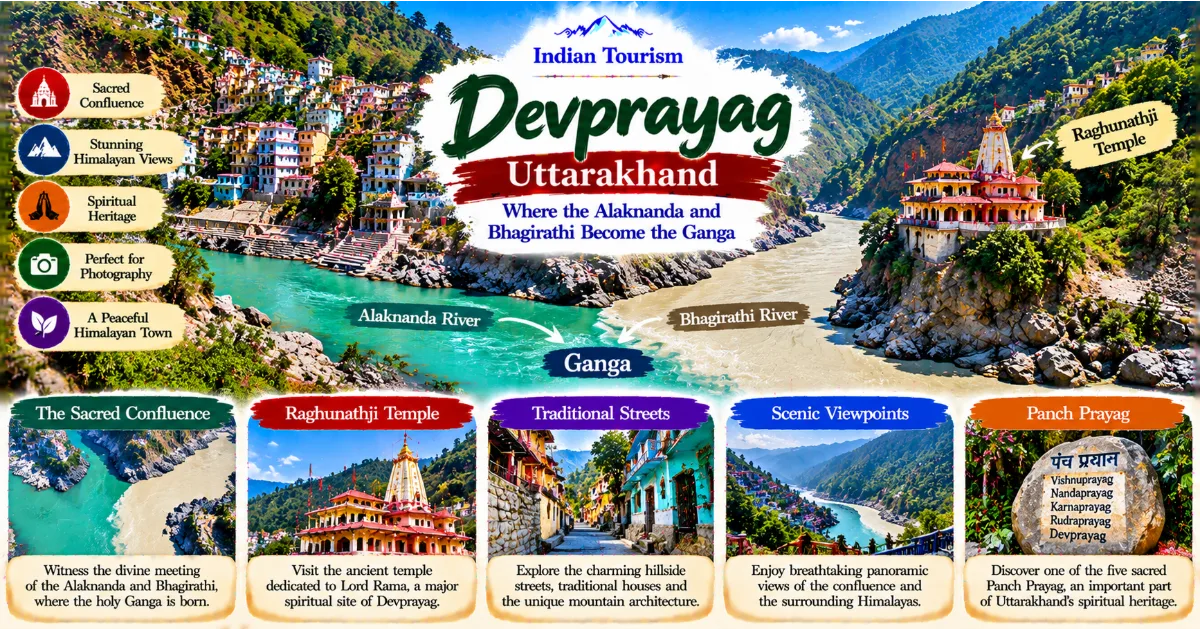
Introduction to Devprayag
Devprayag is one of the most spiritually significant and geographically remarkable destinations in Uttarakhand. Located in the Garhwal Himalayas, this historic town is famous for the confluence of the Alaknanda and Bhagirathi rivers, which meet here to form the Ganga. For Hindu pilgrims, the meeting of these two sacred rivers represents an important moment in the journey of the Ganga from the Himalayan mountains towards the plains of northern India. For travellers, Devprayag offers a remarkable combination of river scenery, ancient religious traditions, mountain architecture and the quiet atmosphere of a traditional Himalayan settlement.
Unlike larger tourist destinations that are known for crowded markets, hotels and commercial attractions, Devprayag retains the character of a small pilgrimage town. Its houses climb the surrounding hillsides, temples occupy important positions above the river, and narrow lanes connect residential neighbourhoods with religious sites and bathing ghats. The sound of flowing water remains a constant presence, while the changing colours of the two rivers create a striking natural spectacle.
Devprayag is especially attractive to travellers interested in religious heritage, geography, photography and slow travel. The town offers an opportunity to understand the physical journey of the Ganga as well as its importance in Indian culture. Visitors can observe the meeting of the rivers, explore temples, walk through traditional streets and learn about the spiritual stories associated with the region.
The destination can be visited as part of a wider Uttarakhand journey, particularly by travellers exploring Rishikesh, Srinagar in Garhwal, Rudraprayag, or routes leading towards the higher Himalayan pilgrimage centres. However, Devprayag deserves more than a hurried stop beside the road. Spending time in the town allows visitors to appreciate its landscape, religious traditions and everyday life.
The geographical importance of Devprayag
Devprayag occupies a distinctive place in the geography of northern India. It is one of the Panch Prayag, or five sacred river confluences, associated with the Alaknanda river system in Uttarakhand. At Devprayag, the Alaknanda and Bhagirathi meet, and their combined waters continue downstream as the Ganga.
The Alaknanda flows through a mountainous region containing several important valleys and pilgrimage destinations. Along its route, it receives water from tributaries descending from the Himalayas. The Bhagirathi originates in the higher Himalayan region and travels through deep valleys before reaching Devprayag. Their meeting marks a major geographical and cultural point in the river's journey.
Visitors can often distinguish the two rivers by their colour, although the appearance changes according to rainfall, sediment levels, sunlight and the season. One river may appear greener or clearer while the other carries a different shade of sediment-laden water. The contrast can be especially noticeable after periods of rain, but it is not constant throughout the year.
The meeting point is more than a scenic attraction. It helps visitors understand how large river systems develop through the joining of tributaries. The Ganga is not formed by a single stream emerging from one place. It is part of a wider network of rivers, glaciers, mountain catchments and tributaries that gather water across the Himalayan region.
The surrounding mountains shape the movement of water and influence local weather, transport and settlement patterns. Steep slopes restrict the space available for construction, so houses and roads follow the contours of the terrain. The result is a town that appears to rise above the river, with buildings arranged along hillsides and narrow routes connecting different levels.
Devprayag also illustrates the close relationship between geography and religious imagination in India. Rivers are not understood only as physical resources. In Hindu tradition, the Ganga is revered as a sacred river associated with purification, devotion and spiritual liberation. The confluence at Devprayag therefore holds meaning at both a physical and a religious level.
The spiritual significance of the Panch Prayag
Devprayag is one of five important confluences traditionally recognised as the Panch Prayag of Uttarakhand. These sacred meeting points lie along the Alaknanda river system and are important destinations for pilgrims travelling through the Garhwal Himalayas.
The five confluences are Vishnuprayag, Nandaprayag, Karnaprayag, Rudraprayag and Devprayag. Each is associated with a particular meeting of rivers and a distinct local religious tradition. Together, they form a significant part of the pilgrimage geography of Uttarakhand.
Vishnuprayag is associated with the meeting of the Alaknanda and Dhauliganga rivers. Nandaprayag marks the confluence of the Alaknanda and Nandakini. Karnaprayag is where the Alaknanda meets the Pindar. Rudraprayag is formed by the meeting of the Alaknanda and Mandakini. Devprayag marks the confluence of the Alaknanda and Bhagirathi, after which the combined river is known as the Ganga.
These places connect natural geography with religious practice. Pilgrims may visit them during journeys to important Himalayan shrines, while other visitors explore them to understand the region's history and landscape. The confluences are also reminders of the importance of rivers to settlements, agriculture, travel and cultural identity.
Devprayag is especially significant because of its position in the traditional understanding of the Ganga's formation. The river carries enormous spiritual importance across northern India, and the town's confluence is often regarded as a place where the sacred identity of the Ganga becomes fully established.
Visitors do not need to be religious pilgrims to appreciate the significance of the Panch Prayag. Learning about the five confluences offers a useful introduction to Uttarakhand's geography and cultural traditions. Travellers planning a longer trip can also explore more than one confluence, although the mountain roads and distances require careful scheduling.
The sacred confluence of the Alaknanda and Bhagirathi
The confluence is the central attraction of Devprayag. From suitable viewpoints, visitors can observe the two rivers approaching from different directions and joining to form a single channel. The surrounding hills create a dramatic setting, while temples and settlements above the water reinforce the town's connection with pilgrimage.
The visual appearance of the confluence changes with the seasons. During periods of lower flow, the river channels and rocky banks may be easier to distinguish. During the monsoon, increased rainfall can raise water levels and carry more sediment downstream, changing the colour and force of the water. Visitors should never assume that the river is safe simply because it appears calm from a viewpoint.
The best way to appreciate the confluence is to take time to observe it rather than rushing to capture a photograph. The movement of water, the surrounding cliffs and the arrangement of the town reveal how closely Devprayag is connected to the river system.
Photography is popular here, particularly during the early morning and late afternoon when the light can bring out the colours of the hills and water. However, visitors should remain within safe areas and avoid climbing onto unstable rocks or standing close to unprotected edges. Strong currents, slippery surfaces and sudden changes in water levels can make the river dangerous.
The confluence also provides an opportunity to reflect on the importance of Himalayan rivers to communities far beyond the mountains. The water that passes through Devprayag continues towards the plains, supporting settlements, agriculture and ecosystems along its route. Its significance therefore extends beyond the town itself.
Responsible visitors should avoid throwing flowers wrapped in plastic, food packaging or other waste into the water. Religious traditions deserve respect, but worship and environmental care can coexist. Keeping the riverbanks clean helps protect the landscape that makes Devprayag such an important destination.
Raghunathji Temple
Raghunathji Temple is one of Devprayag's most important religious landmarks. Dedicated to Lord Rama, it occupies a prominent place in the town's spiritual life and attracts pilgrims throughout the year. The temple is closely associated with the religious traditions of the Garhwal region and forms an important stop for visitors exploring Devprayag's sacred heritage.
Lord Rama is worshipped as an incarnation of Lord Vishnu in Hindu tradition. The temple's dedication connects Devprayag with the wider network of places associated with the Ramayana and Vaishnava worship. For pilgrims, visiting the temple may be part of a journey involving several religious destinations in Uttarakhand.
The temple's architecture reflects the character of traditional Himalayan religious buildings, adapted to the terrain and conditions of the region. Its setting above the river adds to its visual importance, while the surrounding lanes provide a sense of the town's historical layout.
Visitors should approach the temple with respect for worshippers and local customs. Dress modestly, follow instructions concerning footwear and photography, and check local arrangements before visiting during major religious occasions. The atmosphere can become particularly busy during festivals and pilgrimage periods.
The temple can be included in a walking tour of Devprayag, alongside the confluence and nearby streets. Because the town has uneven paths and changes in elevation, travellers should allow enough time to move comfortably between attractions.
Traditional streets and hillside architecture
One of the most appealing aspects of Devprayag is its traditional settlement pattern. The town occupies steep terrain, and buildings follow the available slopes above the river. From a distance, houses appear layered across the hillside, creating a distinctive mountain-town landscape.
The streets are often narrow, with steps and sloping pathways connecting different neighbourhoods. Small shops serve residents and visitors, while homes and religious buildings occupy spaces shaped by the natural contours of the land. The layout reflects the practical challenges of building in a mountainous environment.
Walking through these streets offers a different experience from visiting a single viewpoint. Visitors can observe everyday life, notice the relationship between homes and temples, and appreciate how residents navigate the steep terrain. The town's atmosphere is shaped by its role as both a pilgrimage destination and a living community.
Travellers should remember that many of the lanes are residential. It is important to respect privacy, avoid photographing people without permission and keep noise to a minimum. Some pathways may be steep or uneven, so comfortable shoes are essential.
The traditional architecture also provides insight into how settlements adapt to limited space. Buildings may have compact footprints, upper floors and small courtyards, while routes follow the natural shape of the hills. These features contribute to Devprayag's character and distinguish it from larger, more commercially developed destinations.
The bathing ghats and riverfront
The riverfront is an important part of Devprayag's religious and social life. Designated bathing areas and ghats allow pilgrims to approach the water for ritual purposes, while the surrounding steps and pathways connect the river with the town above.
For many Hindu devotees, bathing in a sacred river has religious significance. At Devprayag, the presence of the confluence adds to the importance of the experience. Visitors may observe people praying, offering flowers or performing rituals according to family and regional traditions.
Travellers who are unfamiliar with these practices should observe respectfully and avoid interfering with ceremonies. The riverfront is a place of worship as well as a scenic location, and people may be engaged in private or deeply personal religious activities.
Safety is particularly important near the water. The currents at a confluence can be powerful, and the depth may change quickly. Rocks and steps can become slippery, especially during wet weather. Visitors should use designated areas, obey warning signs and never enter restricted sections of the river.
The riverfront can be especially beautiful during the early morning, when the town begins to awaken and the surrounding hills may be softly illuminated. Later in the day, sunlight can create strong contrasts between the water, buildings and rocky slopes.
A visit to the ghats should be unhurried. Spending a few quiet moments observing the river can provide a more meaningful experience than attempting to cover every attraction within a short period.
Best time to visit Devprayag
The best time to visit Devprayag depends on weather, road conditions and the type of experience a traveller wants. The town can be visited during several seasons, but mountain weather can change quickly, and the river requires caution throughout the year.
Spring from March to April
Spring generally offers pleasant conditions for sightseeing and exploring the town on foot. Temperatures are often comfortable during the day, and the surrounding hills begin to show signs of seasonal change. This is a good period for visiting the confluence, exploring temples and photographing the traditional settlement.
Travellers should still carry a light jacket, particularly for mornings and evenings. The weather can vary between sunny periods and cooler conditions, so flexible clothing is useful.
Spring is suitable for visitors who want to explore Devprayag as part of a wider trip through Uttarakhand. Road journeys may be more comfortable than during periods of heavy rainfall, although conditions should always be checked before departure.
Summer from May to June
Summer brings warmer daytime temperatures, making early mornings and late afternoons particularly pleasant for walking and sightseeing. Devprayag can be a useful stop for travellers moving between the plains and the higher Himalayan region.
The town may experience increased visitor numbers during school holidays and pilgrimage seasons. Accommodation should be arranged in advance if travelling during busy periods.
Visitors should carry drinking water, sun protection and comfortable footwear. Although the river may look inviting, it should never be treated as a recreational swimming area without official guidance. Strong currents and unpredictable depths create serious risks.
Monsoon from July to September
The monsoon brings rainfall to the surrounding mountains and can dramatically change the appearance and behaviour of the rivers. The hills become greener, but increased water flow can make the confluence more powerful and dangerous.
Heavy rain may cause landslides, road closures, delays and restricted access to some locations. Travellers should check weather forecasts and local advisories before beginning their journey. It is sensible to keep accommodation and transport plans flexible during this period.
Visitors should remain well away from swollen riverbanks and avoid attempting to reach viewpoints that require crossing unstable ground. Photography is never worth risking a fall or entering an unsafe area.
Autumn from October to November
Autumn is often an attractive season for visiting Devprayag. The monsoon generally recedes, and clearer conditions can improve views of the surrounding hills. The town's religious sites and riverfront can be explored in more comfortable weather.
This season is suitable for photography, walking tours and journeys that include several destinations in the Garhwal region. Festival periods can bring additional crowds, so visitors should check local schedules and book accommodation early when necessary.
Winter from December to February
Winter can bring cold mornings and evenings, while daytime conditions may be pleasant under clear skies. Travellers should pack warm layers and be prepared for changes in temperature.
The quieter atmosphere can appeal to visitors who prefer a slower trip. However, mountain travel should always be planned carefully, and visitors should check road conditions before setting out. Fog, rain or cold weather can affect journey times.
How to reach Devprayag
Devprayag is connected by road to several important towns in Uttarakhand. Most visitors reach it by road from Rishikesh, Haridwar or other destinations in the Garhwal region. The journey follows mountainous terrain, so travel time depends on road conditions, traffic, weather and the starting point.
By air
Jolly Grant Airport near Dehradun is the nearest major airport commonly used by visitors travelling to this part of Uttarakhand. From the airport, travellers can continue towards Rishikesh and then travel by road to Devprayag.
A taxi offers flexibility, particularly for visitors carrying luggage or planning to stop at viewpoints along the route. Travellers using public transport may need to combine several services, so checking connections in advance is advisable.
Visitors arriving late in the day should consider staying overnight in a larger nearby town if onward transport is uncertain. Mountain roads are best approached with enough daylight and time to account for delays.
By train
Haridwar and Rishikesh are useful rail gateways for travellers heading towards Devprayag. The most suitable station depends on available train services and the traveller's origin.
After arriving by train, visitors can continue by road using a taxi, bus or other local transport where available. Since public transport schedules can vary, travellers should confirm the onward journey before finalising accommodation plans.
By road
Road travel is the principal way to reach Devprayag. The town is connected to Rishikesh and other settlements along the mountain routes of Garhwal. The journey itself can be scenic, with views of forested hills, valleys, villages and river channels.
Private vehicles provide flexibility, but drivers should be comfortable with mountain roads and changing conditions. Those unfamiliar with the terrain may prefer a local driver experienced in the region.
Buses and shared vehicles may be available along the route, but schedules and seating can vary. Travellers should avoid relying on the final possible connection if they have a fixed appointment or onward journey.
Exploring Devprayag on foot
Walking is one of the best ways to experience the town's character. The confluence, temples, riverfront and traditional streets are connected through a network of paths, lanes and steps. Exploring these areas on foot allows visitors to appreciate the relationship between the built environment and the surrounding hills.
However, Devprayag is not a flat destination. The elevation changes can be tiring, particularly for older visitors, young children or anyone with mobility limitations. Travellers should move at a comfortable pace, take breaks and avoid attempting steep routes in poor weather.
Comfortable footwear with good grip is essential. After rainfall, stone steps and narrow paths can become slippery. Carrying a small amount of drinking water and keeping personal belongings secure can make the walk easier.
Visitors should also be aware that local people use these paths for everyday travel. Avoid blocking narrow passages for photographs, and give way where space is limited. Respecting residents helps maintain a welcoming atmosphere.
A guided walking tour may be useful for visitors who want to learn about the history, religious traditions and geography of the town. If choosing a guide, agree on the duration, route and price beforehand.
Local food and dining
Devprayag is a relatively small town, and its food options are more limited than those in major tourist centres. Travellers can generally expect simple meals, tea, snacks and familiar Indian dishes, although the selection depends on the season and the establishments operating at the time of the visit.
A basic meal may include rice, lentils, vegetables, roti and other common dishes. These meals reflect the practical food culture of a mountain settlement and can be satisfying after a day of walking.
Visitors should not expect the same variety of international cafés and speciality restaurants found in larger destinations. Travellers with particular dietary requirements should plan ahead and confirm available options before arriving.
Food safety is important, particularly during warmer weather. Choose places that appear clean, drink safe water and be cautious with food that has been left uncovered. If undertaking a longer road journey, carrying suitable snacks can be helpful.
Supporting local eateries is one way to contribute to the town's economy. Treating restaurant workers respectfully and avoiding food waste are small but worthwhile ways to practise responsible tourism.
Where to stay in Devprayag
Accommodation in Devprayag is generally more limited than in major destinations such as Rishikesh. Visitors may find guesthouses, small hotels and basic accommodation, while travellers seeking a broader range of facilities may choose to stay in a nearby town and visit Devprayag during the day.
The right choice depends on the purpose of the trip. Travellers interested in an early morning visit to the confluence may appreciate staying locally, while those prioritising restaurants, transport connections or a wider range of hotel facilities may prefer a larger base.
Before booking, check the exact location, road access, room facilities, meal arrangements and cancellation policy. A property that looks close on a map may still require a steep walk or a difficult approach because of the town's terrain.
Visitors travelling with older family members or young children should pay particular attention to stairs, access routes and the availability of assistance with luggage. Those arriving by public transport should confirm how to reach the property from the drop-off point.
Accommodation should be booked in advance during popular pilgrimage periods and public holidays. It is also sensible to keep a flexible plan during the monsoon, when road conditions may change unexpectedly.
Suggested one-day itinerary
A one-day visit can provide a good introduction to Devprayag if the journey begins early and road conditions are favourable. Visitors should avoid packing too many activities into the schedule, because the mountain roads and walking routes require time.
Begin with a visit to a safe viewpoint overlooking the confluence. Spend time observing the meeting of the Alaknanda and Bhagirathi, and learn about their geographical and religious significance. If the conditions are suitable, continue towards the designated riverfront areas to observe the ghats.
Later in the morning, visit Raghunathji Temple and explore the surrounding lanes. Allow time to understand the local atmosphere rather than rushing between locations. A simple lunch at a local eatery can provide a break before continuing the walk.
During the afternoon, explore additional viewpoints and traditional streets, depending on the weather and your energy level. Keep away from unstable slopes and unsafe riverbanks. If travelling during the monsoon, shorten the outdoor portion of the itinerary whenever conditions demand it.
Before returning to your accommodation or continuing to another destination, check the road conditions and allow enough time for the journey. Visitors who want to photograph the confluence in different light may prefer to stay overnight rather than attempting to see everything in a single rushed visit.
A two-day itinerary for a deeper experience
A two-day visit allows travellers to explore Devprayag more slowly and appreciate its spiritual and geographical importance.
On the first day, arrive and settle into the accommodation before visiting the confluence. Explore the viewpoints and riverfront areas that are safely accessible, then visit Raghunathji Temple and the surrounding neighbourhood. Spend the evening observing the town's quieter rhythm and preparing for the following day's activities.
On the second day, begin with an early walk through the traditional streets. If local arrangements permit, spend additional time near the confluence and learn more about the Panch Prayag. A local guide can help explain the area's history and religious traditions, provided the guide is knowledgeable and the route is suitable.
The remainder of the day can be spent exploring nearby locations or continuing towards another destination in Garhwal. The choice should depend on road conditions and the amount of time available. Visitors should avoid adding a long mountain journey immediately before a tightly scheduled onward connection.
A two-day itinerary is particularly useful for travellers interested in photography, religious heritage or slow travel. It allows time to appreciate the landscape without turning the visit into a checklist of attractions.
Devprayag for photography enthusiasts
Devprayag offers many photographic opportunities because of its distinctive combination of river, mountains, temples and hillside buildings. The confluence is the most obvious subject, but the town's architecture and everyday life can be equally interesting.
Early morning light can illuminate the hills softly, while late afternoon may create strong contrasts across the water and buildings. Conditions vary with cloud cover and season, so photographers should remain flexible rather than expecting the same colours in every visit.
A wide-angle composition can show the two rivers meeting beneath the surrounding slopes. A longer lens may help capture details of temples, houses and the patterns formed by the river channels. Photographers should use safe, established viewpoints and avoid climbing onto unstable rocks for a more dramatic angle.
Respect for people is essential. Ask permission before taking close photographs of residents, pilgrims or religious ceremonies. Avoid intrusive photography during prayer and follow any restrictions within temples.
Rain and mist can add atmosphere to the landscape, but wet surfaces create additional hazards. Protect camera equipment from moisture and prioritise secure footing over capturing a particular image.
Cultural etiquette and responsible travel
Devprayag is a living pilgrimage town, and visitors should approach it with respect for local customs and religious practices. Modest clothing is appropriate when visiting temples and sacred areas. Footwear should be removed where required, and visitors should follow instructions from temple staff.
Religious ceremonies may be deeply personal for the people participating in them. Avoid loud conversations, intrusive photography and behaviour that disrupts worship. If uncertain about a custom, observe what others do or ask politely.
The river is central to the town's identity, and protecting it is a shared responsibility. Do not throw plastic, packaging or other rubbish into the water. Use designated waste bins where available and carry waste away when suitable disposal facilities are not nearby.
Visitors should also respect the physical limits of the landscape. The slopes are steep, the paths can be narrow, and the river currents can be dangerous. Follow safety signs, remain within authorised areas and do not enter the water unless official guidance confirms that the activity is permitted and safe.
Supporting local businesses can help ensure that tourism benefits residents. Eating at local establishments, purchasing suitable locally made products and hiring knowledgeable local guides are practical ways to contribute to the community.
Responsible travel does not require complicated arrangements. It begins with recognising that Devprayag is more than a scenic stop. It is a place where people live, worship, work and maintain traditions connected to the river.
Practical tips for first-time visitors
First-time visitors should prepare for the combination of mountain terrain, religious activity and river safety requirements. Comfortable walking shoes, drinking water, sun protection and clothing appropriate to the season are useful throughout the year.
Check weather forecasts and road conditions before departure. During the monsoon, allow extra time and remain prepared to change plans if heavy rainfall affects access. Even in other seasons, mountain journeys can take longer than expected.
Carry enough cash for small purchases and local services, especially if travelling beyond larger towns. Digital payment availability can vary, and mobile connectivity may not be equally reliable everywhere.
Visitors should confirm transport arrangements before arriving, particularly if planning to return to another town on the same day. Public transport schedules may not align perfectly with a short sightseeing itinerary.
Older visitors and people with mobility limitations should consider the steep streets and steps before choosing accommodation or planning a walking route. Taking breaks and avoiding unnecessary climbs can make the experience more comfortable.
Finally, allow enough time to observe the confluence without rushing. The most memorable part of Devprayag is often the opportunity to understand the relationship between two rivers, the surrounding mountains and the religious traditions that have grown around them.
Is Devprayag worth visiting?
Devprayag is worth visiting for travellers who appreciate meaningful destinations shaped by geography, culture and religious history. The confluence of the Alaknanda and Bhagirathi is visually impressive, but its importance extends beyond the scenery. It marks a significant point in the journey of the Ganga and occupies a special place in Hindu pilgrimage traditions.
The town also offers a more intimate experience than larger tourist centres. Its hillside streets, temples, riverfront and traditional buildings create an atmosphere that encourages visitors to slow down and pay attention to their surroundings.
Devprayag may not offer a large collection of entertainment facilities or extensive shopping districts. Its appeal lies instead in the landscape, religious heritage and opportunity to understand an important part of Uttarakhand's cultural geography.
For travellers already visiting Rishikesh or other destinations in Garhwal, Devprayag can be a rewarding addition. Those with an interest in the Panch Prayag may also use it as part of a longer journey through the region.
The key to a successful visit is to plan realistically, respect the river and local customs, and give the town enough time to reveal its character.
Conclusion
Devprayag is one of Uttarakhand's most meaningful destinations because it brings together the geography of the Himalayan rivers and the spiritual traditions associated with the Ganga. The meeting of the Alaknanda and Bhagirathi creates a remarkable landscape, while Raghunathji Temple, the bathing ghats and the traditional hillside settlement reflect the town's enduring religious identity.
Whether visited as a short stop or as part of a longer journey through Garhwal, Devprayag offers a chance to experience a quieter side of Himalayan travel. Its beauty is not limited to a single viewpoint. It can be found in the changing colours of the rivers, the arrangement of homes along the slopes, the sounds of daily life and the continued importance of the confluence to pilgrims.
Travellers who approach Devprayag with curiosity, patience and respect will gain more than photographs of a famous river meeting. They will gain a deeper appreciation of the natural and cultural forces that have shaped one of the most significant landscapes in Uttarakhand.
#IndianTourism #Devprayag #UttarakhandTourism #PanchPrayag #RiverConfluence #Ganga #GarhwalHimalayas #ExploreUttarakhand #SpiritualTravel #IndianCulture #HimalayanTravel #ResponsibleTourism
