
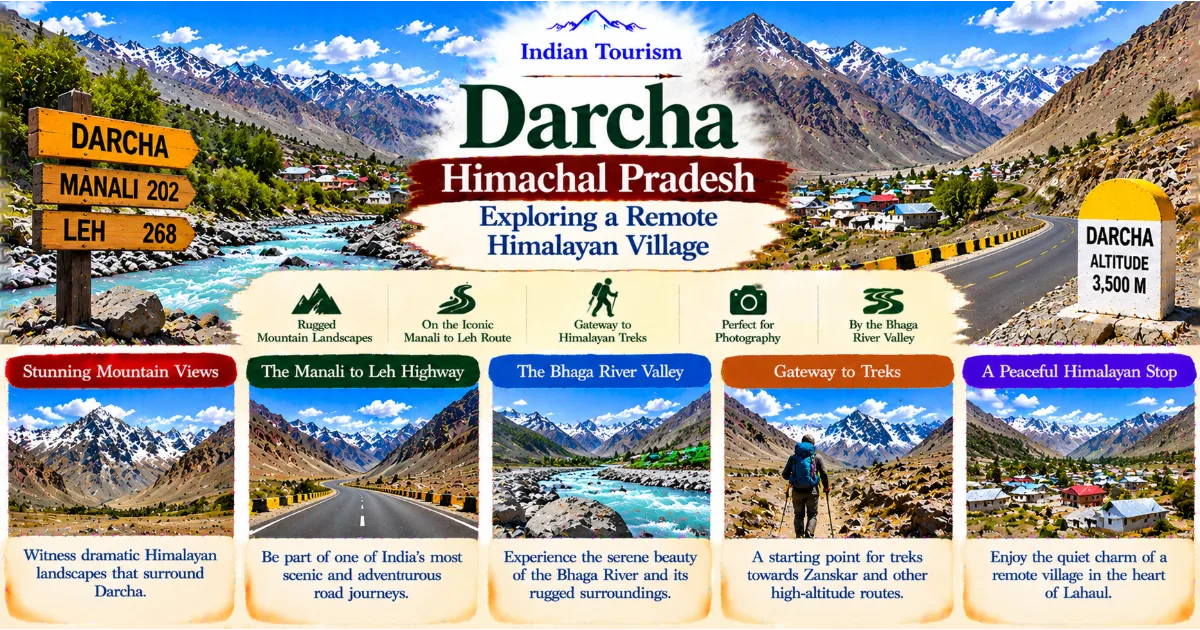
Discovering the Rugged Beauty of Darcha
Himachal Pradesh is a land of remarkable geographical diversity, where green valleys, pine forests, snow-covered mountains and ancient settlements create some of India's most memorable travel experiences. Yet, beyond the familiar hill stations and popular holiday destinations, the state has remote mountain regions that offer a very different perspective on Himalayan life. Lahaul, with its dramatic landscapes, scattered settlements and high-altitude roads, is one such region. Among its distinctive destinations is Darcha, a small Himalayan village that attracts travellers with its rugged surroundings, river valley scenery and importance along the Manali to Leh highway.
Darcha is not a conventional tourist town filled with large hotels, shopping streets and organised attractions. Its appeal lies in its location and the landscape that surrounds it. Situated beside the Bhaga River and associated with the meeting of mountain streams, Darcha marks an important point on the journey towards the high passes leading to Ladakh. As travellers move north from Keylong and Jispa, the landscape becomes increasingly open, rocky and exposed. Darcha offers a glimpse of this changing environment before the road continues into more remote mountain territory.
For road-trip enthusiasts, Darcha is a recognisable stop along one of India's most celebrated high-altitude journeys. For trekkers, it is associated with routes towards Zanskar and other mountainous areas. For photographers, the surrounding valleys, river channels and rugged slopes provide opportunities to capture the raw character of the western Himalayas.
The village also offers an opportunity to understand the practical realities of life and travel in a remote mountain region. Weather conditions, seasonal road access, limited facilities and high altitude all influence how people move through the area. A successful visit requires preparation and respect for the environment rather than an expectation of conventional holiday comforts.
Darcha is best experienced as part of a wider journey through Lahaul. Travellers can combine it with stops in Keylong and Jispa, observe the changing landscape along the Bhaga River, and continue towards the high mountain passes when conditions permit. For those who appreciate quiet places, dramatic scenery and the experience of travelling through the Himalayas, Darcha provides a meaningful addition to an exploration of Himachal Pradesh.
Understanding Darcha and Its Geographical Setting
Darcha is located in the Lahaul region of Himachal Pradesh, along the Manali to Leh highway. The village lies at an elevation of approximately 3,500 metres, although published elevation figures vary. Its position makes it an important reference point for travellers heading towards the high-altitude landscapes beyond Lahaul.
The surrounding geography is shaped by mountains, river valleys and streams that descend from higher terrain. Darcha is associated with the meeting of the Bhaga River and nearby mountain watercourses, including streams connected with the routes towards Shinkun La. This meeting of waterways contributes to the character of the valley and helps explain why the landscape opens out around the settlement.
The terrain here differs considerably from the green valleys around Manali. Trees become sparse as the road moves into higher elevations, while exposed rock, gravel and broad mountain slopes dominate the scenery. The landscape can appear stark, but its beauty lies in its scale, textures and constantly changing light.
Darcha is also an important transition point for travellers. South of the village, places such as Keylong and Jispa provide a stronger sense of settled valley life. Beyond Darcha, the road continues towards more exposed terrain and high mountain passes, where weather and road conditions can become major considerations.
The village should not be mistaken for a large commercial destination. Its facilities are comparatively limited, and services may vary with the season. Travellers should confirm accommodation, food availability, transport and current road conditions before setting out.
Understanding Darcha's geographical position helps visitors appreciate its role in the wider region. It is not simply a point on a map but a place where river valleys, mountain routes and the changing character of the high Himalayas come together.
Why Darcha Is Worth Exploring
Darcha appeals to a particular kind of traveller. Rather than offering a long list of commercial attractions, it provides an opportunity to experience the rugged character of Lahaul and observe a landscape that remains closely connected to the natural environment.
One of its main attractions is the surrounding mountain scenery. The open valley, rocky slopes and flowing waterways create a visual experience very different from the crowded streets of popular hill stations. Travellers can pause, observe the mountains and appreciate the sense of space that defines this part of Himachal Pradesh.
Another reason to explore Darcha is its position along the Manali to Leh highway. The road journey itself is a major attraction for people who enjoy mountain travel. Darcha represents one of the recognisable stages along this route, where the scenery becomes more exposed and the journey begins to feel increasingly remote.
The village is also relevant to trekking enthusiasts. Several trekking routes towards Zanskar and the surrounding mountains are associated with Darcha, including journeys that cross high passes. These routes require proper planning, experienced guidance and suitable equipment, but their presence gives the village an important place in the wider trekking geography of the western Himalayas.
Photography is another rewarding activity. The surrounding river channels, mountain ridges and road views offer opportunities for landscape photography. Travellers can capture the contrast between the road and the immense terrain, or focus on smaller details such as the movement of water over rocks and the changing colours of the slopes.
Darcha is especially suitable for travellers who value quiet environments and geographical variety. It is less appropriate for those seeking luxury accommodation, extensive nightlife or a large range of organised recreational activities. Its value lies in the landscape, its role in mountain travel and the opportunity to experience a less commercialised part of Himachal Pradesh.
The Bhaga River and the Landscape Around Darcha
The Bhaga River is one of the defining geographical features of Lahaul. Flowing through the valley, it shapes the surrounding landscape and provides a constant presence along parts of the road journey. Around Darcha, the river and associated streams contribute to the character of the terrain.
Mountain rivers behave differently from rivers in the plains. Their flow can be influenced by snowmelt, rainfall and seasonal changes in temperature. Water may run quickly through rocky channels, creating sounds and movement that contrast with the stillness of the surrounding mountains.
The river valley also provides opportunities to observe the relationship between water and the landscape. Over time, flowing water transports sediment, shapes channels and contributes to the formation of river terraces. The broadening of the valley around Darcha is part of the wider geographical story of the region.
The scenery changes with the seasons. During periods of stronger snowmelt, water levels and flow can increase. Later in the season, the surrounding terrain may appear drier, while the river continues to provide a striking contrast against the muted colours of rock and gravel.
Visitors should observe the river from safe locations. Fast-flowing mountain water can be dangerously cold, and currents may be stronger than they appear. Slippery stones and unstable banks can create additional risks. Swimming or entering the river is not recommended simply for photographs or recreation.
The river also deserves environmental protection. Visitors should avoid leaving rubbish along the banks, washing items directly in natural watercourses or disturbing the surrounding vegetation. Keeping the area clean helps protect both the landscape and the communities that depend on local water resources.
For travellers exploring Darcha, the Bhaga River is more than a scenic feature. It is part of the geography that shapes settlement, transport and the overall experience of travelling through Lahaul.
Darcha and the Manali to Leh Highway
The Manali to Leh highway is one of India's most memorable mountain routes. It connects the Kullu and Lahaul regions of Himachal Pradesh with Ladakh through a landscape of river valleys, high passes and exposed mountain terrain. For many travellers, the journey is an adventure in its own right.
Darcha is one of the important points along this route. Travellers moving north from Manali typically pass through the Lahaul region before reaching the village. The road continues towards high-altitude areas associated with Baralacha La and the route to Ladakh.
The landscape changes gradually along the way. The greener surroundings of the lower valleys give way to more open terrain, where vegetation becomes sparse and rocky slopes dominate the view. The road follows the contours of the mountains, crossing exposed sections and connecting settlements separated by considerable distances.
Mountain driving requires patience. Sharp bends, narrow stretches, rough surfaces, weather changes and occasional roadwork can affect journey times. A route that appears manageable on a map may take considerably longer than expected.
Travellers should check current road conditions before departure and follow instructions from the authorities. Road access can change according to snow, rainfall, landslides and maintenance work. Conditions on the main highway do not automatically indicate that every branch road or mountain pass is open.
Vehicle preparation is important. Drivers should inspect tyres, brakes, lights and other essential components. Fuel should be planned around confirmed availability, and travellers should carry water, food, warm clothing and basic emergency supplies.
Darcha's role along the highway makes it a useful place to understand the transition from a settled mountain valley to more remote terrain. The village is part of a much larger journey, and its importance becomes clearer when viewed within the geography of the entire route.
Darcha as a Starting Point for Himalayan Treks
Darcha is known among trekking enthusiasts because it is associated with routes towards Zanskar and other remote mountain areas. Treks from this region may involve high passes, long distances, difficult terrain and limited opportunities for resupply. These journeys can be rewarding, but they demand a very different level of preparation from a normal sightseeing trip.
One of the well-known trekking connections is the route between Darcha and Padum in the Zanskar region. Depending on the itinerary, trekkers may cross Shinkun La or follow other high mountain routes. Such journeys can involve several days of walking through remote terrain, with camping and logistical arrangements required along the way.
The landscape encountered during these treks may include rocky valleys, high mountain passes, glacially shaped terrain and isolated settlements. The experience offers a deeper appreciation of the scale and remoteness of the western Himalayas.
However, these routes should not be attempted casually. Trekkers need suitable equipment, physical preparation, acclimatisation and reliable information about current conditions. Weather can change rapidly at high elevations, and route conditions may differ significantly from descriptions published in previous years.
Travellers should arrange experienced local guides or reputable trekking operators when appropriate. They should also confirm whether any permits, registrations or other formalities apply to the intended route. Requirements may vary according to the destination and current administrative rules.
A responsible trekking plan includes realistic daily distances, safe campsites, sufficient food and water, emergency communication arrangements and a strategy for dealing with altitude-related illness. Trekkers should never assume that a route is safe simply because other visitors have completed it.
For visitors who are not planning a long trek, Darcha can still be appreciated as a gateway to the surrounding mountains. The village's connection with these routes adds depth to its identity and highlights its importance in the wider network of Himalayan travel.
Best Time to Visit Darcha
The most suitable time to visit Darcha depends on the purpose of the journey, the condition of the road and the weather. High-altitude travel is strongly influenced by seasonal changes, so visitors should confirm current conditions before making firm plans.
Summer: The Main Travel Season
Summer is generally the most practical period for travelling through the high-altitude sections of the Manali to Leh highway. Snow clearance and improving weather can make the route more accessible, although exact opening dates vary from year to year.
During the main travel season, road-trip enthusiasts, motorcyclists and trekking groups may be seen passing through the region. Seasonal accommodation and roadside food facilities may operate at selected locations, but availability should always be confirmed in advance.
Daytime conditions can be pleasant when the weather is clear, but temperatures may fall sharply after sunset. Travellers should carry warm clothing even when visiting during the warmer months.
Early Autumn: Clear Mountain Views
Early autumn can provide attractive mountain scenery when road access remains open. Clear skies may improve visibility, while cooler air creates a crisp atmosphere.
However, winter approaches quickly in high-altitude areas. Snowfall or other weather events can affect access, and some seasonal services may close. Travellers should avoid assuming that a route will remain open throughout autumn.
Spring: Changing Conditions
Spring is a transition period in which snow clearance and road access vary. Some sections may become accessible while higher routes remain closed or difficult to travel.
Visitors planning a spring journey should obtain current information from reliable official sources and local authorities. An open road to Darcha does not necessarily mean that a high pass beyond the village is accessible.
Winter: A Season for Caution
Winter brings severe cold and substantial snowfall to many high-altitude areas around Lahaul. Access beyond Darcha may be restricted or closed, depending on conditions.
Although travel within parts of Lahaul may sometimes be possible during winter, visitors should not assume that the route towards Ladakh or the surrounding passes is open. Winter travel requires reliable local information, appropriate equipment and realistic expectations.
For most sightseeing and road-trip visitors, the main summer season offers the most practical opportunity to explore Darcha and its surroundings.
How to Reach Darcha
Darcha is reached by road along the Manali to Leh highway. Its location makes it relatively straightforward to include in a wider journey through Lahaul when the route is open, although the high-altitude environment requires careful planning.
Reaching from Manali
Manali is a common starting point for travellers visiting Darcha. The journey passes through the Kullu Valley and continues into Lahaul, often using the Atal Tunnel when route conditions and traffic arrangements permit.
Travellers should allow sufficient time for the journey rather than relying entirely on estimated driving times. Weather, roadwork, traffic restrictions and rest stops can all influence the schedule.
Before departure, check road conditions and prepare the vehicle. Carry drinking water, food, warm clothing and essential personal medication. It is also wise to confirm accommodation for the night if the journey forms part of a longer trip.
Reaching from Keylong
Keylong is an important settlement in Lahaul and serves as a practical starting point for the journey towards Darcha. Travellers can continue north along the highway, passing through the Bhaga River valley and the settlement of Jispa.
This shorter approach allows visitors to explore Darcha as a day trip, provided road conditions and available daylight make the journey practical. It can be particularly useful for travellers who are staying in Keylong or Jispa.
Reaching from Jispa
Jispa lies south of Darcha along the same road. The two places are relatively close, making it possible to include Darcha in a short excursion from Jispa when conditions permit.
Jispa may be a more convenient overnight base for visitors who prefer established accommodation options and a quieter riverside setting. Travellers should still confirm current services before relying on them.
Motorcycle and Private Vehicle Travel
Motorcycle travel is popular on the Manali to Leh highway, but the journey requires experience and preparation. Riders should wear protective equipment, inspect their motorcycles and plan fuel carefully.
Private vehicles offer flexibility, although drivers must remain alert to steep gradients, narrow sections and changing weather. High-clearance vehicles may be useful on rough or unpaved branches, but the suitability of a vehicle depends on the actual route and current road condition.
Public Transport and Organised Tours
Public transport services may operate along parts of the Manali, Keylong and wider Lahaul route, with schedules varying by season. Travellers should verify the current timetable rather than assume that a service will be available on a particular day.
Organised road trips may be helpful for visitors unfamiliar with high-altitude driving. Before booking, confirm the itinerary, accommodation, vehicle suitability and emergency arrangements.
Places to Explore Around Darcha
Darcha can be included in an itinerary covering several destinations in Lahaul. Each location offers a different perspective on the region's landscape, settlements and mountain environment.
Jispa
Jispa is a quiet settlement beside the Bhaga River, south of Darcha. Its river valley, mountain views and peaceful atmosphere make it a useful stop for travellers exploring the region.
Visitors can enjoy the riverside landscape, observe the surrounding mountains and use the settlement as an overnight base when suitable accommodation is available. Jispa provides a more settled environment before the road continues towards Darcha and higher terrain.
Keylong
Keylong is one of the important settlements in Lahaul. It offers more facilities than many remote roadside locations and can be useful for accommodation, food and travel preparation.
Travellers can explore the town, observe the surrounding mountains and learn more about the region's cultural and geographical character. It is also a practical place to check local information before continuing towards more remote destinations.
Baralacha La
Baralacha La is a high mountain pass associated with the Manali to Leh highway. Its surroundings include exposed mountain slopes, rocky terrain and snow during suitable seasons.
The pass is an important geographical feature of the route, but access depends on current road conditions and weather. Visitors should check official information before travelling and avoid attempting to cross the pass when conditions are unsafe.
Suraj Tal
Suraj Tal is a high-altitude lake associated with the Baralacha La region. Its setting combines water, rugged mountains and snow during suitable conditions.
The lake can be an attractive stop for photographers and travellers who enjoy high-altitude scenery. However, its elevation and exposed environment require caution. Visitors should carry essential supplies and avoid assuming that food, accommodation or emergency services will be available nearby.
Deepak Tal
Deepak Tal is another small high-altitude lake along the wider route. When conditions are favourable, the lake can reflect the surrounding mountains and sky.
Its appearance changes according to season, weather and light. Travellers should use safe stopping areas and avoid leaving the road to reach unstable or environmentally sensitive ground.
Tandi
Tandi is known for the meeting of the Chandra and Bhaga rivers, which form the Chandrabhaga River, also known as the Chenab farther downstream. The confluence provides an important geographical landmark in Lahaul.
A visit to Tandi offers a different experience from the exposed terrain around Darcha. The river landscape helps visitors understand the waterways that shape the valleys and settlements of the region.
Photography and Scenic Experiences in Darcha
Darcha offers opportunities for travellers who enjoy landscape photography and quiet observation. The combination of mountains, river channels and open terrain creates a setting in which the natural environment dominates the scene.
Wide-angle photography can capture the scale of the valley and the relationship between the road and the surrounding mountains. A road winding through the landscape can create a strong sense of distance, while the river adds movement and contrast.
The changing light is another important element. Morning sunlight may reveal cool tones across the distant ridges, while later light can bring warmer colours to the rocky slopes. Shadows move across the valley throughout the day, changing the appearance of familiar features.
Photographers can also focus on smaller details, including the texture of exposed rock, the movement of water through the river channel and the sparse vegetation that survives in the high-altitude environment.
The village and its surroundings are best photographed from safe locations. Avoid standing in traffic lanes or stopping vehicles where they obstruct the road. Unstable riverbanks and loose slopes should not be approached simply to obtain a better angle.
Visitors should also be considerate of local residents. Ask permission before taking close photographs of people, homes or private property. Respecting privacy is an important part of responsible travel.
Photography in Darcha is most rewarding when it is combined with patience. Rather than rushing from one viewpoint to another, travellers can spend time observing how the landscape changes and capturing the distinctive character of Lahaul.
Local Culture and Life in Lahaul
Lahaul has a distinctive cultural identity shaped by its mountain geography, history, religious traditions and connections with neighbouring regions. Communities have adapted their lives to a climate in which winters can be severe and the growing season is relatively short.
Settlement patterns reflect the practical challenges of living in a high-altitude environment. Villages are often located where land, water and access make habitation possible. Roads and rivers connect communities, while the surrounding mountains influence travel, trade and seasonal activity.
Religious traditions are an important part of cultural life in the wider region. Buddhist monasteries, local temples and community festivals contribute to Lahaul's heritage. Traditions vary between settlements, so visitors should approach local customs with curiosity and respect rather than assuming that every village follows identical practices.
Food, clothing and household life also reflect the region's climate and resources. Warm clothing, preserved foods and practical building methods have long been important in mountain communities. Modern roads and tourism have changed many aspects of daily life, but the natural environment continues to shape local routines.
Darcha's significance is connected partly with its position along a major mountain route. Travellers passing through should remember that the village is not merely a scenic stop. It is part of a living region where people work, travel and maintain their communities under demanding conditions.
Visitors can support the local economy by using legitimate local services where available, respecting private property and avoiding unnecessary disturbance. A thoughtful approach helps ensure that tourism remains considerate of the people who live in the mountains.
Accommodation and Food Near Darcha
Darcha has limited facilities compared with larger tourist towns. Accommodation and food options may be basic, seasonal or dependent on the level of road traffic. Travellers should confirm arrangements before arriving, particularly outside the main travel season.
For many visitors, Jispa or Keylong may be more practical overnight bases. These settlements offer a wider range of potential services than isolated points along the highway, although availability can still vary.
Before booking accommodation, ask about room availability, meals, bedding, heating and sanitation. Cold nights are common in high-altitude areas, even during the warmer months, so suitable protection from low temperatures is important.
Food options along the route may include simple roadside establishments when they are operating. Travellers should carry drinking water and suitable snacks, especially if continuing towards remote sections where services are widely spaced.
People with dietary restrictions should plan ahead rather than assume that every roadside establishment can meet their needs. It is also sensible to carry personal medication and a small supply of essential items.
Visitors should avoid leaving rubbish near accommodation sites, rivers or roadsides. Waste disposal can be difficult in remote mountain regions, and plastic litter can remain in the environment for a long time.
The best approach is to plan accommodation around confirmed facilities and treat Darcha primarily as a stop within a wider journey. This makes the experience more comfortable and reduces the risk of being forced to continue driving when tired.
A Suggested Two-Day Itinerary for Darcha
Day One: Explore Keylong and Jispa
Begin your journey in Manali or another suitable starting point after checking current road conditions. Travel into Lahaul at a measured pace, allowing time for rest stops and changes in the road environment.
If the schedule permits, explore Keylong and continue towards Jispa. Observe the changing landscape, enjoy the river valley scenery and take photographs from safe locations.
Stay overnight in a location with confirmed accommodation. Jispa may be a convenient option when suitable facilities are operating, while Keylong provides an alternative with a wider range of services.
Use the evening to rest, organise supplies and review the following day's road conditions. Avoid strenuous activity if you have recently travelled to a significantly higher elevation.
Day Two: Visit Darcha and Enjoy the Mountain Scenery
Begin the day after checking weather conditions and confirming that the route is suitable for travel. Continue north from Jispa towards Darcha, allowing time for the short road journey and safe stops.
Explore the surrounding scenery from accessible locations. Observe the Bhaga River valley, the rocky slopes and the landscape that marks the transition towards higher mountain terrain.
Travellers who are continuing towards Baralacha La or Ladakh should confirm the road status and plan their remaining journey carefully. An open road to Darcha does not guarantee that every section farther north is safe or accessible.
Return to the planned overnight destination or continue only if the schedule, weather and road conditions permit. Avoid rushing to meet an unrealistic timetable.
This itinerary is designed for a relaxed exploration of the region rather than a demanding expedition. Travellers planning a multi-day trek from Darcha will need a separate itinerary, proper equipment and appropriate local guidance.
Darcha for Different Types of Travellers
For Road-Trip Enthusiasts
Darcha is a worthwhile stop for people who enjoy long mountain journeys. Its location along the Manali to Leh highway makes it part of a route known for dramatic scenery and changing terrain.
Road-trip enthusiasts should allow enough time for the journey, keep their vehicles in good condition and avoid treating estimated travel times as guarantees. The experience is more rewarding when there is time to appreciate the surroundings without rushing.
For Motorcycle Riders
Experienced motorcyclists may appreciate Darcha as part of a wider high-altitude route. The combination of open valleys, mountain roads and remote surroundings creates a distinctive riding experience.
However, riders should prepare for cold weather, strong winds and possible road damage. Protective clothing, basic repair equipment and careful fuel planning are essential. Riding should stop when fatigue or weather conditions make it unsafe.
For Trekkers
Darcha is relevant to trekkers planning routes towards Zanskar and surrounding mountain areas. The village's position makes it an important starting or ending point for certain journeys.
These treks require appropriate fitness, acclimatisation, equipment and reliable information about current conditions. Travellers should arrange experienced guidance where needed and confirm any applicable permits or registration requirements.
For Photographers
Photographers can enjoy the contrast between the river valley, rocky mountains and the road. The changing light provides opportunities for both wide landscape compositions and detailed images.
Safe viewpoints should always take priority over dramatic photographs. Visitors should also respect local privacy and avoid disturbing the environment.
For Families
Families can consider visiting Darcha as part of a wider journey through Lahaul, but the suitability of the trip depends on the needs of each traveller. The area has limited facilities and a high-altitude environment that may not be comfortable for everyone.
Families travelling with young children, older adults or people with medical concerns should seek appropriate professional advice before planning high-altitude travel. A shorter visit from a suitable overnight base may be preferable to a demanding onward journey.
Responsible Tourism and Environmental Protection
The high-altitude environment around Darcha is sensitive to disturbance. Vegetation is sparse in many areas, waste disposal is challenging and natural recovery can be slow. Responsible tourism helps protect the landscape for local communities and future visitors.
Travellers should carry their rubbish until proper disposal is available. Plastic bottles, food packaging and disposable items should never be left beside the road or thrown into rivers.
Avoid driving off established routes or damaging vegetation to reach a viewpoint. Do not disturb wildlife, collect plants or remove stones and other natural features as souvenirs.
Water resources should be treated with care. Avoid washing vehicles, clothes or utensils directly in natural streams and rivers, particularly where these water sources may be used by local communities.
Visitors should also respect local customs and private property. Ask permission before photographing people closely, and avoid loud behaviour near homes or religious places.
Road safety forms part of responsible tourism. Stop only where it is safe to do so, keep roads clear and follow the instructions of local authorities. Mountain roads are used by residents, transport operators and other travellers who may be working under difficult conditions.
Supporting legitimate local businesses where available can help distribute tourism benefits to the region. Visitors should remember that remote mountain communities face practical challenges in maintaining transport, accommodation and waste management.
The most meaningful way to experience Darcha is to leave the landscape as clean and undisturbed as possible.
High-Altitude Safety and Practical Travel Advice
Safety should be a priority when visiting Darcha because of its elevation, cold weather and limited facilities. Travellers arriving from lower elevations should allow time to acclimatise and avoid strenuous activity immediately after reaching higher terrain.
Altitude illness can affect people regardless of their physical fitness. Symptoms may include headache, nausea, dizziness, unusual fatigue and loss of appetite. Severe or worsening symptoms, confusion, difficulty walking normally or breathlessness at rest require urgent medical attention. Descent to a lower elevation may be necessary, depending on the situation and medical advice.
Anyone with a relevant medical condition should consult a qualified healthcare professional before planning high-altitude travel. Visitors should also avoid using alcohol or sedatives as a way to manage the discomfort of travel at altitude.
Carry warm layers, gloves, a cap and weatherproof clothing. Strong winds can make the temperature feel much lower, and conditions may change rapidly. Sunglasses and sunscreen are useful because sunlight can be intense at elevation.
Vehicle preparation is equally important. Check tyres, brakes, lights and essential equipment before departure. Plan fuel around confirmed availability and carry water, food, personal medication, a torch and basic emergency supplies.
Mobile connectivity may be unreliable in remote areas. Download offline maps, keep important contact details accessible and share your travel plan with someone trusted.
Avoid unnecessary night driving and do not attempt to cross closed roads, unstable debris or flooded sections. If conditions deteriorate, follow official instructions and change the itinerary.
Flexibility is essential. Delaying a journey or changing an overnight stop is preferable to taking unnecessary risks in a remote mountain environment.
What to Pack for a Visit to Darcha
Packing for Darcha should reflect the season, length of the journey and planned activities. Even during summer, high-altitude temperatures can fall considerably after sunset.
Carry thermal clothing, a warm insulating layer, a windproof jacket and waterproof outerwear. Gloves, a warm cap and suitable socks help maintain comfort during cold mornings and evenings.
Comfortable shoes with good grip are useful for walking around safe stopping areas. Trekkers need additional equipment appropriate to their route, including suitable footwear, navigation tools, sleeping equipment and emergency supplies.
Sun protection should include sunglasses, sunscreen and a hat. The combination of elevation and exposed terrain can make sunlight intense even when the air feels cold.
Carry personal medication, a basic first-aid kit, drinking water and suitable snacks. A power bank and torch may be useful, particularly where electricity and mobile connectivity are limited.
Drivers should prepare essential vehicle supplies, while motorcyclists should carry appropriate protective gear and basic repair equipment. Keep identification and relevant travel documents accessible.
Finally, carry sufficient cash for situations in which digital payments or banking services are unavailable. Confirm accommodation, transport and any required permissions before departure.
A thoughtful packing plan can make a remote mountain journey more comfortable and reduce the consequences of unexpected delays.
Budget Planning for Darcha
The cost of visiting Darcha depends on the wider itinerary, transport method, group size, accommodation choices and season. Since the village is primarily a stop along a mountain route, travellers should calculate expenses for the entire journey rather than considering Darcha in isolation.
Transport can account for a significant share of the budget. Private vehicles require fuel and maintenance, while motorcycle journeys may involve additional spending on protective equipment and repairs. Organised tours may combine transport, accommodation and meals, but their inclusions vary.
Accommodation costs depend on where travellers choose to stay. Jispa and Keylong may offer more practical overnight options when suitable establishments are operating. Prices and availability should be confirmed before travel.
Food expenses depend on the availability of roadside services and the length of the journey. Carrying suitable snacks and drinking water can be helpful, but travellers should not compromise on essential supplies to reduce costs.
A contingency budget is important in remote mountain regions. Road closures, weather disruptions, vehicle problems or altitude-related illness may require additional accommodation or changes to the travel plan.
The most sensible approach is to estimate major expenses, confirm essential arrangements and retain enough flexibility to respond to unexpected circumstances. In high-altitude travel, safety should always take priority over minor savings.
Common Mistakes to Avoid When Visiting Darcha
One common mistake is expecting Darcha to function like a conventional hill station. It is a small remote village with limited facilities, and its main appeal lies in the surrounding landscape and its role along the mountain route.
Another mistake is assuming that the road beyond Darcha will always be open because the village itself is accessible. High passes and connecting routes can have separate conditions, and their status should be confirmed independently.
Travellers may also underestimate the effects of altitude. Headache, nausea and unusual fatigue should not automatically be dismissed as normal travel discomfort. Severe or worsening symptoms require prompt medical attention.
Unrealistic driving schedules can create additional risks. Mountain roads are slow, and weather or roadwork may cause delays. Allow sufficient time and avoid continuing when tired.
Inadequate clothing is another avoidable problem. Warm layers and weather protection remain necessary even during the main summer travel season.
Visitors should also avoid stopping in unsafe locations for photographs, approaching fast-flowing water or leaving rubbish in the landscape. These actions can endanger both travellers and the environment.
Finally, do not treat a trekking route as a casual walk. High mountain passes require appropriate preparation, current route information and suitable equipment. Travellers should seek reliable local guidance when necessary.
Avoiding these mistakes makes the experience safer, more comfortable and more rewarding.
Is Darcha Worth Visiting?
Darcha is worth visiting for travellers who want to explore the remote landscapes of Lahaul and experience the journey along the Manali to Leh highway. Its appeal comes from its mountain setting, the Bhaga River valley and its association with high-altitude trekking routes.
It is especially relevant to road-trip enthusiasts, experienced motorcyclists, landscape photographers and trekkers planning suitable expeditions. The village offers a perspective on the rugged side of Himachal Pradesh that differs from the forests, busy markets and established tourist facilities of popular hill stations.
However, Darcha may not meet the expectations of visitors seeking luxury accommodation, extensive restaurants or a large number of organised attractions. Facilities are limited, and the surrounding environment requires careful planning.
The best way to experience Darcha is to include it in a wider Lahaul itinerary. Travellers can explore Keylong and Jispa, enjoy the river valley scenery and continue towards higher terrain when conditions permit. Those planning a trek should make separate arrangements for equipment, acclimatisation and local guidance.
A visit becomes most rewarding when travellers understand the nature of the destination and approach it with realistic expectations. Darcha is not defined by commercial attractions but by its geographical position and the landscape that surrounds it.
Conclusion: Experiencing the Quiet Majesty of Darcha
Darcha represents the rugged and remote character of Himachal Pradesh. Situated in the high-altitude landscape of Lahaul, the village provides a memorable perspective on the mountains, river valleys and roads that connect this region with Ladakh and the wider western Himalayas.
Its position along the Manali to Leh highway makes it a familiar landmark for road travellers, while its association with routes towards Zanskar gives it significance among trekking enthusiasts. The surrounding terrain offers opportunities for landscape photography, quiet observation and a deeper appreciation of the challenges of travelling through remote mountain regions.
Darcha also reminds visitors that the Himalayas are living environments rather than simply scenic backdrops. Rivers, weather, altitude and geography shape the lives of local communities and influence the practical realities of travel.
Preparation is essential. Visitors should confirm road access, plan accommodation and fuel, carry appropriate clothing and remain alert to altitude-related symptoms. Responsible tourism also means protecting the river, avoiding litter and respecting the people who live in the region.
For travellers willing to move beyond conventional tourist destinations, Darcha offers a different kind of Himalayan experience. Its beauty lies in its open landscapes, its quiet surroundings and its place along a remarkable mountain journey.
Exploring Darcha is ultimately about appreciating the journey as much as the destination. It is an opportunity to discover another side of Himachal Pradesh, where the mountains remain the defining presence and every stretch of road reveals a new view of the Himalayas.
#IndianTourism #HimachalPradesh #Darcha #Lahaul #BhagaRiver #ManaliToLeh #HimalayanTravel #ExploreHimachal #MountainVillages #HimalayanTrekking #AdventureTravelIndia #ResponsibleTourism #ExploreIndia
