
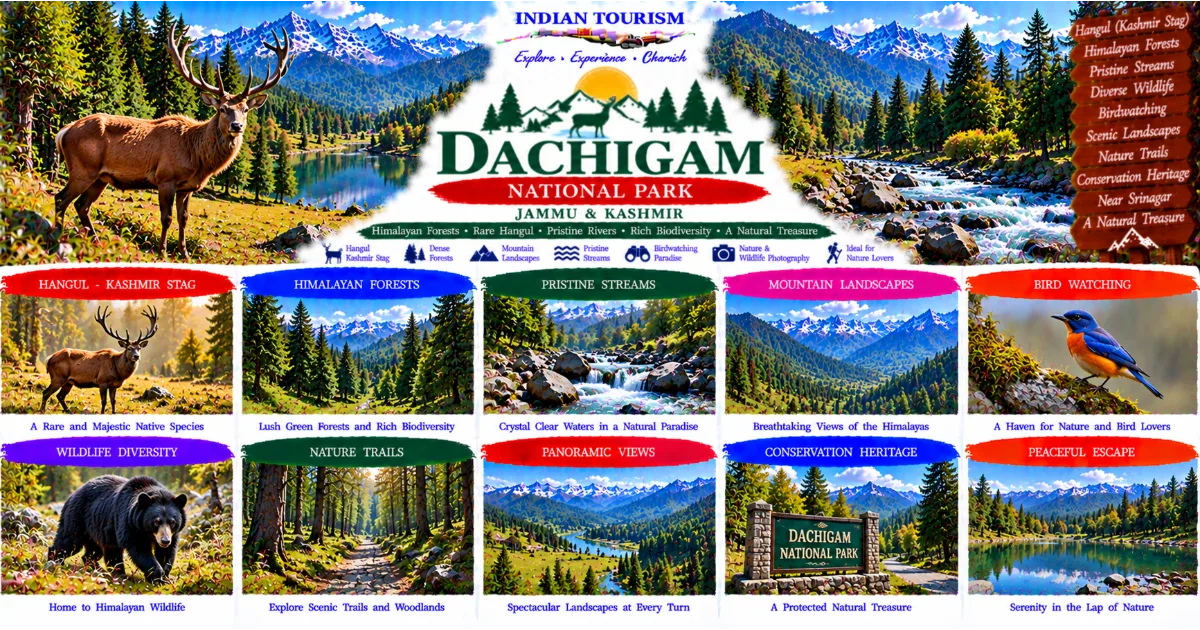
A Wilderness Near Srinagar
Jammu and Kashmir is famous for its lakes, gardens, snow-covered mountains and green valleys, but its natural heritage extends far beyond the landscapes most travellers see on a conventional sightseeing trip. Near Srinagar, the capital city of the Kashmir Valley, lies Dachigam National Park, a protected Himalayan landscape known for its forests, mountain streams, rich biodiversity and association with the endangered Hangul, also called the Kashmir stag.
Dachigam offers a different experience from the gardens, lakes and mountain resorts that usually appear on Kashmir itineraries. It is a place where conservation takes priority over entertainment, where the landscape is shaped by natural ecological processes and where visitors must approach wildlife with patience and respect. Its forested slopes, rugged terrain and changing vegetation provide a glimpse of the natural environment that supports some of Kashmir’s most remarkable animal and bird species.
The park lies in the Zabarwan mountain range, northeast of Srinagar, and is commonly described as being around 20 to 22 kilometres from the city centre, depending on the starting point. It covers approximately 141 square kilometres and contains landscapes that range from lower forested areas to higher mountain environments. These differences in elevation create varied habitats and make the park important for wildlife conservation.
Dachigam is particularly significant because it protects the Hangul, a rare red deer found in Kashmir. The species has faced serious conservation challenges, and its survival depends on protecting suitable habitat, maintaining ecological connections and reducing disturbance. The park also supports other mammals, birds and plant life that contribute to the ecological richness of the region.
For travellers interested in nature, wildlife, birdwatching and environmental education, Dachigam can be a rewarding addition to a visit to Srinagar. However, it is not an ordinary public park. Entry permissions, seasonal closures, visitor restrictions and conservation rules can affect access. Planning a visit therefore requires more preparation than a simple stop at a garden or viewpoint.
This guide explores Dachigam’s history, landscape, wildlife, seasons, travel arrangements and responsible tourism practices to help visitors understand what makes this protected area so important.
The History and Meaning of Dachigam
The Meaning Behind the Name
The name Dachigam is commonly interpreted as meaning “ten villages.” The name is associated with the history of settlements in the area and the changes that accompanied the creation of a protected landscape. Accounts of the park’s development describe the relocation of ten villages when the area was set aside for protection.
This history is an important reminder that conservation landscapes are not simply empty wildernesses. They are connected to human settlements, livelihoods, water resources and changing land management practices. The creation of a protected area can provide major environmental benefits, but it can also affect communities whose lives are connected to the land.
Understanding this background helps visitors appreciate Dachigam as both an ecological treasure and a place with a human history. Responsible tourism should recognise these connections rather than treating the forest as scenery without a wider context.
The Early Protection of the Area
Dachigam was protected in the early twentieth century, with the area associated with efforts to safeguard the water supply for Srinagar. The landscape and its catchment are important because forests, soils and streams influence the movement and quality of water through the environment.
Healthy mountain ecosystems help regulate water flows, reduce erosion and support vegetation. Protecting the catchment therefore has benefits that extend beyond the boundaries of the forest itself.
Dachigam was subsequently declared a national park in 1981. Its protected status reflects the importance of its habitat and wildlife, particularly the Hangul. Today, the park is recognised as one of Kashmir’s most important conservation landscapes.
From Protected Forest to Wildlife Conservation Destination
Dachigam’s role has developed over time. Its significance is no longer limited to the protection of a watershed. It is also central to efforts to preserve rare wildlife and maintain the ecological processes that allow mountain species to survive.
The park’s landscape supports different forms of vegetation and wildlife across varying elevations. Lower areas and higher mountain zones offer different conditions for feeding, shelter and seasonal movement. This diversity makes the area valuable for ecological research and conservation management.
Visitors should remember that a national park is primarily a protected natural environment, not a recreational facility designed around guaranteed wildlife sightings. The opportunity to observe animals is a privilege that depends on the health of the ecosystem and the rules established to protect it.
The Natural Landscape of Dachigam National Park
The Zabarwan Mountain Range
Dachigam lies within the Zabarwan mountain range, which forms part of the landscape surrounding Srinagar and Dal Lake. The mountains influence local weather, vegetation and water systems, creating habitats that differ from the more developed areas of the city.
The park’s terrain includes wooded slopes, rocky sections, streams and higher mountain landscapes. These features provide shelter and feeding opportunities for different species while contributing to the region’s scenic character.
For visitors, the mountains create a sense of separation from urban life. The sounds and visual details of a forest environment differ from those of a busy city, and even a short visit can provide a useful introduction to the natural systems that surround Srinagar.
However, the rugged terrain also means that not every area is suitable for casual walking. Visitors should remain within authorised zones and follow guidance from park officials.
Forests, Trees and Vegetation
Dachigam supports a variety of plant communities, including coniferous forests and broadleaf vegetation. Trees such as deodar, pine and other Himalayan species contribute to the structure of the forest, while shrubs, grasses and seasonal plants provide food and shelter for wildlife.
Vegetation changes with elevation, exposure and the availability of moisture. Lower areas may contain a different mix of plants from higher slopes and alpine environments. These differences help explain why the park can support several types of habitat within a relatively compact geographical region.
Seasonal changes make the forest visually distinctive throughout the year. Spring brings new growth and flowering plants in suitable areas. Summer produces dense greenery, while autumn can introduce warm colours to deciduous trees and shrubs. Winter may bring snow and colder conditions that alter the appearance and accessibility of the landscape.
The vegetation should be treated as part of a living ecosystem. Visitors must avoid picking plants, breaking branches or leaving waste that can affect wildlife and the natural environment.
Streams and the Water Catchment
Water is fundamental to Dachigam’s ecological importance. Mountain streams and drainage channels support plant growth, provide water for wildlife and contribute to the wider catchment that serves the surrounding region.
The park’s streams are part of a larger natural system. Water moves through the landscape, interacting with soil, vegetation and rock before contributing to downstream water resources. Healthy forest cover can help regulate runoff and reduce soil erosion, although the exact effects depend on local conditions.
Visitors may be attracted to the sound of flowing water or the appearance of clear streams, but natural water sources should not automatically be considered safe for drinking. Carry suitable drinking water and avoid contaminating streams with food waste, soap or other materials.
The protection of water systems is one of the reasons conservation matters beyond the park boundary. A healthy mountain environment benefits wildlife, local communities and the wider landscape.
The Hangul: Dachigam’s Most Important Wildlife Symbol
Understanding the Kashmir Stag
The Hangul, commonly known as the Kashmir stag, is one of the most significant animals associated with Dachigam National Park. It is a rare red deer found in Kashmir and has become a symbol of the region’s wildlife conservation efforts.
The animal is recognisable by its deer-like body, brown coat and, in adult males, branching antlers. Its appearance changes with the seasons, and the antlers are especially noticeable during the breeding period.
The Hangul’s survival has been threatened by a range of pressures, including habitat changes, disturbance and other factors affecting its ability to maintain a healthy population. Protecting the species requires more than protecting individual animals. It depends on suitable habitat, access to food and water, opportunities for breeding and the long-term management of the landscape.
Dachigam is central to these efforts because it contains important habitat for the species. The park’s conservation value is therefore closely linked to the future of the Hangul.
Why the Hangul Needs Protection
Rare wildlife can be vulnerable when populations become small or fragmented. A reduced population may face challenges associated with breeding, genetic diversity and environmental changes. Habitat disturbance can make these problems more difficult to address.
For the Hangul, maintaining a suitable natural environment is essential. Conservation work involves protecting habitat, monitoring the population, managing human disturbance and understanding how animals use different parts of the landscape.
Visitors can contribute simply by following the rules of the protected area. Loud noise, approaching animals, leaving food waste and attempting to force a wildlife encounter can all interfere with the purpose of conservation.
A responsible visitor understands that a successful trip does not depend on seeing a Hangul at close range. The continued survival of the animal is more important than any photograph.
Wildlife Viewing and Realistic Expectations
Wild animals move according to their own needs and are not present on a predictable schedule. Even in a park known for a particular species, sightings are never guaranteed.
Visitors may encounter signs of wildlife without seeing the animals themselves. Bird calls, tracks, feeding marks and changes in vegetation can reveal the presence of life in the forest. These observations can make a visit rewarding even when larger mammals remain hidden.
If wildlife viewing is permitted, follow the instructions of authorised guides and park staff. Maintain a safe distance and use binoculars or a suitable camera lens rather than approaching animals.
Never feed wildlife, call animals to attract them or attempt to block their movement. The best wildlife experience is one in which the animal can continue its natural behaviour without interference.
Other Wildlife Found in Dachigam
Himalayan Black Bears
Dachigam is associated with Himalayan black bears, which use forested habitats for shelter and feeding. These animals are powerful wild mammals and must never be treated as approachable attractions.
Bear activity varies with season, food availability and environmental conditions. Visitors should not assume that sightings will occur or attempt to search for bears independently.
Follow all safety instructions provided by authorised personnel. Keep food securely stored where relevant, avoid leaving waste and never approach a bear for photography.
Leopards and Other Mammals
The wider Dachigam landscape supports other mammal species, including leopards and smaller forest animals. Leopards are naturally elusive, and sightings are uncommon for most visitors.
Their presence illustrates the importance of maintaining healthy ecosystems. Predators depend on prey populations and suitable habitat, while the wider food web relies on interactions among plants, herbivores and carnivores.
Visitors should never attempt to locate predators independently or follow signs of an animal away from authorised routes. The park’s value lies in allowing wildlife to live with as little unnecessary disturbance as possible.
Smaller Mammals and Forest Life
A forest ecosystem contains many animals that may receive less attention than large mammals but remain important to its functioning. Small mammals contribute to food webs, seed movement and other ecological processes.
Observing these species often requires patience and careful attention. Visitors may notice movement in the undergrowth, feeding activity or other signs without obtaining a clear view.
Avoid handling wild animals or attempting to move them for photographs. Even apparently harmless species can become stressed or injured through contact with people.
Birdwatching in Dachigam National Park
A Landscape for Bird Diversity
Dachigam’s varied habitats make it an appealing area for birdwatchers. Forests, streams, open patches and changing elevations provide different conditions for birds throughout the year.
Depending on season and habitat, visitors may have opportunities to observe woodland birds, pheasants, raptors and other Himalayan species. Bird diversity changes with weather, breeding cycles and seasonal movement.
Birdwatching is most rewarding when approached quietly. Birds may respond to disturbance by moving away or stopping their normal activity, so patience and a respectful distance are essential.
How to Prepare for Birdwatching
Binoculars can make a substantial difference when observing birds in a forest. A field guide or bird identification application may also help visitors understand what they see, provided the device can be used without disturbing the environment.
Wear comfortable clothing suited to the weather and avoid bright, noisy equipment where it might disrupt a quiet observation experience. A notebook can be useful for recording species, locations and behaviour.
Do not play recorded bird calls to attract birds unless an activity is explicitly authorised for a conservation or research purpose. Such practices can disturb wildlife and interfere with natural behaviour.
Photography and Bird Conservation
Bird photography can be rewarding, but it requires particular care. Long lenses allow photographers to capture details without approaching too closely. Avoid disturbing nests, following birds through dense vegetation or using flash in situations where it could cause stress.
Do not publish sensitive location details for vulnerable species if doing so could increase the risk of disturbance. Responsible photography places the welfare of wildlife ahead of the desire for a close-up image.
Best Time to Visit Dachigam National Park
Spring: Fresh Growth and Bird Activity
Spring is often an appealing period for exploring the lower parts of the Dachigam landscape, subject to current access rules. Vegetation begins to renew itself, streams may carry increased water from seasonal melt and the forest gradually becomes greener.
The season can be attractive to nature lovers and birdwatchers who enjoy observing changing habitats. Temperatures may remain cool in the morning, and weather can change quickly in mountain areas.
Carry layers and suitable footwear, and check whether the areas you intend to visit are open. Spring conditions in the lower park may differ significantly from those at higher elevations.
Summer: Green Forests and Mountain Scenery
Summer generally brings a greener appearance to much of the park. Lower forested areas may be comfortable for permitted visits, while higher areas can become more accessible depending on snow conditions and local restrictions.
This season can be suitable for landscape observation and nature education. Visitors may appreciate the variety of vegetation and the contrast between forest cover and open mountain terrain.
Even in summer, weather can change, and rain may make surfaces slippery. Follow local guidance and do not assume that a route is safe simply because temperatures are mild.
Autumn: Seasonal Colours and Wildlife Awareness
Autumn brings changing colours to parts of the landscape, particularly where deciduous trees and shrubs grow among evergreen vegetation. Cooler air and clearer views can create attractive conditions for photography.
Autumn is also associated with the Hangul’s breeding period, making it a particularly sensitive time for wildlife protection. Authorities may restrict or suspend visitor access to reduce disturbance.
Before planning a visit during this season, confirm the latest rules with the relevant authorities. A temporary closure is part of conservation management and should be respected.
Winter: Snow and Restricted Access
Winter can transform Dachigam’s landscape. Snow, frost and low temperatures may affect roads, paths and the availability of particular areas. Higher elevations can become especially difficult to access.
Although winter scenery can be beautiful, it is not always the most practical season for general sightseeing. Visitors should verify opening arrangements, road conditions and any restrictions before travelling.
Wear warm clothing and footwear suitable for cold and potentially icy surfaces. Never attempt to enter a closed area or continue along a route that has been declared unsafe.
How to Reach Dachigam National Park
Reaching the Park from Srinagar
Srinagar is the most convenient base for many visitors planning to explore Dachigam. The park is located northeast of the city, and the journey is commonly made by road through the Harwan area.
Travel time depends on traffic, the starting point and current road conditions. A private taxi or arranged vehicle can provide flexibility, but visitors should confirm where vehicles are permitted to go and whether any restrictions apply inside the protected area.
Do not assume that ordinary city transport will take you directly to every authorised visitor point. Confirm the route and access arrangements before setting out.
Reaching the Park from the Airport
Travellers arriving at Srinagar’s airport can arrange transport to their accommodation and plan a separate visit to Dachigam. The exact journey duration depends on traffic and the location of the accommodation.
For a more relaxed experience, consider staying in Srinagar and visiting the park as a planned excursion rather than attempting to combine it with a long list of other attractions on arrival day.
Confirm any required permits and entry arrangements in advance. Do not assume that arriving at the gate guarantees admission.
Transport and Entry Permissions
Dachigam is a protected area, and access may require permission from the relevant wildlife authorities. Requirements can change according to the season, conservation priorities and operational arrangements.
Before booking transport, verify whether visitors are currently being admitted, whether an application or permit is required and whether an authorised guide must accompany the visit. Confirm fees and other conditions directly with the relevant authority rather than relying on old travel listings.
A permit does not necessarily mean that every part of the park is accessible. Some zones may have additional restrictions, and visitor access can be suspended when wildlife protection requires it.
Understanding Visitor Rules and Conservation Closures
Why Access May Be Restricted
National parks are managed primarily to protect wildlife and habitat. Authorities may limit visitor numbers, close particular areas or temporarily suspend access during sensitive periods.
Breeding seasons can be especially important because disturbance may affect animal behaviour. Seasonal closures allow wildlife to use important areas with less human interference.
Dachigam has recently been reported closed to visitors through 31 October 2026 to protect Hangul during its breeding period, with reopening reported for 1 November. Since such arrangements can change, visitors should confirm the current status with the wildlife authorities before making travel plans.
The possibility of a closure should be treated as a normal part of visiting a protected area, not as an inconvenience to be bypassed.
Respecting Permit Conditions
If entry is permitted, follow all instructions provided by park officials. Restrictions may cover routes, group size, vehicle movement, photography or other activities.
Do not enter areas marked as closed or attempt to continue beyond authorised boundaries. If a guide or official instructs you to change direction, comply immediately.
These rules help protect both wildlife and visitors. The park’s natural features can include steep terrain, unpredictable weather and animals that should not be approached.
Responsible Visitor Behaviour
Keep noise to a minimum, carry waste out of the park and avoid feeding or touching animals. Do not remove plants, stones or other natural materials.
Stay with authorised guides where required and never leave a group to follow an animal. Keep a safe distance from streams, slopes and unstable ground.
The goal is to leave the environment as undisturbed as possible. A responsible visitor recognises that wildlife conservation is more important than completing a planned sightseeing route.
Nearby Attractions Around Dachigam
Harwan Garden
Harwan Garden is a landscaped attraction in the broader area near Dachigam. It offers a different experience from the national park, with garden surroundings and opportunities for a relaxed outdoor visit.
The garden can be considered as part of a wider outing, subject to current opening arrangements. Visitors who enjoy both natural landscapes and historic garden design may find the contrast rewarding.
Check the route and the time needed for each stop before planning the day.
Dal Lake
Dal Lake is one of Srinagar’s most recognised attractions. Its waters, houseboats, shikara rides and surrounding mountain views provide a classic Kashmir experience.
Combining a visit to Dachigam with time around Dal Lake can create a balanced itinerary, with one experience focused on protected wilderness and the other on the cultural and recreational landscape of Srinagar.
If you are visiting both in one day, allow enough time for road travel and any required entry formalities at Dachigam.
Nishat Bagh
Nishat Bagh is a historic Mughal garden overlooking Dal Lake. Its terraces, water channels and landscaped spaces reflect the tradition of formal garden design in Kashmir.
The garden offers a useful contrast with Dachigam’s forest environment. One is a carefully arranged cultural landscape, while the other is a protected natural ecosystem.
Visitors interested in Kashmir’s environmental and cultural heritage may enjoy exploring both.
Shalimar Bagh
Shalimar Bagh is another well-known Mughal garden in Srinagar. Its historic layout, water features and planted spaces provide insight into the region’s royal garden traditions.
A visit can be combined with other Srinagar attractions, depending on available time and current access conditions. Do not rush through the garden merely to fit in additional stops.
Shankaracharya Temple
Shankaracharya Temple occupies a hilltop position overlooking Srinagar and the surrounding landscape. It is an important religious destination and offers broad views of the city and Dal Lake.
Visitors should check current access arrangements and follow local rules, particularly those relating to religious practice and photography.
The temple can be a meaningful addition to an itinerary that combines natural landscapes with Kashmir’s cultural and religious heritage.
A Suggested One-Day Nature Itinerary
Morning: Plan the Dachigam Visit
Begin by confirming that the park is open and that you have the required permission. If access is authorised, arrive according to the official instructions and follow the designated route.
Spend the permitted time observing the landscape, learning about local ecology and looking for signs of wildlife without disturbing it. If an authorised guide is required, listen carefully to their safety and conservation guidance.
If the park is closed, do not attempt to enter. Choose an alternative attraction in Srinagar or postpone the wildlife visit.
Midday: Explore the Harwan Area
If access and time permit, consider visiting Harwan Garden or another suitable attraction in the surrounding area. This provides a more relaxed outdoor experience after a conservation-focused visit.
Take a break for lunch at a suitable local establishment and carry any waste to an appropriate disposal point.
Afternoon: Visit a Srinagar Garden or Lake
Choose either Dal Lake, Nishat Bagh or Shalimar Bagh according to your interests. A lake visit may offer a different perspective on Srinagar’s landscape, while a garden visit provides an introduction to the region’s historic landscaping traditions.
Avoid trying to visit every attraction in a single afternoon. A smaller number of well-chosen stops allows more time to enjoy each place.
Evening: Return to Srinagar
Return with enough time to accommodate traffic and changing conditions. Use the evening to review any plans for the following day and check whether weather or access arrangements may affect them.
A flexible schedule is particularly important when wildlife areas are involved.
Dachigam for Families, Students and Nature Enthusiasts
Family Visits
Dachigam can provide an educational introduction to wildlife conservation, forest ecosystems and the importance of protected areas. Families should first confirm that visitor access is available and appropriate for their group.
Children can learn about the Hangul, mountain vegetation and the relationship between forests and water. Encourage them to observe quietly and understand why wildlife must not be approached or fed.
Follow all age-related or group restrictions imposed by the authorities. If a visit is not suitable or access is closed, a garden or nature-focused attraction nearby may offer a more appropriate alternative.
Educational and Nature Study Visits
Students interested in biology, geography or environmental studies may find Dachigam valuable because it demonstrates the relationship between habitat, species and conservation management.
Educational groups should arrange access through the relevant authorities and follow any specific requirements for school or college visits. A visit should have clear learning objectives and adequate supervision.
Field observations should be conducted responsibly. Collecting specimens, disturbing nests or leaving marked objects in the environment should not be undertaken without appropriate authorisation.
Wildlife and Landscape Photography
Photographers may be attracted by the Hangul, birds, forest scenery and mountain landscapes. However, photography must remain secondary to wildlife protection.
Use suitable lenses and observe from authorised locations. Do not approach animals, use bait or disturb vegetation to obtain a better view.
Confirm whether special permission or a separate photography fee applies. Rules for professional equipment may differ from those for ordinary personal photography.
Practical Tips for a Successful Visit
What to Carry
Bring drinking water, comfortable footwear, clothing suited to the season and any personal medicines you may need. Binoculars can be useful for wildlife observation, while a camera with a suitable zoom lens can help capture distant subjects.
A waterproof layer may be useful in changeable weather. During colder months, carry adequate warm clothing and avoid assuming that conditions near Srinagar will match those inside the park.
Do not bring unnecessary items that could create waste or make movement more difficult.
Health and Safety
Follow all instructions from park officials and authorised guides. Keep a safe distance from wildlife, avoid unfamiliar trails and do not approach steep slopes or fast-flowing streams.
If weather deteriorates or an official advises leaving an area, follow the guidance promptly. Do not take risks to complete a planned route or obtain a photograph.
Visitors with mobility needs should confirm the terrain and facilities before booking, since a protected mountain environment may not provide the same access features as an urban garden.
Planning Around Weather and Access
Check the weather forecast and the latest access information before travelling. Seasonal closures, road conditions and conservation requirements can change the practical options available to visitors.
Keep alternative plans ready. Srinagar offers lakes, gardens, cultural sites and other attractions that may be suitable when Dachigam is unavailable.
Flexibility is an important part of responsible nature tourism. The best plan is one that adapts to the needs of the environment as well as those of the traveller.
Why Dachigam National Park Deserves a Place in Your Kashmir Journey
Dachigam National Park offers a valuable perspective on Kashmir that differs from the familiar images of lakes, gardens and mountain resorts. Its forests, streams, wildlife and changing elevations reveal the ecological systems that support the wider region.
The park’s greatest significance lies in its conservation role, particularly its importance for the Hangul. Protecting this rare deer requires a healthy habitat and careful management of human activity. Visitors who understand this purpose can appreciate the park even without seeing a large mammal.
For nature enthusiasts, Dachigam offers opportunities to learn about Himalayan vegetation, birdlife and the relationship between forests and water. For students, it provides a real-world setting for understanding conservation. For photographers, the landscape offers a variety of subjects, provided images are captured without disturbing wildlife.
Its location near Srinagar also makes it possible to combine a protected natural environment with the city’s cultural attractions. Dal Lake, Nishat Bagh, Shalimar Bagh and other sites offer complementary experiences that help travellers understand the diversity of Kashmir.
The most rewarding visit is one planned with respect for the rules, an appreciation of the ecosystem and realistic expectations about wildlife viewing.
Conclusion: Protecting the Wild Heart of Kashmir
Dachigam National Park is one of Kashmir’s most important natural treasures. Its forests and mountain landscapes support a rich variety of life, while its role in protecting the Hangul gives it special significance for wildlife conservation in India.
A visit provides an opportunity to move beyond conventional sightseeing and learn about the natural systems that sustain the Kashmir Valley. The experience may involve observing birds, appreciating forest vegetation, learning about the water catchment or simply understanding why protected areas need careful management.
Before travelling, confirm whether the park is open, check permit requirements and follow the latest guidance from the wildlife authorities. Be prepared to change your plans if conservation needs or weather conditions require it.
Whether you are a nature lover, a student, a photographer or a traveller seeking a deeper understanding of Kashmir, Dachigam offers a meaningful connection with the region’s natural heritage. Its true value is not measured by the number of animals seen or photographs taken, but by the continued survival of the wildlife and habitats it protects.
Travel responsibly, leave no waste, respect all restrictions and remember that the best way to experience a wilderness is to allow it to remain wild.
#IndianTourism #DachigamNationalPark #KashmirTourism #JammuAndKashmir #Hangul #KashmirStag #WildlifeConservation #NatureTourism #WildlifePhotography #Birdwatching #Srinagar #HimalayanForests #EcoTourism #ExploreIndia #ResponsibleTourism
