
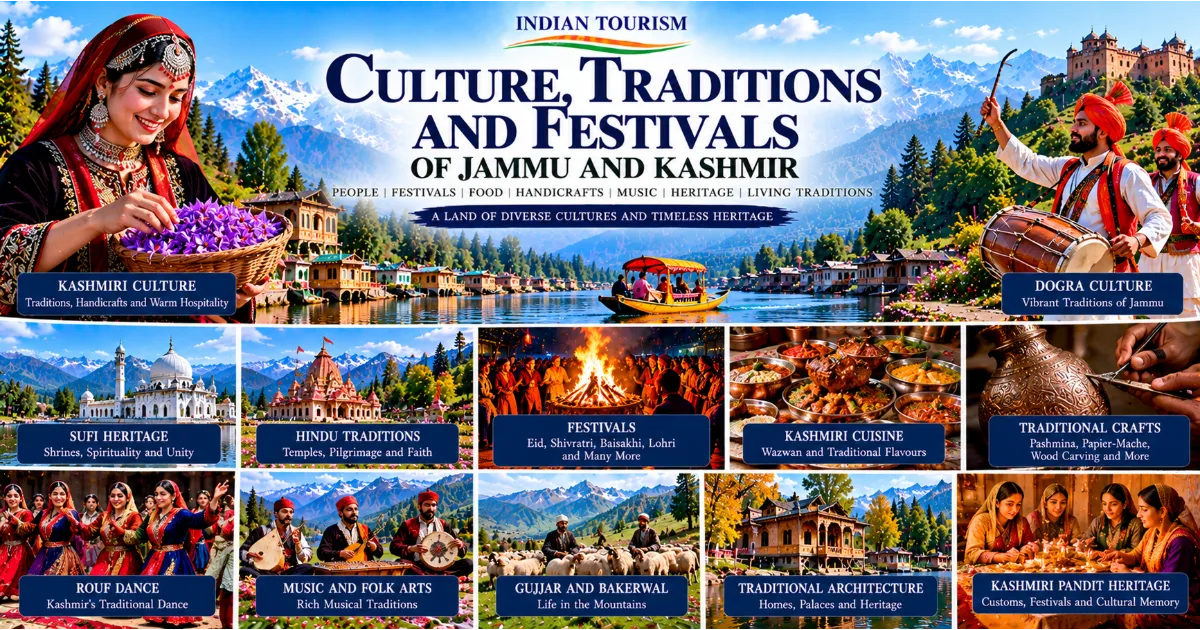
A Land of Many Cultures and Traditions
Jammu and Kashmir is a region of extraordinary natural beauty, but its identity extends far beyond mountains, lakes, gardens and valleys. Its culture has developed through centuries of history, migration, trade, religious traditions, artistic expression and interaction between different communities. The result is a rich cultural landscape where languages, music, food, clothing, architecture, crafts and festivals reflect the diversity of the people who call this region home.
The cultural identity of Jammu and Kashmir cannot be described through a single tradition. The Kashmir Valley has distinctive linguistic, artistic and culinary traditions, while the Jammu region reflects the heritage of Dogra communities, as well as the diverse cultures of its mountain districts and plains. Areas such as Kishtwar, Bhaderwah, Poonch, Rajouri, Doda and the Chenab Valley contribute their own customs, dialects, festivals and ways of life. Ladakh, which was historically part of the former princely state of Jammu and Kashmir but is now a separate Union Territory, also has a distinct cultural heritage and should be understood separately in discussions of present-day administration.
Religion has played an important role in shaping the region's cultural history. Islam, Hinduism, Sikhism and Buddhism have influenced architecture, music, literature, festivals and community practices in different parts of the wider Himalayan region. Sufi traditions, pilgrimage sites, temples, shrines and historic monasteries have all contributed to the cultural landscape. Many local customs also reflect the rhythms of agricultural life, seasonal changes and the close relationship between communities and their natural surroundings.
Traditional crafts are another important part of this heritage. Kashmiri shawls, papier-mache products, carpets, wood carving and embroidered textiles are known for their intricate workmanship. In Jammu, traditional embroidery, metalwork, woodwork and regional handicrafts reflect different artistic influences. These crafts preserve techniques passed from one generation to another and provide livelihoods for artisans.
Food offers another way to understand the region. Kashmiri wazwan, rice-based meals, aromatic teas and traditional breads reflect the culinary traditions of the Valley. Dogra cuisine, with its own distinctive preparations and flavours, adds another dimension to the food culture of Jammu. Recipes vary from family to family and from district to district, making regional cuisine a living expression of cultural identity.
Festivals bring these traditions into public life. Eid, Navroz in communities that observe it, Shivratri, Navratri, Baisakhi, Lohri, Urs gatherings and regional fairs are among the occasions celebrated by different communities. Their forms and significance vary, but they often provide opportunities for families to gather, communities to renew social connections and younger generations to learn about inherited customs.
This article explores the culture, traditions and festivals of Jammu and Kashmir, highlighting the people, languages, crafts, cuisine, music and celebrations that make the region distinctive. It also considers how cultural heritage can be preserved while communities adapt to contemporary life.
1. The Cultural Diversity of Jammu and Kashmir
Jammu and Kashmir is culturally diverse because of its geography, historical connections and the variety of communities living across the region. Mountains and valleys have sometimes separated settlements, allowing local languages and customs to develop distinctive characteristics. At the same time, trade routes, pilgrimage journeys, migration and political changes have connected communities over many centuries.
The Kashmir Valley has a strong tradition of Kashmiri language, literature, poetry, music and handicrafts. Its cultural identity has been shaped by interactions among local traditions, Persianate influences, Sufi thought and other historical connections. Srinagar's historic neighbourhoods, shrines, mosques, temples, gardens and traditional houses provide visible reminders of this layered history.
The Jammu region has a different but equally varied cultural character. Dogra traditions are important in Jammu city and surrounding areas, while mountain districts contain a range of linguistic and community identities. Pahari-speaking communities, Gojri-speaking Gujjar communities and other groups contribute to the cultural diversity of the region. Their songs, clothing, food, oral histories and seasonal practices reflect different relationships with the landscape.
The Chenab Valley, including areas around Doda, Kishtwar and Bhaderwah, has its own linguistic and cultural characteristics. Local celebrations, folk traditions and community customs vary across settlements, making the region especially interesting for travellers who want to understand cultural diversity beyond major cities.
Poonch and Rajouri also contain varied cultural traditions shaped by mountain geography, local history and connections across the wider region. The customs of individual villages and communities may differ even when they share certain linguistic or religious practices.
This diversity means that cultural tourism should be approached with curiosity rather than assumptions. A custom followed in Srinagar may not be practised in the same way in Jammu or a remote mountain village. Clothing, food, wedding traditions and festival observances can differ considerably between families and communities.
Visitors can learn about these differences through local guides, museums, craft workshops, community festivals and conversations with residents. It is important to ask questions respectfully and avoid treating a community's traditions as performances arranged solely for tourists.
The cultural richness of Jammu and Kashmir lies in the coexistence of many traditions within a connected geographical region. Understanding this diversity provides a more complete picture of the place and the people who have shaped its history.
2. Kashmiri Language, Literature and Oral Traditions
Language is one of the most important elements of cultural identity in Jammu and Kashmir. Kashmiri, commonly known as Koshur, is widely associated with the Kashmir Valley and has a long literary and oral tradition. Dogri is another important regional language, particularly associated with the Jammu region. Other languages spoken across the wider region include Gojri, Pahari varieties, Urdu, Punjabi and several local linguistic forms.
These languages carry more than everyday communication. They preserve family histories, traditional knowledge, folk songs, proverbs, religious expressions and memories of earlier generations. The vocabulary used to describe food, farming, weather, relationships and local landscapes often reflects the environment in which a community has developed.
Kashmiri literature includes poetry, devotional writing, storytelling and modern literary works. Poets and writers have explored themes such as love, spirituality, nature, social change and human experience. Oral traditions remain important because stories and songs can be passed between generations even when written records are limited.
Lal Ded, also known as Lalleshwari, is one of the most celebrated figures in Kashmir's literary and spiritual history. Her short poetic compositions, commonly called vakhs, are remembered for their philosophical reflections and direct expression. Her legacy has influenced how later generations understand the relationship between spirituality, poetry and everyday life.
Sheikh Noor-ud-din Noorani, widely known as Nund Rishi, is another important figure associated with Kashmir's spiritual and poetic heritage. His teachings are remembered within the region's Rishi tradition, which developed within a distinctive cultural and religious environment.
Dogri literature has also developed through poetry, folk expression, storytelling and modern writing. Traditional songs often preserve memories of family relationships, agricultural life, migration and regional history. Contemporary writers continue to explore identity, language preservation and the changing experiences of communities in Jammu and Kashmir.
Oral traditions are especially valuable in mountain communities where local stories may explain the origins of a place, describe historic events or convey lessons about nature and social behaviour. These stories should not always be treated as literal historical records, but they are important expressions of how communities understand their past.
Language preservation requires continued use in homes, schools, literature, music and public life. Younger generations may grow up using several languages, and this multilingual ability can be an important cultural resource.
Visitors can support local language traditions by learning a few respectful greetings, buying books from local writers and attending cultural events when appropriate. Even a small effort to understand the language of a place can make interactions more meaningful.
The languages of Jammu and Kashmir are living cultural treasures. Their continued development depends on people using them, teaching them and creating new literature while preserving the oral traditions that connect generations.
3. Sufi Traditions and the Spiritual Heritage of Kashmir
Sufi traditions have played an influential role in the religious and cultural history of the Kashmir Valley. They are associated with spiritual reflection, poetry, devotion, teaching and the establishment of shrines that continue to attract visitors and worshippers.
Kashmir's spiritual history includes several traditions and movements that developed through interaction between local religious practices and wider intellectual networks. Sufi teachers and poets contributed to the region's literary life, while shrines became important places for prayer, remembrance and community gatherings.
The legacy of Nund Rishi is particularly significant. Associated with the Rishi tradition of Kashmir, he is remembered for teachings that emphasised spiritual discipline, ethical conduct and reflection on human life. His shrine at Charar-e-Sharief is an important religious site and a destination for many devotees.
The Hazratbal Shrine in Srinagar is another major religious landmark, known for its white architecture and position beside Dal Lake. It is an important place of Muslim devotion and holds special significance because of the sacred relic associated with the shrine. Visitors should observe local rules and respect religious practices when visiting.
Other shrines throughout the Valley reflect the importance of local spiritual traditions. Some are connected with widely revered teachers, while others hold significance for particular communities or localities. Their role may include worship, religious education, community gatherings and the preservation of historical memory.
Sufi poetry and devotional music have also influenced the region's cultural expression. Spiritual themes appear in songs, poetry and oral traditions, although the precise forms vary by community and occasion.
For travellers, visiting a shrine can provide an opportunity to understand the religious history of the region. It is important, however, to remember that these are living places of worship, not simply heritage attractions. Dress modestly, follow entry requirements, ask before taking photographs and avoid interrupting prayer or ceremonies.
The region's spiritual heritage should not be reduced to a single narrative. Different communities have their own religious traditions, histories and interpretations, and these deserve to be understood on their own terms.
Sufi heritage remains an important part of Kashmir's cultural identity because it connects literature, spirituality, architecture and community life. It demonstrates how religious traditions can shape not only places of worship but also the language and imagination of a society.
4. Temples and Hindu Traditions in Jammu and Kashmir
Hindu religious traditions have a long history in Jammu and Kashmir, expressed through temples, pilgrimage routes, festivals, devotional music and family customs. The region contains numerous sacred sites, ranging from major pilgrimage destinations to neighbourhood temples and historic shrines.
The Jammu region is particularly associated with pilgrimage tourism. The Shri Mata Vaishno Devi shrine near Katra attracts large numbers of devotees each year. The pilgrimage involves a journey towards the sacred shrine in the Trikuta hills, and many visitors consider the walk itself an important part of their religious experience.
The Raghunath Temple in Jammu city is another major religious landmark. Its complex of shrines and religious spaces reflects the importance of Hindu worship in the city's cultural history. Visitors can learn about the traditions associated with the site while respecting its religious significance.
Other temples across Jammu and Kashmir preserve local traditions and stories connected with particular deities, sacred landscapes and historical events. The importance of individual sites varies according to regional beliefs and community practices.
In the Kashmir Valley, temples and pilgrimage sites also form part of the region's historical landscape. The Shankaracharya Temple, situated on a hill overlooking Srinagar, is among the best-known landmarks. Its elevated position gives it both religious importance and a prominent place in the city's geography.
Hindu festivals are celebrated in different ways across the region. Shivratri holds particular cultural importance among Kashmiri Pandit communities, while Navratri, Diwali, Janmashtami and other festivals are observed by many Hindu families according to their traditions.
Ritual practices may involve prayers, fasting, family gatherings, temple visits and the preparation of special foods. Customs can differ between families and communities, so it is important not to assume that every household celebrates in the same way.
Pilgrimage tourism also has an economic and social dimension. Transport providers, accommodation businesses, food sellers and local guides may benefit from visitors, while pilgrimage routes require attention to sanitation, crowd management and environmental protection.
Travellers should check current arrangements before visiting major shrines, particularly during festivals or busy pilgrimage periods. Access, transport and waiting times can vary considerably.
The temples and Hindu traditions of Jammu and Kashmir form an important part of the region's cultural heritage. Understanding them alongside other traditions provides a more complete view of the area's religious diversity and historical depth.
5. Dogra Culture: The Heritage of the Jammu Region
Dogra culture is an important part of Jammu's identity and is associated with distinctive traditions in language, food, festivals, dress, music and architecture. It has developed through the history of the Jammu region, its royal traditions, agricultural communities and connections with the wider northern Indian cultural landscape.
Dogri is one of the most important expressions of this heritage. The language has a rich tradition of folk songs, poetry, oral storytelling and modern literature. Traditional songs may reflect love, family relationships, seasonal changes, marriage customs and everyday experiences.
Dogra food includes a variety of dishes that reflect local ingredients and culinary practices. Preparations such as rajma with rice are widely enjoyed in the region, while other traditional dishes vary by community and household. The food culture also includes breads, lentil preparations, seasonal vegetables and dishes served during festivals or family occasions.
Festivals play an important role in Dogra community life. Lohri is celebrated by many families during the winter season, while Baisakhi has agricultural and religious significance for different communities. Navratri and other Hindu festivals are also observed across the region.
The historical heritage of the Dogra rulers remains visible in Jammu's palaces, temples, forts and public buildings. Mubarak Mandi Palace Complex reflects the architectural history of the royal period, while Amar Mahal Palace is another prominent landmark associated with the region's royal heritage.
Traditional clothing and embroidery also contribute to Dogra cultural identity, although everyday dress has changed significantly over time. Clothing varies according to location, occasion, age and personal preference.
The cultural diversity of Jammu should not be understood exclusively through Dogra traditions. The region also includes many other communities with their own languages, histories and customs. A full understanding of Jammu requires attention to this wider diversity.
For travellers, exploring Dogra culture can involve visiting historic sites, learning about Dogri literature, sampling regional food and attending local fairs or cultural programmes. Museums and heritage centres may provide useful context, while conversations with local residents can offer insight into how traditions are maintained today.
Dogra culture demonstrates how regional identity is shaped by a combination of history, language, family practices and shared memory. Its continued vitality depends on both preserving traditional forms and allowing new generations to express their cultural identity in contemporary ways.
6. Kashmiri Pandit Traditions and Cultural Memory
Kashmiri Pandit communities have made important contributions to the literature, religious life, scholarship, music and cultural history of the Kashmir Valley. Their traditions include distinctive forms of worship, family customs, festival observances, food practices and linguistic expression.
Kashmiri Pandit cultural memory is closely connected with the landscapes and religious sites of the Valley. Temples, ancestral homes, family histories and local traditions carry significance for communities whose experiences have been shaped by historical change, including displacement and migration.
Shivratri, known in Kashmiri Pandit tradition as Herath, is one of the most important festivals. Its observance can involve religious rituals, family gatherings, special preparations and customs passed from one generation to another. The precise practices differ between families, and many households preserve their own variations.
Language and oral history are important in maintaining cultural continuity. Family stories, songs, recipes and ritual practices can preserve knowledge that might otherwise be lost when communities become geographically dispersed.
Traditional Kashmiri Pandit cuisine includes a range of dishes prepared for everyday meals and special occasions. Ingredients, methods and the use of spices vary between households, and food often carries memories of family and place.
The history of Kashmiri Pandit communities also includes experiences of conflict and displacement. These experiences have influenced community life and the transmission of cultural traditions across generations. Discussions of this history should be approached with sensitivity and respect for the diversity of individual experiences.
Cultural heritage can be maintained through family gatherings, literature, community organisations, religious observances and the documentation of oral histories. Younger generations may preserve traditional practices while adapting them to new locations and contemporary lifestyles.
Visitors interested in this heritage should learn through reliable historical sources, cultural programmes and respectful conversations. Religious sites should be treated as living places of worship, and personal histories should never be demanded from individuals simply because of their community identity.
Kashmiri Pandit traditions are an important part of the wider cultural history of Jammu and Kashmir. Their preservation contributes to a fuller understanding of the Valley's diverse past and the continuing significance of cultural memory.
7. Gujjar and Bakerwal Communities: Traditions of the Mountains
The Gujjar and Bakerwal communities are important contributors to the cultural diversity of Jammu and Kashmir. Many families within these communities have historically been associated with pastoral livelihoods, livestock rearing and seasonal movement between different elevations.
Seasonal movement is often connected with the availability of grazing land. Families may travel between lower-elevation winter areas and higher summer pastures, following patterns shaped by climate, livestock needs and local conditions. These journeys are part of a broader relationship between people, animals and mountain environments.
Gojri is an important language associated with many Gujjar and Bakerwal communities. Oral traditions, songs, stories and community knowledge help preserve cultural identity and transmit information between generations.
Traditional livelihoods involve considerable knowledge of animals, weather, pasture conditions and routes through mountain terrain. This knowledge has developed through experience and is closely connected with the practical demands of pastoral life.
Clothing, food and household practices vary between families and locations. Visitors should avoid treating either community as culturally uniform, because lifestyles differ according to geography, livelihood, education and personal choice.
The lives of pastoral communities are also affected by modern changes. Access to grazing land, education, healthcare, transport, employment and administrative arrangements can influence how families maintain traditional livelihoods. Some continue pastoral practices, while others combine them with new forms of work and settlement.
Tourism can create opportunities for cultural exchange, but it should be approached carefully. Visitors should ask permission before photographing people, avoid interfering with livestock and respect the privacy of families moving through mountain areas.
Local guides and community organisations may provide opportunities to learn about pastoral traditions in an appropriate setting. Cultural learning should not involve pressuring people to demonstrate practices or share personal information.
The Gujjar and Bakerwal communities demonstrate the importance of understanding culture as a living relationship with the environment. Their traditions reflect practical knowledge, social organisation and a history of adapting to the challenges of mountain life.
8. Traditional Kashmiri Clothing and Textiles
Clothing is an important expression of cultural identity in Jammu and Kashmir. Traditional garments reflect the climate, available materials, local craftsmanship and changing social customs. Some garments remain common in everyday life, while others are more closely associated with festivals, ceremonies or particular generations.
The pheran is one of the most recognisable garments associated with Kashmir. It is a loose outer garment traditionally worn by people across different communities, with variations in style, fabric, length and decoration. Its practical design makes it suitable for cold conditions, although contemporary versions vary widely.
Kashmiri clothing traditions also include shawls, embroidered garments and textiles made from wool and other fibres. The region's cold winters have encouraged the use of warm fabrics, while skilled artisans have developed decorative techniques that add cultural and artistic value.
Kashmiri shawls are particularly famous for their fine materials and intricate designs. Different types of shawls vary in fibre, weaving method and ornamentation. Some are valued for the softness of their wool, while others are known for elaborate embroidery or woven patterns.
Pashmina is associated with fine cashmere fibre obtained from particular breeds of goats adapted to high-altitude environments. Authenticity and quality can vary widely in the marketplace, so buyers should seek reliable information about the material and production process.
Embroidery is another important textile tradition. Kashmiri embroidery styles include detailed floral and other decorative motifs, with the appearance varying according to technique and product. Shawls, clothing, bags and household textiles may all feature embroidered designs.
Traditional clothing is not frozen in time. Contemporary fashion combines local garments with modern tailoring, changing fabrics and individual preferences. Younger people may wear traditional clothing on special occasions while choosing other styles for everyday life.
In Jammu, clothing traditions reflect different climates, communities and social settings. Garments worn in the plains may differ from those used in colder mountain areas, and ceremonial clothing can vary between communities.
Visitors interested in textiles should buy from reputable sellers and ask questions about materials, craftsmanship and care. A genuine handmade product may require more time and cost than a mass-produced imitation, but it can also support the skills of local artisans.
Traditional clothing and textiles preserve artistic knowledge while adapting to contemporary needs. They remain an important connection between cultural identity, practical life and regional craftsmanship.
9. Kashmiri Handicrafts: Skills Passed Down Through Generations
Kashmir is known for a range of handicrafts that combine technical skill with artistic expression. Many crafts have been practised for generations, with techniques learned through family workshops, apprenticeships and community networks.
Papier-mache is one of the region's best-known crafts. Artisans shape prepared paper material into objects and decorate them with detailed painted patterns. Traditional products may include boxes, ornaments, decorative panels and household items. Floral designs, colours and fine linework contribute to the craft's distinctive appearance.
Wood carving is another important tradition. Skilled craftspeople create decorative patterns on wooden furniture, panels and other objects. The complexity of the carving varies according to the product and the time required to complete it.
Carpet weaving has a long association with Kashmir. Handwoven carpets can involve intricate patterns and substantial labour, with design traditions reflecting different influences. The quality of a carpet depends on several factors, including materials, knotting or weaving technique, density, finishing and the skill of the maker.
Textile crafts include embroidery, shawl production and other forms of decorative work. Some products require many hours of detailed handwork, making the value of the finished item closely connected with the labour involved.
In Jammu, traditional crafts also include regional embroidery, woodwork, metalwork and other handmade products. Local styles differ according to community and district, and not every craft is practised uniformly throughout the region.
Handicrafts are important not only for tourism but also for livelihoods and cultural preservation. Artisans maintain specialised knowledge that can be difficult to replace if younger generations have limited opportunities to learn the skills.
Visitors can support craft traditions by buying from reputable makers and asking about the production process. They should be cautious of claims that every product is handmade or made from a particular material, especially in markets where mass-produced goods may be sold alongside traditional work.
Photography in workshops should be done with permission, and visitors should avoid disrupting the artisan's work. A conversation about the craft can be more valuable than simply treating the workshop as a place to take pictures.
Traditional handicrafts demonstrate how cultural heritage can remain economically active. When artisans receive fair recognition and payment, their skills have a better chance of surviving and developing in future generations.
10. Wazwan: The Grand Culinary Tradition of Kashmir
Kashmiri cuisine is one of the most recognisable elements of the region's cultural identity. Among its most celebrated traditions is wazwan, a formal multi-course meal associated with Kashmiri Muslim culinary culture and communal hospitality.
Wazwan is often served during weddings and important gatherings. Its preparation can involve specialised knowledge, careful timing and coordination among cooks. The meal is not simply a collection of dishes but a social tradition that brings guests together around shared food.
The number and selection of dishes can vary according to the occasion, family preference and resources available. Commonly recognised preparations include rogan josh, rista, goshtaba, tabak maaz and other meat-based dishes, although recipes and serving practices differ.
Rogan josh is known for its aromatic sauce and carefully prepared meat. Rista features meatballs in a rich gravy, while goshtaba is another traditional meatball preparation associated with wazwan. Tabak maaz is a preparation of lamb ribs that is often included in ceremonial meals.
Rice is central to many Kashmiri meals and is often served as the base around which other dishes are enjoyed. The sequence and presentation of food can carry social meaning, especially at large gatherings.
Kashmiri cuisine also includes many everyday dishes that differ from the elaborate ceremonial meal. Haak, made with leafy greens, is widely associated with home cooking, while seasonal vegetables, rice preparations and breads contribute to daily food culture.
Kashmiri Pandit cuisine has its own distinctive traditions and recipes. Some dishes overlap with broader regional food culture, while methods of preparation, ingredients and the use of spices may differ. Families preserve their own versions of recipes, and food is often closely connected with religious and seasonal observances.
Visitors should remember that food traditions are diverse and that not every household follows the same menu. Dietary requirements should be discussed directly with restaurants or hosts.
Experiencing Kashmiri food provides insight into hospitality, family life and the relationship between ingredients and regional history. A shared meal can become one of the most memorable parts of a visit because it brings cultural traditions into everyday experience.
11. Dogra Cuisine: Flavours of Jammu
The cuisine of the Jammu region reflects its agricultural traditions, climate, local ingredients and community diversity. Dogra food culture includes familiar home-style meals as well as dishes associated with festivals, family celebrations and regional hospitality.
Rice, wheat, lentils, vegetables and dairy products feature in many meals, although the exact ingredients depend on location and household preferences. Seasonal availability influences cooking, while family recipes preserve techniques and flavours passed between generations.
Rajma with rice is widely enjoyed in Jammu and the surrounding region. The preparation varies from one kitchen to another, with differences in seasoning, consistency and cooking method. Other dishes made with lentils, pulses and vegetables form part of everyday food culture.
Ambal is associated with Dogra cuisine and is often prepared using pumpkin with a sweet and sour flavour profile. As with many traditional dishes, recipes differ between families and occasions.
Khatta preparations are another feature of some regional meals, offering sour flavours that may be created using ingredients such as tamarind or other locally preferred souring agents. The exact method depends on the dish and the cook.
Food served during festivals can differ from everyday meals. Families may prepare special dishes for religious observances, weddings and seasonal gatherings, creating links between cuisine and cultural memory.
The Jammu region is culturally diverse, so Dogra cuisine should not be treated as the only culinary tradition found there. Communities across the region have their own food practices, and mountain districts may use ingredients and methods shaped by local conditions.
Visitors can explore regional cuisine through local restaurants, home-style food establishments and food festivals where available. Asking about the dish's ingredients and regional background can help make the experience more informative.
Respect for dietary preferences is also important. Visitors should communicate allergies and other requirements clearly, because recipes may use ingredients that are not immediately obvious from a dish's name.
Dogra cuisine reflects the everyday life of the region. Its importance lies not only in particular dishes but also in the memories, family relationships and traditions connected with preparing and sharing food.
12. Traditional Music and Folk Dance
Music and dance are important forms of cultural expression across Jammu and Kashmir. They preserve local languages, celebrate social occasions and communicate stories about love, work, spirituality, family life and the natural environment.
Kashmiri music includes devotional, folk and contemporary forms. Traditional instruments and vocal styles vary by occasion, while songs may be performed at weddings, religious gatherings and cultural events. The region's musical history reflects both local traditions and wider influences.
Sufiana music is associated with a classical tradition that developed through historical cultural exchanges. It has a distinctive musical structure and is connected with the region's wider literary and spiritual heritage. Its performance requires specialised musical knowledge and has been preserved through teachers and performers.
Chakri is a well-known form of Kashmiri folk music. It is associated with traditional singing and instrumental accompaniment, although performance styles vary. It has played a role in community gatherings and celebrations.
Rouf is a traditional dance associated with Kashmiri women and is often performed during festivals and special occasions. Dancers move in coordinated formations, with the rhythm and movements creating a distinctive group performance. Its form may vary across settings and contemporary cultural presentations.
In Jammu, folk music and dance traditions reflect the diversity of Dogra and other regional communities. Kud is one of the best-known folk dance traditions associated with the Jammu region. It is commonly linked with community celebrations and has been performed in different local contexts.
Other local musical forms and dances are associated with particular districts, festivals and communities. Their names, movements and instruments may differ, illustrating the cultural diversity of the wider region.
Traditional performance is not only entertainment. Songs and dances can preserve language, social memory and shared identity. They may also provide a way for communities to maintain connections with their cultural heritage after migration or social change.
Visitors should seek out performances organised by reputable cultural institutions or community groups. They should respect the performers, ask before recording and avoid assuming that a sacred or private ceremony is intended for tourists.
Supporting local musicians and dance groups can help maintain performance traditions and provide opportunities for younger artists to learn from experienced practitioners.
13. Festivals of Jammu and Kashmir
Festivals provide a window into the cultural and religious life of Jammu and Kashmir. They bring families and communities together, mark important events in the religious calendar and preserve traditions through food, music, prayer and social gatherings.
The festivals observed vary by religion, community and locality. Their importance may also differ between families, making it essential to avoid treating the region as culturally uniform.
Eid-ul-Fitr
Eid-ul-Fitr marks the conclusion of Ramadan, the month of fasting observed by Muslims. Families gather for prayers, share meals and visit relatives and friends. Clothing, food and charitable practices may form part of the celebration.
In Jammu and Kashmir, the festival is observed by Muslim communities in different ways according to family and local traditions. Visitors should respect prayer times and the significance of the occasion.
Eid-ul-Adha
Eid-ul-Adha is an important Islamic festival associated with devotion, sacrifice and generosity. Families may gather for prayers, meals and charitable sharing. The details of observance vary according to religious practice and household circumstances.
Herath and Shivratri
Herath is the Kashmiri Pandit observance of Shivratri and has particular cultural significance within the community. Its traditions may include worship, family gatherings and special food preparations. Practices vary between households, and the festival is an important occasion for maintaining cultural continuity.
Navratri
Navratri is observed by many Hindu families and communities in Jammu and other parts of the region. The festival involves forms of worship, fasting, devotional gatherings and other practices that vary according to tradition.
The Vaishno Devi pilgrimage is particularly busy during some festival periods, so visitors should check current arrangements if they plan to travel to Katra at these times.
Baisakhi
Baisakhi has agricultural and religious significance for different communities in northern India, including people in Jammu and Kashmir. Its observance may include religious services, fairs, family gatherings and cultural programmes.
Lohri
Lohri is celebrated by many families in Jammu and other parts of northern India during the winter season. Community gatherings, traditional foods and seasonal customs form part of the celebration, with practices varying by locality.
Navroz
Navroz, the Persian New Year, is observed by some communities associated with Persianate cultural traditions. Its significance and practices differ between communities, and visitors should learn about the local context rather than assuming that it is celebrated uniformly across Jammu and Kashmir.
Festivals can create opportunities for cultural tourism, but visitors should plan carefully. Crowds, road conditions and accommodation availability may change during major celebrations. Religious ceremonies should be observed respectfully, and photography should only take place where permitted.
14. Baisakhi, Lohri and Regional Fairs
Regional fairs and seasonal celebrations are an important part of community life in Jammu and Kashmir. They often combine religious observance, trade, food, music and social gathering, creating spaces where local traditions are passed on through participation.
Baisakhi is associated with the agricultural calendar and is celebrated by different communities in northern India. In Jammu and Kashmir, the ways it is observed vary according to religious and local traditions. Some gatherings may include fairs, devotional activities and community celebrations.
Lohri is widely associated with wintertime celebrations in parts of northern India, including Jammu. Families and neighbours may gather, share food and mark the season through customary practices. The festival's significance can vary by community and household.
Local fairs may be connected with temples, shrines, seasonal events or regional markets. They can provide opportunities to buy local products, sample traditional food and observe performances. Their size and schedule differ, so visitors should confirm dates through reliable local information.
In rural areas, fairs may also serve practical purposes by bringing people together for trade and social exchange. Livestock, agricultural products, handicrafts and household goods may feature in particular events.
Visitors should approach fairs as community gatherings rather than simply as tourist spectacles. Ask before taking close photographs of people, respect queues and local customs, and avoid blocking access to religious spaces or stalls.
Seasonal celebrations can be affected by weather, administrative arrangements and local circumstances. It is wise to confirm whether an event is taking place before planning a journey around it.
Regional fairs help maintain the connection between culture and everyday life. They offer opportunities for artisans, performers and small businesses to share their work while allowing communities to renew social relationships.
15. Weddings and Family Traditions
Weddings are among the most important social occasions in Jammu and Kashmir. They bring together extended families, friends and communities, often involving several days of preparation, ceremonies, food and celebration.
Wedding traditions vary considerably between communities. Religious practices, family customs, regional identities and personal preferences all influence the way a wedding is organised.
In Kashmiri Muslim weddings, wazwan may be a central feature of the celebration. The preparation and serving of the meal can involve considerable planning, and the gathering provides an opportunity for relatives and guests to share food and conversation.
Kashmiri Pandit weddings include distinctive rituals and family practices associated with the community's religious traditions. The ceremonies may involve exchanges between families, religious observances and customs that have been preserved over generations.
Dogra weddings also reflect regional traditions, with customs varying by family, locality and religious practice. Food, music, clothing and ceremonial exchanges can all form part of the celebration.
Traditional clothing may play an important role in weddings, particularly through embroidered garments, shawls and jewellery. However, contemporary weddings often combine traditional dress with modern fashion, reflecting changing preferences among younger generations.
Music and dance may feature in celebrations, although their form depends on the family and the type of event. In some cases, professional performers are invited, while in others, relatives participate in informal singing and dancing.
Weddings can also reveal the importance of hospitality. Guests may be welcomed with food, tea and opportunities to meet members of the extended family. The scale of the event varies widely according to personal circumstances.
Visitors should remember that weddings are private family occasions unless they have been explicitly invited to attend a public cultural event. Photographing ceremonies without permission or entering private spaces is inappropriate.
The diversity of wedding customs demonstrates how cultural traditions remain connected with family life. They preserve inherited practices while allowing each generation to make its own choices about how to celebrate.
16. Traditional Homes and Architecture
Architecture in Jammu and Kashmir reflects climate, available materials, historical influences and local ways of living. Traditional homes, religious buildings, palaces and public structures reveal how communities have adapted their surroundings to local conditions.
In the Kashmir Valley, traditional houses have often used timber and other locally available materials. Some older buildings feature intricate wooden balconies, carved details and projecting windows. These elements contribute to the distinctive appearance of historic neighbourhoods in Srinagar.
Traditional architecture has also responded to cold winters and seasonal weather. Building forms, room arrangements and materials reflect practical concerns such as insulation, heating and protection from the elements.
The houseboat tradition on Dal Lake represents another distinctive part of Kashmir's built heritage. Houseboats became associated with tourism and local craftsmanship, with decorative woodwork and furnished interiors contributing to their appeal.
Mosques and shrines in the Valley display a variety of architectural styles. Some historic buildings incorporate timber construction and distinctive roofs, while others reflect stonework, brickwork and influences from different periods. Their designs should be understood within the history of the particular site rather than treated as a single uniform style.
Jammu's architecture includes forts, temples, palaces and other buildings associated with different historical periods. Mubarak Mandi Palace Complex and Amar Mahal Palace are prominent examples of royal architectural heritage, while Bahu Fort is a major historic landmark.
Rural architecture varies between districts. In mountain areas, buildings may reflect the availability of timber, stone and other local materials, while settlement patterns respond to terrain, climate and livelihood.
Preserving traditional buildings can be challenging because materials require maintenance and modern lifestyles create new needs. Conservation efforts must balance the protection of historical character with safety, accessibility and practical use.
Visitors can appreciate architectural heritage by observing details, learning about construction methods and respecting restrictions around historic structures. Avoid climbing on walls or damaging carved surfaces for photographs.
Traditional architecture provides a visible record of how people have lived, worshipped and organised their communities. Protecting it helps maintain the cultural character of towns, villages and historic neighbourhoods.
17. Seasonal Life and the Relationship with Nature
The seasons influence cultural life across Jammu and Kashmir. Changes in temperature, snowfall, rainfall and vegetation affect farming, food, clothing, travel and community routines.
In the Kashmir Valley, winter has traditionally required careful preparation for cold conditions. Families store supplies, use warm clothing and adapt daily routines to the weather. Traditional foods and warm drinks have a practical role as well as cultural significance.
Spring brings a visible change in the landscape, with fresh vegetation and flowering plants appearing across many areas. Gardens, orchards and fields begin to change, while outdoor activities become more common as temperatures rise.
Summer allows greater movement into some mountain areas and pastures. For communities involved in pastoral livelihoods, seasonal changes may influence where livestock are kept and how families organise their work.
Autumn is associated with harvests, changing leaf colours and preparations for colder weather. Agricultural communities may focus on collecting produce and preparing resources for the coming winter.
The Jammu region has different climatic conditions from the Kashmir Valley. Its plains can become very hot during summer, while higher mountain districts experience cooler temperatures and different seasonal patterns.
Traditional knowledge about weather, plants, animals and farming has developed through generations of experience. Such knowledge may be highly local and should not be assumed to apply uniformly throughout the region.
Modern infrastructure, changing employment patterns and climate-related changes are influencing seasonal routines. Some traditional practices continue, while others are being adapted to new circumstances.
For travellers, understanding the seasons helps explain why the region's culture cannot be separated from its geography. Clothing, food, festivals and livelihoods all reflect the changing conditions of the landscape.
Seasonal cultural tourism is most rewarding when visitors learn about the relationship between people and their environment rather than viewing nature only as a backdrop for photographs.
18. How Tourism Can Help Preserve Cultural Heritage
Tourism can support cultural preservation when it creates opportunities for local communities to share their traditions on their own terms. Visitors who buy handmade products, attend legitimate cultural events and use local services can contribute to livelihoods connected with heritage.
However, cultural tourism also creates challenges. Excessive commercialisation can encourage imitation products, simplify complex traditions or place pressure on communities to perform customs for visitors. Responsible tourism requires a balance between economic opportunity and cultural respect.
Supporting artisans is one practical way to contribute. Buying genuine handmade products from reputable sellers can help sustain specialised skills. Visitors should ask about materials and methods rather than assuming that every item described as traditional has been made locally.
Museums, heritage centres and cultural organisations can provide context about architecture, history, language and craft traditions. They can also help visitors distinguish documented historical information from stories that have developed through oral tradition.
Language preservation is another important area. Supporting local literature, attending cultural programmes and learning about regional languages can encourage appreciation of the region's linguistic diversity.
Religious tourism should be approached with particular sensitivity. Temples, shrines and other sacred sites are living places of worship. Visitors should follow dress requirements, respect prayer times and avoid photographing rituals where it is not permitted.
Cultural festivals can generate economic benefits, but community needs should guide how events are organised. Local residents should have a voice in decisions about visitor access, commercial activity and the presentation of traditions.
Tourism businesses can help by providing accurate information and avoiding stereotypes. Marketing should recognise the diversity of Jammu and Kashmir rather than reducing its culture to a few familiar images.
When managed thoughtfully, tourism can strengthen interest in cultural heritage while helping local communities benefit from their knowledge and creativity. The goal should be to support traditions as living practices, not to freeze them in an imagined past.
Conclusion: Experience the Living Culture of Jammu and Kashmir
The culture of Jammu and Kashmir is as varied as its mountains, valleys and rivers. Kashmiri poetry and Sufi traditions, Dogra heritage, regional languages, traditional textiles, handicrafts, distinctive cuisines and community festivals all contribute to the identity of the region.
The Kashmir Valley preserves a rich history of literature, music, architecture and craftsmanship. Jammu adds its own traditions of language, food, pilgrimage and royal heritage, while the mountain districts contain diverse communities whose customs reflect local geography and history.
Festivals such as Eid, Herath, Navratri, Baisakhi and Lohri illustrate the range of celebrations observed by different communities. Traditional weddings, shared meals, folk songs and local fairs show how cultural heritage continues through family life and community participation.
The region's crafts also deserve recognition. Papier-mache, shawl embroidery, carpet weaving, wood carving and other forms of handmade work preserve specialised knowledge and provide livelihoods for artisans. Supporting genuine craft traditions can help ensure that these skills remain valuable to future generations.
Exploring the culture of Jammu and Kashmir requires curiosity and respect. Learn about local customs before visiting religious sites, ask permission before photographing people and remember that traditions differ between communities and families. A single visit cannot capture the full diversity of the region, but even a small effort to understand local life can make travel more meaningful.
Cultural heritage is not only a record of the past. It is something people continue to practise, adapt and pass on. Languages develop, recipes change, crafts find new markets and festivals evolve while retaining important connections with history.
Whether you are listening to traditional music, exploring a historic palace, tasting a regional dish or learning about an artisan's work, each experience reveals another part of Jammu and Kashmir's identity.
Discover the living heritage of Jammu and Kashmir, where languages, traditions, craftsmanship, food and festivals bring the history of the Himalayas to life.
#IndianTourism #JammuAndKashmir #KashmirCulture #DograCulture #KashmiriTraditions #KashmiriPanditHeritage #GujjarBakerwal #KashmiriCuisine #Wazwan #DograCuisine #KashmiriHandicrafts #Pashmina #KashmiriMusic #RoufDance #DogriLanguage #KashmiriLanguage #IndianFestivals #CulturalTourism #IndianHeritage #ExploreKashmir #ExploreJammu #TravelIndia

