
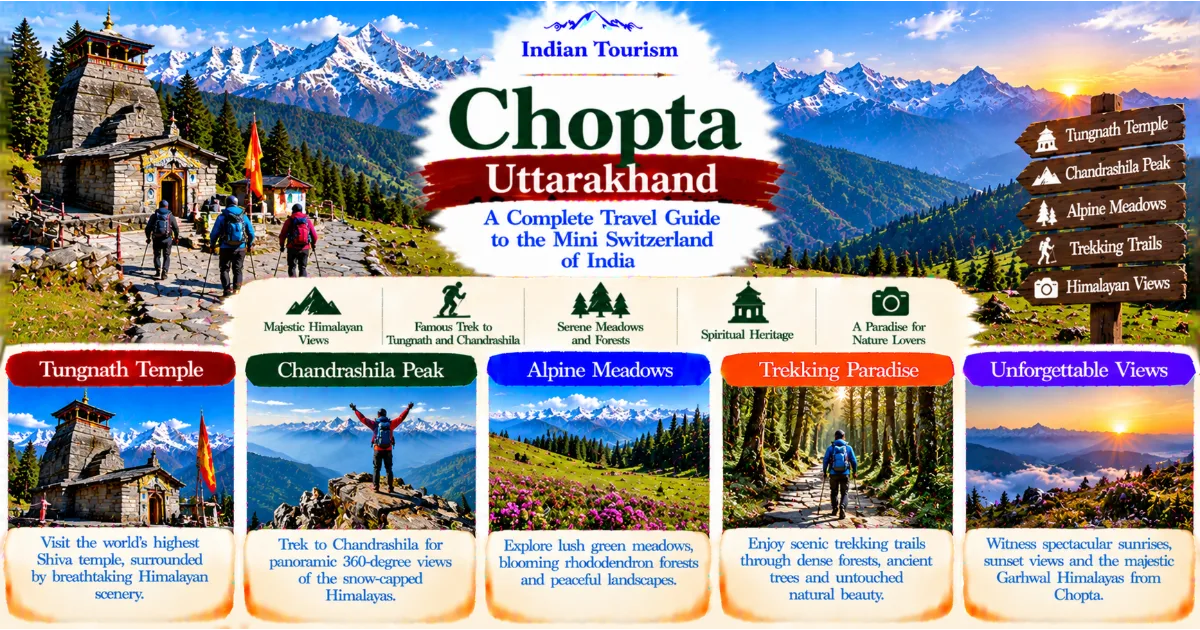
Introduction to Chopta, the Hidden Gem of the Garhwal Himalayas
Nestled in the Garhwal Himalayas of Uttarakhand, Chopta is a beautiful mountain destination known for its green alpine meadows, dense forests, spectacular Himalayan views, peaceful surroundings, and access to two of the region's most memorable trekking destinations, Tungnath Temple and Chandrashila Peak. Far removed from the noise and rush of large cities, Chopta offers an opportunity to experience the mountains at a slower pace, where the changing weather, fresh mountain air, forest trails, and distant snow-covered peaks become central to the journey. It is an appealing destination for nature lovers, trekkers, photographers, couples, families, and travellers who want to explore a quieter side of Uttarakhand.
Chopta is often called the Mini Switzerland of India because of its rolling meadows, forested slopes, and impressive mountain scenery. Although this nickname captures the visual charm of the region, Chopta has its own distinct identity shaped by the landscape, wildlife, Garhwali culture, and religious traditions of the Himalayas. The experience here is not about finding a European landscape in India. It is about discovering the natural beauty and cultural character of a Himalayan region that changes dramatically with the seasons.
One of the biggest reasons travellers visit Chopta is its connection with Tungnath Temple, widely recognised as the highest Shiva temple in the world. The temple lies along a trekking route that continues towards Chandrashila Peak, a celebrated viewpoint offering expansive views of the surrounding mountains on clear days. These attractions make Chopta especially popular among people who enjoy combining natural scenery with spiritual experiences and outdoor adventure.
However, Chopta is much more than a starting point for a trek. The surrounding forests, meadows, village landscapes, and quiet mountain roads offer opportunities to appreciate the Garhwal Himalayas without rushing from one attraction to another. A well-planned visit allows travellers to experience the destination according to their interests, whether that means undertaking a challenging walk, enjoying scenic photography, learning about local traditions, or simply spending time surrounded by nature.
Understanding the seasons is important when planning a journey to Chopta. Summer brings relatively pleasant conditions and green landscapes, while winter can transform the area into a snowy mountain destination. The monsoon creates lush surroundings but can also make roads and trails difficult to access. Travellers who prepare for these changing conditions can enjoy Chopta more comfortably and responsibly.
Where Is Chopta Located?
Chopta is located in the Rudraprayag district of Uttarakhand, within the Garhwal Himalayan region. It lies along a mountain route connecting important destinations in the wider region, including Ukhimath and the areas around Tungnath. The settlement and surrounding meadows are situated at a high elevation, giving visitors access to mountain scenery, forested slopes, and views towards prominent Himalayan peaks.
The surrounding landscape includes oak and rhododendron forests, grassy clearings, winding mountain roads, and slopes that become increasingly dramatic as the terrain rises. During favourable weather, the region provides impressive views of the Himalayan ranges. Snowfall can cover parts of the landscape during winter, while spring and summer bring fresh vegetation and flowering plants to suitable areas.
Chopta is relatively remote compared with major tourist towns. It does not have the extensive shopping, entertainment, or transport infrastructure found in larger destinations. This is part of its appeal for travellers seeking a quieter mountain experience, but it also means that visitors should plan accommodation, meals, transportation, and emergency arrangements carefully.
Ukhimath and other settlements along the approach route can serve as useful reference points when organising a trip. The exact route and travel time depend on the starting location, road conditions, weather, and the chosen mode of transport. Mountain journeys can take longer than expected because roads are winding and vulnerable to disruption.
Before departing, travellers should confirm the condition of the road to Chopta, the availability of accommodation, and the latest information about trekking routes. These checks are particularly important during winter snowfall and the monsoon season.
Why Chopta Deserves a Place on Your Travel List
Chopta offers a combination of landscapes and experiences that makes it different from many conventional hill stations. Instead of relying primarily on markets, shopping streets, or commercial attractions, the destination draws visitors through its meadows, mountain views, forest trails, and access to significant Himalayan trekking routes.
For trekkers, the route towards Tungnath Temple and Chandrashila Peak is the principal attraction. The journey combines gradual changes in elevation with open mountain scenery, religious heritage, and panoramic viewpoints. The difficulty of the walk depends on the weather, trail conditions, altitude, and the traveller's fitness. During winter, snow and ice can make sections considerably more demanding than they appear in photographs.
For nature lovers, Chopta provides opportunities to observe the changing character of Himalayan forests and meadows. Oak and rhododendron forests create a rich natural environment, while open slopes offer broad views of the surrounding mountains. Birdwatchers may also find the region rewarding, although sightings depend on season, habitat, weather, and patience.
Photographers can explore different subjects throughout the day. Morning light may reveal the mountain peaks, while mist and clouds can create dramatic conditions across the forested slopes. During spring, flowering vegetation adds colour to the landscape. In winter, snow creates a contrasting white environment that changes the appearance of the trails and meadows.
Chopta is also attractive for couples and families who prefer peaceful surroundings. A visit does not have to involve a difficult trek. Travellers can enjoy the scenery from accessible areas, take short walks where conditions permit, and spend time learning about the culture and natural environment of the region.
The destination's religious significance adds another dimension. Tungnath is associated with Hindu traditions and the Panch Kedar pilgrimage circuit. Visiting the temple can be a meaningful experience for pilgrims, while others may appreciate its architecture, setting, and place within the spiritual landscape of Uttarakhand.
The Best Time to Visit Chopta
The best time to visit Chopta depends on whether your priority is trekking, green meadows, mountain photography, pilgrimage, or snow. Each season has a different character, and the conditions can vary from one year to another. Travellers should always check current weather forecasts, road conditions, and local guidance before beginning their journey.
Spring: March to April
Spring is an appealing period for visitors who want to experience the transition from winter to warmer weather. Snow may remain along higher sections of the route, while lower areas begin to reveal vegetation and forest colours. Rhododendron flowering can add vivid shades of red and pink to suitable forest areas, making the season particularly interesting for nature lovers and photographers.
The appearance of the landscape depends on the preceding winter and local temperatures. Some years retain substantial snow at higher elevations, while other years experience an earlier transition. Travellers should therefore avoid assuming that every trail will be snow-free or that all trekking routes will be accessible.
Spring is a good period for those interested in visiting Tungnath when the temple is open and conditions permit. However, temple opening dates are seasonal and should be verified before planning the trip around a particular religious occasion.
Visitors should carry layers of clothing because daytime temperatures may feel comfortable while mornings and evenings remain cold. Sturdy footwear is useful, especially if the trail contains mud, snow, or wet sections.
Summer: May to June
Summer is a popular season for visiting Chopta because the weather is often more suitable for outdoor exploration than during the coldest winter months. The meadows become greener, the forests provide shade, and the trekking route towards Tungnath attracts pilgrims and outdoor enthusiasts.
This season is particularly suitable for travellers who want to combine sightseeing with a trek. The longer daylight hours can make planning easier, but visitors should still begin walks early enough to avoid rushing back in the evening.
May and June can also be busy because of school holidays and pilgrimage travel. Accommodation may become limited during popular periods, so booking ahead is advisable. Travellers should confirm whether their chosen property provides meals, heating when needed, and reliable transport arrangements.
Although summer is generally attractive for mountain travel, weather can still change quickly. Clouds may obscure the peaks, and rain can affect the condition of the trail. Carrying drinking water, sun protection, a light rain jacket, and warm clothing is sensible even when the forecast appears favourable.
Monsoon: July to September
The monsoon season brings rainfall to the Garhwal Himalayas, encouraging vegetation growth and creating a lush appearance across forests and meadows. For photographers, the landscape can be beautiful when mist moves through the hills and clouds gather around the mountain slopes.
However, this period also brings significant travel challenges. Heavy rainfall can cause landslides, falling rocks, road blockages, and unstable trail conditions. Visibility may deteriorate, and journeys can take longer than expected. These risks are particularly important in a mountainous region where alternative roads and emergency services may be limited.
Travellers with fixed schedules or little experience of mountain conditions should think carefully before choosing the monsoon season. Anyone planning a visit should check official weather advisories and road information before leaving and remain willing to change plans.
Trekking during heavy rain, thunderstorms, or poor visibility should be avoided. Slippery stones, muddy paths, and reduced visibility can turn an otherwise manageable walk into a dangerous one. If local authorities or guides advise against a route, their guidance should take priority over a planned itinerary.
Autumn: October to November
Autumn can be rewarding for travellers who want to enjoy mountain views and outdoor exploration after the main monsoon period. When skies are clear, the surrounding peaks can appear especially striking, and the forests and meadows offer opportunities for photography.
Temperatures gradually become colder as winter approaches. Visitors should carry warm layers and prepare for chilly mornings and evenings, especially if staying at a high elevation.
Autumn is suitable for people interested in trekking, photography, and quieter mountain experiences. However, access to Tungnath Temple is seasonal, and visitors must confirm the temple's opening dates before making religious visits a central part of the trip.
Snowfall is possible as winter approaches, but it should not be treated as guaranteed. Travellers who specifically want a snowy landscape should check recent local conditions and understand that the timing and amount of snowfall vary from year to year.
Winter: December to February
Winter transforms Chopta into a dramatically different destination. Snow can cover the meadows, forest paths, and surrounding slopes, creating an atmosphere that attracts travellers seeking winter scenery and snow photography.
This season requires the greatest attention to safety and preparation. Roads may become difficult or temporarily inaccessible, and trekking routes can be covered with snow and ice. The walk towards Tungnath and Chandrashila may be significantly more demanding than it is during favourable summer conditions.
Visitors should check road access before departure and confirm whether accommodation and transport services are operating. Appropriate winter clothing, waterproof footwear, gloves, and warm layers are essential. Travellers should avoid attempting high-altitude routes without suitable experience, equipment, and current local guidance.
The Tungnath Temple route is affected by seasonal conditions and temple closure arrangements. Visitors should not assume that the temple will be open during winter. Anyone planning a winter trek should confirm trail accessibility and seek advice from experienced local guides.
Winter is best suited to travellers who are flexible, prepared for cold conditions, and willing to change their plans when weather makes an activity unsafe.
Tungnath Temple: A Sacred Himalayan Destination
Tungnath Temple is one of the most important attractions associated with Chopta. Located at a high elevation in the Garhwal Himalayas, it is widely recognised as the highest Shiva temple in the world. Its stone architecture, mountain setting, and religious significance make it a memorable destination for pilgrims and travellers interested in Himalayan heritage.
The temple forms part of the Panch Kedar tradition, which connects five important Shiva temples in Uttarakhand. These sites hold a special place in regional religious life and attract pilgrims who travel through the mountains to visit them.
The walk from the Chopta area towards Tungnath is an important part of the experience. The route gradually climbs through mountain scenery, offering views of surrounding slopes and distant peaks when visibility is favourable. The trail is well known, but its difficulty should not be underestimated. The high elevation, uphill gradient, weather, and surface conditions can make the walk tiring, especially for visitors who are not accustomed to mountain trekking.
Pilgrims should confirm the temple's opening and closing dates before travelling. The temple is generally open during a defined pilgrimage season, while winter conditions lead to seasonal closure and associated religious arrangements. The exact dates vary and should be checked for the year of the visit.
Visitors should approach the temple with respect for local customs and religious practices. Follow instructions regarding footwear, photography, entry, and behaviour within the temple area. Those visiting primarily for the scenery can still appreciate the site while respecting its spiritual importance.
A visit to Tungnath can be deeply rewarding because it combines physical effort, natural beauty, and cultural heritage. Rather than treating the temple as a quick stop for photographs, travellers can allow time to appreciate its setting and the role it plays in the religious traditions of Uttarakhand.
Chandrashila Peak: A Trek Towards Panoramic Himalayan Views
Chandrashila Peak is another major attraction near Chopta. The name is commonly associated with the summit above Tungnath, from which trekkers can experience expansive views of the surrounding Himalayan landscape when the weather is clear.
The trek is popular among people who want a more adventurous experience than a simple sightseeing trip. The route generally continues beyond Tungnath and involves additional climbing. At high elevation, the combination of steep sections, thin air, and changing weather can make the final stretch physically demanding.
The summit is known for its broad mountain panorama. On clear days, visitors may see an impressive range of Himalayan peaks, although the exact visibility depends on weather, clouds, and atmospheric conditions. Sunrise visits are especially popular among trekkers seeking early light across the mountains.
However, a summit trek requires more planning than an ordinary walk. Starting times, daylight, trail conditions, physical fitness, and weather forecasts should all be considered. During winter, snow and ice can make the route difficult and may require specialist equipment or make the trek unsuitable altogether.
Travellers should not attempt the summit simply because other visitors have done so. The correct decision depends on current conditions and individual ability. If visibility deteriorates, the trail becomes unsafe, or a guide recommends turning back, it is better to abandon the summit attempt than to continue at unnecessary risk.
For those who are adequately prepared and visit under favourable conditions, Chandrashila can provide one of the most memorable mountain experiences in Uttarakhand.
Explore Chopta's Meadows and Forests
Beyond the famous trekking route, Chopta is known for its natural landscape of open meadows, forested slopes, and mountain views. These areas provide opportunities for travellers to appreciate the region without necessarily undertaking a strenuous hike.
During spring and summer, the landscape may become greener as vegetation develops across the slopes. Rhododendron and other flowering plants can add colour to the forests, while the meadows provide open views of the surrounding mountains. In winter, snow can change the character of the same landscape completely.
Gentle walks around accessible areas can be enjoyable for families, couples, and photographers. Visitors should nevertheless pay attention to the terrain. A meadow may look flat from a distance but contain uneven ground, hidden drainage channels, wet patches, or steep edges.
Staying on established paths helps reduce damage to fragile vegetation. It also lowers the risk of becoming disoriented in unfamiliar terrain, especially when mist or cloud reduces visibility.
Travellers should avoid disturbing wildlife or collecting plants and flowers. The natural environment is an important part of Chopta's identity, and responsible behaviour helps preserve it for future visitors.
Birdwatching and Wildlife Around Chopta
The forests and surrounding habitats around Chopta form part of a rich Himalayan ecological landscape. Visitors interested in nature may enjoy looking for birds and observing changes in vegetation as elevation and season vary.
Birdwatching is best approached patiently. Early mornings can be rewarding because bird activity is often noticeable before the day becomes busy. Binoculars, a camera with a suitable lens, and a field guide can help visitors identify species without disturbing them.
Wildlife sightings are never guaranteed. Travellers should not assume that particular animals will appear during a short visit, and they should never attempt to attract wildlife with food. Feeding animals can change their behaviour and create risks for both visitors and wildlife.
Keep a respectful distance from animals and follow guidance from local forest authorities. Do not enter restricted areas or wander off established routes in search of sightings. The purpose of wildlife observation should be to appreciate the natural environment rather than to obtain a close photograph at any cost.
Visitors should also take care with rubbish. Food packaging, plastic bottles, and other waste can harm animals and degrade the habitat. Carry waste back to appropriate disposal points and avoid leaving anything behind in the forest.
Nearby Attractions to Include in Your Trip
Ukhimath
Ukhimath is an important town in the Rudraprayag district and can serve as a useful stop on a journey to Chopta. It has religious significance and is associated with the winter worship arrangements for the deity of Kedarnath when the main temple is closed for the season.
The town offers an opportunity to learn about the religious traditions of the Garhwal Himalayas and to experience a settlement that plays a role in the wider pilgrimage network. Visitors can explore its cultural atmosphere while arranging onward travel according to their itinerary.
Ukhimath may also provide practical access to accommodation and transport connections. As with other mountain towns, the availability of services varies, so travellers should confirm arrangements before arrival.
Deoria Tal
Deoria Tal is a beautiful high-altitude lake in the wider region, known for its mountain surroundings and reflections on clear days. The lake is frequently included in travel plans by visitors who want to combine a Chopta trip with another nature-oriented excursion.
The approach generally involves travelling towards the Sari village area and continuing on foot along the established route. Walking time depends on pace, weather, and trail conditions. Visitors should check the current access arrangements and local guidance before setting out.
The lake is particularly attractive to photographers because the water can reflect the surrounding mountain landscape when conditions are calm. Clouds, wind, and changing light can alter the scene quickly, so patience is useful.
Visitors should respect local rules about camping, fires, waste disposal, and overnight stays. Because the lake lies in a sensitive mountain environment, protecting its surroundings is essential.
Rudraprayag
Rudraprayag is an important town associated with the confluence of the Alaknanda and Mandakini rivers. It has religious significance and serves as a regional connection point for travellers exploring parts of Uttarakhand.
The town can be included in a longer road journey depending on the chosen route. Travellers interested in the cultural and geographical features of the Garhwal region may find it worthwhile to understand the importance of river confluences in local religious traditions.
As with other mountain destinations, visitors should exercise caution around rivers, particularly during periods of heavy rainfall or high water levels. Avoid approaching unstable banks or entering the water when conditions are unsafe.
Kedarnath Region
Some travellers consider combining Chopta with the Kedarnath pilgrimage region, but this requires a separate and carefully planned journey. Kedarnath is a major religious destination located in a high-altitude Himalayan environment, and access follows seasonal arrangements.
It should not be treated as a simple nearby sightseeing stop. Travellers need to account for road transfers, the approach to the pilgrimage route, trekking requirements, accommodation availability, and official instructions. The physical demands and timing of the journey may require additional days.
Anyone planning to visit Kedarnath should verify the official opening dates and current travel conditions. It is better to allocate adequate time for the pilgrimage than to attempt an exhausting schedule that combines too many destinations.
How to Reach Chopta
By Air
The nearest commonly used airport for a journey to Chopta is Jolly Grant Airport near Dehradun. From there, travellers generally continue by road through the Garhwal region, using a route appropriate to their itinerary and current road conditions.
The road journey is substantial and passes through mountainous terrain. Visitors should avoid assuming that they can reach Chopta immediately after a flight, particularly if the flight arrives late in the day. Traffic, roadworks, landslides, and weather can affect travel times.
For a more comfortable journey, consider arranging a suitable vehicle in advance and allowing enough time for breaks or an overnight stop. Confirm the final road access to your accommodation before departing.
By Train
Haridwar and Rishikesh are commonly used railway gateways for travellers heading towards the Garhwal Himalayas. The most suitable station depends on the train schedule and the overall route.
From the railway station, travellers generally continue by road through the mountain region towards Chopta. Public transport may be available on portions of the journey, but connections and schedules can vary. A private taxi offers greater flexibility but may cost more.
If arriving by train, coordinate the onward transfer carefully. A late arrival can make it difficult to complete a long mountain drive comfortably on the same day.
By Road
Chopta is accessible through the regional road network serving destinations such as Rudraprayag, Ukhimath, and nearby mountain settlements. The precise route depends on the point of departure and current road conditions.
Mountain roads can be winding and narrow, with travel times affected by traffic, weather, roadworks, and temporary closures. Drivers should be experienced in mountain driving, particularly during winter and the monsoon season.
Avoid unnecessary night driving on unfamiliar routes. Check the weather and road situation before setting out, carry essential supplies, and allow extra time in case of delays.
Public transport may serve some sections of the route, but travellers should confirm the availability of onward connections to Chopta. Depending on the season, local taxis may be necessary for the final stretch.
Where to Stay in Chopta
Accommodation around Chopta ranges from simple guesthouses and lodges to camps and other seasonal stays, depending on local operating conditions. Some travellers prefer staying close to the trekking route, while others choose accommodation in nearby settlements for greater access to services.
The best option depends on budget, comfort requirements, transport arrangements, and the season. Visitors should check whether the property has reliable heating, clean bedding, suitable bathrooms, meal arrangements, and convenient access to the road or trekking starting point.
During popular trekking and pilgrimage periods, accommodation can become limited. Advance booking is advisable, particularly for weekends and holiday periods. Travellers should confirm the reservation directly and ask about cancellation policies in case weather or road closures affect the trip.
In winter, do not assume that every accommodation provider will remain open or that every road will be accessible. Confirm operating dates and arrival arrangements before departure.
Travellers should also be realistic about services in a remote mountain destination. The range of restaurants, shops, medical facilities, and transport options may be smaller than in major towns. Planning ahead helps avoid unnecessary inconvenience.
What to Eat in Chopta
Food around Chopta reflects the practical needs and traditions of the Himalayan region. Depending on the establishment, visitors may find simple Indian meals, lentils, rice, vegetables, chapatis, soups, and warming drinks that are especially welcome after spending time outdoors.
Travellers interested in regional cuisine can ask local hosts about Garhwali dishes. Traditional preparations associated with Uttarakhand include chainsoo, phaanu, kafuli, and foods made using mandua, also known as finger millet. Availability varies, so it is worth asking what is freshly prepared rather than expecting every dish to appear on every menu.
Warm meals and drinks can be particularly comforting during cold weather. Visitors should carry suitable snacks for longer walks, but food packaging should always be taken back for proper disposal.
If you have food allergies or dietary restrictions, explain them clearly when arranging meals. In smaller mountain settlements, it may be helpful to discuss requirements with the accommodation provider in advance.
Supporting local eateries and food providers can help distribute tourism income within the region. Treating local hosts respectfully and appreciating regional traditions can make the experience more meaningful.
Chopta for Couples and Honeymoon Travellers
Chopta can be an appealing destination for couples who enjoy peaceful surroundings, mountain scenery, and outdoor experiences. Its meadows, forest trails, and Himalayan views offer a different atmosphere from busy commercial hill stations.
Couples can plan a relaxed holiday around scenic walks, photography, local meals, and time spent enjoying the mountain landscape. Those interested in trekking may include Tungnath Temple and Chandrashila Peak when the routes are accessible and their fitness is suitable.
The most enjoyable itinerary is not necessarily the one that includes the greatest number of attractions. Watching morning light across the mountains, taking a gentle walk through an accessible area, or enjoying a quiet evening can be just as memorable as completing a long trek.
Accommodation should be selected according to comfort, weather, and access. A remote property may offer excellent scenery but limited nearby services, while a more accessible location can make travel easier.
Couples should also remember that Chopta is a mountain destination where weather can change quickly. Build flexibility into the schedule and avoid planning an important onward journey immediately after a demanding trek.
Chopta for Families
Families can enjoy Chopta through nature walks, mountain views, photography, and visits to accessible attractions. The destination can introduce children to Himalayan landscapes and provide opportunities to learn about forests, wildlife, and regional culture.
Parents should consider the altitude, travel time, weather, and physical demands of planned activities. A relaxed itinerary is generally preferable to a schedule that requires long walks and frequent transfers.
The trek to Tungnath and the further climb towards Chandrashila may be challenging for younger children or travellers who are not accustomed to uphill walking. Families should assess current conditions and individual fitness rather than assuming that the route is suitable for everyone.
In winter, snow and ice create additional risks. Keep children away from steep slopes, slippery road edges, and unguarded areas. Appropriate clothing and footwear are essential.
Families should also confirm accommodation facilities, meal availability, and access to basic medical assistance. Carry necessary personal medicines and keep emergency contact information available.
A Suggested Itinerary for Chopta
Two-Day Trip
A two-day trip can provide an introduction to Chopta, although travellers should account for the time required to reach the region. On the first day, travel to the destination, settle into the accommodation, and explore nearby accessible areas if daylight and weather permit.
Spend the evening resting and preparing for the following day. Check the forecast, ask about current trail conditions, and organise food, water, clothing, and transport as needed.
On the second day, consider trekking towards Tungnath if the temple is open and the trail is suitable. More experienced and adequately prepared trekkers may consider continuing towards Chandrashila, but only when weather, fitness, and trail conditions permit. If the route is unsafe or time is limited, enjoy the accessible surroundings instead.
Allow sufficient time to return safely. A two-day itinerary can feel rushed if the journey from your home city is long, so consider adding another day where possible.
Three-Day Trip
A three-day itinerary provides more flexibility. On the first day, travel to Chopta and settle into the accommodation. Use any remaining daylight for gentle exploration rather than attempting a demanding walk after a long drive.
On the second day, devote time to Tungnath Temple and, if conditions permit, Chandrashila Peak. Start early, carry sufficient water and suitable clothing, and be prepared to turn back if the weather deteriorates.
On the third day, explore accessible meadows or travel towards a nearby attraction such as Deoria Tal, provided the route and timing are practical. Alternatively, use the day to return at a comfortable pace.
This approach balances trekking with relaxation and reduces the pressure to complete every activity in a limited period.
Four to Five-Day Trip
Travellers with more time can explore a wider section of the Garhwal region. Chopta can be combined with places such as Ukhimath, Deoria Tal, or Rudraprayag, depending on the chosen route and current conditions.
A longer itinerary is particularly useful for photographers and nature enthusiasts who want time for changing weather, early morning views, and quieter walks. It also provides flexibility if a trail or road becomes temporarily inaccessible.
Do not combine too many distant destinations simply because they appear close on a map. Mountain roads and trekking routes require realistic time allowances, and some places have seasonal access restrictions.
Estimated Budget for a Chopta Trip
The total cost of a Chopta holiday depends on the departure city, travel season, accommodation category, transport method, meal arrangements, and activities. A traveller using public transport and simple accommodation may spend considerably less than someone hiring a private vehicle and choosing premium lodging.
A practical budget should include transport, accommodation, meals, local transfers, possible guide services, personal equipment, and emergency expenses. During busy periods, accommodation and private transport may cost more, particularly when demand is high.
Obtain current quotations before departure rather than relying on old price estimates. If you intend to trek with a guide or arrange winter equipment, confirm the cost and what is included.
Keep some financial flexibility for an additional night or an unexpected transfer. Road closures and weather-related delays can increase expenses, so a small reserve can make the trip less stressful.
Essential Travel Tips for Chopta
Prepare for Changing Weather
Mountain weather can change quickly. Carry layers, warm clothing, and rain protection even when the forecast looks favourable. During winter, use suitable insulated clothing and footwear designed for cold and slippery conditions.
Check the forecast before trekking and ask local accommodation providers or guides about the current state of the route. If conditions deteriorate, postpone the walk rather than taking unnecessary risks.
Respect Altitude and Physical Limits
Chopta and the surrounding trekking routes are situated in a high-altitude environment. Visitors may experience fatigue or discomfort when walking uphill, particularly if they have travelled directly from lower elevations.
Walk at a comfortable pace, take breaks, and avoid pushing beyond your ability. Anyone experiencing severe breathlessness, confusion, difficulty walking, or other concerning symptoms should stop the activity and seek prompt medical assistance.
People with existing medical concerns should consider professional advice before attempting strenuous high-altitude activities.
Carry Essential Supplies
Carry drinking water, personal medicines, identification, a charged phone, a power bank, and some cash. Connectivity and digital payment facilities may vary across remote areas.
For trekking, wear suitable footwear and carry snacks, weather protection, and a small light source. Tell someone about your planned route and expected return time, especially if you intend to walk away from the main settlement.
Check Temple and Trail Access
Tungnath Temple has seasonal opening arrangements, and the trail towards Chandrashila can be affected by weather and snow. Confirm current information before travelling.
Do not assume that a route is safe simply because it appears in a travel photograph or an older itinerary. Follow local instructions and avoid restricted areas.
Travel Responsibly
Chopta's appeal depends on its forests, meadows, wildlife, and mountain scenery. Avoid littering, damaging vegetation, disturbing animals, or leaving food waste along trails.
Use established paths and follow local guidance on camping and fires. Support local businesses where possible, respect residents, and ask permission before photographing people.
Responsible travel protects the landscape while helping ensure that tourism benefits the communities that make the region their home.
Responsible Tourism and the Future of Chopta
Tourism can provide important income for mountain communities through accommodation, food services, transport, guiding, and local products. At the same time, growing visitor numbers can place pressure on roads, waste management, water resources, forests, and fragile meadows.
Travellers can help reduce these pressures through thoughtful choices. Staying in locally operated accommodation, using authorised guides, avoiding unnecessary disposable packaging, and disposing of rubbish properly can make a meaningful difference.
Water and energy conservation are particularly important in remote mountain areas. Visitors should use resources carefully and understand that services may be more limited than in large towns.
Respecting wildlife is another essential part of responsible tourism. Do not feed animals, disturb birds, collect wild plants, or leave marked routes in search of photographs. The natural environment should be appreciated without being damaged.
Seasonal changes and variable snowfall also influence the experience of Chopta. Travellers should remain flexible and appreciate the destination beyond the presence or absence of snow. Its cultural traditions, forests, meadows, and Himalayan scenery offer value throughout the year, although the activities available change with conditions.
Is Chopta Worth Visiting?
Chopta is worth visiting for travellers who want to experience the natural beauty of the Garhwal Himalayas and enjoy a destination where forests, meadows, mountain views, and trekking routes shape the journey. Its connection with Tungnath Temple and Chandrashila Peak gives it a distinctive place among Uttarakhand's mountain destinations.
The region offers different experiences across the seasons. Spring and summer can be attractive for trekking and green landscapes, autumn may provide clear mountain views, and winter can bring snow-covered scenery when conditions allow. The monsoon, however, requires additional caution because heavy rainfall can affect roads and trails.
The most rewarding visit is one that matches the traveller's interests and physical ability. Some visitors will enjoy the challenge of a summit trek, while others may prefer gentle walks, photography, cultural exploration, or simply appreciating the mountain landscape.
Planning ahead is essential. Confirm accommodation, road access, weather conditions, temple opening dates, and trekking arrangements before departure. Allow enough time for mountain travel and remain prepared to change plans when conditions require it.
Chopta is more than a gateway to a famous temple or summit. It is a place where the landscape, local culture, religious heritage, and quiet atmosphere come together to offer a memorable Himalayan experience. For travellers seeking a natural escape in Uttarakhand, it deserves a place on the itinerary.
Hashtags: #IndianTourism #Chopta #ChoptaUttarakhand #UttarakhandTourism #ExploreUttarakhand #TungnathTemple #ChandrashilaPeak #GarhwalHimalayas #HimalayanTrekking #MountainTravel #NatureTravel #IndiaTravel #HimalayanViews #ResponsibleTourism
