
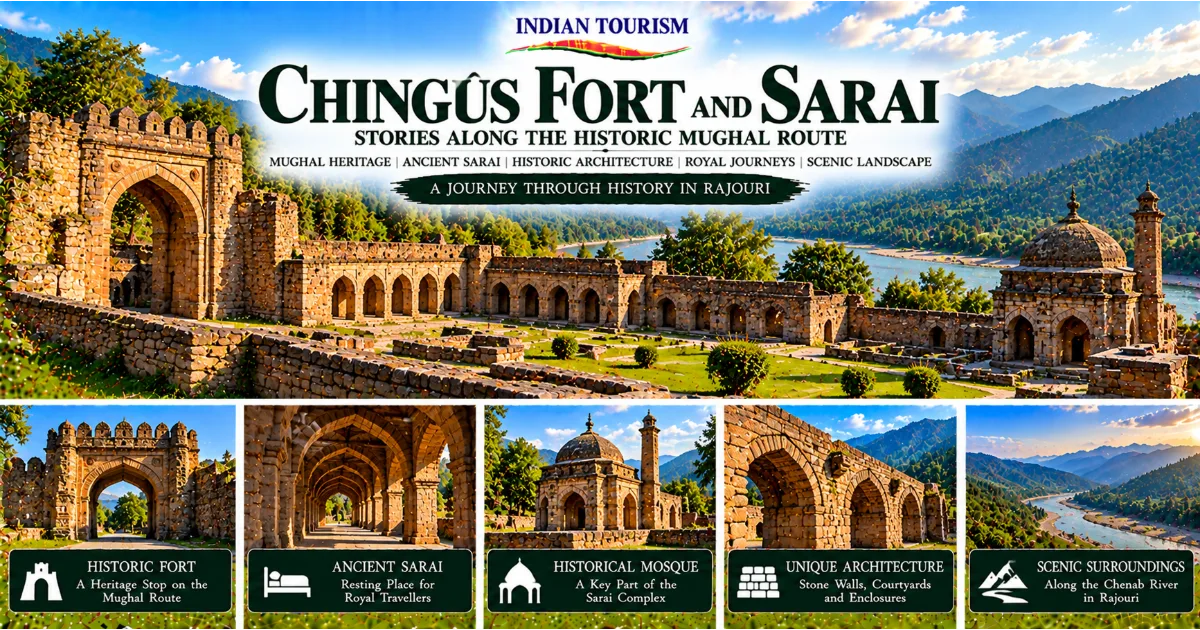
Where History Meets the Road to Kashmir
The mountains of Jammu and Kashmir have witnessed the movement of emperors, merchants, soldiers, pilgrims, pastoral communities, and ordinary travellers for centuries. Long before modern highways connected the region, journeys between the plains and the Kashmir Valley depended on mountain passes, river valleys, established settlements, and carefully chosen resting places. Among the most fascinating reminders of this historical movement is Chingus Fort and Sarai, a heritage complex in the Rajouri region of Jammu and Kashmir.
Located along the historic Mughal travel corridor, Chingus Sarai is an important example of the infrastructure that supported long-distance journeys through the Pir Panjal mountains. Its enclosed courtyards, fortified walls, gateways, residential cells, mosque, and associated structures reveal how a roadside establishment could serve several purposes at once. It was not simply a place where travellers slept. It formed part of a wider system that provided shelter, organisation, security, and accommodation along a demanding route.
Chingus is especially well known for its association with Mughal Emperor Jahangir and Empress Nur Jahan. Local tradition connects the site with the story of Jahangir's death during a journey and the burial of his internal organs at the sarai before his body was transported onwards. The account has become an important part of the monument's popular identity, although it should be understood as a historical tradition rather than an independently established fact in every detail.
For visitors interested in architecture, Mughal history, heritage conservation, and the old routes of Jammu and Kashmir, Chingus offers a distinctive experience. It reveals how travel was organised before modern transport transformed the region, while its surviving buildings preserve a sense of the scale and complexity of imperial movement.
The monument also tells a broader story about the relationship between history and infrastructure. Roads are often remembered through the destinations they connect, but their success depended on the resting places, supplies, settlements, and local communities that made journeys possible. Chingus Sarai provides a valuable opportunity to explore this less familiar side of the region's past.
Where Is Chingus Fort and Sarai Located?
Chingus Sarai is situated in the Rajouri region of Jammu and Kashmir, along the modern road corridor associated with the Mughal Road. The monument stands near the Sukh Tao River, whose surrounding landscape adds to the site's character.
The location is historically significant because it occupies part of the wider route that connected the Punjab plains and other southern regions with the Kashmir Valley. Travellers crossing the Pir Panjal mountains needed places where they could stop, rest, obtain supplies, and prepare for the next stage of their journey. Chingus developed importance within this network of travel facilities.
The surrounding terrain helps explain the practical value of the site. Mountain travel was difficult for much of history, particularly when roads were narrow, weather conditions changed rapidly, and journeys involved pack animals or large travelling parties. A reliable stopping place could make a major difference to the organisation of a long journey.
Today, visitors can approach Chingus by road, making it possible to include the monument in a wider exploration of Rajouri and the historic travel corridor. The journey also provides opportunities to observe the landscape that shaped the movement of people through this part of Jammu and Kashmir.
However, the present road system should not be treated as an exact reproduction of the historic imperial route. The modern Mughal Road incorporates contemporary engineering and road alignments, while the older route followed terrain and stopping points according to the needs and limitations of its time. Research into the original route continues to be important for understanding the full historical landscape.
For travellers, the distinction adds depth to the visit. Chingus is not merely a monument beside a modern road. It is part of a much larger story about how people crossed the mountains and maintained connections between different regions.
What Was a Sarai in the Mughal Period?
The word sarai generally refers to a roadside inn or resting establishment where travellers could stay during a journey. Across historical South Asia, sarais played an important role in the movement of people and goods. They provided accommodation and a degree of organisation for journeys that could take many days or weeks.
A sarai might contain rooms or cells arranged around an enclosed courtyard. Depending on its scale and purpose, it could also include a mosque, water facilities, storage areas, spaces for animals, service rooms, and accommodation for people associated with the travelling party.
These establishments were particularly important along routes used by rulers, officials, merchants, pilgrims, and other travellers. A long-distance journey required more than a passable road. Travellers needed shelter, food, water, places for animals, and opportunities to rest before continuing.
The organisation of a sarai could also provide a measure of security. An enclosed compound with controlled entrances made it easier to manage access and separate different activities. Such arrangements were especially valuable when a large group travelled together with attendants, animals, supplies, and equipment.
Chingus Sarai is a particularly interesting example because its layout extends beyond a simple courtyard surrounded by rooms. Research on the monument describes multiple connected enclosures, including accommodation areas, a central courtyard, service spaces, a mosque, an associated tomb, and a garden area. This arrangement suggests a complex designed to support several functions rather than one basic purpose.
The exact use of every room cannot always be established with certainty, but the overall plan reveals how architecture helped organise movement and daily life. Visitors who examine the complex carefully can begin to understand how a historical resting place operated as a small, structured environment within a larger travel network.
The Mughal Road and Its Historical Importance
The Mughal Road is associated with the historic route used by Mughal rulers and their travelling parties to reach Kashmir. During the Mughal period, Kashmir became an important destination for imperial visits, administration, and seasonal retreats. Travel between the plains and the valley required a carefully managed journey through mountainous terrain.
The route linked settlements and resting places across what are now parts of Punjab, Jammu, and Kashmir. It crossed difficult landscapes and depended on the availability of suitable stopping points. Sarais along the way helped break a long journey into manageable stages.
The Rajouri region formed part of this wider network. The official history of Rajouri describes the importance of settlements and resting stations along the route, noting that Mughal rulers travelling between Delhi and Kashmir used the region as a place to halt. It also records the construction of forts, sarais, mosques, and other structures associated with the historic corridor.
The route was not used only by emperors. Local inhabitants, traders, officials, and other travellers also depended on mountain corridors for movement and exchange. The road therefore had a broader regional importance, even though imperial journeys are often the most visible part of its popular history.
It is also important to distinguish the historical Mughal route from the modern road that carries the same name. Parts of the present road overlap with older corridors, but the modern alignment was shaped by contemporary engineering decisions. The historic route followed river valleys and terrain that could offer practical advantages for travel, while modern roads may cross higher ground or bypass earlier stopping points.
This distinction matters because historic roads are cultural landscapes, not simply lines connecting two destinations. Their meaning lies in the relationships between the route, its resting places, the surrounding settlements, and the communities that used it.
Chingus Sarai provides a tangible link to this history. Its walls and courtyards help visitors imagine the organisation required to support travel through the mountains before motor vehicles and modern transport facilities existed.
Chingus and the Mughal Royal Journey
Chingus is strongly associated with Mughal Emperor Jahangir, whose reign lasted from 1605 to 1627. Jahangir's journeys to Kashmir form an important part of the historical background of the Mughal Road. Kashmir's climate, gardens, landscapes, and strategic importance made it a valued destination for the Mughal court.
Royal travel was a complex undertaking. The emperor did not travel alone. A royal entourage could include members of the household, officials, attendants, guards, cooks, medical personnel, and others responsible for maintaining the court while on the move. Animals and supplies also had to be transported, and arrangements were needed for accommodation at each stopping point.
The sarais along the route helped support this movement. Their design had to accommodate the practical needs of travellers while also reflecting the status and organisation of the imperial journey. Larger or more important establishments could contain special accommodation for prominent members of the travelling party, alongside rooms for attendants and other visitors.
Chingus's association with Jahangir has made it one of the best-known heritage stops along this corridor. Local accounts describe the sarai as a place connected with a dramatic episode during the emperor's return journey from Kashmir.
The story has helped give the monument a distinctive identity, but it should not overshadow the broader significance of the building. Even without the famous tale, Chingus would remain important as an example of historic travel architecture and as part of the wider system of routes linking Kashmir with the south.
For visitors, understanding the practical demands of a royal journey makes the monument easier to appreciate. Its multiple enclosures, accommodation spaces, and fortified boundaries were part of a larger system intended to manage people, animals, supplies, and movement.
The Legend of Jahangir's Entrails
One of the most widely repeated stories associated with Chingus Sarai concerns the death of Emperor Jahangir. According to local tradition, Jahangir became seriously ill and died while travelling in the region. His internal organs were reportedly removed and buried at the sarai, while his embalmed body was transported onwards towards Lahore.
The story is linked to the name Chingus, which is commonly explained through a Persian word associated with intestines. In popular accounts, the burial of the emperor's internal organs gave the place its name and created a lasting connection between the monument and the royal journey.
Some versions of the story suggest that the burial was intended to delay the announcement of Jahangir's death until the royal party reached Lahore. These accounts often connect the episode with Empress Nur Jahan and the political uncertainty that could follow the death of a Mughal emperor.
The tale is memorable because it combines imperial history, travel, illness, secrecy, and political concerns. It has become a defining part of the way many people understand Chingus.
However, the story should be approached with historical caution. Popular tradition, oral history, and established documentary evidence are not always the same thing. The association of the sarai with Jahangir's internal organs is an important local narrative, but visitors should not treat every detail of the story as conclusively verified.
The value of the tradition lies partly in how it has shaped the monument's identity. Across India, historic buildings often become associated with stories that are passed down through generations. These stories can preserve community memory and give a place a distinctive cultural meaning, even when some details remain uncertain.
At Chingus, the legend invites visitors to consider how imperial journeys were remembered and how a historical building can become connected with an event that captures the imagination.
Empress Nur Jahan and the Mughal Court
Nur Jahan was one of the most influential women in Mughal history. Born Mehr-un-Nissa, she married Jahangir in 1611 and became an important figure in the political, cultural, and artistic life of the imperial court.
Her historical significance extends far beyond the popular stories associated with Chingus. She exercised considerable influence in court affairs, participated in decisions of state, and was associated with architectural patronage, artistic production, and the management of imperial interests.
The stories surrounding Chingus often portray Nur Jahan as the central figure responsible for the handling of Jahangir's death during the journey. These accounts form part of the local tradition connected with the sarai.
The historical relationship between Nur Jahan and the monument is therefore best approached through two perspectives. One is the wider documented importance of Nur Jahan within Mughal political history. The other is the local narrative that links her with a dramatic episode at Chingus.
Keeping these perspectives distinct allows visitors to appreciate the site's cultural identity without confusing a popular story with a fully established historical record.
The Mughal court was a complex political environment in which succession, authority, family relationships, and the movement of information could all have serious consequences. The death of an emperor was a significant event, and the transition to a new ruler could involve uncertainty and competition.
The Chingus story draws on these wider realities. Whether every element of the narrative occurred exactly as it is commonly told is a separate question from the fact that the story has become an enduring part of the site's public memory.
For visitors interested in Mughal history, Chingus offers a useful starting point for exploring the relationship between royal travel, court politics, and the historical imagination.
Exploring the Architecture of Chingus Sarai
The architecture of Chingus Sarai is one of the monument's most important features. Research on the complex describes a fortified enclosure built with a combination of brick and rubble masonry, using lime and brick-dust mortar traditionally known as lime surkhi.
The sarai is notable for its unusual arrangement of connected spaces. Rather than relying on one simple courtyard, the complex contains several enclosures that appear to have supported different activities. These include the main residential courtyard, areas associated with services and movement, and a garden enclosure.
The arrangement shows how the building responded to the practical demands of a major stopping place along an important route. Travellers needed accommodation, while animals and supplies required separate spaces. Officials or prominent guests could also require different arrangements from ordinary travellers.
Fortification Walls and Bastions
The complex is surrounded by substantial walls with defensive features, including corner bastions. Such structures helped define the boundary of the sarai and control movement into and out of the compound.
Fortified walls should not automatically be interpreted as evidence that the site functioned primarily as a military fort. In the context of a roadside establishment, walls could provide security, privacy, and a controlled environment for people staying overnight.
The bastions and gateways also gave the complex a strong architectural presence. Their scale helped communicate the importance of the establishment and distinguished it from a simple roadside shelter.
Gateways and Entrances
The gateways were essential to the organisation of the sarai. They controlled access between the outside road and the internal spaces, while the arrangement of different entrances helped separate areas with different functions.
A visitor entering the complex today can appreciate how movement through a building was shaped by architectural planning. Gateways were not merely openings in a wall. They formed part of the sequence through which people entered, moved, and reached their intended destination.
The layout also demonstrates how architecture could manage a large number of activities within a limited area.
Residential Cells and Courtyards
The sarai contains rows of cells arranged around enclosed spaces. These rooms provided accommodation for travellers and members of the travelling party. The repetitive design helped make the complex practical, while larger chambers could serve more prominent guests or specialised functions.
The courtyard formed an important shared space. It provided circulation and allowed access to the rooms surrounding it. In many historic sarais, courtyards also served as places for temporary gathering, the management of animals, and other daily activities.
The surviving structure allows visitors to see how repeated rooms and enclosed spaces created a functioning architectural system.
The Mosque Within the Sarai
A mosque forms part of the Chingus Sarai complex and remains a significant element of its architectural and religious character. Its presence reflects the role of religious facilities within historic travel establishments.
For travellers following a long route, a mosque provided a place for prayer within the compound. The integration of religious space into the wider sarai reflects the way accommodation, communal activity, and religious practice could coexist within a single complex.
The mosque's location within the courtyard also contributes to the overall organisation of the building. Its relationship with surrounding rooms and other structures demonstrates that the sarai was designed as a connected environment rather than a collection of unrelated buildings.
The presence of a mosque does not mean that every visitor historically used the site in the same way. The sarai served a variety of travellers and functions, and its religious space was one component of the wider establishment.
Today, the mosque also has significance for members of nearby communities who use it for prayer. This means the complex should be understood not only as an archaeological monument but also as a place with continuing local religious importance.
Visitors should behave respectfully around the mosque, follow any instructions regarding access, and avoid interrupting prayer or other religious activities. Appropriate clothing, quiet behaviour, and consideration for worshippers are important.
The continued use of a religious space within a historic monument creates a direct connection between past and present. It demonstrates that heritage sites are not always frozen in time. Some continue to serve communities while also preserving evidence of earlier architectural and historical traditions.
The Garden and Service Areas
The architectural layout of Chingus Sarai includes areas beyond the main courtyard. Research on the complex describes an additional enclosure associated with a garden and other spaces linked to service activities.
The presence of these areas is significant because it suggests that the sarai supported more than overnight accommodation. A major travelling party needed food, water, supplies, and arrangements for animals. The people responsible for these activities required space and access that could be managed separately from the main residential courtyard.
A garden enclosure may also have provided a more private or pleasant setting for certain visitors. Gardens were important elements of many Mughal architectural environments, where water, vegetation, shade, and carefully arranged spaces contributed to the experience of a place.
The surviving garden area at Chingus does not necessarily preserve its original appearance. Vegetation, changes in land use, and the passage of time can alter the character of an outdoor space. Reconstructing its historical form requires evidence from the physical remains and relevant historical accounts.
For visitors, the garden and service areas are reminders that a sarai was a small but complex environment. Its operation depended on the coordination of accommodation, movement, supplies, religious practice, and the needs of travellers.
The arrangement of these different spaces also demonstrates the practical intelligence behind historic architecture. Buildings were planned not only to look impressive but also to support the activities that took place within them.
Life Inside a Mughal Sarai
Imagining life inside Chingus Sarai helps bring the monument into focus. During a busy period, the compound may have accommodated travellers arriving from different directions, attendants preparing for the next stage of a journey, and people responsible for maintaining the establishment.
Animals and supplies would have been important parts of long-distance travel. Horses, pack animals, and other transport animals required care and suitable spaces. Travellers needed food, water, rest, and opportunities to repair equipment or reorganise their belongings.
A sarai could bring together people who had different roles and backgrounds. Some might have been members of an imperial party, while others were officials, merchants, local workers, or independent travellers. Their time at the establishment was often temporary, but the repeated use of such places helped maintain the wider travel network.
The courtyard and rooms created a structured environment in which these activities could take place. The walls and gateways helped manage access, while the internal layout separated some functions from others.
The experience would have been very different from modern tourism. There were no motor vehicles, electronic communications, or contemporary accommodation services. Travel depended on physical effort, animal movement, daylight, weather, and the availability of supplies.
A journey that now appears manageable by road could once require careful planning over several stages. A sarai such as Chingus helped make that journey possible.
For visitors today, the building provides a physical framework for imagining these activities. Looking at the cells, entrances, and courtyards can help explain how travel was organised and why these establishments were essential to historical mobility.
The Rajouri Region and Its Historical Connections
Rajouri occupies an important position in the historical geography of Jammu and Kashmir. Its landscape includes hills, valleys, settlements, and routes that connect different parts of the region. Over time, the area developed its own political history while also maintaining relationships with neighbouring territories.
The official history of Rajouri records that local rulers were associated with the construction of forts, sarais, mosques, and other buildings along the Mughal route. It also describes the upkeep of the route and the importance of stopping stations used by Mughal rulers travelling to Kashmir.
These details place Chingus within a broader network of historical sites. It was not an isolated structure without connections to surrounding settlements. Its significance depended on its position along a route and its relationship with the people and authorities who maintained that corridor.
The history of Rajouri also includes changes in political authority and administration. Local principalities, regional rulers, and later state structures all contributed to the area's development. These changes affected the use of settlements, roads, and built heritage.
A visit to Chingus can therefore be part of a wider exploration of Rajouri's historical landscape. Other heritage destinations in the region include Dhanidhar Fort and additional remnants of the historic Mughal travel corridor.
Travellers should approach these sites as parts of a connected story rather than treating each monument as an independent attraction. Together, they help explain how political power, travel, architecture, and local life shaped the region.
Conservation and the Survival of Chingus Sarai
The survival of Chingus Sarai is especially important because many historic roadside structures have deteriorated or disappeared. Buildings that once supported travel can be damaged by weather, vegetation, neglect, unsuitable repairs, changes in land use, and the pressures of modern development.
Chingus underwent extensive conservation work beginning in the early twenty-first century. Research on the monument describes documentation, material testing, and repair work intended to retain the historic character of the structure. The conservation programme placed emphasis on using materials compatible with the original brick, rubble, and lime-surkhi construction.
This approach matters because historic buildings can be damaged by repairs that use unsuitable materials. Modern cement, for example, may behave differently from traditional lime-based mortar and can affect how moisture moves through historic masonry. Conservation therefore requires an understanding of the original materials and construction techniques.
The work at Chingus also demonstrates that conservation is not simply a matter of making a building look new. A responsible approach seeks to preserve surviving historic fabric while stabilising damaged areas and documenting interventions.
Some sections of the complex have required more attention than others, and the site has experienced periods of changing use and restricted access. The history of conservation is therefore part of the monument's modern story.
Despite improvements, heritage sites can still face challenges involving visitor facilities, interpretation, maintenance, accessibility, and the protection of surrounding spaces. Continued care is essential if the monument is to remain accessible and meaningful.
Visitors can support conservation by following site rules, avoiding contact with fragile structures, keeping the area clean, and reporting visible damage to the relevant authorities where appropriate.
Why Chingus Matters Beyond the Jahangir Legend
The story of Jahangir's death is an important part of Chingus's public identity, but the monument's historical value extends much further.
First, it is a significant example of Mughal travel architecture. Its multiple enclosures, residential cells, mosque, service areas, and fortified boundaries demonstrate how a major roadside establishment could support complex travel arrangements.
Second, the sarai provides evidence of the historic connections between the plains and Kashmir. It reminds visitors that travel through the mountains depended on an organised network of stopping places, settlements, and routes.
Third, the monument illustrates the relationship between architecture and everyday activity. Its design reflects the needs of travellers, attendants, animals, and people responsible for managing the establishment.
Fourth, Chingus offers an opportunity to examine the challenges of heritage conservation. The survival of a historic building depends on careful documentation, compatible materials, sustained maintenance, and public understanding.
Finally, the site is part of the cultural landscape of Rajouri. It connects local history with wider developments in the Mughal period and with the continuing importance of the region's historic routes.
These dimensions make Chingus worth visiting even for travellers who are unfamiliar with the legend associated with Jahangir. The monument tells a story about mobility, administration, architecture, and the practical requirements of imperial travel.
Best Time to Visit Chingus Fort and Sarai
The best time to visit depends on weather, road conditions, and the wider itinerary. Chingus lies in the Rajouri region rather than at the highest point of the Pir Panjal range, but the surrounding landscape can still be affected by rain, cold conditions, and seasonal changes.
Spring: Pleasant Conditions for Heritage Exploration
Spring can offer comfortable conditions for exploring the sarai and the surrounding landscape. Visitors may find the changing vegetation and river setting particularly appealing for photography.
It is still sensible to check the weather forecast and wear suitable footwear. Uneven ground and wet surfaces can make walking more difficult after rain.
Summer: A Convenient Period for Road Trips
Summer can be a practical time to include Chingus in a wider road journey through Rajouri and the Mughal Road corridor. Visitors should plan around daytime temperatures and carry drinking water.
The best approach is to allow time for the monument itself rather than treating it as a brief stop between distant destinations.
Autumn: Time for a Relaxed Heritage Visit
Autumn may provide comfortable conditions for exploring the architectural details and the surrounding landscape. The season can suit travellers who prefer a quieter itinerary.
Visitors should still confirm road conditions and allow enough daylight for the return journey.
Winter: Check Weather and Access
Winter conditions can vary, and road access may be affected by rain, cold weather, or other local conditions. Check current travel information before departure and avoid travelling if official advice indicates that the route is unsafe.
Regardless of the season, the most important consideration is to confirm that the site is accessible and to allow enough time to explore without rushing.
How to Reach Chingus Fort and Sarai
Chingus Sarai can be reached by road in the Rajouri region. The historic monument lies along the modern road corridor associated with the Mughal Road, making it possible to include the site in a broader journey through the area.
Travellers arriving from Jammu can plan a road journey towards Rajouri and continue according to the current route and access arrangements. Visitors coming from the Kashmir side should confirm the condition and availability of the relevant road crossing before departure.
A private vehicle or taxi offers flexibility, especially for travellers who wish to stop at additional heritage sites. Those using local transport should confirm services and return arrangements in advance.
Mountain road journeys require attention to traffic, weather, and the condition of the route. Travellers should not rely solely on an online map to determine whether a road is open or safe. Official traffic information and local advice are particularly important during periods of poor weather or maintenance.
The historic Mughal Road and the modern road network should also be understood as different, though connected, elements. The present road does not reproduce every section of the original route, and some historical stopping places may be difficult to access or may not be preserved in the same condition as Chingus.
Before visiting, check whether the monument is open, whether any restrictions apply, and whether facilities such as parking or visitor information are available.
A Suggested Heritage Road Trip Through Rajouri
Chingus can form part of a heritage-focused itinerary through Rajouri and the wider Jammu region. The most suitable plan depends on the starting point, available time, road conditions, and the opening arrangements of individual sites.
Begin with Chingus Sarai, allowing enough time to examine the different enclosures, gateways, residential cells, mosque, and surrounding walls. Consider how the arrangement of spaces supported travel and daily activities.
After visiting Chingus, travellers may explore Rajouri town and other heritage locations in the area. Dhanidhar Fort is another important site associated with the region's history and can provide a useful comparison with the architecture of a roadside sarai.
Those with additional time may plan a longer journey along the Mughal Road, subject to current accessibility and weather. The wider route offers opportunities to observe the landscapes that influenced historic movement between the southern districts and Kashmir.
Avoid attempting to cover too many destinations in one day. Mountain roads can take longer than expected, and heritage visits are more rewarding when there is time to observe the buildings carefully.
The itinerary should remain flexible. If road conditions change or a site is inaccessible, adjust the plan rather than attempting an unsafe detour.
A successful heritage road trip is not measured by the number of monuments visited. It is measured by how much the traveller learns about the landscape, the people who used the route, and the buildings that survive from earlier periods.
Photography at Chingus Sarai
Chingus Sarai offers several opportunities for architectural photography. The gateways, enclosed courtyards, repetitive cells, fortified walls, and relationship with the river landscape provide a range of subjects.
Wide photographs can show the scale and layout of the complex, while closer images can highlight brickwork, arches, niches, and the details of the gateways. Looking from different positions may reveal how the enclosures connect and how the architecture directs movement through the site.
Light can significantly affect the appearance of the monument. Softer daylight may help reveal the texture of masonry, while stronger directional light can emphasise the depth of arches and wall surfaces.
Visitors should follow all photography rules and avoid using equipment in ways that obstruct other visitors or worshippers. Drone use should not be assumed to be permitted at a heritage site.
Never climb on walls, sit on fragile architectural elements, or remove barriers to obtain a photograph. Historic structures can contain unstable sections, and unnecessary contact may accelerate deterioration.
It is also important to respect the mosque and any ongoing religious activity. Photography should not interfere with worship or violate the privacy of people using the complex.
The most valuable images are those that communicate the site's character while preserving its dignity and integrity.
Responsible Tourism and Respect for Local Communities
Heritage tourism can support local communities by creating interest in regional history and encouraging spending on transport, food, accommodation, and guiding services. However, tourism should be managed in a way that protects both the monument and the people who live nearby.
Visitors should avoid littering and should not leave plastic bottles, food packaging, or other waste inside the compound or along the river. Waste disposal facilities may be limited, so carrying rubbish until suitable disposal is available is a sensible practice.
Respect local customs and the continuing religious use of the mosque. Dress appropriately, maintain reasonable noise levels, and follow instructions about access to particular areas.
Do not write on walls, remove stones, scratch surfaces, or disturb architectural remains. Even small acts of damage can affect a historic structure and reduce its value for future research.
Support local businesses where appropriate, but avoid pressuring residents for photographs or treating private spaces as tourist attractions. The area around the monument is part of a living community.
Responsible tourism also involves sharing accurate information. The Jahangir story is an important local tradition, but it should be presented as a tradition rather than as an unquestionable fact in every detail. A balanced understanding allows the monument's cultural meaning to be appreciated without confusing legend and documented history.
Respectful travel helps preserve Chingus as both a historical landmark and a place connected with the life of the surrounding region.
Final Thoughts: A Window into the Historic Mughal Road
Chingus Fort and Sarai is one of the most distinctive heritage destinations along the historic travel corridor between Jammu and Kashmir. Its fortified walls, connected courtyards, residential cells, mosque, service areas, and associated garden reveal the complexity of a roadside establishment designed to support long journeys.
The monument's association with Jahangir and Nur Jahan adds a compelling narrative, while its architecture provides direct evidence of how travel was organised during the Mughal period. The site also demonstrates the importance of local settlements and resting places in maintaining the wider route through the Pir Panjal mountains.
A visit to Chingus encourages travellers to look beyond the famous names of Mughal history. It brings attention to the buildings, workers, services, and communities that made imperial journeys possible. It also highlights the need to preserve the physical remains that connect the present with the past.
For anyone exploring Rajouri, the Mughal Road, or the wider heritage of Jammu and Kashmir, Chingus deserves a thoughtful visit. Take time to observe the architecture, understand the historical context, respect the site's religious significance, and appreciate the surrounding landscape.
The story of Chingus is ultimately a story of movement and connection. It reminds us that historic roads were sustained not only by the people who travelled them, but also by the resting places and communities that made those journeys possible.
#IndianTourism #ChingusSarai #ChingusFort #Rajouri #MughalRoad #JammuAndKashmir #MughalHistory #Jahangir #NurJahan #HistoricArchitecture #HeritageTourism #IndianHistory #ExploreJammu #ResponsibleTourism
