
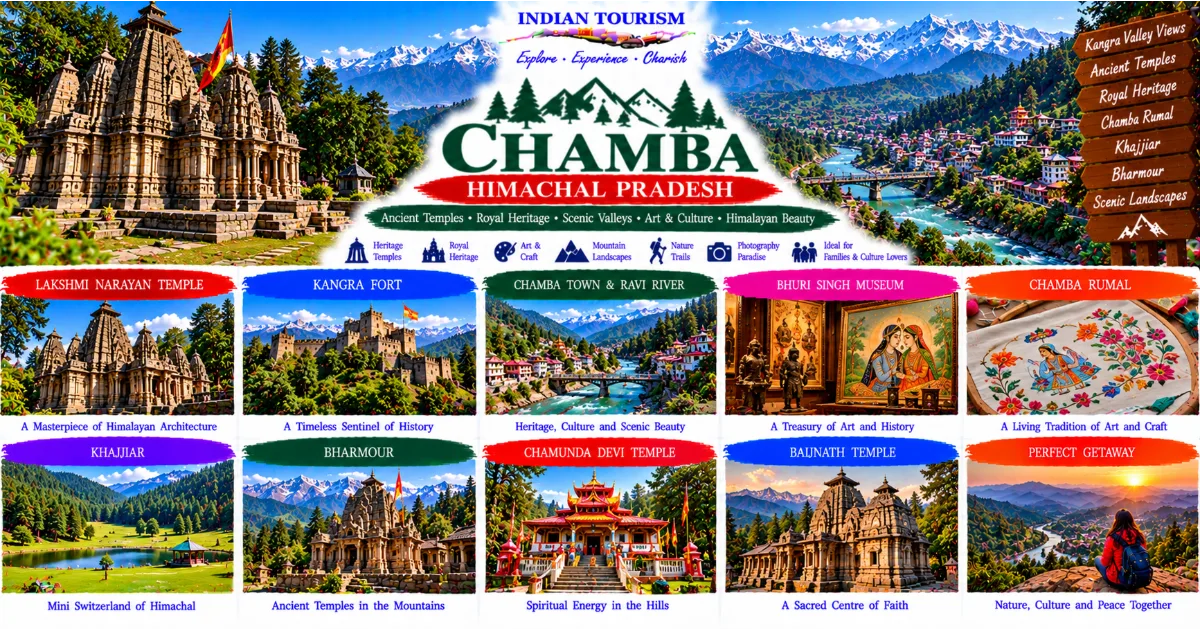
Discover the Historic Charm of Chamba
Nestled in the northwestern part of Himachal Pradesh, Chamba is a mountain town where ancient traditions, Himalayan landscapes and centuries of history come together. Located along the banks of the Ravi River, the town is known for its historic temples, traditional architecture, colourful handicrafts, scenic valleys and distinctive cultural identity. While destinations such as Shimla, Manali and Dharamshala attract large numbers of visitors, Chamba offers a different kind of Himalayan experience. It invites travellers to slow down, explore its old streets, admire the craftsmanship of its temples and discover the stories preserved in its palaces, festivals and villages.
Chamba is the principal town of the Chamba district, a region of considerable geographical and cultural diversity. The district includes river valleys, forested slopes, high mountain settlements and routes leading towards the dramatic landscapes of the Pir Panjal and the greater Himalayan region. Its heritage reflects the influence of ancient ruling dynasties, local religious traditions, artistic communities and the communities that have lived in the surrounding mountains for generations.
For travellers interested in heritage tourism, Chamba is especially rewarding. The town preserves historic temples associated with Hindu traditions, while its old buildings and local museum provide glimpses into the artistic and political history of the former princely state. For nature lovers, the surrounding countryside offers river views, mountain roads, peaceful villages and access to celebrated destinations such as Khajjiar and Bharmour. For cultural travellers, traditional embroidery, metalwork, miniature painting and local festivals reveal a rich artistic heritage that remains closely connected to everyday life.
Chamba is not simply a destination to visit for photographs. It is a place to understand how mountain communities have shaped their architecture, food, religious practices and relationship with the natural environment. A thoughtful journey here combines sightseeing with time spent in the old town, conversations with local residents, visits to traditional markets and excursions into the surrounding valleys.
The History of Chamba: A Mountain Kingdom Through the Centuries
Chamba has a long and distinguished history as a regional political and cultural centre. The traditional foundation of the town is associated with Raja Sahil Varman, who is generally credited with establishing Chamba as his capital in the tenth century. Historical traditions connect the name of the town with Champavati, a figure associated with the royal family's religious and cultural memory. Over time, Chamba developed into an important centre of administration, temple construction, artistic patronage and regional trade.
The rulers of Chamba maintained a distinct identity while navigating relationships with neighbouring hill states and larger political powers. The mountains offered a degree of geographical protection, but they also created connections between communities through passes, river valleys and trade routes. These connections helped shape the region's architecture, religious institutions and artistic traditions.
The town's historic temples are among the clearest reminders of its past. Their construction, ornamentation and continued use demonstrate how religious life and royal patronage supported one another. Temples were places of worship, but they also served as important social institutions, connecting communities through festivals, rituals and shared responsibilities.
Chamba later became part of the British-era political landscape of the western Himalayas while retaining its princely-state identity. Its rulers continued to support cultural activities, and the town developed institutions that helped preserve local history and art. After Indian independence, Chamba became part of the wider administrative structure of Himachal Pradesh.
Today, the historic centre offers an opportunity to explore this layered past. The most meaningful way to experience Chamba is to look beyond individual monuments and consider how the town developed around its river, temples, royal institutions and mountain environment.
Best Places to Visit in Chamba
Lakshmi Narayan Temple Complex
The Lakshmi Narayan Temple Complex is one of Chamba's most important religious and architectural landmarks. Located in the historic town, the complex is associated with Lord Vishnu and contains several temples that reflect the region's distinctive stone architecture. The main shrine dedicated to Lakshmi Narayan is especially significant for its religious importance and traditional construction.
The temples are known for their shikhara-style towers, carefully arranged stonework and carved architectural details. Their design reflects the adaptation of wider North Indian temple traditions to the climatic and geographical conditions of the Himalayan foothills. The buildings have endured through centuries of changing political circumstances, weather and restoration, making them valuable examples of the region's architectural heritage.
Visitors should spend time observing the relationship between the temples and their surroundings. The complex is not merely an architectural attraction. It remains a place of worship where local residents participate in religious activities throughout the year. Travellers should therefore dress respectfully, follow local instructions and avoid disturbing ceremonies.
Morning visits can be particularly pleasant, when the atmosphere is quieter and the details of the stone structures are easier to appreciate. Photography rules may vary, especially within active shrines, so visitors should ask before taking pictures.
Champavati Temple
Champavati Temple is another important landmark connected with the history and traditions of Chamba. The temple is traditionally associated with Champavati, whose story forms part of the town's foundation legends. Its religious significance and historic character make it an essential stop for visitors interested in understanding the cultural origins of the settlement.
The temple's setting within the town allows travellers to combine the visit with a walk through nearby streets and markets. This makes it easier to understand how historic religious sites remain integrated into everyday urban life. Unlike isolated monuments that are separated from modern settlements, Chamba's temples form part of a living cultural landscape.
Visitors interested in local history should ask about the stories associated with the temple, while remembering that oral traditions can differ in their details. Such stories are valuable because they reveal how communities understand their own past and preserve connections between historical memory and religious practice.
Bhuri Singh Museum
The Bhuri Singh Museum is an important destination for anyone interested in the art, history and cultural heritage of Chamba. Named after Raja Bhuri Singh, the museum preserves objects that illuminate the region's historical development and artistic traditions. Its collections have helped bring wider recognition to Chamba's miniature paintings, manuscripts, inscriptions, decorative arts and other cultural materials.
The museum is particularly valuable because mountain history is not always recorded through large monuments alone. Paintings, documents, sculptures and everyday objects provide evidence of how people lived, what they valued and how artistic ideas travelled between regions. Visitors can gain a deeper understanding of Chamba by examining these materials before exploring the temples and historic streets outside.
The region's miniature painting traditions are especially noteworthy. These works demonstrate the skill of artists who used fine lines, carefully composed figures, rich colours and detailed settings to depict religious narratives, courtly life and themes from literature. The paintings form part of the broader Pahari school of art, which developed in several Himalayan hill states.
A museum visit is also useful for travellers who want context rather than a quick checklist of attractions. Understanding the artistic traditions and political history of Chamba makes the town's architecture and festivals more meaningful.
Museum opening days and hours can change, so visitors should confirm the current arrangements locally before planning their day around the visit.
Rang Mahal
Rang Mahal is among Chamba's best-known historic buildings and is associated with the region's royal heritage. Its architectural character reflects a blend of influences that developed through the interactions of local building traditions and broader styles found across northern India. The building's name and historic associations make it an interesting stop for travellers exploring the town's royal past.
Rang Mahal is also connected with the artistic traditions of Chamba, particularly embroidery and decorative craft. The region is known for Chamba rumal, an embroidered textile that has long held cultural importance. Traditional examples feature carefully composed motifs, often inspired by religious stories, floral designs and scenes from traditional narratives.
The building's present use and access arrangements may differ from those of its historical period, so travellers should check which areas are open to visitors. Even when access is limited, the surrounding area contributes to an understanding of Chamba's historic urban character.
Chaugan: The Open Heart of Chamba
Chaugan is a broad open space in the centre of Chamba and an important part of the town's public life. Its open grounds provide a contrast to the narrow streets and closely grouped historic buildings nearby. Local gatherings, cultural events and public activities have long helped make Chaugan a central meeting place.
The area becomes especially lively during important festivals and community celebrations. Visitors can use it as a starting point for exploring the town, buying local products or taking a relaxed walk while observing the rhythm of everyday life.
Chaugan also provides a useful reminder that heritage includes more than temples and palaces. Public spaces are important because they allow communities to gather, celebrate and maintain shared traditions. Their continued use gives historic towns a living character that cannot be experienced through monuments alone.
Hari Rai Temple
Hari Rai Temple is a significant religious and architectural site in Chamba, traditionally associated with Lord Vishnu. Its stone construction and carved details make it a rewarding stop for visitors interested in the region's temple architecture. The shrine is particularly known for its sculptural representation of Vishnu in a distinctive form.
The temple's scale may be modest compared with some larger religious complexes, but its artistic importance lies in its craftsmanship and historical setting. Travellers who take time to examine the stonework can appreciate the care involved in producing religious images and decorative architectural elements.
A visit to Hari Rai Temple can be combined with a broader heritage walk through Chamba. Rather than rushing from one site to another, visitors should consider how the temples relate to the town's history, religious practices and artistic identity.
Sui Mata Temple
Sui Mata Temple is associated with a local tradition that holds a special place in Chamba's cultural memory. The story linked to the temple concerns sacrifice, water and the welfare of the community. As with many regional traditions, details may vary between tellings, but the central theme reflects the importance of collective well-being in the town's historical imagination.
The temple is particularly connected with the Sui Mata fair, during which people gather to honour the tradition through religious observances and community celebrations. Such festivals provide an opportunity to understand how oral history is preserved through ritual, movement, music and shared participation.
Visitors should approach the temple with respect for the beliefs associated with it. The story is not simply a tourist legend. It forms part of a cultural framework through which residents remember their past and express their relationship with the place.
Akhand Chandi Palace
Akhand Chandi Palace is an important landmark associated with the former rulers of Chamba. Its location and architecture reflect the town's royal history, while its changing use illustrates how historic buildings can acquire new roles over time.
The palace complex offers a different perspective from the religious architecture found elsewhere in the town. Royal buildings were designed to support administration, residence, ceremonial activities and the expression of political authority. Their architecture therefore reveals something about the social organisation of the former princely state.
Access to particular sections may be restricted or affected by their current institutional use. Travellers should check local arrangements before visiting. Even from accessible areas, the palace remains an important part of Chamba's historic landscape and helps explain the relationship between royal patronage and the town's cultural development.
Chamba Rumal: The Embroidered Art of the Himalayas
Chamba is widely associated with Chamba rumal, a distinctive form of traditional embroidery that has become one of the region's most recognisable crafts. The word rumal refers to a cloth, and these embroidered pieces are valued for their detailed needlework, balanced compositions and artistic themes.
Historically, Chamba rumals were used in ceremonial and gift-giving contexts. Their designs often drew inspiration from religious narratives, courtly scenes and traditional visual culture. The embroidery could transform a simple piece of cloth into a carefully planned composition in which figures, decorative borders and surrounding motifs worked together to tell a story.
One of the most interesting features of Chamba rumal is its relationship with miniature painting. Some designs reflect the compositional principles and visual language associated with Pahari paintings. The embroidery therefore demonstrates how artistic ideas can move between different media while retaining a distinct local identity.
For visitors, learning about Chamba rumal adds depth to a shopping experience. Instead of viewing embroidery as a decorative souvenir, travellers can appreciate the patience, skill and cultural knowledge required to produce it. When purchasing handmade work, it is worth asking about the maker, the technique, the materials and whether the piece is traditionally embroidered or machine-produced.
Supporting genuine local craft can help sustain skilled artisans and encourage younger generations to continue traditional practices. Visitors should buy thoughtfully, avoid bargaining in ways that disregard the labour involved and choose products whose origins are explained clearly.
Pahari Miniature Paintings and the Artistic Legacy of Chamba
Chamba forms part of the wider Pahari artistic landscape, a group of painting traditions associated with the Himalayan hill states. Pahari paintings are celebrated for their fine detail, expressive figures, carefully arranged compositions and sensitive use of colour. Different regional centres developed their own characteristics, shaped by courtly patronage, religious interests and the work of individual artists.
In Chamba, painting traditions developed alongside the cultural life of the former princely state. Artists worked with themes drawn from religious literature, mythology, poetry and royal settings. The resulting works offer insight into the beliefs, tastes and visual imagination of the communities and patrons who supported them.
The Bhuri Singh Museum is a useful place to begin learning about these traditions. After viewing examples of miniature painting, travellers may find it easier to recognise the relationship between visual storytelling, religious sculpture and embroidered textiles across the town.
Art lovers should remember that traditional painting is not simply a matter of attractive colours. The scale of the works, the precision of the lines and the careful organisation of space demand considerable skill. Preserving these traditions requires both public appreciation and opportunities for artists to earn a livelihood from their work.
Khajjiar: The Meadow Often Called Mini Switzerland
Khajjiar is one of the most celebrated destinations in the Chamba district. Located amid forested mountains, the area is known for its open meadow, surrounding deodar trees and scenic views. Its landscape has earned it the popular nickname Mini Switzerland, although Khajjiar has its own distinctive Himalayan character that should not be reduced to a comparison with another country.
The central meadow is the main attraction. Visitors can walk across open grassland, enjoy views of the surrounding slopes and spend time in a setting that feels very different from the crowded streets of larger hill stations. Depending on the season, the landscape may appear lush and green, misty and atmospheric or quiet beneath a covering of snow.
Khajjiar is suitable for families, couples, photographers and travellers who want a relaxed excursion from Chamba. Visitors should check road and weather conditions before setting out, particularly during winter or periods of heavy rain. Mountain roads can be affected by snowfall, landslides and temporary closures.
The area is also an important natural environment. Visitors should avoid leaving rubbish, disturbing wildlife or damaging grassland and forest vegetation. The meadow is most enjoyable when treated as a landscape to appreciate rather than a space for careless recreational activity.
Bharmour: Ancient Temples and the Gateway to High Mountain Country
Bharmour, located in the Chamba district, is an important destination for travellers interested in religious heritage and mountain culture. Historically associated with the former rulers of the region, Bharmour is known for its group of ancient temples and its position along routes leading into higher Himalayan landscapes.
The Chaurasi Temple Complex is the best-known heritage attraction in Bharmour. The name is associated with the number eighty-four, and the complex contains shrines of different sizes arranged around an open area. The temples are connected with religious traditions that remain important to the local population.
The complex is particularly significant for travellers who want to understand the relationship between mountain settlements and pilgrimage. Religious sites in the Himalayas often developed along routes shaped by geography, water sources, local communities and seasonal movement. Their importance extends beyond architecture because they continue to organise festivals, worship and community identity.
Bharmour is also associated with the Manimahesh region, an important pilgrimage destination in the high mountains. Travel to remote areas requires careful planning, suitable clothing, attention to altitude and respect for local guidance. Visitors should not treat high-altitude routes as casual extensions of an ordinary sightseeing trip.
A visit to Bharmour can be a full-day excursion or part of a longer journey through the district. Travellers should account for road conditions, journey times and the possibility of delays, particularly when weather changes rapidly.
The Ravi River and the Natural Landscape Around Chamba
The Ravi River is central to the geography and identity of Chamba. Its valley has influenced settlement patterns, agriculture, transportation and connections between mountain communities. The river and its tributaries also contribute to the scenery that makes the region attractive to nature lovers.
The landscape around Chamba changes with elevation. Lower slopes may contain cultivated land and settlements, while higher areas feature dense forests, steep ridges and mountain meadows. These changes create varied opportunities for photography, scenic drives and quiet exploration.
Travellers should remember that rivers in mountainous regions can be unpredictable. Water levels may rise rapidly after rain or snowmelt, and currents can be stronger than they appear. Visitors should avoid entering unfamiliar stretches of water and should follow local safety guidance.
The most rewarding way to experience the Ravi valley is often through observation rather than activity. A viewpoint, a peaceful roadside stop or a walk through a village can reveal the relationship between the river, the surrounding fields and the mountain communities that depend on the landscape.
Local Food: What to Eat in Chamba
Food in Chamba reflects the wider culinary traditions of Himachal Pradesh, shaped by the mountain climate, locally available ingredients and household cooking practices. Meals often include rice, lentils, seasonal vegetables, grains and preparations suited to cooler weather. Recipes vary between communities and households, so travellers should not expect a single menu to represent the entire region.
One traditional dish worth seeking is madra, a rich preparation commonly associated with Himachali cuisine and often made with chickpeas or other legumes cooked in a yoghurt-based gravy. Its flavour and texture vary according to local recipes. It is frequently associated with celebratory meals and traditional feasts.
Dham is another important part of Himachali food culture. It is a traditional festive meal served at weddings and other special occasions in several parts of the state. The dishes and serving traditions differ by region, and travellers may encounter versions containing rice, lentils, yoghurt-based preparations and other regional specialties.
Local kitchens may also offer seasonal vegetables, simple lentil dishes, flatbreads and warming preparations suited to mountain weather. In smaller villages, food availability can be limited, so visitors should be flexible and ask what is freshly prepared.
When trying local food, travellers should communicate dietary requirements clearly. Those who prefer vegetarian meals will find options, but the range of dishes depends on the establishment and season. Eating at locally owned restaurants can also provide opportunities to learn about family recipes and regional ingredients.
Festivals and Cultural Traditions of Chamba
Festivals are an important part of Chamba's identity because they bring together religious practice, community participation, music, traditional dress and local trade. They also help preserve cultural knowledge by passing customs from one generation to the next.
Minjar Fair
The Minjar Fair is Chamba's most famous festival and one of the major cultural events in the region. It is generally held during the summer period and is associated with local traditions, religious observances and community celebrations. The fair brings together residents and visitors for processions, performances, markets and other public activities.
The name Minjar is connected with a traditional tassel or sheaf symbol associated with the festival. The celebration reflects the relationship between the town, its religious institutions and the surrounding agricultural landscape. Its programme can include ceremonial events and activities that draw participants from different parts of the district.
For travellers, Minjar offers an opportunity to experience Chamba at its most lively. However, festival dates and schedules can vary, so visitors should confirm the current programme before making travel arrangements. Accommodation may become busier during the event, making early planning useful.
Sui Mata Fair
The Sui Mata Fair is connected with the local tradition associated with Sui Mata Temple. The celebration reflects the importance of community memory, religious devotion and stories that have shaped Chamba's cultural identity.
Visitors attending the fair should approach it as a living cultural event rather than a performance staged solely for tourists. Respectful observation, appropriate clothing and attention to local instructions help ensure that the celebration remains comfortable for residents and visitors alike.
Other Religious and Community Celebrations
Throughout the year, temples and villages in the Chamba district observe religious occasions according to local calendars and traditions. The form of these celebrations may vary from one settlement to another. Some involve processions and music, while others are centred on worship, family gatherings or village-level events.
Travellers who want to experience local festivals should ask about the cultural meaning of the event and any expectations for visitors. A little preparation can turn a brief stop into a more meaningful encounter with the region's living traditions.
Shopping in Chamba: Handicrafts and Local Souvenirs
Chamba's markets offer opportunities to discover regional handicrafts, textiles, traditional designs and locally produced goods. The best purchases are often those that reflect the place rather than generic products sold across many tourist destinations.
Chamba rumal is one of the most distinctive crafts associated with the region. Depending on availability, visitors may also encounter woollen products, embroidered textiles, metal objects, paintings and other decorative items inspired by local traditions. The selection varies between shops and seasons.
When buying handicrafts, travellers should ask whether a product is handmade, where it was produced and what materials were used. Traditional techniques can require substantial time and training, and the price should reflect the skill involved. A genuine craft purchase can support local makers and help keep traditional knowledge economically viable.
Food products and small souvenirs may also be available in local markets. Visitors should check packaging and transport requirements when buying perishable goods, particularly if they are travelling long distances after leaving Chamba.
Best Time to Visit Chamba
Chamba can be visited during much of the year, but the best season depends on the experiences a traveller wants.
Spring, March to April
Spring brings changing temperatures and renewed colour to the surrounding countryside. The weather can be pleasant for walking around the historic town, visiting temples and taking short excursions. Higher areas may remain cold, and conditions can change quickly, so warm layers are still useful.
Summer, May to June
Summer is a popular period for visiting Chamba because temperatures in the town are generally more comfortable than in many lowland destinations. It is a suitable season for heritage sightseeing, trips to Khajjiar and excursions into nearby valleys. Travellers planning to attend the Minjar Fair should check the confirmed dates and make accommodation arrangements in advance.
Monsoon, July to September
The monsoon can make the landscape lush and dramatic, but it also brings travel challenges. Heavy rainfall may affect mountain roads and increase the risk of landslides. Visitors travelling during this period should monitor local weather information, avoid unnecessary journeys during severe rain and remain flexible with their plans.
Autumn, October to November
Autumn is often a rewarding season for travellers who prefer clearer views and comfortable conditions for sightseeing. The air can feel crisp, and the surrounding landscape may offer excellent opportunities for photography. Evenings become colder as the season progresses, so suitable clothing is important.
Winter, December to February
Winter brings colder conditions, especially at higher elevations. Some surrounding destinations may experience snowfall, creating beautiful scenery but also increasing the possibility of road disruption. Travellers should confirm conditions before driving to Khajjiar, Bharmour or other higher areas. Warm clothing, flexible schedules and reliable local transport arrangements are essential.
For many first-time visitors, late spring and autumn offer a practical balance of sightseeing comfort and access to the surrounding region. Festival travellers may prefer to plan around Minjar, while snow enthusiasts should understand that winter access and snowfall are never guaranteed.
How to Reach Chamba
By Road
Road travel is the main way most visitors reach Chamba. The town is connected by mountain roads to other parts of Himachal Pradesh and to transport hubs in neighbouring regions. Journey times depend on the starting point, road conditions, traffic and weather.
Travellers arriving from larger cities may need to combine rail or air travel with a road journey. It is sensible to allow extra time for mountain driving, especially during the monsoon, winter or busy holiday periods.
By Train
Chamba does not have a major railway station within the town. Travellers generally use rail connections serving other parts of the region and continue by road. The most practical rail route depends on the city of origin and the available train services at the time of travel.
Before booking, compare the complete journey rather than only the train segment. A station that appears close on a map may still require several hours of mountain driving.
By Air
The nearest practical airport depends on current flight schedules and the planned route. Kangra's Gaggal Airport may be useful for some itineraries, while travellers may also consider larger airports farther away if they offer more convenient connections. Every airport option requires a road transfer to Chamba.
Flight availability, road journey times and weather-related disruptions can change. Travellers should confirm current transport arrangements before finalising their itinerary.
Getting Around Chamba
The historic town can be explored partly on foot, particularly when visiting the central temples, Chaugan and nearby heritage sites. Walking allows visitors to notice architectural details, small shrines, market activity and everyday scenes that are easy to miss from a vehicle.
For destinations outside the town, taxis and locally arranged transport are often practical choices. Travellers planning to visit Khajjiar or Bharmour should agree on the itinerary, waiting time and return arrangements before starting the journey. Public transport may be available on some routes, but frequency and convenience can vary.
Mountain roads require patience. Curves, changing weather, narrow stretches and local traffic can affect journey times. Visitors should avoid planning too many distant destinations in a single day and should not assume that a short distance on a map means a quick journey.
Suggested Chamba Itinerary
One Day in Chamba Town
Begin the day with a visit to the Lakshmi Narayan Temple Complex, allowing enough time to appreciate its architecture and religious atmosphere. Continue to Champavati Temple and Hari Rai Temple, then explore the old streets and local markets at a relaxed pace.
After lunch, visit the Bhuri Singh Museum if it is open, followed by a walk around Chaugan and the area surrounding Rang Mahal. This itinerary focuses on the town's major cultural attractions without making the day unnecessarily rushed.
Two Days in Chamba
Spend the first day exploring the historic town, including its temples, museum, royal heritage and traditional markets. Use the evening to enjoy local food and observe everyday life around the central public spaces.
On the second day, take a day trip to Khajjiar, subject to road and weather conditions. The meadow and surrounding forest make a pleasant contrast to the historic town. Travellers who prefer religious heritage and mountain culture may choose Bharmour instead, but the journey requires careful planning and enough time for the return.
Three Days in Chamba
A three-day visit allows a more balanced experience. Dedicate the first day to the town's temples, museum, palace heritage and markets. Use the second day for Khajjiar and the surrounding landscape. Reserve the third day for Bharmour or a slower exploration of nearby villages, depending on road conditions and personal interests.
Travellers should avoid trying to combine every attraction in the district into a short stay. Chamba rewards visitors who leave room for unexpected discoveries, changing weather and time spent understanding local culture.
Where to Stay in Chamba
Accommodation in and around Chamba ranges from simple guesthouses and budget hotels to more comfortable properties suited to families and longer stays. The best area depends on whether the priority is walking access to the historic town, road access for day trips or a quieter setting with views of the surrounding landscape.
Staying near the central town can make it easier to visit temples, markets and the museum without arranging transport for every stop. Accommodation outside the centre may provide a more peaceful atmosphere, but visitors should check the distance from restaurants, transport points and the places they intend to visit.
During major festivals and popular holiday periods, booking ahead is advisable. Travellers should confirm heating arrangements for winter visits, parking availability if travelling by car, meal options and cancellation policies in case mountain roads become inaccessible.
Responsible Tourism in Chamba
Chamba's appeal depends on the survival of its cultural heritage and the health of its mountain environment. Responsible tourism helps ensure that visitors contribute positively to the place they have come to appreciate.
At temples and religious sites, dress respectfully, follow instructions and ask before photographing people or ceremonies. Avoid touching delicate carvings, climbing on historic structures or leaving litter in temple grounds. Historic buildings require care, and small acts of damage can gradually affect their preservation.
When visiting forests, meadows and river valleys, carry waste back to appropriate disposal points and avoid disturbing wildlife. Do not leave plastic packaging or food waste in natural areas. Mountain environments can be fragile, and waste left by visitors may remain there for a long time.
Support local businesses where possible. Buying authentic handicrafts, eating at locally owned establishments and hiring local guides can help tourism income reach the people who maintain the region's cultural traditions. Fair payment for skilled work is particularly important when purchasing handmade embroidery or art.
Visitors should also respect the daily routines of rural communities. Ask permission before entering private land or photographing people, avoid excessive noise and remember that villages are homes rather than open-air attractions.
Practical Travel Tips for Chamba
Carry clothing suited to the season and remember that temperatures can fall sharply in the evening, even when daytime conditions are comfortable. Comfortable walking shoes are useful for exploring temple complexes, old streets and uneven paths.
Keep some cash available for small purchases and local transport, particularly when travelling beyond the main town. Digital payment options may be available in many places, but connectivity and acceptance can vary.
Check weather forecasts and road conditions before day trips. During the monsoon and winter, plans should remain flexible. Travellers going to higher elevations should take altitude, physical fitness and changing weather seriously, especially if continuing beyond ordinary sightseeing areas.
If travelling with children or older family members, plan regular breaks and avoid packing too many destinations into one day. Chamba's historic centre is best experienced at a comfortable pace, and the surrounding roads can make excursions longer than expected.
Finally, learn a few local expressions of courtesy and show interest in the region's history. Residents may be happy to explain the meaning of a festival, a temple tradition or a local craft when approached respectfully.
Why Chamba Deserves a Place on Your Himachal Pradesh Itinerary
Chamba offers a distinctive combination of historical depth, artistic achievement and natural beauty. Its ancient temples preserve architectural traditions, its museum provides insight into regional history, and its handicrafts demonstrate the skill of generations of artists. The Ravi River and surrounding mountains provide a dramatic setting, while nearby destinations such as Khajjiar and Bharmour allow visitors to experience different aspects of the district.
The town is especially rewarding for travellers who want more than a conventional hill-station holiday. Here, sightseeing can become an exploration of how geography, religion, craftsmanship and community life have shaped a Himalayan settlement over centuries. A visit to a temple becomes more meaningful when understood in the context of local history. A handmade textile becomes more valuable when its technique and cultural significance are recognised. A walk through the town becomes an opportunity to see how heritage continues to function in everyday life.
Chamba also encourages a slower style of travel. Instead of rushing through a long list of attractions, visitors can spend time in the museum, explore the old streets, enjoy regional food and take carefully planned excursions into the surrounding landscape. This approach creates a more personal connection with the destination and helps ensure that tourism benefits local communities.
For anyone exploring Himachal Pradesh, Chamba is a place where heritage and nature complement each other. Its temples, royal buildings, traditional crafts, festivals and mountain scenery make it a memorable destination for history enthusiasts, cultural travellers, families, photographers and nature lovers.
Conclusion
Chamba is one of the most culturally distinctive destinations in Himachal Pradesh. Its historical temples, royal heritage, miniature painting traditions, embroidered Chamba rumal, lively festivals and scenic mountain surroundings offer a rich travel experience. The town's character is shaped not only by its monuments but also by the communities that continue to preserve its traditions.
Plan enough time to explore the historic centre, visit its cultural institutions, enjoy local food and discover the surrounding valleys. Choose excursions according to the season and current road conditions, and travel with respect for the environment and local customs. With thoughtful planning, Chamba can become one of the most memorable stops on a journey through the western Himalayas.
#IndianTourism #Chamba #ChambaTourism #HimachalPradesh #ExploreIndia #IndianHeritage #HimalayanTravel #LakshmiNarayanTemple #BhuriSinghMuseum #Khajjiar #Bharmour #ChambaRumal #PahariArt #CulturalTourism #MountainDestinations
