
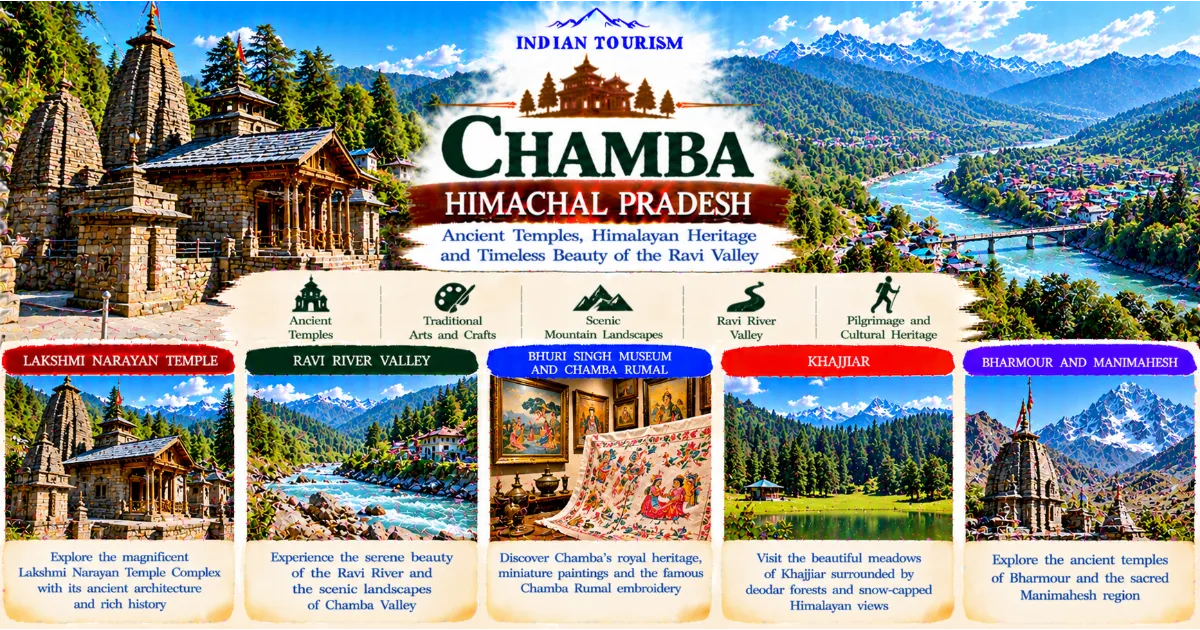
Exploring the Historic Heart of Chamba
Chamba is one of Himachal Pradesh's most distinctive destinations, offering a remarkable combination of Himalayan scenery, ancient temples, traditional architecture, regional crafts and a history that stretches back more than a thousand years. Situated in the northwestern part of the state, Chamba occupies a scenic valley associated with the Ravi River and is surrounded by mountains, forests and settlements that reflect the cultural diversity of the western Himalayas.
Unlike destinations known primarily for adventure sports or seasonal mountain views, Chamba attracts travellers who want to understand the relationship between history, religion, art and everyday life in the Himalayan region.
The town is particularly famous for its ancient temples, traditional wooden and stone architecture, miniature painting traditions, embroidered Chamba Rumal textiles and distinctive local festivals. Its historic centre preserves an atmosphere that connects modern life with the legacy of the former Chamba princely state. Walking through the town allows visitors to encounter temple courtyards, traditional houses, bustling market streets and views of the surrounding mountains within a relatively compact area.
Chamba also provides access to a wider landscape of mountain villages, valleys, forests and high-altitude destinations. The nearby Bharmour region is especially significant for its ancient temples and pastoral traditions, while the celebrated Manimahesh pilgrimage connects the area with one of the most important sacred landscapes of Himachal Pradesh. Khajjiar, with its meadow and surrounding deodar forest, is another well-known destination associated with the wider Chamba region.
The appeal of Chamba lies in the variety of experiences it offers. Visitors can spend a morning studying centuries-old temple architecture, an afternoon exploring local handicrafts and an evening enjoying the peaceful atmosphere of the Ravi Valley. Travellers who have more time can explore surrounding settlements and mountain routes, discovering how communities have adapted to the geography and climate of the western Himalayas.
Chamba deserves attention not only as a scenic destination but also as a place where cultural heritage remains an important part of daily life. Its temples, crafts, festivals and historic buildings are not isolated relics of the past. They continue to shape local identity and provide a connection between generations.
For anyone planning a journey through Himachal Pradesh, Chamba offers a deeper understanding of the state beyond its popular hill stations. It is a destination where the mountains provide the setting, while history, craftsmanship and living traditions give the landscape its distinctive character.
Where Is Chamba Located?
Chamba is located in the northwestern part of Himachal Pradesh, close to the Jammu and Kashmir region. The historic town stands in the Ravi River valley and serves as an important administrative and cultural centre for the surrounding district.
Its geographical position has influenced the development of the region for centuries. Mountain slopes, river valleys and narrow routes shaped the movement of people, goods and religious traditions. These geographical conditions also contributed to the distinctive architecture and cultural practices that developed in Chamba and neighbouring communities.
The town is surrounded by a landscape of forested hills and distant mountain ridges. The Ravi River forms an important part of the region's physical identity, while smaller valleys and settlements extend into the surrounding terrain. The landscape changes considerably with elevation, creating differences in vegetation, climate, agricultural practices and accessibility.
Chamba is also a useful base for exploring other destinations in the district. Bharmour provides access to the ancient Chaurasi Temple complex and routes associated with the Manimahesh pilgrimage. Khajjiar is known for its open meadow and forested surroundings, while Dalhousie offers a different experience shaped by colonial-era architecture and established hill-station tourism.
However, these destinations should not be treated as if they are all within a short walking distance. Mountain roads can be winding, and travel times depend on the route, weather, traffic and road conditions. Visitors planning to explore several locations should organise their itinerary according to realistic travel times.
Chamba's location makes it suitable for travellers who want to combine cultural exploration with mountain scenery. It is particularly rewarding for those interested in heritage tourism, traditional crafts, religious architecture and the history of Himalayan communities.
The History of Chamba: A Kingdom in the Himalayas
Chamba has a long and distinctive political history. Traditional accounts associate the foundation of the town with Raja Sahil Varman, who is generally credited with establishing the historic settlement in the tenth century. The town developed as the centre of a regional kingdom that maintained its identity through changing political circumstances.
The history of Chamba is closely connected with the wider development of Himalayan principalities. Mountain geography created both opportunities and challenges for rulers. Valleys supported agriculture and settlement, while difficult terrain influenced trade, communication and military movement. Political relationships with neighbouring kingdoms and larger powers also shaped the region over time.
The former rulers of Chamba supported religious institutions, temple construction, artistic traditions and public works. Their patronage contributed to the development of a cultural landscape in which temples and historic buildings became important expressions of political authority and religious devotion.
Chamba's temples are particularly valuable for understanding this history. Their architectural forms, carved details and inscriptions, where preserved, provide evidence of changing artistic influences and religious practices. Some structures have undergone repairs and modifications over the centuries, illustrating how historic monuments remain part of living communities rather than existing outside time.
The town's historic centre also reflects its development as an administrative and commercial settlement. Markets, residential areas and religious buildings grew in relation to one another, creating an urban landscape shaped by both practical needs and cultural priorities.
The princely state eventually became part of independent India during the political integration of the former princely territories. Chamba subsequently developed within the modern administrative structure of Himachal Pradesh.
Today, the legacy of the former kingdom remains visible in the town's architecture, cultural institutions, festivals and traditional crafts. Visitors interested in history should take time to understand the stories associated with individual monuments rather than treating them simply as picturesque backgrounds.
Chamba's past is one of the main reasons the destination remains important. It demonstrates how a Himalayan community preserved a distinct identity while adapting to broader political and social changes.
Lakshmi Narayan Temple Complex: The Spiritual Centre of Chamba
The Lakshmi Narayan Temple Complex is among the most important heritage attractions in Chamba. It consists of a group of historic Hindu temples that reflect the region's long tradition of religious architecture and royal patronage.
The principal temple is dedicated to Lord Vishnu in the form of Lakshmi Narayan. Its traditional architecture, carved wooden details and stone construction make it a significant example of the region's historic temple-building practices. The complex also contains other shrines, creating a sacred environment in which architecture and worship are closely connected.
The temples are generally associated with the early medieval period, although individual structures have experienced changes and repairs over time. Their surviving features provide insight into the artistic vocabulary used by builders and craftspeople working in the western Himalayan region.
Visitors should observe the temples carefully. Roof forms, carved entrances, stonework and the arrangement of shrines reveal details that may be missed during a hurried visit. The complex is also a place of worship, so visitors should maintain respectful behaviour and follow any instructions regarding photography, footwear and access.
The atmosphere changes according to the time of day and religious calendar. During quieter periods, visitors may be able to appreciate the architectural details without large crowds. During festivals and special occasions, the complex may become more active as devotees gather for worship.
The Lakshmi Narayan temples are important not only because of their age but also because they remain part of the living religious landscape of Chamba. Their continued use demonstrates the connection between historical architecture and present-day community life.
For travellers interested in Indian heritage, this complex offers an introduction to the region's artistic traditions and religious history. It is one of the essential stops for anyone exploring Chamba town.
Bhuri Singh Museum: Understanding Chamba's Cultural Heritage
The Bhuri Singh Museum provides an opportunity to explore the history, art and cultural traditions of Chamba in greater depth. Named after Raja Bhuri Singh, the museum was established to preserve and present important elements of the region's heritage.
Its collections have historically included objects associated with local painting traditions, inscriptions, manuscripts, decorative arts and regional history. The exact displays and gallery arrangements can change, so visitors should check current information before planning a visit around a specific collection.
The museum is especially valuable because Chamba's history extends beyond monuments. Artworks, documents and objects can reveal details about patronage, religious practices, craftsmanship and everyday life that are not always visible in buildings alone.
Miniature painting traditions associated with the region are particularly interesting. These works demonstrate the importance of artistic exchange across Himalayan courts and neighbouring cultural centres. Their subjects may include religious narratives, courtly life and themes drawn from literary and devotional traditions.
A visit to the museum can also provide context for the architecture encountered elsewhere in town. Understanding the region's artistic history makes it easier to appreciate the details of temple carvings, decorative objects and traditional textiles.
Visitors should allow enough time to explore the displays rather than treating the museum as a brief stop between other attractions. Reading the interpretive material can help connect individual objects with broader historical developments.
Opening hours, entry arrangements and photography policies should be confirmed before arrival. Museum schedules can change, particularly during public holidays or maintenance periods.
For travellers who want to understand why Chamba is culturally significant, the Bhuri Singh Museum provides an important foundation. It transforms the visit from simple sightseeing into a more informed exploration of Himalayan history.
Chamba Rumal: The Art of Embroidered Storytelling
Chamba is famous for the Chamba Rumal, a distinctive form of embroidered textile traditionally associated with the region's royal and cultural heritage. The word rumal means handkerchief or cloth, but these embroidered pieces can be much more than ordinary household textiles. They represent a sophisticated artistic tradition in which thread is used to create detailed scenes, figures and decorative compositions.
Historically, Chamba Rumals were often produced for ceremonial and gift-giving purposes. Their designs could draw inspiration from religious narratives, including episodes associated with Hindu mythology, as well as courtly and decorative themes.
The embroidery is known for its fine workmanship and the way figures and scenes are arranged across the cloth. Traditional examples often use a double-sided technique that allows the design to remain visually effective on both sides. The skill required to maintain consistent detail and colour across a composition reflects the patience and experience of the craftsperson.
Chamba Rumal embroidery is closely connected with the region's artistic culture. It brings together textile skills, painting-inspired design and storytelling, demonstrating how different forms of artistic expression can influence one another.
The tradition has also faced challenges associated with changing markets, the time required for hand production and competition from machine-made products. Supporting genuine craftwork can help preserve the skills of artisans and maintain opportunities for future generations.
Visitors interested in purchasing embroidered textiles should ask about the origin, materials and method of production. Handcrafted pieces require time and expertise, and prices may reflect the complexity of the design and the labour involved.
A Chamba Rumal is not merely a souvenir. It is an example of the region's artistic identity, carrying stories and techniques developed over generations.
Chamba Chappal: Traditional Footwear and Local Craftsmanship
Another craft associated with Chamba is its traditional footwear, often known as Chamba Chappal. These handcrafted sandals reflect the region's practical needs as well as its decorative traditions.
Traditional footwear production involves knowledge of materials, shaping, stitching and finishing. Depending on the design, decorative elements may distinguish different styles and demonstrate the craftsperson's skill.
Chamba Chappals are valued as regional products because they connect everyday objects with local craftsmanship. Their significance lies not only in appearance but also in the continuity of skills passed between makers.
Visitors exploring local markets may find traditional footwear alongside textiles, embroidered products and other handicrafts. Availability, quality and production methods can vary, so it is worth taking time to examine the items and ask sellers about their origins.
Buying directly from legitimate local artisans or established craft businesses can help support the people who maintain these traditions. Visitors should avoid assuming that every item marketed as traditional has been made locally or by hand.
The craft also illustrates how cultural heritage can remain relevant in modern life. Traditional products may be adapted to contemporary tastes while retaining important elements of regional design.
For travellers who enjoy discovering local craftsmanship, Chamba's footwear tradition adds another dimension to the destination. It provides a tangible connection with the skills and creativity of the community.
Chaugan: The Open Heart of Chamba Town
The Chaugan is a prominent open space in Chamba town and an important part of its public life. The broad green area provides a contrast to the compact streets and historic buildings surrounding it.
The Chaugan has traditionally served as a place for gatherings, recreation and public events. Its open character makes it a natural focal point for community activities and festivals. It also offers visitors a place to pause between visits to temples, museums and markets.
The surrounding townscape provides opportunities to observe how Chamba's historic centre functions today. Shops, streets and public buildings connect the Chaugan with the daily routines of residents.
The open area can be particularly interesting during festival periods, when public celebrations bring together local people and visitors. Outside these occasions, it remains useful as a place to relax and take in the atmosphere of the town.
Visitors should remember that public spaces are shared by residents. Keep the area clean, avoid damaging grass or other features and follow any restrictions during events.
The Chaugan is not simply an attraction to photograph. It is part of the social geography of Chamba, providing a setting where community life, recreation and cultural traditions intersect.
Chamba's Traditional Architecture
Architecture is one of the most revealing aspects of Chamba's cultural identity. The town and surrounding settlements contain historic temples, traditional homes and buildings that reflect the region's response to climate, terrain and available materials.
Stone has been widely used in the construction of religious and civic structures, while timber plays an important role in many traditional buildings. Roof designs, balconies, carved elements and the arrangement of interior spaces reflect a combination of practical knowledge and artistic expression.
The region's climate has influenced building practices. Structures must respond to seasonal rain, cold weather and, in higher areas, snow. Construction methods have developed through generations of local experience, although contemporary materials and designs have become increasingly common.
Historic buildings also reflect social organisation. Temples and public spaces were often supported by rulers, religious institutions or communities, while residential architecture responded to household needs and local resources.
Visitors exploring old neighbourhoods should look for details such as wooden window frames, carved doorways, roof forms and the relationship between buildings and the surrounding landscape.
Preservation requires ongoing care. Timber and stone structures can deteriorate through weather exposure, changes in use and inadequate maintenance. Respectful tourism can help create interest in heritage, but visitors should avoid touching fragile carvings, climbing on old structures or entering private buildings without permission.
Chamba's architecture is most meaningful when understood as a record of adaptation. It demonstrates how communities created buildings suited to their environment while expressing their religious, artistic and social values.
Ravi River: The Landscape That Shapes Chamba
The Ravi River is one of the major geographical features of the Chamba region. Its valley has influenced settlement patterns, agricultural activity, transportation routes and the development of communities across the surrounding mountains.
The river landscape changes with the seasons. Water levels, vegetation and the appearance of the surrounding slopes vary according to rainfall, snowmelt and broader weather patterns. These changes influence both the visual character of the valley and the practical conditions for travel.
From suitable viewpoints, visitors can appreciate how the river cuts through the mountainous terrain. The combination of water, forested slopes and distant ridges provides opportunities for photography and quiet observation.
The Ravi is also an important natural resource. River systems support ecosystems and human communities, but they can be affected by pollution, construction, changing water use and other pressures. Responsible visitors should avoid throwing waste into the water or disturbing sensitive areas along its banks.
The river should not be treated as a swimming destination without reliable information about safety. Currents, changing depths, cold water and unstable banks can create serious hazards. Visitors should remain in safe, accessible areas and follow local advice.
The Ravi River gives Chamba much of its geographical character. It links the town with a wider Himalayan landscape and helps explain why settlements and cultural traditions developed where they did.
Bharmour: The Ancient Cultural Landscape Near Chamba
Bharmour is one of the most important destinations associated with the wider Chamba region. Historically significant and surrounded by mountains, it is known for its ancient temples, pastoral culture and connections with the Manimahesh pilgrimage.
The area is particularly famous for the Chaurasi Temple complex, which contains a group of shrines in a sacred setting. The name Chaurasi is traditionally associated with the number eighty-four, reflecting the religious and cultural significance attributed to the complex.
The temples demonstrate the importance of religious patronage and pilgrimage in the history of the region. They remain connected with living devotional traditions, and visitors should approach them with respect.
Bharmour also has a distinctive cultural identity shaped by mountain geography and pastoral livelihoods. In some communities, seasonal movement with livestock remains part of the wider regional tradition, although contemporary life varies from village to village.
The journey from Chamba to Bharmour passes through mountain terrain, and road conditions should be checked before departure. Visitors planning to continue towards high-altitude areas need to account for changes in weather, elevation and accessibility.
Bharmour deserves more than a brief stop for travellers interested in Himalayan heritage. It offers a chance to explore the relationship between sacred architecture, local culture and the mountain environment.
Manimahesh: A Sacred Journey into the High Himalayas
Manimahesh is one of the most significant pilgrimage destinations associated with the Chamba region. The sacred landscape includes Manimahesh Lake and the mountain traditionally revered as Manimahesh Kailash.
The pilgrimage is closely connected with devotion to Lord Shiva. Many pilgrims undertake the journey during the annual Manimahesh Yatra, when the route becomes an important centre of religious activity.
The setting is dramatic, with high mountains, changing weather and terrain that requires preparation. Unlike a simple visit to a roadside viewpoint, reaching the lake involves a demanding journey that may include substantial walking and exposure to high-altitude conditions.
Visitors should obtain current information about official pilgrimage arrangements, route accessibility, medical facilities and weather before travelling. Conditions can change quickly in high mountain areas, and the pilgrimage may be subject to restrictions or adjustments depending on the season.
Altitude can affect people differently. Travellers should not underestimate the physical demands of the route, and anyone experiencing symptoms of altitude illness should seek appropriate assistance rather than continuing upwards.
The pilgrimage is both a spiritual undertaking and an encounter with a sensitive mountain environment. Visitors should respect religious practices, follow official instructions and carry out all waste.
Manimahesh illustrates the profound relationship between faith and geography in the Himalayas. For many pilgrims, the journey is an expression of devotion, endurance and personal reflection. For other visitors, the region offers an opportunity to understand the cultural importance of sacred landscapes, provided the journey is approached with preparation and respect.
Khajjiar: Meadows and Deodar Forests
Khajjiar is one of the best-known scenic destinations in the wider Chamba region. Its open meadow, surrounded by forested slopes and mountain scenery, creates a landscape that differs from the compact historic streets of Chamba town.
The meadow provides an inviting setting for leisurely walks and photography. The surrounding deodar forests contribute to the area's distinctive character, while the changing weather can transform the appearance of the landscape throughout the day.
Khajjiar is sometimes promoted through comparisons with famous European landscapes, but its real appeal lies in its own Himalayan environment. The meadow, forest and nearby settlements reflect the ecology and cultural geography of Himachal Pradesh.
Visitors should check weather and road conditions, especially during winter and the monsoon. Fog, rain, snow and road disruptions can affect visibility and accessibility.
The area may become busy during holidays and peak travel periods. Travellers seeking a quieter experience can consider arriving earlier in the day, while respecting local rules and the needs of residents.
Khajjiar can be combined with Chamba as part of a wider itinerary, but visitors should allow realistic time for mountain travel. The best experience comes from enjoying the landscape rather than attempting to fit too many destinations into a single day.
Best Time to Visit Chamba
Chamba can be visited in different seasons, and the most suitable time depends on whether your priorities are heritage sightseeing, pleasant weather, festivals or high-altitude travel.
Spring: March to April
Spring brings a gradual change in temperature and can be a pleasant time for exploring Chamba town. Visitors can spend time at temples, museums, markets and nearby viewpoints without necessarily planning demanding mountain excursions.
Mornings and evenings may still be cool, so layered clothing is useful. Visitors planning to travel farther into the mountains should check conditions carefully because higher elevations can remain cold.
Summer: May to June
Summer is often a convenient period for cultural sightseeing and regional travel. Daytime conditions can be suitable for exploring historic buildings and taking road trips to nearby destinations.
This is also a popular travel period, so accommodation and transport should be arranged in advance where possible. Higher mountain routes may have different conditions from the town itself.
Monsoon: July to September
The monsoon brings rainfall and greener scenery, but it can also create travel challenges. Landslides, slippery roads, reduced visibility and temporary route closures may affect journeys through the region.
Visitors should check official weather and road information before departure. Avoid planning tight connections or attempting unfamiliar mountain routes during severe rainfall.
Autumn: October to November
Autumn can offer comfortable conditions for exploring the town and enjoying mountain views. The atmosphere may feel clearer during suitable weather, although temperatures decline as winter approaches.
This period can be attractive for travellers who want to focus on cultural attractions without the intensity of peak summer travel.
Winter: December to February
Winter brings colder weather, and higher elevations may experience snow or icy conditions. Chamba town and surrounding mountain destinations can have different levels of accessibility.
Travellers should confirm road status, heating arrangements and accommodation availability before leaving. Those planning to visit higher-altitude areas must be especially cautious about snow and changing conditions.
For general sightseeing, spring and autumn can provide a useful balance of comfortable weather and cultural exploration. Summer can also be rewarding, while monsoon and winter journeys require more attention to safety and access.
Chamba's Festivals and Living Traditions
Festivals are an important part of Chamba's cultural identity. They bring together religious devotion, local music, traditional dress, community gatherings and regional customs.
The Minjar Fair is among the best-known celebrations associated with Chamba. It is a major annual event that combines religious traditions, public festivities and community participation. The fair is closely linked with local identity and attracts people from the surrounding region.
The festival's significance extends beyond entertainment. It provides an opportunity for communities to maintain relationships, express shared traditions and pass cultural practices to younger generations.
Other religious celebrations and local fairs are associated with temples and seasonal observances. Their dates and activities may vary according to the calendar and local arrangements, so visitors interested in attending should confirm current information before planning a trip.
Festival travel can provide a deeper understanding of Chamba, but it also requires sensitivity. Public spaces may become crowded, transport may be busier and accommodation may be in greater demand.
Visitors should follow local instructions, dress appropriately for religious sites and ask before photographing ceremonies or participants. Not every part of a festival is intended as a performance for tourists.
When approached respectfully, festivals provide a valuable way to understand how Chamba's cultural heritage remains active in contemporary life.
Food and Culinary Experiences in Chamba
Food in Chamba reflects the broader culinary traditions of Himachal Pradesh, with regional variation shaped by geography, agricultural practices, seasonal availability and household customs.
Traditional meals in the region may include grains, pulses, vegetables and preparations suited to the mountain climate. Local households often adapt recipes according to available ingredients, while restaurants may serve a combination of regional and familiar North Indian dishes.
Travellers interested in local cuisine should ask about traditional preparations rather than assuming that every restaurant offers the same menu. Home-style meals at a legitimate homestay can provide an opportunity to learn about local ingredients and food customs.
Dham is a well-known ceremonial meal tradition in Himachal Pradesh, although the dishes and practices vary across regions and occasions. Visitors may encounter regional variations during festivals or special gatherings.
Food availability can differ between Chamba town and smaller mountain settlements. Travellers planning long road journeys should not assume that restaurants will be open at every point along the route.
Visitors with allergies or dietary restrictions should explain their requirements clearly when ordering. It is useful to carry suitable snacks for excursions into areas with fewer services.
Exploring local food is an important part of cultural travel. A meal can reveal something about the region's agricultural traditions, seasonal rhythms and hospitality, making it more than simply a break between sightseeing stops.
Shopping for Authentic Chamba Handicrafts
Shopping in Chamba provides an opportunity to discover traditional crafts and support local makers. The town is associated with embroidered Chamba Rumals, handcrafted footwear, decorative objects and other products reflecting regional artistic traditions.
Visitors should take time to examine the workmanship and ask questions about materials and production methods. Handcrafted items can vary in complexity, and prices may reflect the time and skill required.
When purchasing a Chamba Rumal, ask whether the embroidery is handmade, what materials have been used and whether the seller can explain the design's background. Genuine handwork may take considerably longer to produce than machine-made alternatives.
Traditional footwear and other crafts can also make meaningful souvenirs. However, buyers should not assume that every item sold in a tourist market has been produced locally. Asking about provenance helps support transparent purchasing.
Shopping directly from artisans or established local craft businesses can help sustain traditional skills. It also provides an opportunity to learn about the people who maintain these practices.
Avoid bargaining in ways that disregard the labour involved in handmade work. A fair purchase recognises both the value of the product and the expertise of its maker.
The most meaningful souvenir from Chamba is often an object with a clear connection to the region's cultural heritage.
How to Reach Chamba
Chamba is accessible by road, although its mountain setting means that journeys can take longer than the distance alone might suggest.
By Road
Road travel is the main way to reach Chamba. The town is connected with other parts of Himachal Pradesh through routes that pass through valleys, hills and mountain settlements.
Travellers should select a route based on their starting point and current road conditions. Mountain roads may include narrow sections and sharp bends, so drivers should remain alert and avoid travelling too quickly.
During the monsoon, landslides and heavy rainfall can cause disruptions. Winter weather may affect higher routes, making it important to check current conditions before departure.
By Bus
Bus services connect Chamba with other towns and regional transport centres, although schedules and journey times vary. Confirm current departure times and availability before travelling.
Long-distance journeys may require changes between services. If you are travelling with children, older adults or substantial luggage, allow additional time for transfers.
By Train
Chamba does not have a railway station. Visitors arriving by train must continue by road from a suitable station serving their wider route.
By Air
There is no airport in Chamba town. Travellers arriving by air need to arrange onward road transport from an airport that fits their itinerary.
Local Transport
Taxis and local vehicles can help visitors reach nearby attractions and surrounding settlements. Agree on fares and the planned return journey before beginning a trip, especially when travelling to places where public transport is limited.
For a multi-day itinerary, it may be useful to arrange transport in advance rather than relying on finding a vehicle at every destination.
Accommodation in Chamba
Chamba offers a range of accommodation options, including hotels, guesthouses and smaller properties. Availability and facilities vary according to the location, season and price category.
Staying in the town can be convenient for visitors who want to explore temples, museums and markets on foot. Travellers planning trips to surrounding valleys may prefer accommodation that offers easier access to their intended road routes.
Before booking, confirm the room facilities, heating, hot water, parking, meal arrangements and cancellation terms. These details can be particularly important during colder months or periods of disrupted travel.
Visitors who prefer a more personal experience may consider a legitimate homestay. Staying with local hosts can provide insight into regional food, household customs and everyday life, although facilities may be simpler than those of larger hotels.
Accommodation should be booked in advance during major festivals and popular travel periods. If your itinerary includes Bharmour, Khajjiar or other destinations, consider whether changing accommodation would save time or create unnecessary travel.
Respect hotel and homestay rules, keep noise levels reasonable and dispose of waste responsibly. Tourism is most beneficial when it supports local businesses while respecting the communities that host visitors.
A Three-Day Chamba Itinerary
A three-day visit provides enough time to explore the main cultural attractions in Chamba town and experience one or two destinations in the surrounding region.
On the first day, arrive in Chamba and settle into your accommodation. Spend the afternoon exploring the Lakshmi Narayan Temple Complex and learning about the town's religious architecture. Continue to the Chaugan and nearby market streets, where you can observe daily life and look for traditional handicrafts.
On the second day, visit the Bhuri Singh Museum and allow time to understand the region's painting, textile and historical traditions. Explore additional historic neighbourhoods and enjoy a meal featuring regional cuisine. If time permits, learn more about the history of Chamba's former princely state.
On the third day, choose an excursion according to your interests and the available time. Khajjiar may suit travellers looking for meadow and forest scenery, while Bharmour is particularly rewarding for those interested in ancient temples and pilgrimage traditions.
Avoid attempting to visit Bharmour, Khajjiar and several other destinations in a single day without checking realistic travel times. Mountain roads require patience, and the experience is better when the itinerary leaves room for exploration.
Travellers with additional time can extend their visit to explore more of the district, including higher mountain areas where conditions permit.
A Five-Day Chamba and Surrounding Region Itinerary
A five-day itinerary allows a more relaxed experience of Chamba and its surrounding cultural landscape.
Spend the first two days exploring Chamba town. Visit the major temples, museum, Chaugan and traditional markets, and allow time to appreciate the town's architecture and crafts.
On the third day, travel to Khajjiar if weather and road conditions are suitable. Enjoy the meadow and surrounding forest without rushing through the area. Return to Chamba or stay elsewhere according to your wider itinerary.
Use the fourth day to travel towards Bharmour. Explore the Chaurasi Temple complex and learn about the area's cultural significance. The journey itself offers an opportunity to observe how the landscape changes as the road enters a more mountainous environment.
The fifth day can be reserved for additional exploration, a carefully planned excursion or the return journey. Visitors considering Manimahesh should treat the pilgrimage as a separate undertaking requiring appropriate preparation, current route information and sufficient time.
This itinerary should remain flexible. Weather, road conditions and local events can affect travel, so it is sensible to prioritise the experiences that matter most to you.
Responsible Tourism in Chamba
Chamba's heritage and natural environment require thoughtful care. Responsible tourism helps protect historic buildings, support local livelihoods and preserve the character of the surrounding mountain landscape.
At temples, follow local customs and instructions. Dress respectfully, observe rules concerning footwear and photography, and avoid disturbing people engaged in worship.
Historic buildings may contain fragile carvings and architectural features. Do not climb on monuments, scratch surfaces or remove objects from heritage sites.
When visiting villages, respect private homes, agricultural fields and local routines. Ask permission before photographing residents or entering private property.
Support local artisans by purchasing genuine handicrafts from transparent sellers. Ask about materials and production methods, particularly when buying products marketed as handmade.
Carry rubbish with you when travelling to remote areas. Avoid polluting rivers and streams, and do not disturb wildlife.
Mountain travel requires awareness of changing conditions. Check weather and road information before departure, and follow official guidance during landslides, heavy rain or snowfall.
If visiting high-altitude pilgrimage areas, prepare carefully and follow current instructions from the relevant authorities. Do not underestimate the physical demands of the journey.
Respectful tourism allows visitors to appreciate Chamba while recognising that its monuments, crafts and landscapes remain important to the people who live there.
Practical Travel Tips for Chamba
Carry clothing suitable for changing temperatures. Even when daytime conditions are comfortable, evenings can become cold, particularly during winter and in higher areas.
Wear comfortable footwear for temple visits, market streets and uneven paths. If planning forest walks or mountain excursions, choose footwear appropriate to the terrain.
Confirm temple and museum opening arrangements before travelling, especially if a particular site is central to your itinerary.
Book accommodation early during festivals and popular holiday periods. Transport can also become busier during major events.
Check road conditions before visiting Bharmour, Khajjiar or high-altitude destinations. Allow extra time for mountain travel and avoid tight connections.
Carry essential medication, drinking water and suitable snacks for longer road journeys.
Download maps and important information before entering areas with limited mobile connectivity.
Ask permission before photographing people, ceremonies or private property.
Keep small amounts of cash available for local purchases, while using secure payment methods whenever possible.
Most importantly, plan your trip around the experience you want. Chamba rewards travellers who take time to understand its history, architecture and living traditions rather than treating the town as a brief stop on a crowded itinerary.
Conclusion: Why Chamba Belongs on Your Himachal Pradesh Travel List
Chamba is a destination where the cultural history of the western Himalayas remains visible in temples, museums, traditional crafts, festivals and everyday village life. Its historic streets and architectural heritage provide a different experience from the commercial atmosphere of many popular hill stations.
The Lakshmi Narayan Temple Complex reveals the region's religious and artistic traditions, while the Bhuri Singh Museum provides a deeper understanding of its history. The Chamba Rumal and traditional footwear demonstrate the skill of local craftspeople, and the Chaugan reflects the importance of shared public spaces in the life of the town.
Beyond Chamba itself, the wider region offers additional experiences. Bharmour introduces visitors to ancient temples and pilgrimage traditions, Manimahesh represents one of the area's most important sacred landscapes, and Khajjiar provides a striking combination of meadow and forest scenery.
A rewarding visit requires realistic planning. Mountain roads, seasonal weather and the distances between destinations should guide the itinerary. Visitors who prepare carefully can combine cultural exploration with natural scenery without rushing through the region.
Chamba's greatest strength is its ability to connect the past with the present. Its heritage is not limited to monuments, and its identity is not defined by scenery alone. It lives through the people who maintain traditional crafts, participate in festivals, care for temples and continue the everyday practices that give the region its character.
For travellers seeking a meaningful journey through Himachal Pradesh, Chamba offers a chance to discover the Himalayan world through its history, craftsmanship, spirituality and landscape.
#IndianTourism #Chamba #HimachalPradesh #ChambaValley #LakshmiNarayanTemple #BhuriSinghMuseum #ChambaRumal #HimalayanHeritage #Bharmour #Manimahesh #Khajjiar #IndianCulture #HeritageTourism #ExploreHimachal #IncredibleIndia
