
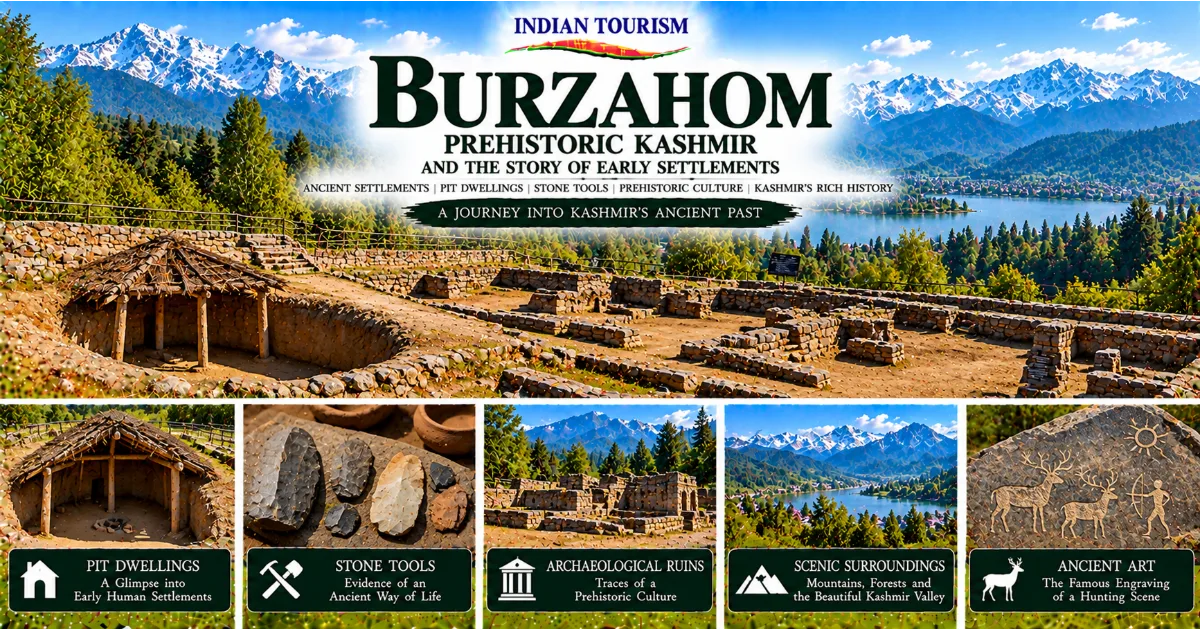
Discovering the Ancient Human Story of the Kashmir Valley
Kashmir is widely known for its snow-covered mountains, tranquil lakes, green meadows and traditional wooden houses. Yet beneath this celebrated landscape lies a much older story, one that reaches far beyond recorded kingdoms, medieval monuments and the development of modern towns. Near Srinagar, the archaeological site of Burzahom offers a remarkable glimpse into the lives of people who inhabited the Kashmir Valley thousands of years ago. Their homes, tools, pottery, animal remains and burial practices provide evidence of a society that gradually developed ways to survive, adapt and establish communities in a challenging mountain environment.
Burzahom is among the most important prehistoric archaeological sites in the Indian subcontinent. Its significance comes from the evidence it preserves of early human settlement, particularly the use of pits as dwellings, the manufacture of stone tools and the changing relationship between people, animals and agriculture. The site helps historians and archaeologists investigate how communities lived before the rise of large cities, formal kingdoms and written historical records in Kashmir.
For travellers interested in history, archaeology, culture and the origins of human settlement, Burzahom offers a different perspective on Jammu and Kashmir. It is not a destination defined by grand palaces or elaborate architectural decoration. Instead, its importance lies in the traces of ordinary lives that survived for millennia. The remains invite visitors to imagine how families organised their homes, prepared food, made tools, cared for animals and responded to the seasonal conditions of the valley.
Where Is Burzahom Located?
Burzahom is situated in the Srinagar region of the Kashmir Valley, northeast of the central urban area and within the broader landscape surrounding Dal Lake. The site lies in an area associated with ancient settlement activity and the distinctive natural geography of Kashmir. Its location is significant because the valley's lakes, wetlands, forests, rivers and surrounding mountains provided resources that early communities could use for food, shelter and movement.
The word Burzahom is commonly associated with the Kashmiri expression referring to a place of birch trees. Birch has long been a characteristic tree of parts of the Himalayan region, particularly at higher elevations. The name reflects the relationship between the landscape and the communities that have lived within it, although the prehistoric inhabitants of the site cannot be assumed to have used the same name.
Burzahom is part of the wider cultural landscape of Kashmir, a region that has supported human communities through changing climatic conditions and economic systems. Its archaeological remains demonstrate that the valley's human history began long before the appearance of the historical settlements that feature prominently in modern travel guides.
Visitors travelling from Srinagar can generally plan Burzahom as a half-day historical excursion, depending on transport arrangements, site access and the amount of time spent exploring the surrounding area. Because archaeological sites are protected heritage locations, travellers should confirm current access arrangements before visiting and follow the instructions of site authorities.
Why Burzahom Matters to Indian Archaeology
Burzahom occupies a special place in the study of prehistoric Kashmir because it provides evidence of settlement practices that are not identical to those found at many other archaeological sites in India. The discovery of pit dwellings, stone implements, pottery and human burials allows researchers to reconstruct aspects of life during periods for which written records do not exist.
Prehistory refers to the period before written historical documentation became available for a particular society. Studying prehistoric communities therefore requires different methods from those used to investigate historical kingdoms. Archaeologists examine physical evidence such as tools, building remains, bones, seeds, pottery and the relationships between objects found in different layers of soil.
At Burzahom, these discoveries help explain how communities adapted to their surroundings and how their way of life changed over time. The site is especially valuable because it preserves evidence of more than one phase of settlement. Researchers have identified cultural developments that include an early Neolithic phase and later periods associated with changes in material culture and settlement practices.
The Neolithic period is often described as the New Stone Age. In many parts of the world, this period involved important changes in how people obtained food, made tools and organised their communities. These changes did not happen in precisely the same way everywhere. Local environments, available resources and cultural traditions influenced how individual communities developed.
Burzahom demonstrates the importance of examining prehistoric societies on their own terms. Rather than assuming that every community followed an identical path towards agriculture or permanent settlement, archaeologists can use the site's evidence to explore the specific choices and adaptations made by people in the Kashmir Valley.
The Discovery and Archaeological Investigation of Burzahom
Modern archaeological investigations brought Burzahom to wider scholarly attention during the twentieth century. Excavations revealed evidence of ancient occupation beneath the present-day landscape, including distinctive pits and a range of objects associated with daily life.
Excavation is a careful scientific process. Archaeologists remove soil in controlled stages, record the position of objects and document the relationships between different layers. These details matter because an object becomes much more informative when researchers know where it was found and which other remains were associated with it.
The discoveries at Burzahom helped establish the importance of Kashmir in discussions of prehistoric settlement in South Asia. Before extensive archaeological work, much of the region's better-known historical narrative focused on later political, religious and cultural developments. Burzahom showed that the valley also possessed a substantial archaeological record extending deep into antiquity.
Researchers have examined the site's dwellings, stone tools, pottery, animal remains and burial evidence to understand its chronology and cultural development. Such interpretations can change as new methods, comparisons and scientific analyses become available. Archaeology is not simply the discovery of old objects. It is an ongoing effort to understand the people who created and used them.
For visitors, the history of archaeological investigation adds another dimension to the experience. The remains visible at a protected site represent only part of a much larger research process involving excavation records, laboratory analysis, comparative studies and the interpretation of evidence collected over many years.
Pit Dwellings: Homes Built into the Earth
One of Burzahom's most distinctive features is its pit dwellings. Instead of constructing every home entirely above ground, inhabitants created pits in the earth and used them as part of their living spaces. This form of construction provides important clues about how prehistoric people adapted their homes to the environmental conditions of the Kashmir Valley.
A pit dwelling generally consists of a depression excavated into the ground. The pit could be used as a sheltered living area, with a superstructure or roof providing additional protection. Depending on the dwelling's design, supports, roofing materials and other structural elements may have been made from wood, branches, plant material and locally available resources.
Building partly below ground can offer practical advantages in a climate where cold weather is an important consideration. The surrounding earth can moderate temperature changes, while a roof and enclosed structure can help protect occupants from wind and precipitation. However, the exact purpose and performance of individual dwellings must be understood through archaeological evidence rather than assumptions about modern construction.
The pits at Burzahom vary in form and size, suggesting that the settlement was not made up of a single standard design. Different structures may have served different purposes or reflected changes in building practices over time. Archaeologists examine features such as the shape of the pit, its depth, access arrangements and associated objects to interpret how each space may have been used.
Imagining a prehistoric household at Burzahom requires looking beyond the physical depression in the ground. A functioning home would have involved activities such as preparing food, maintaining warmth, storing belongings, making tools and caring for children. The layout of the dwelling would have influenced how these activities were organised.
The remains also remind us that architecture does not begin with monumental buildings. Long before palaces, temples and forts appeared across the region, people were developing practical solutions to the everyday problem of creating safe and comfortable places to live.
Living with Kashmir's Mountain Climate
The geography of Kashmir has always shaped the choices available to its inhabitants. The valley experiences marked seasonal changes, and its surrounding mountains influence temperature, rainfall, snowfall and the distribution of natural resources. For prehistoric communities, these conditions would have affected food availability, movement and the construction of shelter.
The use of pit dwellings at Burzahom is often discussed in relation to the need for protection from cold conditions. A partly underground home could offer shelter from exposure and help create a more stable interior environment. Nevertheless, the complete design of prehistoric homes remains a subject for archaeological interpretation, and it is important not to attribute every feature to a single climatic explanation.
The landscape would also have influenced how people collected fuel, found water and obtained materials for tools and construction. Trees, grasses, stones, animal resources and water bodies formed part of the environment within which daily life took place. Access to these resources would have varied according to season and location.
The modern visitor sees a landscape transformed by agriculture, roads, settlements and changing patterns of land use. The prehistoric environment was not identical to the present one. Climate and vegetation have changed over thousands of years, and archaeologists use environmental evidence to reconstruct earlier conditions.
Burzahom therefore provides an opportunity to think about adaptation. Human communities do not simply occupy a landscape. They learn its seasonal rhythms, identify useful resources and modify their behaviour in response to challenges. The site's archaeological evidence gives researchers a way to explore how early inhabitants of Kashmir managed these demands.
Stone Tools and the Skills of Early Communities
Stone tools are among the most important sources of evidence for prehistoric life. Before metal implements became widely available, communities relied heavily on stone for cutting, scraping, shaping and other tasks. The production of these tools required an understanding of suitable materials and the ability to shape them for particular purposes.
At Burzahom, archaeologists recovered stone tools associated with daily activities. Their forms and manufacturing techniques help researchers investigate how people processed materials, prepared food and carried out other practical tasks. Different tools could have been used for different purposes, although determining the exact function of an individual object requires careful analysis.
Toolmaking involved more than striking one stone against another. Skilled toolmakers needed to recognise useful raw materials, understand how stone fractured and select techniques that produced an effective working edge. Knowledge of these processes could be passed between generations through observation and practice.
The archaeological record can also reveal changes in technology. If tool types, materials or manufacturing methods change between occupation phases, researchers may investigate whether those changes reflect new needs, different contacts or developments in local traditions. Such interpretations require comparison with other evidence from the site and the wider region.
For travellers, stone tools can seem small compared with the monumental objects found in later historical sites. Their significance, however, is considerable. A simple cutting implement might represent countless hours of practical knowledge and the ability to transform a natural material into something useful.
The tools of Burzahom also challenge the idea that prehistoric people lived without sophisticated knowledge. Their technology was different from modern technology, but it was adapted to the materials and requirements of their time. Survival depended on observation, memory, cooperation and practical skill.
Pottery and the Changing Organisation of Daily Life
Pottery provides another important source of information about prehistoric communities. Ceramic vessels can be used for preparing, storing and serving food, as well as for other household purposes. Their shapes, surfaces, manufacturing methods and decorative features can help archaeologists compare communities and identify changes over time.
Pottery fragments found at Burzahom contribute to the reconstruction of domestic life. Even when a vessel survives only as broken pieces, its material and form may reveal how it was manufactured and what kinds of activities it might have supported. Researchers study the clay, firing conditions and vessel design to understand the technical knowledge available to the inhabitants.
The production of pottery required a series of decisions. A potter had to select and prepare suitable clay, shape the vessel, allow it to dry and fire it under appropriate conditions. The resulting object needed to be strong enough for its intended use. These processes could be carried out within households or through specialised patterns of production, depending on the community.
Ceramic evidence can also help archaeologists examine the movement of ideas and materials. Similarities between objects from different locations may indicate shared traditions, contact or comparable practical needs. Similar appearance alone does not prove direct contact, so researchers must consider other evidence before drawing conclusions.
At Burzahom, pottery forms part of a broader picture of how people managed food, household equipment and practical activities. The value of these objects lies not only in their age but also in what they reveal about the organisation of everyday life.
From Hunting and Gathering to Food Production
One of the major questions in the study of prehistoric communities concerns the relationship between hunting, gathering, animal management and agriculture. These activities did not necessarily replace one another in a simple sequence. Communities could combine several ways of obtaining food, adjusting their strategies to local conditions and seasonal opportunities.
The archaeological record at Burzahom offers evidence that helps researchers investigate these changing practices. Animal remains, tools, plant-related evidence where available and other finds can be examined together to understand how people obtained and processed food. Different kinds of evidence answer different questions, and conclusions must reflect what the surviving material can support.
Hunting would have required knowledge of animal behaviour, terrain and suitable equipment. Gathering edible plants demanded familiarity with seasonal growth and the distinction between useful and harmful species. Food production, where practised, introduced additional demands involving the management of crops or animals and the organisation of labour.
These activities could have overlapped. A community might have cultivated or managed some resources while continuing to hunt animals and gather wild plants. The balance between different food sources could change according to weather, availability and cultural preferences.
Burzahom is important because it allows archaeologists to examine how subsistence practices developed within the particular environment of Kashmir. The valley's natural resources created opportunities, but the cold season and the changing availability of food would also have required planning.
Food was more than a matter of survival. Its production and preparation influenced where people lived, how they organised their time and how they cooperated with others. The remains of food-related activities can therefore reveal wider aspects of prehistoric society.
Animals and the Relationship Between People and Nature
Animal remains recovered from archaeological sites provide evidence about the relationship between human communities and their environment. Bones can help identify which species were present, how animals may have been used and whether people relied on hunting, herding or a combination of activities.
At Burzahom, animal remains are part of the evidence used to understand prehistoric subsistence and domestic life. They may offer clues about the animals available in the surrounding environment and the ways in which people interacted with them. Archaeologists must examine the context of each discovery before deciding whether an animal was hunted, managed, consumed or associated with another activity.
The relationship between humans and animals can also change over time. Some animals may be hunted for meat, hides or bones, while others may eventually become part of more regular systems of management. Such changes can affect the organisation of settlement, the use of land and the movement of people.
Animals could also have held symbolic or cultural importance. This possibility is particularly relevant when animal remains appear in unusual contexts, including burials or objects that seem to have had special significance. Interpreting these contexts requires caution, because the presence of an animal bone alone cannot establish the beliefs of the people who deposited it.
The evidence from Burzahom encourages visitors to think about prehistoric life as a relationship between people and the natural world. Early inhabitants depended on animals and plants, but they also developed knowledge and practices that helped them make use of the resources around them.
Burials and Beliefs About Death
Burial practices are among the most compelling aspects of prehistoric archaeology because they can reveal how communities treated their dead. Burzahom has produced burial evidence that helps researchers examine the treatment of human remains and the possible cultural meanings associated with death.
Burials may include the position of the body, the arrangement of the grave, objects deposited with the deceased and the relationship between the burial and nearby structures. Each of these details can contribute to interpretation, but no single feature necessarily reveals the full meaning of a burial.
The treatment of the dead can reflect practical concerns, social customs, relationships between households and beliefs about life and death. However, it is not possible to reconstruct an entire religious system from a limited number of graves. Archaeologists must distinguish between what the evidence directly demonstrates and what remains a hypothesis.
Burial practices can also change over time. Different forms of burial at a site may indicate changing customs, different cultural influences or variations within a community. Researchers compare the evidence from multiple graves and occupation phases to determine whether patterns are consistent.
At Burzahom, burial discoveries help place individuals within the broader story of settlement. They remind us that prehistoric communities were not simply groups of people producing tools and finding food. They were human societies with relationships, memories, customs and ways of responding to death.
The archaeological record cannot tell us the personal names or individual stories of most people buried at the site. Nevertheless, the remains establish that people lived and died here across long periods of time, leaving traces that continue to inform research today.
The Famous Engraving of a Hunting Scene
Burzahom is also known for a remarkable engraved stone associated with a hunting scene. The carving has attracted scholarly attention because of its imagery and the questions it raises about the relationship between prehistoric art, observation and possible symbolic expression.
The engraving is commonly discussed as depicting animals and human figures, with interpretations focusing on a hunting scene and a possible celestial element. The precise meaning of the composition has been debated, and it should not be treated as a completely understood illustration of a particular event or belief.
Prehistoric engravings are valuable because they preserve visual information that differs from the evidence provided by tools and bones. An image can reveal which subjects were considered important enough to represent, although it may not provide a direct account of the event or idea behind it.
Researchers examining such objects consider the material, carving technique, style and archaeological context. They may compare the imagery with other archaeological evidence, but interpretations remain limited by the absence of written explanations from the people who created it.
The engraving at Burzahom reminds visitors that artistic expression has deep roots in human history. Long before modern photography, printed books or written descriptions, people used visual forms to represent aspects of their world. Whether the carving recorded an event, conveyed symbolic meaning or combined several ideas remains a matter for careful interpretation.
Its significance lies partly in the questions it raises. The image offers a rare opportunity to consider how prehistoric people observed animals, represented human activity and expressed ideas through visual marks.
What Burzahom Reveals About Social Organisation
Archaeological remains can help researchers investigate how households and communities were organised. The size and arrangement of dwellings, the distribution of tools, evidence of food preparation and the location of burials may provide clues about how people shared space and carried out daily activities.
At Burzahom, the presence of multiple dwelling pits suggests that settlement involved more than one household or living unit. The relationship between these structures can help archaeologists consider whether domestic activities were organised within individual households or shared across the wider community.
However, the existence of separate dwellings does not automatically reveal the exact structure of family relationships or leadership. Archaeologists cannot confidently assign modern social categories to prehistoric households without supporting evidence. Instead, they examine patterns in the archaeological record and consider several possible explanations.
Cooperation would have been important in many aspects of life. Building shelters, gathering materials, obtaining food and caring for young members of a community all required time and practical knowledge. People may have exchanged skills and shared responsibilities in ways that are difficult to reconstruct directly.
The development of a settlement also involves choices about where to place homes, how to reach water and how to organise activities around available resources. These choices reveal how communities responded to their surroundings and managed their collective needs.
Burzahom allows researchers to explore these questions without assuming that prehistoric society was either entirely simple or organised in the same way as a modern village. The evidence points towards a community whose daily life involved technology, environmental knowledge and social relationships.
Burzahom Within the Wider History of Kashmir
The history of Kashmir did not begin with its medieval rulers, famous temples, religious institutions or later centres of learning. Those developments belong to a much longer sequence of human occupation and cultural change.
Burzahom provides evidence for an early chapter in that sequence. Its prehistoric remains demonstrate that people were establishing settlements and developing distinctive ways of life in the valley thousands of years before the political and cultural institutions documented in later historical sources.
Kashmir's location between the plains of the Indian subcontinent and the mountain regions of Central and South Asia makes its archaeological record especially interesting. Mountain passes and regional routes have connected different areas over long periods, although specific relationships between prehistoric communities must be established through evidence rather than assumed from geography alone.
Archaeologists compare Burzahom with other sites in Kashmir and beyond to investigate similarities and differences in settlement design, tools, pottery and subsistence practices. These comparisons help identify local traditions and possible connections with wider cultural developments.
The site's importance is not that it explains every stage of Kashmir's history. Instead, it provides one essential part of the larger picture. Later kingdoms, architectural traditions and cultural achievements developed within a landscape that had already supported human communities for many generations.
For visitors, Burzahom broadens the meaning of heritage. Heritage includes not only the buildings and monuments that remain visible above ground but also archaeological evidence of communities whose names and languages may no longer be known.
The Archaeological Landscape and Heritage Conservation
Archaeological sites are fragile resources. Soil layers, exposed structures and ancient objects can be damaged by weather, uncontrolled construction, inappropriate visitor activity and the removal of materials. Once an archaeological context is destroyed, information that could have helped researchers understand the past may be lost permanently.
Burzahom's value therefore depends on responsible conservation. Protecting the site involves maintaining its physical remains, documenting its condition and managing access in ways that allow research and public appreciation to continue. Conservation is not simply a matter of making a site look attractive. It requires preserving the evidence that makes the place historically meaningful.
Visitors can contribute to this effort through simple, responsible behaviour. They should remain within permitted areas, avoid climbing on fragile remains, refrain from touching or moving archaeological objects and follow instructions from site staff. Even a small stone or pottery fragment can be part of a larger archaeological record.
Photography should be carried out respectfully and according to any restrictions in place. Travellers should also avoid leaving litter and should not carve names, markings or messages into the ground or nearby structures.
Local communities are important partners in heritage protection. Archaeological places exist within living landscapes, and conservation works best when the people who live nearby understand the value of the site and can benefit from responsible heritage tourism.
Burzahom offers an opportunity to connect tourism with education. Visitors who learn about the site's importance can help encourage wider appreciation of Kashmir's prehistoric heritage and support the preservation of archaeological resources for future generations.
Planning a Visit to Burzahom
Burzahom can be included in a broader heritage-focused visit to the Srinagar area. Travellers interested in archaeology may choose to combine the site with other cultural attractions, traditional neighbourhoods or landscape destinations, depending on their available time and current access conditions.
Before travelling, visitors should confirm whether the archaeological site is open to the public, whether guided visits are available and whether any seasonal or conservation-related restrictions apply. Access arrangements can change, so relying on old travel information may lead to disappointment.
A visit is likely to be most rewarding for people who have some interest in prehistoric history. Unlike a museum filled with reconstructed scenes or a monument covered in elaborate decoration, an archaeological site may require visitors to use their imagination and knowledge to understand what remains visible.
Reading a little about Neolithic life before arriving can help make the experience more meaningful. Understanding the purpose of pit dwellings, the role of stone tools and the significance of burial practices provides a useful framework for interpreting the site.
Visitors should also allow time to appreciate the surrounding landscape. The relationship between the settlement and its environment is central to understanding why people chose to live in this part of Kashmir. The terrain, access to natural resources and seasonal conditions were not background details. They were essential elements of prehistoric life.
Because the site is part of a living region, travellers should be considerate of local residents and follow established transport and visitor arrangements. A thoughtful visit can combine historical learning with respect for the contemporary community.
Best Time to Explore Burzahom
The most suitable time for a visit depends on weather, accessibility and the wider travel itinerary. Spring and autumn are often comfortable seasons for exploring the Srinagar region, with opportunities to enjoy the landscape as well as its historical sites. Summer can also be suitable, although popular destinations may experience greater visitor activity.
Winter brings cold conditions to Kashmir, and weather can affect road travel and outdoor sightseeing. Travellers planning a winter visit should check current forecasts and local advice before setting out. Conditions can vary significantly from one day to another.
The archaeological site should not be approached as a place that offers the same experience in every season. Ground conditions, visibility and the surrounding landscape may change throughout the year. Visitors should also remember that conservation requirements take priority over convenience, and some areas may be restricted regardless of the season.
For a history-focused itinerary, it is sensible to visit during daylight hours and allow enough time to understand the archaeological context. A rushed stop may provide photographs but little opportunity to appreciate why Burzahom matters.
Who Should Visit Burzahom?
Burzahom is especially suitable for travellers who enjoy history, archaeology and cultural learning. Students, teachers, researchers and families with an interest in the past may find it particularly rewarding because it introduces a period of human history that is rarely represented by monumental architecture.
The site can also appeal to visitors who have already explored Srinagar's better-known attractions and want to understand a different aspect of the region. Kashmir's lakes, gardens and mountain scenery are important parts of its tourism identity, but prehistoric archaeology adds depth to the experience.
Families can use a visit as an opportunity to discuss how people lived before electricity, modern buildings, written records and contemporary transport. Children may find the idea of houses built partly underground particularly interesting, while older visitors can explore the wider questions surrounding agriculture, technology and social organisation.
Photography enthusiasts may appreciate the contrast between the archaeological remains and the natural landscape. However, the site is most rewarding when visitors look beyond photographs and take time to consider the evidence that has survived.
Burzahom may be less immediately dramatic than a large palace or a mountain viewpoint, but its historical importance makes it a valuable destination for thoughtful travellers.
Why Burzahom Deserves a Place in Indian Tourism
Indian tourism is often presented through famous monuments, religious destinations, beaches, wildlife reserves and scenic landscapes. These categories are important, but the country's archaeological heritage deserves equal attention. Sites such as Burzahom show how much can be learned from modest physical remains when they are studied carefully.
Burzahom represents an opportunity to bring prehistoric history into mainstream travel. It connects the modern visitor with a period in which communities were developing practical technologies, managing food resources and establishing settlements in the Himalayan environment.
Promoting archaeological tourism can also support educational travel. Schools, colleges and cultural organisations can use sites like Burzahom to encourage interest in archaeology, anthropology and the study of early societies. A visit can make concepts from history books more tangible by connecting them with a real place.
Responsible tourism can help increase public awareness, but it must be balanced with conservation. The goal should not be to transform every archaeological location into a heavily commercial attraction. Instead, tourism should encourage learning, respect and long-term protection.
Burzahom's greatest contribution may be the way it changes our perspective on Kashmir. The valley is not only a landscape of spectacular mountains and later cultural achievements. It is also a place where people developed ways of living, adapting and building communities over thousands of years.
Conclusion: Listening to the Deep Past of Kashmir
Burzahom offers a rare opportunity to explore the prehistoric foundations of life in the Kashmir Valley. Its pit dwellings, stone tools, pottery, animal remains, burials and engraved stone provide evidence of communities whose everyday activities shaped an important chapter in the region's history.
The site demonstrates that the story of Kashmir extends far beyond written chronicles and monumental architecture. Long before the emergence of later kingdoms and celebrated cultural centres, people were adapting to the valley's environment, developing practical skills and creating traditions that archaeologists continue to investigate.
For travellers, Burzahom is a destination that rewards curiosity. Its importance lies not in grandeur but in the details of human life preserved within the archaeological record. Each surviving feature offers a chance to consider how people lived, worked, learned and responded to the world around them.
A visit to Burzahom can deepen an understanding of Jammu and Kashmir by connecting its present landscape with its distant past. It reminds us that history is not limited to famous rulers or spectacular monuments. It also belongs to the people who built homes, prepared food, made tools and created communities long before their names entered written records.
Protecting Burzahom means preserving more than an ancient settlement. It means safeguarding evidence of humanity's shared journey and ensuring that future generations can continue to investigate the remarkable history of prehistoric Kashmir.
#IndianTourism #Burzahom #KashmirTourism #PrehistoricIndia #AncientKashmir #ArchaeologyOfIndia #NeolithicPeriod #KashmirHistory #CulturalHeritage #HeritageTourism #ExploreKashmir #JammuAndKashmir #IndianHistory #ResponsibleTourism
