
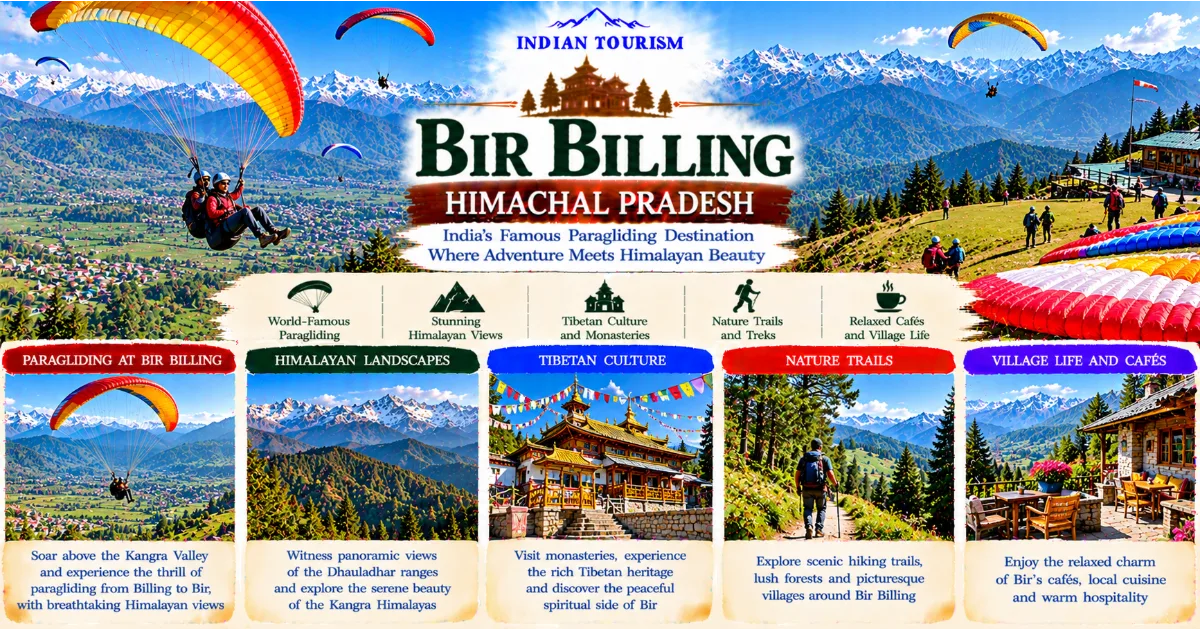
Discovering the Adventure Capital of the Kangra Valley
Himachal Pradesh offers countless ways to experience the Himalayas, from peaceful lakes and ancient temples to forest trails, traditional villages and high mountain passes. Among its most exciting destinations, Bir Billing stands out for its combination of adventure sports, Tibetan cultural heritage, mountain scenery and relaxed village life. Located in the Kangra region, Bir is widely known as a major paragliding destination, while Billing serves as the high-altitude take-off area that makes the experience possible.
The destination attracts adventure enthusiasts, backpackers, photographers, spiritual travellers and people who simply want to spend time in the mountains. Some visitors arrive specifically to experience tandem paragliding above the valleys, while others come to explore monasteries, enjoy local cafés, walk through nearby villages or learn about the Tibetan community that has shaped Bir's cultural identity.
Bir and Billing offer two different but closely connected experiences. Bir is the principal settlement where many visitors find accommodation, restaurants, shops and cultural attractions. Billing lies higher in the mountains and is associated with paragliding take-offs and expansive views across the Himalayan landscape. The road between them passes through changing scenery, with forested slopes and open mountain areas creating an appealing journey in its own right.
Beyond adventure tourism, Bir has developed a distinctive atmosphere shaped by meditation centres, monasteries, traditional livelihoods and a growing community of travellers. The destination offers opportunities to combine outdoor activities with cultural exploration, making it suitable for a wider range of visitors than those interested only in extreme sports.
However, the popularity of Bir Billing also means that visitors should choose activity providers carefully, follow safety instructions and respect local communities. Weather conditions influence paragliding operations, and flights may be cancelled even when the day appears suitable from the ground. Responsible travel involves accepting these limitations and prioritising safety over a fixed schedule.
For travellers exploring Himachal Pradesh, Bir Billing offers a memorable combination of adventure, culture and mountain life. It is a destination where the excitement of flight can be balanced with quieter experiences on the ground.
Where Are Bir and Billing Located?
Bir is located in the Kangra region of Himachal Pradesh, in the western Himalayas. Billing lies at a higher elevation above Bir and is closely associated with the area's paragliding activity. Together, they form one of the best-known adventure tourism destinations in the state.
The landscape around Bir includes agricultural fields, small settlements, forested slopes and distant mountain views. The lower settlement has a more developed tourism environment, with accommodation, cafés and services catering to visitors. As travellers move towards Billing, the landscape becomes more mountainous and open.
The difference in elevation between Bir and Billing is central to their relationship. Paragliding pilots use the higher take-off area at Billing before descending towards the landing area near Bir, subject to suitable wind, visibility and operational conditions. The precise launch and landing arrangements depend on weather and the decisions of authorised operators.
Bir's position also makes it possible to explore other parts of Kangra district. Travellers may combine their visit with nearby cultural destinations, tea-growing areas, mountain villages or heritage sites, depending on available time and transport.
The destination can be reached by road from several towns in Himachal Pradesh. However, travel times depend on the starting point, traffic, road conditions and the route chosen. Visitors should confirm current transport arrangements before departure.
Bir Billing is best understood as a destination with two complementary centres. Bir provides the settlement, accommodation and cultural experience, while Billing offers the high mountain environment associated with paragliding and panoramic views.
Why Bir Billing Is Famous for Paragliding
Bir Billing has earned an international reputation as a paragliding destination because of its mountain terrain, elevation difference and flying conditions during suitable weather periods. The combination of a high launch area and a lower landing area creates opportunities for pilots to gain height and travel across the surrounding landscape when conditions allow.
Paragliding involves flying beneath a fabric wing using airflow, gravity and the pilot's control inputs. Unlike powered aircraft, a conventional paraglider does not have an engine. The pilot relies on appropriate launch conditions, air movement and skill to control the flight.
At Billing, pilots prepare for take-off in an elevated mountain environment. After launching, they may glide across the valley and descend towards the landing area near Bir. The route, duration and overall experience depend on weather, pilot decisions and the type of flight offered.
For visitors, tandem paragliding is a common way to experience the activity without learning to pilot a paraglider independently. A trained pilot controls the flight while the passenger is secured in a harness. Before booking, travellers should confirm the operator's qualifications, equipment standards, insurance arrangements where applicable and safety procedures.
The reputation of a destination does not eliminate the risks of adventure sports. Wind conditions can change, visibility may deteriorate and flights can be cancelled. A responsible operator should be willing to postpone or cancel an activity when conditions are unsuitable.
Visitors should never pressure a pilot to fly simply because they have travelled a long distance or paid in advance. Safety decisions must take priority over convenience.
Billing: The High Mountain Take-Off Area
Billing is the high-altitude location most closely associated with the paragliding experience at Bir. Its elevated position provides the geographical advantage required for flights towards the lower valley.
The journey from Bir to Billing is a significant part of the experience. The road climbs through mountainous terrain, passing forested slopes, open areas and changing views. Depending on the weather, travellers may see layers of hills stretching into the distance.
The landscape at Billing can feel quite different from the settlement below. Temperatures may be lower, wind can be stronger and weather can change quickly. Visitors who travel to the launch area should bring warm clothing and follow instructions from their operator or guide.
Billing is not simply a viewpoint where visitors can expect a flight to be available at any time. Paragliding operations depend on specific weather and safety requirements. Wind direction, wind strength, cloud cover and visibility all influence whether a flight can proceed.
Visitors who are not flying may still appreciate the mountain scenery, provided access is permitted and conditions are safe. However, they should avoid walking into launch areas or obstructing pilots and ground staff.
The high-altitude environment requires care. Do not approach steep edges, stand in the path of a launching paraglider or enter restricted operational areas for photographs.
Billing's importance lies in its combination of mountain geography and adventure activity. Its relationship with Bir has helped establish the wider destination as a major centre for paragliding in India.
The Paragliding Experience: What Visitors Can Expect
For many visitors, a tandem paragliding flight is the main reason to travel to Bir Billing. The experience begins with a briefing from the operator, followed by preparation of the harness and other equipment. The pilot explains the passenger's role during take-off, flight and landing.
Passengers should listen carefully and follow the pilot's instructions. Depending on the launch conditions, the pilot may ask the passenger to run a few steps during take-off. The landing procedure may involve keeping the legs positioned as instructed and preparing to stand or run briefly when the paraglider reaches the ground.
Once airborne, the experience can feel surprisingly peaceful. The surrounding hills, fields and villages appear from a new perspective, and the sound of the wind may replace the noise of roads and crowds below.
Some flights may include gentle turns or additional manoeuvres when the pilot considers them appropriate and the passenger is comfortable. Visitors should communicate any concerns before take-off and should not feel pressured to agree to manoeuvres they do not want.
Flight duration varies according to the package, weather, air conditions and operator arrangements. Travellers should ask what is included before paying, including whether photographs or videos are provided and whether these cost extra.
Not everyone is suitable for every flight. Age, weight, health, mobility and other requirements depend on the operator and applicable safety rules. Visitors should disclose relevant information honestly and follow any restrictions.
The most important part of the experience is not simply being airborne. It is participating in an adventure activity with appropriate preparation, a qualified pilot and a clear understanding that weather may change the plan.
Best Time for Paragliding in Bir Billing
Paragliding depends heavily on weather, so the best time to visit is not determined by calendar dates alone. Wind conditions, visibility, cloud development and local operational decisions determine whether flights can take place.
Autumn is often regarded as a favourable period for paragliding in Bir Billing because conditions can provide clear mountain views and suitable flying weather. Spring can also attract visitors, although conditions vary from day to day.
During warmer months, weather may support outdoor activities, but the monsoon season can bring rain, cloud cover and unstable conditions. Flights may be cancelled when conditions are unsuitable, and road travel may also be affected by heavy rainfall.
Winter can provide beautiful mountain scenery, but colder temperatures and weather variations may affect flight availability. Visitors should confirm current operating schedules rather than assuming that flights run every day.
Travellers planning a paragliding experience should allow more than one possible day for the activity if their schedule permits. This provides flexibility if the weather changes or an operator cancels flights.
It is sensible to book with an established operator, confirm the expected meeting time and understand the cancellation or rescheduling policy before making payment. Do not rely on promotional photographs as proof that a flight will be possible on a particular date.
The safest flight is one that takes place only when the pilot and operator consider conditions appropriate. A cancelled flight can be disappointing, but it is a necessary part of responsible adventure tourism.
Beyond Paragliding: Exploring Bir Village
Although Bir is internationally known for paragliding, its village atmosphere is equally important to its identity. The settlement includes traditional neighbourhoods, agricultural areas, local businesses and cultural spaces that provide a different experience from the high-altitude launch site.
Walking through accessible village areas allows visitors to observe how tourism interacts with everyday life. Shops, cafés and guesthouses serve travellers, while farming, local trade and community activities continue alongside the tourism economy.
The pace of life can feel more relaxed than in larger hill stations. Visitors often spend time walking, reading, talking with other travellers or enjoying the mountain views from cafés and accommodation courtyards.
Bir is also associated with the Tibetan community and Buddhist institutions in the wider area. This cultural presence has contributed to the destination's distinctive character and attracts visitors interested in religious architecture, meditation and Tibetan traditions.
Travellers should remember that Bir is a living community rather than an attraction designed exclusively for visitors. Residential lanes, farms and religious spaces deserve respect. Ask permission before photographing people or entering private property.
Exploring Bir on foot can be one of the most rewarding ways to experience the destination. It provides time to notice details that may be missed when travelling only between adventure activity locations.
Tibetan Culture and the Heritage of Bir
Bir is closely associated with Tibetan cultural life in Himachal Pradesh. The wider area has become home to Tibetan communities, religious institutions and cultural activities that contribute to the region's identity.
Tibetan Buddhist traditions place importance on spiritual practice, learning, compassion and the preservation of religious teachings. Monasteries can serve as places of worship, study, community gathering and cultural continuity.
Visitors may encounter prayer flags, religious artwork, traditional colours and architectural features associated with Tibetan Buddhist institutions. These elements should be approached with respect and an understanding that they have religious significance beyond their appearance.
Cultural traditions are not identical across every institution or community. Practices, ceremonies and access arrangements may vary, so visitors should follow local guidance rather than assume that all monasteries operate in the same way.
Bir's cultural environment also reflects the wider history of migration and settlement. Communities have maintained traditions while adapting to life in Himachal Pradesh, creating a distinctive cultural landscape that differs from other parts of the state.
Travellers interested in learning more can visit accessible cultural institutions, observe public areas and purchase locally produced crafts where available. A respectful conversation with a knowledgeable guide may provide context that is not apparent from architecture alone.
Photography should be approached carefully. Some monasteries restrict photography inside prayer halls or during ceremonies. Ask before taking photographs and avoid interrupting religious activities.
Bir's cultural identity is one of its strongest attractions. It offers visitors the opportunity to understand the Himalayas not only through scenery and adventure, but also through living traditions and community life.
Monasteries and Spiritual Places Around Bir
Monasteries are an important part of the cultural experience in Bir and the surrounding region. They provide spaces for Buddhist practice, education and community activities, while also preserving forms of art and architecture.
A monastery visit can be a quiet and meaningful addition to a trip focused on outdoor adventure. Visitors may observe the design of prayer halls, traditional decorative features and the arrangement of buildings within the wider landscape.
However, monasteries are active religious institutions, and access may vary according to the time of day, ceremonies and local rules. Some areas may be closed to visitors, and certain events may not be suitable for photography or sightseeing.
Before entering, check whether visitors are welcome and whether any special instructions apply. Dress modestly, keep noise low and avoid touching religious objects unless invited to do so.
Visitors should not treat monks or worshippers as tourist subjects. Ask permission before taking close-up photographs, and accept a refusal without argument.
Some travellers choose to include meditation or cultural learning in their visit. If an institution offers an organised programme, confirm its schedule, expectations and any participation requirements in advance.
The monasteries around Bir provide a perspective on the spiritual traditions that have helped shape the destination. Their value lies not only in their visual appeal, but also in their continuing role within the community.
Bir Landing Site and the Valley Landscape
The landing area near Bir is an important part of the paragliding system. It is where flights generally conclude under suitable conditions, and it provides an opportunity for visitors to observe the activity from the ground.
Paragliders arriving over the valley create a distinctive sight as their wings move across the sky before descending towards the landing zone. The area can become busy during popular flying periods, with pilots, passengers and ground staff coordinating activity.
Visitors should remain outside marked or active landing areas unless instructed otherwise. Paragliders require space to descend and land safely, and walking into the landing path can create unnecessary risks.
The surrounding valley landscape includes fields, roads, settlements and distant hills. It offers photographic opportunities even for visitors who do not plan to fly.
The landing area also illustrates the relationship between adventure tourism and local land use. Suitable open space is necessary for safe operations, while the surrounding land may serve agricultural, residential or other purposes.
Travellers should avoid damaging crops, leaving rubbish or blocking access routes. Respecting land boundaries is particularly important in areas where tourism activity takes place close to working fields and homes.
Watching paragliders land can be enjoyable, but visitors should prioritise safety and follow the instructions of staff. The best viewing location is one where spectators can remain clear of flight operations.
Trekking and Nature Walks Around Bir
Bir and the surrounding hills offer opportunities for walking and exploring the mountain environment. Depending on the route, visitors may encounter village paths, forested slopes, agricultural fields and viewpoints across the Kangra region.
Walking is a useful way to experience the destination at a slower pace. It allows travellers to observe vegetation, architecture and local life without relying on motor transport for every short journey.
The difficulty of a walk depends on elevation, distance, surface conditions and weather. Some paths may be suitable for casual visitors, while others require more fitness, appropriate footwear and local guidance.
Travellers should ask about route conditions before setting out. Rain can make paths slippery, and fog or low cloud may reduce visibility. In unfamiliar terrain, a local guide can help with route selection and provide information about the area.
Carry water, snacks and a charged phone. Tell someone where you are going and when you expect to return, especially if exploring a longer route.
Stay on established paths and avoid walking through private fields without permission. Do not disturb livestock or wildlife, and carry all rubbish back to suitable disposal points.
Nature walks can provide an excellent balance to the excitement of paragliding. They allow visitors to appreciate the quieter aspects of Bir and gain a deeper understanding of the landscape that makes the destination so distinctive.
Mountain Biking and Other Outdoor Activities
The terrain around Bir Billing can attract visitors interested in outdoor activities beyond paragliding. Mountain biking, cycling on suitable roads and guided nature excursions may be available through local providers, depending on conditions and current services.
Mountain biking requires suitable equipment, an appropriate route and an honest assessment of skill level. Steep gradients, loose stones, uneven surfaces and traffic can create hazards, particularly for inexperienced riders.
Visitors should confirm the condition of equipment, helmet availability, route difficulty and any support arrangements before booking. A route described as scenic may still be physically demanding or technically challenging.
Cycling on public roads requires particular caution. Mountain roads can be narrow, with sharp bends and limited visibility. Riders should remain aware of vehicles, avoid risky descents and use appropriate safety equipment.
Other outdoor experiences may include guided walks, nature observation and local excursions. Availability varies, so travellers should confirm what is actually offered during their visit.
Adventure activities should always be selected according to fitness, experience and current conditions. Visitors should not feel pressured to attempt something simply because it is popular among other travellers.
Bir Billing is rewarding because it offers a range of ways to engage with the landscape. Responsible choices allow visitors to enjoy these activities without taking unnecessary risks.
Cafés, Local Food and the Social Atmosphere
Bir has developed a café culture that reflects its popularity among backpackers, adventure travellers and visitors interested in a relaxed mountain lifestyle. Depending on the establishment, travellers may find Indian meals, Tibetan-inspired dishes, baked goods, coffee and other casual dining options.
The variety of food available can be wider than in smaller mountain settlements because Bir receives visitors throughout the year. However, menus, opening hours and availability change, so travellers should not assume that every establishment will be open during their visit.
Local food traditions remain an important part of the wider Kangra region. Visitors may encounter regional meals in local eateries or accommodation, while Tibetan cultural influences may be reflected in some menus.
Travellers with dietary restrictions should ask about ingredients and preparation methods. If a particular food is important to the itinerary, confirm availability before arriving.
Cafés can also provide spaces to rest between activities, read, work remotely or meet other travellers. Visitors should respect business rules and avoid occupying tables for long periods when the establishment is crowded.
Supporting locally operated businesses can help ensure that tourism contributes to the community. Choose legitimate establishments, pay agreed prices and treat staff respectfully.
The social atmosphere of Bir is part of its appeal. It allows visitors to combine outdoor adventure with a more leisurely experience of mountain life.
Shopping and Local Products
Shopping in Bir is generally a modest experience rather than a major attraction in itself. Visitors may find locally made crafts, clothing, souvenirs, travel supplies and products connected with the wider cultural environment.
Some shops may offer Tibetan-inspired handicrafts or decorative items, although the origin and authenticity of products can vary. Travellers interested in cultural crafts should ask sellers about the item and avoid assuming that every product is handmade locally.
Purchasing from local artisans and legitimate businesses can support the community. Visitors should agree on prices before completing a purchase and keep receipts when appropriate.
Avoid buying products made from protected wildlife or other restricted materials. Responsible shopping means considering both the origin of an item and its potential environmental or cultural impact.
Shopping should not replace the broader experience of exploring Bir. The destination's main attractions remain its mountain environment, adventure opportunities and cultural heritage.
Visitors can also support local livelihoods by choosing locally operated accommodation, transport and food services.
Best Time to Visit Bir Billing
The best time to visit Bir Billing depends on the activities planned, particularly whether paragliding is a priority. Weather conditions can vary from day to day, and flight operations may be cancelled when conditions are unsuitable.
Spring: March to April
Spring can be a pleasant time to explore Bir. Temperatures begin to rise, and the surrounding landscape gradually changes with the season. Visitors may enjoy village walks, cultural sites and outdoor activities when conditions are suitable.
Paragliding availability depends on wind and visibility, so travellers should confirm current operations rather than assuming that flights will take place every day.
Summer: May to June
Summer is a practical period for exploring the village and surrounding region. Daytime temperatures may be comfortable for walking and sightseeing, although conditions vary with elevation and weather.
The area can attract visitors during holidays, so accommodation should be booked in advance if travelling at a busy time.
Monsoon: July to September
The monsoon brings rainfall and can make the landscape greener. However, heavy rain may affect road access, trails and outdoor activities.
Paragliding depends on suitable weather, and flights may be cancelled during periods of poor visibility or unstable conditions. Visitors should remain flexible and avoid travelling on unsafe roads.
Autumn: October to November
Autumn is often considered an attractive period for visiting Bir Billing, especially for travellers interested in paragliding and clear mountain scenery. Conditions can be favourable, but no particular day guarantees a flight.
Book with a reputable operator and allow flexibility in the schedule.
Winter: December to February
Winter brings colder temperatures, particularly at higher elevations. The village may still be enjoyable to explore, but outdoor activities depend on local conditions and operating schedules.
Visitors should carry warm clothing and confirm accommodation, transport and flight availability before travelling.
For travellers whose main goal is paragliding, spring and autumn are often useful periods to consider. The actual decision should always be based on current conditions and operator guidance.
How to Reach Bir Billing
Bir is accessible by road, with onward travel required to reach Billing. Transport arrangements depend on the starting point and the type of experience planned.
By Road
Travellers can reach Bir by road from several towns in Himachal Pradesh and neighbouring regions. The route and travel time depend on the starting point, traffic and road conditions.
If driving, prepare for mountain roads and allow extra time for delays. Drivers should avoid rushing, especially on unfamiliar routes with sharp bends.
Billing is reached by continuing uphill from Bir along a mountain road. Visitors planning to fly should confirm transport arrangements with their operator, including the meeting point and expected departure time.
By Bus
Bus services connect Bir and the surrounding region with other towns, although schedules and direct connections may vary. Confirm current services before departure.
If arriving at a nearby town, check whether onward transport is available and allow sufficient time for the connection.
By Train
Travellers may use railway services serving the broader Kangra region, but the suitability of a station depends on the route and current service availability. The final journey to Bir requires road transport.
Verify railway schedules and onward connections before booking.
By Air
Travellers arriving by air may consider an airport serving the Kangra region or another airport suitable for their wider itinerary. The final journey to Bir requires road transport, and the most convenient option depends on current flight schedules and road conditions.
Local Transport
Taxis and other local transport options may be available for journeys between Bir, Billing and nearby destinations. Confirm the price, route and timing before beginning the trip.
For paragliding, use the transport arrangements recommended by the operator rather than improvising a last-minute journey to the launch site.
Accommodation in Bir
Bir offers a range of accommodation options that may include guesthouses, homestays, hostels, hotels and smaller properties. Availability and facilities vary by season and location.
Hostels and budget guesthouses may appeal to backpackers and solo travellers, while couples and families may prefer private rooms or properties with additional facilities. Travellers interested in cultural experiences may choose a locally operated homestay.
Before booking, confirm heating, hot water, meals, parking, connectivity and cancellation terms. These details can be especially important during colder months or periods of poor weather.
Visitors planning to paraglide should consider the location of their accommodation relative to the operator's meeting point. An early start may be necessary, and arranging transport in advance can reduce stress.
During busy periods, accommodation can become more difficult to find. Booking ahead is advisable, particularly for weekends, holidays and popular paragliding seasons.
A longer stay can provide more flexibility if flights are cancelled or the weather changes. It also allows time to explore cultural sites and nearby villages rather than concentrating on a single activity.
Bir Billing for Families, Couples and Solo Travellers
Bir Billing can suit different types of travellers, provided the itinerary is planned around individual needs and interests.
For Families
Families can enjoy the village, cafés, cultural sites and surrounding scenery. Paragliding may be available to eligible participants, but age, weight and other requirements depend on the operator.
Children should be supervised near roads, active landing areas and steep terrain. Families should choose activities according to the comfort and abilities of each member.
For Couples
Couples may enjoy the combination of mountain views, cafés, village walks and adventure activities. A relaxed itinerary can balance paragliding with cultural exploration and time spent enjoying the landscape.
If a flight is a major part of the trip, allow an additional day where possible in case weather conditions prevent the activity.
For Solo Travellers
Bir's accommodation and café environment can make it appealing to solo visitors. However, travellers should confirm transport arrangements, use reputable activity providers and share plans when exploring unfamiliar routes.
Solo visitors should avoid isolated trails in poor weather and follow safety instructions during adventure activities.
For Adventure Enthusiasts
Paragliding is the destination's main draw for many adventure travellers. Other activities may also be available, depending on the season and providers.
Choose activities according to experience and fitness, and prioritise operator qualifications, equipment standards and weather conditions.
For Cultural Travellers
Bir offers opportunities to explore Tibetan cultural heritage, monasteries and the wider traditions of the Kangra region. Respectful visits can provide a deeper understanding of the destination beyond adventure tourism.
A Suggested Two-Day Bir Billing Itinerary
A two-day itinerary provides a practical introduction to the destination, although visitors who want to paraglide should consider allowing an additional day for weather flexibility.
On the first day, arrive in Bir and settle into accommodation. Spend the afternoon exploring accessible village areas, visiting suitable cultural sites and enjoying the local food scene. Confirm the paragliding arrangements for the next day and ask the operator about the meeting point, equipment and weather policy.
On the second day, follow the operator's instructions if conditions permit a flight. Arrive on time, listen carefully to the briefing and follow the pilot's directions. If the flight is cancelled, use the time to explore the village, enjoy a walk on a suitable route or visit a cultural attraction.
In the afternoon, spend time around the landing area from a safe public location or explore the surrounding countryside. Avoid entering active flight zones.
If time permits, use the evening to learn more about the local community or enjoy a relaxed meal. Travellers with additional days can explore nearby destinations without rushing.
A Three-Day Itinerary for a More Complete Experience
A three-day visit allows more time for both adventure and cultural exploration.
On the first day, arrive in Bir, settle into accommodation and explore the village. Visit accessible cultural sites, enjoy local food and confirm arrangements with any activity providers.
On the second day, plan the paragliding experience if the weather is suitable. Keep the rest of the day flexible in case the activity is delayed or cancelled. If flying is not possible, explore the surrounding landscape or arrange a suitable guided walk.
On the third day, explore another part of the Kangra region or spend more time learning about local culture. Choose a destination that fits the available transport and travel time rather than attempting to cover too many places.
This itinerary gives visitors a better chance of experiencing the different sides of Bir Billing. It also reduces pressure to complete the paragliding activity on one fixed day.
Responsible Tourism in Bir Billing
Tourism brings economic opportunities to Bir, but it also creates responsibilities for visitors. The destination's landscape, cultural institutions and local communities should be treated with care.
Choose reputable paragliding operators and follow all safety instructions. Never pressure pilots to fly when weather conditions are unsuitable.
Respect the landing area and launch site. Keep clear of active flight operations and follow staff instructions.
At monasteries and religious institutions, dress respectfully, keep noise low and ask before taking photographs. Do not interrupt ceremonies or enter restricted areas.
Avoid littering in fields, forest paths and village streets. Carry rubbish to appropriate disposal points and reduce single-use packaging where possible.
Support local businesses and treat workers fairly. Purchasing services from legitimate local providers can help tourism contribute to the regional economy.
Respect private land and agricultural activity. Ask permission before photographing residents or entering property.
Responsible tourism helps maintain the balance between adventure, culture and community life that makes Bir Billing distinctive.
Practical Travel Tips for Bir Billing
Book accommodation in advance during popular periods, particularly if you plan to fly.
Allow flexibility in your itinerary because paragliding depends on weather and may be cancelled.
Confirm the operator's safety procedures, equipment standards, passenger requirements and cancellation policy before paying.
Carry warm clothing for Billing, where conditions can be colder and windier than in Bir.
Wear comfortable footwear for walking and suitable clothing for the planned activities.
Keep essential medication and personal supplies with you, and disclose any relevant health or mobility concerns to the activity provider.
Download maps and important travel information before leaving areas with reliable connectivity.
Follow all instructions at launch and landing sites, and never enter active flight areas without permission.
Respect monasteries, local customs and private property. Ask before photographing people or religious activities.
Conclusion: Why Bir Billing Deserves a Place on Your Himachal Pradesh Itinerary
Bir Billing is one of Himachal Pradesh's most distinctive destinations because it combines adventure sports with cultural heritage and a welcoming mountain settlement. Its international reputation for paragliding attracts visitors from across India and beyond, while its monasteries, cafés, village paths and surrounding scenery offer plenty to explore beyond the sky.
The relationship between Bir and Billing is central to the experience. Bir provides accommodation, food, cultural attractions and a relaxed village atmosphere, while Billing offers the high mountain setting associated with paragliding. Together, they create a destination that appeals to adventure enthusiasts, cultural travellers, couples, families and solo visitors.
A successful visit requires careful planning. Weather determines whether flights can operate, mountain roads can be affected by changing conditions, and adventure activities require appropriate safety standards. Visitors should choose reputable operators, follow instructions and allow flexibility in their schedules.
The cultural side of Bir deserves equal attention. Tibetan traditions, monasteries and local community life give the destination a character that extends beyond adventure tourism. Respectful exploration helps travellers appreciate these traditions without treating them as mere attractions.
For anyone exploring Himachal Pradesh, Bir Billing offers an opportunity to experience the Himalayas from several perspectives. Whether the highlight is a tandem flight, a quiet walk through the village, a visit to a monastery or a view of the mountains from Billing, the destination rewards visitors who combine curiosity with responsible travel.
#IndianTourism #BirBilling #HimachalPradesh #Bir #Billing #ParaglidingIndia #AdventureTourism #KangraValley #TibetanCulture #HimalayanTravel #ExploreHimachal #NatureTravel #ResponsibleTourism #IncredibleIndia
