
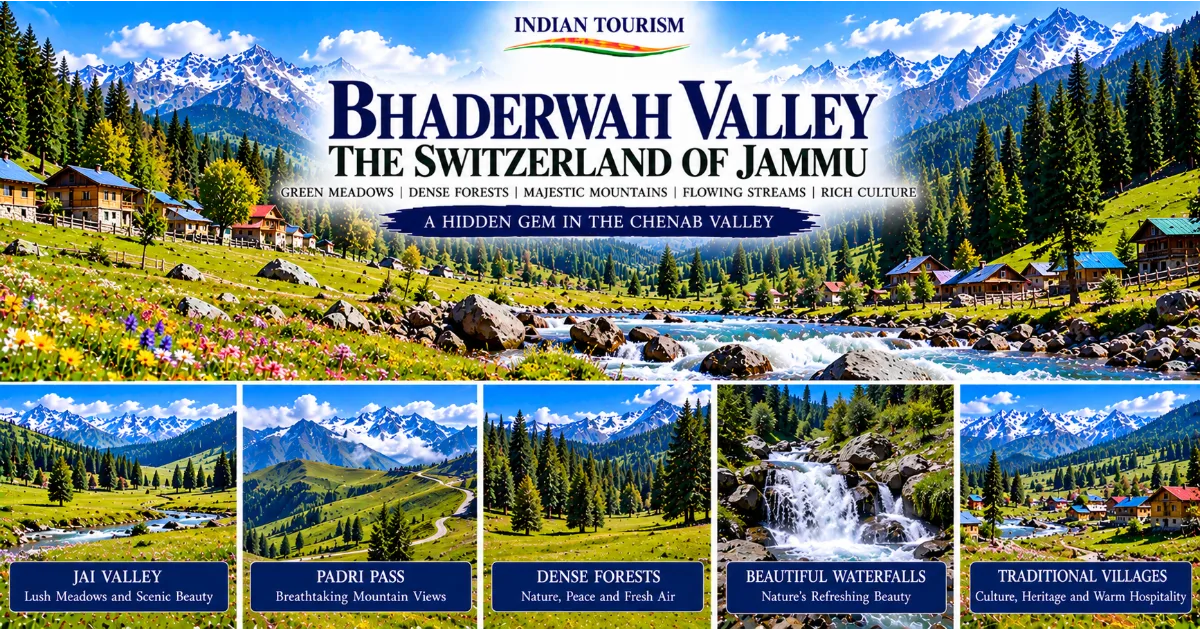
Discovering Green Meadows, Forested Mountains, Waterfalls and the Cultural Heart of the Chenab Valley
A Mountain Paradise Waiting to Be Explored
India is home to countless mountain destinations, from the celebrated valleys of Kashmir to the high-altitude landscapes of Ladakh and the forested hills of Himachal Pradesh. Yet, beyond many of the country's most famous tourist circuits lies a destination that offers a remarkably peaceful combination of natural beauty, cultural heritage and mountain adventure. Bhaderwah Valley, situated in the Doda district of Jammu and Kashmir, is one such place.
Often called the Switzerland of Jammu, Bhaderwah is admired for its lush green meadows, thick forests, clear streams, mountain slopes and picturesque villages. During spring and summer, its landscapes become vibrant with vegetation and seasonal flowers. In autumn, forests and hills acquire warmer colours, while winter can transform the surrounding mountains into a snow-covered landscape. The changing seasons give the valley a character that makes it attractive throughout much of the year, although the best time to visit depends on weather conditions, road accessibility and the activities travellers wish to enjoy.
Bhaderwah is more than a destination for scenic photography. It is also a place where visitors can explore the cultural diversity of the Jammu region, experience the hospitality of mountain communities, discover traditional food and observe how local life adapts to the changing seasons. Its location within the Chenab Valley region adds geographical and cultural significance to the experience.
For travellers seeking a quieter alternative to heavily visited hill stations, Bhaderwah offers an opportunity to slow down and appreciate the relationship between mountains, forests, rivers and village life. It is particularly suitable for nature lovers, families, photographers, couples, road-trip enthusiasts and travellers interested in discovering lesser-known destinations in Jammu and Kashmir.
1. Where Is Bhaderwah Valley Located?
Bhaderwah is a scenic town and valley in the Doda district of Jammu and Kashmir, in northern India. It lies within the broader mountainous region associated with the Chenab Valley and is surrounded by the Himalayan foothills and higher mountain ranges. The landscape is characterised by steep slopes, forested ridges, cultivated terraces, open grasslands and settlements connected by winding mountain roads.
The town serves as an important centre for the surrounding villages and rural areas. Travellers arriving in Bhaderwah can use it as a base for exploring nearby meadows, forests, viewpoints and mountain routes. The surrounding countryside contains numerous landscapes that become especially attractive when the weather is clear and vegetation is at its peak.
Bhaderwah's geographical position gives it a distinctive atmosphere. It is connected to the wider Jammu region but possesses the visual character of a mountain destination. The roads approaching the valley pass through changing terrain, with views of hills, forests and settlements appearing along the journey.
The broader Doda region is also associated with the Chenab River system, which has played an important role in the geography, economy and settlement patterns of the surrounding mountains. The river and its tributaries have shaped valleys and agricultural areas throughout the region.
Visitors should distinguish between Bhaderwah town itself and the wider collection of valleys, meadows and mountain destinations around it. A trip focused only on the town may offer a pleasant introduction, but exploring the surrounding countryside reveals much more of the area's natural diversity.
2. Why Is Bhaderwah Called the Switzerland of Jammu?
The expression Switzerland of Jammu is used to describe Bhaderwah's scenic mountain landscapes. Its appeal comes from the combination of green pastures, rolling hills, forested slopes, distant peaks and open spaces that create an expansive countryside atmosphere.
During the warmer months, many surrounding areas become covered in fresh grass and seasonal vegetation. Meadows stretch across parts of the mountainous terrain, while clusters of trees provide contrast against open slopes. Streams and small watercourses add movement and sound to the landscape, particularly after periods of rainfall or snowmelt.
The comparison with Switzerland is a description of visual appeal rather than a claim that the two places have identical geography, climate or infrastructure. Bhaderwah has its own ecological characteristics, cultural traditions and regional identity. Its beauty is best appreciated on its own terms.
One of the most attractive features of the valley is the way its landscapes change over relatively short distances. A traveller may pass through a busy local market, continue along a winding road, enter a forested stretch and eventually reach a meadow with broad mountain views. These contrasts make the journey itself an important part of the experience.
The valley also appeals to people who prefer destinations where nature remains central to the holiday. Instead of spending every day moving between crowded attractions, visitors can devote time to walking, observing the scenery, enjoying local food and learning about the surrounding communities.
3. Jai Valley: One of Bhaderwah's Most Attractive Landscapes
Jai Valley is among the best-known scenic areas associated with Bhaderwah. It is admired for its mountain scenery, open spaces, forested surroundings and seasonal greenery. For many travellers, visiting Jai Valley is an important part of a trip to the region.
The journey towards the valley offers opportunities to appreciate the changing landscape. Forests, slopes and mountain views create a setting that is particularly attractive for photography. During suitable weather, the combination of green terrain and distant mountains gives the area a peaceful atmosphere.
Jai Valley is especially appealing during the warmer months, when the vegetation becomes more vibrant. Visitors can enjoy the scenery, spend time outdoors and take photographs of the surrounding mountains. The experience is not necessarily about completing a long list of activities. Simply spending time in a quiet natural setting can be one of the most rewarding aspects of the visit.
Travellers should remember that mountain weather can change quickly. Roads may be affected by rainfall, snowfall or other seasonal conditions, and the accessibility of particular areas can vary. Before travelling, visitors should check current road conditions and seek local guidance about the safest places to stop.
Jai Valley is best approached as a landscape to appreciate responsibly. Visitors should avoid leaving litter, damaging vegetation or disturbing grazing animals. Keeping noise levels low and respecting local land use helps preserve the character that makes the area attractive.
4. Padri Pass: A Scenic Mountain Route
Padri Pass is another prominent destination associated with the Bhaderwah region. Situated along the mountain route connecting Bhaderwah with areas towards Chamba in Himachal Pradesh, the pass is known for its high-altitude scenery and seasonal landscapes.
The area is particularly attractive when its grasslands and mountain slopes are green. Open terrain creates broad views of the surrounding landscape, making it a favourite subject for travel photography. The atmosphere can feel very different from that of the town below, with cooler air and a stronger sense of being surrounded by mountains.
Padri Pass is also an example of how geography shapes travel in the Himalayas. Mountain passes connect communities and regions, but they are influenced by weather, elevation and road conditions. Their accessibility may change significantly between seasons.
Visitors should not assume that a route is open simply because it appears on a map or has been accessible during previous years. Heavy snowfall, landslides, rain and maintenance work can affect mountain roads. Travellers planning to visit Padri Pass should confirm current conditions locally before beginning the journey.
When conditions are favourable, the pass can become a highlight of a Bhaderwah holiday. Travellers can enjoy the views, take photographs from safe locations and appreciate the scale of the surrounding mountain terrain. Stopping only at designated or safe roadside locations is important, particularly where roads are narrow or visibility is limited.
5. Forests, Meadows and the Natural Environment
Bhaderwah's natural appeal depends on the variety of landscapes found across its surrounding mountains. Forests cover many slopes, while meadows and cultivated areas create open spaces between wooded ridges. Streams and small watercourses contribute to the area's ecological diversity.
The forests are important not only for their beauty but also for their environmental functions. They help protect soil, regulate water movement and provide habitats for wildlife. In mountain environments, healthy forest cover can reduce erosion and support the ecological systems on which local communities depend.
Meadows have their own seasonal rhythm. Grass growth, flowering plants and grazing activity change throughout the year. These open spaces can look dramatically different in spring, summer and autumn. Their appearance is influenced by rainfall, elevation, temperature and local land use.
For travellers, this diversity means that a visit can be rewarding even without a demanding outdoor itinerary. A short walk along a suitable path, a quiet stop beside a stream or an afternoon spent observing the mountains can provide a meaningful connection with the landscape.
However, natural areas should not be treated as empty recreational spaces without local significance. Some meadows are used for grazing, and some forest routes may pass near private land or sensitive habitats. Visitors should remain on appropriate paths, avoid disturbing livestock and follow local instructions.
The beauty of Bhaderwah will remain an attraction only if tourism grows alongside environmental responsibility. Responsible visitors help protect the forests, waterways and grasslands that give the valley its identity.
6. Exploring Bhaderwah Town and Its Surroundings
Bhaderwah town offers a useful introduction to the region's daily life. It is not simply a starting point for mountain excursions. It is also a living settlement where people shop, work, study, worship and maintain connections with surrounding villages.
A walk through local market areas can reveal a different side of the destination from the open meadows featured in travel photographs. Shops selling everyday goods, small eateries, local transport services and neighbourhood activity provide a glimpse of ordinary life in a mountain town.
Travellers can use the town to purchase essential supplies, arrange transport, ask about current road conditions and identify suitable accommodation. It is also a practical place to experience local cuisine and observe how regional traditions are reflected in everyday food and hospitality.
The surrounding villages offer further opportunities to understand the region. Some settlements occupy slopes or terraces overlooking cultivated land, while others are positioned along roads or near streams. The architecture and layout of villages reflect local climate, available materials and the practical requirements of mountain living.
Visitors should approach village tourism respectfully. A village is not merely a scenic background for photographs. It is someone's home and workplace. Asking permission before photographing residents, avoiding intrusive behaviour and purchasing locally produced goods where possible can help make tourism beneficial to the community.
7. Culture and Traditions of Bhaderwah
Bhaderwah has a distinctive regional identity shaped by the cultural diversity of the Jammu and Kashmir mountains. Its traditions reflect local history, religious practices, languages, seasonal activities and the close relationship between communities and their environment.
Cultural life in the region cannot be reduced to a single custom or identity. Different communities maintain their own traditions, and practices may vary between villages, families and religious groups. This diversity is part of what makes the area interesting for travellers who want to learn about more than its scenery.
Festivals and religious occasions provide opportunities for communities to gather, maintain social connections and pass traditions between generations. Visitors may encounter decorated places of worship, family gatherings, traditional meals and local celebrations, depending on the time of year.
The best way to understand these traditions is through respectful interaction. Travellers can speak with local hosts, learn about the significance of a festival when invited to do so and observe local customs regarding clothing, photography and religious spaces.
The region's cultural heritage is also reflected in its food, music, storytelling and everyday social practices. Although tourism often focuses on mountains and meadows, the experiences that remain most memorable may come from conversations with residents or learning how local people organise their lives around the seasons.
Bhaderwah's appeal is therefore both natural and cultural. The mountains provide the setting, but the people and their traditions give the destination its human character.
8. Local Food and Traditional Flavours
Food is an important part of exploring any destination, and Bhaderwah offers opportunities to experience regional cuisine associated with the wider Jammu area. The food culture reflects local agricultural practices, seasonal availability, household traditions and influences shared across neighbouring mountain communities.
Travellers may find rice-based meals, lentil preparations, seasonal vegetables, breads and dishes prepared with regional spices. The exact menu varies between households and restaurants, so visitors should treat local food as a diverse experience rather than expect every establishment to serve the same specialities.
The wider Jammu and Kashmir region is known for several celebrated culinary traditions, but the food of Bhaderwah should also be explored through its own local preparations and everyday meals. Asking hosts or restaurant owners about dishes made with locally available ingredients can be a useful way to discover flavours that are not always highlighted in standard tourist guides.
Mountain travel also makes practical food choices important. Travellers undertaking long drives or walks should carry drinking water and suitable snacks, particularly when visiting areas where food services are limited. During colder months, warm meals and beverages can make outdoor excursions more comfortable.
Food can also support local livelihoods. Choosing locally operated eateries and buying regional products from legitimate local sellers allows some tourism spending to remain within the community.
Visitors with dietary restrictions should explain their requirements clearly before ordering. Recipes and preparation methods can differ between establishments, and travellers should not assume that a dish is suitable for a particular dietary need without checking.
9. Adventure and Outdoor Experiences
Bhaderwah's mountain setting creates opportunities for outdoor recreation, although the suitability of individual activities depends on season, weather, terrain and available local services. Travellers should choose experiences according to their fitness, experience and the conditions on the day.
Nature walks and short hikes
Walking is one of the simplest ways to appreciate the valley. Suitable routes may pass through forested areas, open meadows or village surroundings. Even a short walk can reveal details that are easy to miss when travelling by vehicle, including seasonal plants, birds, changes in vegetation and views across the slopes.
Visitors should ask local guides or accommodation providers about appropriate routes. A path that looks easy from a distance may become steep, slippery or difficult to follow. Comfortable footwear, drinking water, weather-appropriate clothing and sufficient daylight are essential.
Photography and landscape observation
Bhaderwah is well suited to landscape photography because its scenery includes forests, streams, open pastures, village settlements and distant mountain views. Early morning and late afternoon can provide attractive light, although cloud cover and weather will influence the result.
Photographers should avoid entering private land or sensitive areas for a better viewpoint. Drones may be subject to local restrictions, and permission should be obtained where required. The safety of the traveller and the privacy of residents should take priority over a photograph.
Camping and outdoor stays
Camping may be possible in selected areas when permitted and when suitable facilities or authorised operators are available. Travellers should never assume that every meadow or forest clearing is an acceptable camping location.
Before camping, visitors should confirm land access, fire restrictions, weather conditions, waste arrangements and the availability of emergency support. Open fires can damage vegetation and create serious risks in forested environments. A responsible camping trip should leave the site as clean as, or cleaner than, it was found.
Road trips and scenic drives
The mountain roads around Bhaderwah can be rewarding for travellers who enjoy journeys through changing landscapes. However, road trips require patience and preparation. Curves, steep gradients, narrow sections, fog and sudden weather changes may make driving more demanding than expected.
Drivers should avoid rushing, use safe stopping places for photographs and check vehicle condition before travelling. During periods of heavy rain or snowfall, it may be better to postpone an excursion than attempt a difficult route.
10. Best Time to Visit Bhaderwah Valley
Bhaderwah can be attractive in different seasons, but the best time depends on what travellers want to experience.
Spring: Fresh greenery and seasonal renewal
Spring brings a gradual return of greenery as temperatures rise and plants respond to changing weather. The countryside begins to regain colour, and the valley can be particularly appealing to visitors who enjoy mild conditions and emerging vegetation.
The exact timing of seasonal changes varies with elevation and weather. Some higher routes may remain affected by snow or cold conditions after lower areas have become more accessible. Travellers should confirm local conditions before planning excursions.
Spring is suitable for scenic drives, town exploration and nature walks when paths and roads are safe. Visitors should pack layers because temperatures can change considerably between daytime and evening.
Summer: Meadows and outdoor exploration
Summer is often a popular period for exploring Bhaderwah and its surrounding landscapes. Green meadows, forested slopes and relatively comfortable daytime conditions can make outdoor activities enjoyable.
This season is suitable for travellers interested in photography, village visits, scenic drives and walking. However, summer is not free from weather-related risks. Rainfall can affect mountain roads, and popular locations may become busier during holidays.
Booking accommodation in advance is sensible during peak travel periods. Visitors should also avoid assuming that every high-altitude route will be open or suitable for a standard vehicle.
Autumn: Clear views and quieter experiences
Autumn can offer a calmer atmosphere, with changing colours in some vegetation and a gradual shift towards colder weather. Travellers who prefer quieter surroundings may find this season appealing, especially outside major holiday periods.
Days can remain pleasant, but nights become colder. Visitors should bring warm clothing and confirm the availability of transport and accommodation for their chosen dates.
Winter: Snow, cold weather and seasonal limitations
Winter changes the character of Bhaderwah and its surrounding mountains. Some areas may experience snowfall, and higher routes can become difficult or temporarily inaccessible. The landscape can be beautiful, but winter travel requires more preparation.
Visitors should check current weather forecasts and road advisories, carry suitable warm clothing and avoid entering snow-covered terrain without appropriate knowledge or equipment. Travel plans should remain flexible because conditions can change rapidly.
For travellers whose main goal is to see snow, local advice is particularly important. Snowfall timing and snow cover vary from year to year, so a particular experience cannot be guaranteed for a specific date.
11. How to Reach Bhaderwah
Bhaderwah is reached through the road network of the Jammu region. Travellers usually plan their journey using a combination of rail or air transport to a larger city and onward road travel, depending on their starting point.
By road
Road travel is an important part of reaching Bhaderwah. The journey passes through mountainous terrain, and travel time depends on the starting location, road conditions, traffic, weather and any restrictions in force.
Visitors should check the current route before departure rather than relying entirely on a navigation application. Mountain roads may be affected by maintenance, landslides, snowfall or temporary closures. A local driver familiar with the route can be helpful for travellers who are unfamiliar with Himalayan driving conditions.
It is advisable to begin long drives with sufficient daylight remaining and to include breaks in the journey. Travellers should avoid driving when tired and should never stop in unsafe locations simply to photograph the scenery.
By train
Travellers coming from other parts of India may consider rail connections to Jammu before continuing by road. Train schedules, seat availability and onward transport options should be checked for the intended travel date.
Rail travel can be a practical option for people who prefer not to undertake the entire journey by road. However, the onward mountain journey still requires time and should be included in the itinerary.
By air
Air travellers can investigate flights to Jammu and then arrange onward road transport. The suitability of this option depends on flight schedules, fares, weather and the time available for the trip.
Before booking, travellers should compare the total journey rather than looking only at flight duration. Airport transfers, road travel and possible delays can significantly affect the overall schedule.
Local transport
Once in Bhaderwah, local taxis and other transport services may be available for nearby destinations. Availability can vary by season, location and demand. Travellers planning to visit remote areas should arrange transport in advance and agree on the itinerary, waiting time and return arrangements with the driver.
12. Where to Stay in Bhaderwah
Accommodation options in and around Bhaderwah may include hotels, guesthouses, homestays and other locally operated establishments. The right choice depends on budget, comfort expectations, location and the type of experience a traveller wants.
Staying in the town can be convenient for access to shops, food and transport. It is a practical option for first-time visitors who plan to explore several nearby destinations during the day.
A stay in a village or quieter rural setting may provide a closer experience of mountain life, provided suitable accommodation is available and the location works with the travel itinerary. Visitors should confirm the facilities offered, road access, heating arrangements during colder months and the availability of meals.
Families may prefer accommodation with reliable access, suitable room arrangements and convenient transport. Couples may value peaceful surroundings and scenic views, while budget travellers may prioritise basic comfort and proximity to transport services.
Before confirming a booking, travellers should ask about cancellation terms, seasonal operating schedules, hot water, electricity, parking and meal options. Facilities can differ considerably between properties, particularly outside the main town.
Choosing a locally operated stay can also help distribute tourism income within the community. Guests should respect household rules, conserve water and electricity, and treat hosts and staff with courtesy.
13. A Suggested Three-Day Bhaderwah Itinerary
A three-day visit provides a useful introduction to Bhaderwah and its surrounding scenery. The following plan is flexible and should be adjusted according to road conditions, weather and local advice.
Day One: Arrive and explore Bhaderwah town
Use the first day to reach Bhaderwah, settle into your accommodation and become familiar with the town. Depending on your arrival time, explore local market areas, enjoy a regional meal and ask about current conditions for nearby excursions.
Avoid trying to fit too many activities into the first day, especially if you have travelled a long distance. A relaxed evening allows time to prepare for the following day's outing.
Day Two: Explore Jai Valley and nearby landscapes
Set aside the second day for a scenic excursion towards Jai Valley, subject to road access and weather conditions. Enjoy the journey, make stops only at safe locations and allow enough time to appreciate the scenery rather than rushing between viewpoints.
You can combine the excursion with short walks where appropriate. Carry water, snacks and extra clothing, and return with sufficient daylight remaining. Ask local residents or your driver about any temporary restrictions before beginning the trip.
Day Three: Visit Padri Pass or choose a local cultural experience
If conditions are suitable and the route is open, consider a trip towards Padri Pass. Confirm accessibility before departure and keep the schedule flexible. If the weather is poor or the route is unsuitable, spend the day exploring the town and nearby villages instead.
A village visit, local meal or relaxed walk can provide a rewarding alternative to a long drive. After the excursion, begin your onward journey or spend another night in Bhaderwah if your schedule allows.
This itinerary is only a planning framework. Distances and travel times can vary, and no mountain excursion should take priority over safety.
14. Bhaderwah for Families, Couples and Solo Travellers
Bhaderwah can suit different kinds of travellers when the itinerary is matched to their needs.
Families may enjoy the open landscapes, gentle walks and opportunity to spend time outdoors. Parents should choose locations with safe access, keep children away from steep edges and fast-flowing water, and ensure that transport and accommodation arrangements are suitable.
Couples may appreciate the quieter atmosphere, scenic drives and mountain views. A relaxed itinerary often works better than trying to visit every location in a limited time. The experience can be built around photography, local food and time spent enjoying the scenery.
Solo travellers may find Bhaderwah rewarding because it offers opportunities for independent exploration and interaction with local communities. They should share their plans with someone they trust, confirm transport arrangements and avoid remote routes without adequate preparation.
Adventure enthusiasts should distinguish between ordinary sightseeing and activities that require technical skills or specialised equipment. Hiring an experienced local guide is advisable for unfamiliar routes, challenging hikes or activities where weather and terrain create additional risks.
Regardless of travel style, visitors should maintain realistic expectations. Mountain destinations do not always provide the same convenience or range of facilities as major cities. Flexibility and preparation are important parts of a successful trip.
15. Responsible Tourism: Protecting Bhaderwah's Natural Beauty
The landscapes that attract visitors to Bhaderwah are valuable ecological and cultural assets. Tourism can support local businesses and create opportunities for communities, but unmanaged visitor activity can also damage the environment.
Litter is one of the simplest problems to prevent. Travellers should carry waste back to appropriate disposal points rather than leaving plastic bottles, food wrappers or packaging in meadows, streams and forests. Waste should never be thrown into waterways.
Water conservation is also important. Mountain communities depend on local water sources for household use, agriculture and livestock. Visitors should avoid unnecessary waste and follow local guidance about drinking water and sanitation.
Respect for wildlife and vegetation matters as well. Visitors should not feed wild animals, remove plants or disturb nesting areas. Staying on established paths reduces damage to fragile ground and helps prevent accidental injury.
Tourism should also respect the people who live in the valley. Visitors should ask permission before photographing individuals, avoid entering private property without consent and follow local rules at religious or cultural sites.
Buying local products, eating at local establishments and choosing community-based accommodation can help tourism spending reach residents. However, travellers should avoid treating cultural practices as performances that must be provided on demand. Genuine interaction depends on mutual respect.
Responsible tourism is not an additional activity that needs to be scheduled separately. It is the approach that should guide every part of a visit, from transport and accommodation to photography and waste disposal.
16. Practical Travel Tips for Visiting Bhaderwah
A little preparation can make a mountain holiday more comfortable and reduce the likelihood of unexpected difficulties.
First, check the weather and road conditions shortly before travelling. Conditions can change rapidly, especially on higher routes. Confirm that the places you intend to visit are accessible and that the return journey is realistic.
Second, pack clothing in layers. Even during warmer months, mornings and evenings can be cool, while higher locations may be considerably colder than the town. Waterproof outerwear and comfortable footwear are useful when rain or muddy paths are possible.
Third, carry essential medicines, drinking water, snacks, a charged phone and a power bank. Mobile connectivity can vary by location, so do not rely entirely on uninterrupted internet access for navigation or communication.
Fourth, keep some flexibility in your schedule. A sudden change in weather may make it necessary to replace a mountain excursion with a town visit or a quieter activity. This is a normal part of travel in mountainous regions.
Fifth, confirm transport and accommodation arrangements in advance during busy periods. If you are hiring a vehicle for a full-day excursion, discuss the route, approximate duration, stops and return plan before setting out.
Finally, follow local instructions and avoid taking unnecessary risks for photographs or adventure experiences. The mountains are most enjoyable when explored with patience and respect for their changing conditions.
17. Who Should Add Bhaderwah to Their Travel List?
Bhaderwah is especially attractive to travellers who appreciate landscapes rather than crowded entertainment districts. Nature lovers can explore forests, meadows and streams, while photographers can capture the changing light across the mountains.
Road-trip enthusiasts may enjoy the winding approaches and scenic routes, provided they are comfortable with mountain driving or travel with an experienced driver. Families can plan gentle outings and village visits, while couples may appreciate the calm atmosphere and open views.
Travellers interested in culture can learn about local food, regional traditions and everyday life in the surrounding settlements. Those who prefer destinations with a strong connection to nature may find that Bhaderwah offers a more relaxed pace than some heavily promoted tourist centres.
The destination may be less suitable for visitors who expect extensive nightlife, large commercial entertainment complexes or consistently predictable road access to every attraction. Its appeal is rooted primarily in its landscapes, local character and outdoor experiences.
Bhaderwah is best approached with curiosity and realistic expectations. The experience becomes richer when visitors allow time for unplanned discoveries and understand that the beauty of a mountain region cannot always be measured by the number of attractions visited.
Conclusion: Experience the Quiet Beauty of Bhaderwah Valley
Bhaderwah Valley is one of the remarkable mountain destinations of Jammu and Kashmir, offering green meadows, forested slopes, flowing streams, scenic mountain routes and a cultural atmosphere shaped by the communities of the Chenab Valley region. Its reputation as the Switzerland of Jammu reflects the visual appeal of its open landscapes and mountain scenery, but its real identity is rooted in its own geography, traditions and local way of life.
From the landscapes of Jai Valley to the high mountain setting of Padri Pass, Bhaderwah provides opportunities for nature walks, photography, road trips and peaceful outdoor experiences. The town and surrounding villages add another dimension to the journey, allowing visitors to appreciate local food, hospitality and regional culture.
The best visit is not necessarily the one that covers the greatest number of places. It is the one that allows enough time to enjoy the landscape, understand local conditions and travel responsibly. A few days spent exploring the valley at a relaxed pace can offer a meaningful introduction to the natural and cultural richness of the Jammu region.
For travellers looking beyond familiar destinations, Bhaderwah deserves a place on the map. Its meadows, forests, mountain roads and welcoming communities make it an appealing choice for anyone wishing to experience a quieter side of the Himalayas.
#IndianTourism #BhaderwahValley #SwitzerlandOfJammu #JammuAndKashmir #ChenabValley #JammuTourism #MountainDestinations #NatureTourism #HimalayanTravel #HiddenGemsOfIndia #JaiValley #PadriPass #TravelIndia #ResponsibleTourism
