
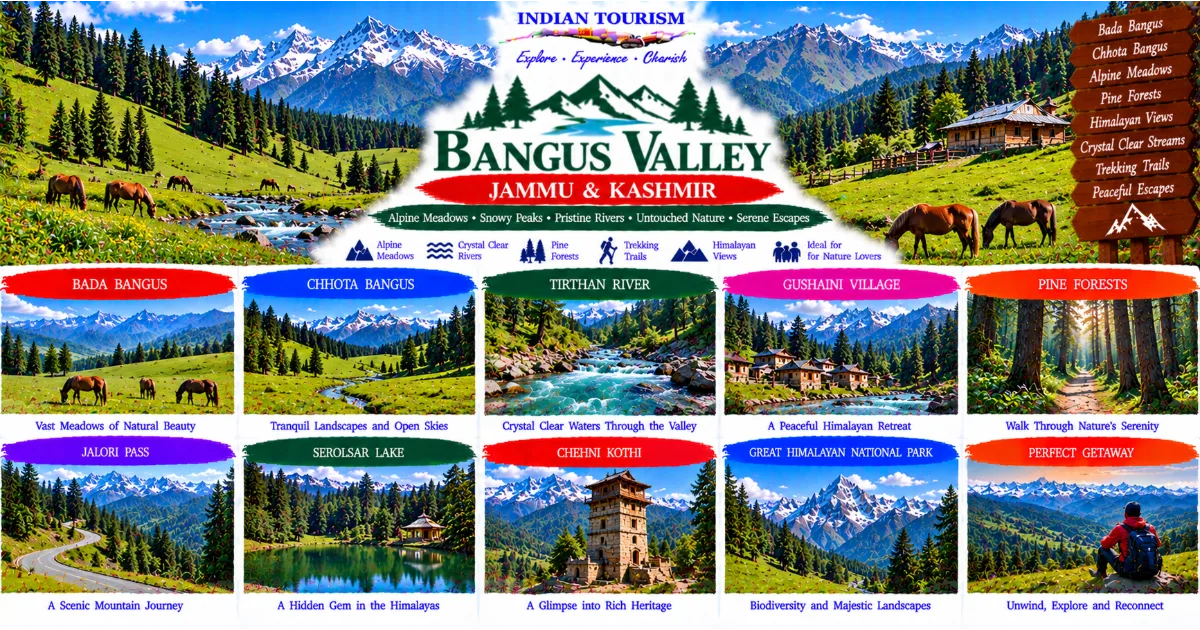
Discover the Hidden Beauty of Bangus Valley
Bangus Valley is one of the most intriguing natural landscapes in Jammu and Kashmir, known for its expansive alpine meadows, surrounding mountain ranges, flowing streams and remarkable sense of wilderness. Located in the Kupwara district of northern Kashmir, the valley offers a different experience from the region's more familiar tourist destinations. While Srinagar, Gulmarg and Pahalgam attract visitors with their lakes, gardens, ski slopes and established tourism facilities, Bangus is associated with open grasslands, forested approaches and a quieter natural environment.
The valley is often described as one of Kashmir's hidden natural treasures because its landscape remains less developed for mainstream tourism than many popular destinations. Its broad meadows, sometimes called margs in the regional landscape vocabulary, are surrounded by mountains and forests that create a striking setting for nature lovers, photographers and travellers interested in exploring places beyond the usual tourist circuit.
Bangus Valley lies within a larger mountainous landscape connected with the northern Kashmir region. The surrounding area contains settlements, forested hills, grazing grounds and routes that have historically supported local livelihoods. Seasonal grazing has been an important part of life in the wider region, and the meadows are connected with the relationship between mountain communities, livestock and the natural environment.
For visitors, Bangus offers the possibility of experiencing Kashmir through its open landscapes rather than through a long list of built attractions. A visit may involve travelling through forested roads, enjoying expansive views, observing the changing colours of the grasslands and learning about the area's ecological and cultural importance. The scenery can vary dramatically with the season, from green meadows in warmer months to misty mountain landscapes during unsettled weather.
However, Bangus Valley is not a destination where visitors should assume that access, transport or tourism facilities will always be available. Security arrangements, administrative permissions, road conditions and weather can affect travel in the region. Before planning a visit, travellers should confirm current access rules with the relevant local authorities and use authorised local guidance where required.
This guide explores Bangus Valley's natural landscape, nearby attractions, seasonal experiences, local culture, travel arrangements and responsible tourism practices. For travellers seeking a different perspective on Kashmir, Bangus provides an opportunity to appreciate the region's vast alpine meadows and the importance of protecting its mountain environments.
Understanding Bangus Valley: Geography and Natural Landscape
Bangus Valley is situated in the Kupwara district of Jammu and Kashmir, in the northern part of the Kashmir region. Its landscape is characterised by open alpine and subalpine meadows, surrounding mountain ridges, forests and watercourses. These natural features create a broad, open environment that contrasts with the more enclosed valleys and densely developed settlements found elsewhere in the region.
The valley is commonly associated with two broad meadow areas, often referred to as Bada Bangus and Chhota Bangus. These names distinguish larger and smaller sections of the wider landscape, although the precise boundaries and local descriptions can vary. Together, the meadows form part of a mountainous environment shaped by elevation, seasonal weather and the movement of water through the terrain.
The surrounding mountains influence the valley's climate and vegetation. At different elevations, forests give way to more open grasslands, while seasonal changes affect the appearance of the meadow. During warmer months, the landscape can become lush and green. In colder periods, temperatures fall considerably, and higher areas may experience snow or difficult access.
Water is another important part of the environment. Streams and smaller watercourses contribute to the landscape and support ecological processes across the meadows and surrounding habitats. Their flow varies with rainfall, snowmelt and seasonal conditions.
Bangus is also important as a natural landscape connected with local livelihoods. Grazing practices and seasonal movement have historically linked communities with the valley. The grasslands are therefore more than a scenic attraction. They form part of a broader relationship between people, livestock, forests and mountain ecosystems.
Because the valley is environmentally sensitive, visitors should avoid treating it as an unrestricted recreational space. Staying on permitted routes, taking waste away and following local guidance help reduce the impact of tourism on the landscape.
Why Bangus Valley Is Known as a Hidden Gem of Kashmir
Bangus Valley is often described as a hidden gem because its expansive natural scenery remains less familiar to many travellers than the better-known destinations of Kashmir. Its appeal lies in the openness of the meadows, the surrounding mountains and the relative absence of the dense commercial development associated with some major tourist centres.
The valley offers a different kind of travel experience. Instead of spending most of the day visiting monuments, shopping areas or organised attractions, visitors may spend time observing the landscape, photographing the mountains and learning about the natural environment.
Its location in northern Kashmir also contributes to its distinctive character. The wider Kupwara region contains forests, mountain terrain and rural settlements that differ from the landscape around Srinagar's urban lakefront. Travelling through this part of Kashmir can provide a broader understanding of the region's geographical and cultural diversity.
However, the phrase hidden gem should not be taken to mean that the valley is entirely untouched or that it is always open to visitors. Local communities use the surrounding landscape, and travel may be affected by security conditions, permissions and seasonal access. Responsible visitors should respect these realities and avoid promoting activities that conflict with local rules.
Bangus Valley's greatest appeal is its natural scale. The open grasslands and surrounding ridges create a feeling of space that is increasingly difficult to find in heavily developed tourist areas. For travellers who appreciate nature, quiet observation and landscape photography, this can be an especially rewarding experience.
Best Places and Natural Highlights Around Bangus Valley
1. Bada Bangus
Bada Bangus is commonly identified as the larger meadow area associated with Bangus Valley. Its broad grasslands, surrounding mountain scenery and open horizon make it one of the region's most recognisable natural features.
The meadow is particularly appealing to visitors who enjoy wide landscape views. Unlike forested trails where visibility is limited by trees, the open grassland allows travellers to appreciate the scale of the surrounding terrain. Mountains frame the landscape, while seasonal vegetation changes its colour and texture.
During suitable warmer conditions, the grasslands can appear vivid green, creating a striking contrast with darker forested slopes. Depending on the season and weather, mist may drift across the meadow, changing the atmosphere and reducing visibility.
Visitors should understand that access to Bada Bangus depends on current local arrangements. Before travelling, confirm whether the route is open and whether any permissions or authorised transport are required. Do not assume that access is unrestricted simply because a route appears in travel photographs or online descriptions.
Once access is confirmed, visitors should remain within permitted areas and follow guidance from local authorities. The meadow is part of a living landscape, and careless driving, littering or disturbance of grazing animals can damage the environment.
2. Chhota Bangus
Chhota Bangus is commonly described as the smaller meadow area associated with the wider Bangus landscape. Like Bada Bangus, it is connected with the region's open grasslands, mountain scenery and seasonal natural environment.
The distinction between the two areas provides a useful way to understand the wider valley, although travellers should rely on local guidance for precise routes and access information. Conditions can differ between locations, and a route suitable for one area may not necessarily be open or practical for another.
Chhota Bangus is of interest to travellers who want to understand the valley beyond a single viewpoint. The broader landscape includes variations in meadow, forest and mountain terrain, and these differences contribute to its ecological character.
Visitors should not attempt to reach remote sections without confirming current access and safety arrangements. Where local rules require authorised transport or guides, those requirements should be followed.
3. The Alpine Grasslands
The alpine and subalpine grasslands are central to Bangus Valley's identity. These open areas provide a contrast with the surrounding forested slopes and form the basis of many of the valley's most memorable views.
Grasslands in mountain environments are influenced by elevation, seasonal temperature and the availability of water. Their appearance changes throughout the year, and the timing of green growth, flowering plants and colder conditions depends on local weather.
For photographers, the grasslands offer opportunities to capture broad compositions with mountains, open sky and vegetation. The landscape can look particularly atmospheric when clouds move across the ridges or when soft morning light reveals the contours of the meadow.
Visitors should avoid trampling sensitive vegetation unnecessarily or driving beyond authorised routes. Grasslands can be vulnerable to erosion and damage, especially where vehicle movement and unmanaged visitor activity become concentrated.
The best way to appreciate the meadows is to observe them carefully, follow local guidance and leave the landscape in the condition in which it was found.
4. The Surrounding Mountain Ridges
The mountains surrounding Bangus Valley create its distinctive visual frame. Their slopes influence the distribution of forests and grasslands, while their changing appearance gives the valley much of its photographic appeal.
On clear days, visitors may enjoy broad views across the ridges and surrounding terrain. When cloud or mist develops, the mountains can appear and disappear behind shifting layers of weather, creating a more dramatic atmosphere.
The ridges should not be treated as informal trekking routes without preparation. Mountain terrain can become difficult quickly, and routes may cross areas where access is restricted. Visitors should confirm whether walking beyond designated viewpoints is permitted and whether local guidance is necessary.
For most travellers, the best way to experience the surrounding mountains is through safe, authorised viewpoints and short walks in permitted areas. Longer excursions should be planned separately with appropriate knowledge of the route and conditions.
5. Forested Approaches to Bangus Valley
The journey towards Bangus Valley can include forested slopes and mountain roads that provide a gradual transition from settled areas into the wider natural landscape. These approaches are part of the experience because they reveal how the valley connects with the surrounding environment.
Forests play an important role in mountain ecosystems. They support wildlife, contribute to soil stability and influence the movement of water through the landscape. Their relationship with open meadows is one of the features that makes the region ecologically interesting.
Visitors should avoid stopping in unsafe road locations to take photographs. Mountain roads may be narrow, and traffic or visibility conditions can change quickly. Use designated stopping areas where available and follow local instructions.
Forest access may also be regulated. Travellers should not enter unfamiliar paths or protected areas without confirming current rules. A knowledgeable local guide can help explain the landscape while ensuring that visitors remain within permitted routes.
6. The Streams and Watercourses of the Valley
Watercourses contribute to Bangus Valley's natural character and support the surrounding grasslands and habitats. Their appearance and flow vary with rainfall, snowmelt and seasonal weather.
The sound of flowing water can add to the sense of tranquillity that many travellers associate with the valley. Small streams and watercourses also create visual contrast within the open grassland and provide opportunities for nature photography from safe locations.
Visitors should be cautious around water, particularly after rainfall or during periods of snowmelt. Mountain streams can rise quickly, and shallow-looking sections may have slippery rocks or stronger currents than expected.
Do not enter unfamiliar watercourses, wash vehicles in streams or leave rubbish near the banks. Water is an essential part of the local ecosystem, and protecting its quality benefits both wildlife and surrounding communities.
7. Kupwara Town
Kupwara is the principal town of the district and an important reference point for understanding the wider region around Bangus Valley. It provides local services and connections to surrounding settlements, although the availability of particular facilities depends on current conditions.
For travellers, Kupwara may serve as a practical stop before arranging an authorised excursion into the valley. Visitors can use local guidance to understand current access arrangements, transport options and any restrictions that may affect the journey.
The town also offers a glimpse of everyday life in northern Kashmir beyond the familiar tourist centres. Markets, local businesses and residential areas reflect the needs of the surrounding communities.
Visitors should approach the town respectfully, ask before photographing people and follow any instructions concerning travel or movement. Current local guidance should take priority over older travel information.
8. Lolab Valley
Lolab Valley is another scenic destination in the Kupwara district, known for its green landscapes, villages, streams and surrounding hills. It offers a different experience from Bangus Valley while sharing the wider region's combination of forests, agricultural land and mountain scenery.
The valley can be of interest to travellers who have additional time and want to explore more of northern Kashmir. Its settlements and landscape provide opportunities to observe rural life and enjoy scenic drives where access is permitted.
Travel arrangements should be checked carefully because conditions can vary. Visitors should confirm road access, local guidance and any security-related restrictions before making plans.
Lolab Valley is best approached as a separate excursion rather than an attraction to add automatically to a Bangus trip. The available time, road conditions and current travel advice should determine whether combining the two destinations is practical.
9. Other Landscapes of Northern Kashmir
The wider Kupwara region contains a variety of mountain landscapes, forested areas, settlements and open valleys. These environments help explain why northern Kashmir has considerable geographical diversity despite being less familiar to some mainstream tourists.
Travellers interested in exploring beyond Bangus should seek current information about destinations that are open and appropriate for visitors. Access conditions may differ considerably between areas, and travel plans should be based on official guidance rather than assumptions.
A regional itinerary can provide a broader understanding of the landscape, but it should not become a reason to travel into restricted or unsafe areas. Respect for local conditions is essential.
The Natural Environment and Ecological Importance of Bangus Valley
Bangus Valley is valuable not only because of its scenic beauty but also because it forms part of a larger mountain ecosystem. Its meadows, forests, streams and surrounding slopes interact to support vegetation, wildlife and local livelihoods.
Mountain grasslands are shaped by seasonal temperature, water availability and grazing patterns. The balance between open meadow and surrounding forest contributes to the landscape's character. Changes in land use, erosion, unmanaged tourism or other pressures can affect these habitats.
Forests surrounding the valley provide important ecological functions. They help stabilise slopes, support wildlife and influence how water moves through the landscape. The streams and watercourses connect different parts of the ecosystem, making the protection of water quality especially important.
The region is also linked with pastoral traditions. Grazing has historically formed part of the relationship between local communities and the meadows. Responsible management is important because excessive pressure on grassland can affect vegetation and soil.
Visitors can support conservation by remaining on permitted routes, avoiding litter, respecting grazing animals and following local instructions. Photography and recreation should not take priority over habitat protection.
It is equally important to understand that a landscape can be ecologically valuable without being entirely free of human use. Local communities have long-standing relationships with the region, and responsible tourism should respect both environmental protection and local livelihoods.
Local Culture and Traditional Livelihoods Around Bangus Valley
The communities surrounding Bangus Valley have developed livelihoods shaped by the mountains, forests, grasslands and changing seasons. Agriculture, livestock rearing, small businesses and other local activities contribute to life in the wider Kupwara region, although practices vary between settlements.
Seasonal grazing is an important part of the broader mountain landscape. Grasslands provide grazing opportunities at certain times of the year, connecting pastoral activities with the natural cycle of vegetation and weather.
Traditional knowledge of routes, seasonal conditions and the landscape can be valuable for visitors trying to understand the valley. Local guides and residents may explain how the surrounding terrain is used and why certain areas are important to the community.
Visitors should remember that cultural experiences are not automatically available as organised tourist activities. Local residents may be working or attending to their daily responsibilities. Ask permission before photographing people, avoid entering private land and respect local customs.
Supporting local services where appropriate can help tourism contribute to livelihoods. However, visitors should not assume that every household wants to host tourists or that all parts of the region are prepared for commercial tourism.
A respectful approach allows travellers to learn about the region without treating local people as attractions. It also helps maintain a balance between visitor interest and the everyday needs of the community.
Best Time to Visit Bangus Valley
The best time to visit Bangus Valley depends on current access arrangements, local security guidance, weather and the type of landscape experience you want. Because the valley lies in a mountainous region, conditions can change significantly between seasons.
Spring: March to April
Spring brings gradual changes in temperature and the beginning of renewed vegetation at lower elevations. Higher areas may remain cold, and the appearance of the meadows depends on local conditions.
Visitors considering a spring trip should confirm whether the route is open and whether travel is permitted. Road and weather conditions may differ from those in more accessible tourist areas.
Summer: May to June
Summer is often associated with greener landscapes and more comfortable daytime conditions in many parts of the Kashmir region. Bangus Valley's meadows can become especially attractive as vegetation develops, although exact conditions vary from year to year.
This period may be suitable for landscape photography and nature observation when access is authorised. Travellers should still confirm current travel requirements, transport arrangements and local guidance before departure.
Monsoon and Summer Rainfall: July to September
Although the Kashmir region does not experience the same monsoon pattern as many parts of India, summer rainfall and unsettled weather can still affect travel. Rain may reduce visibility, make roads slippery and change the condition of streams.
Visitors should monitor current forecasts and avoid unnecessary journeys during severe weather. Access to remote areas should depend on local advice and current conditions rather than assumptions based on the calendar.
Autumn: October to November
Autumn brings cooler temperatures and changing vegetation across much of the region. The landscape may offer different colours and atmospheric views, although higher areas become increasingly cold.
Travellers should confirm access and road conditions before planning a visit. Warm clothing and flexible travel arrangements are advisable.
Winter: December to February
Winter can bring very cold conditions and snow to higher elevations. Roads may become difficult or inaccessible, and ordinary sightseeing may not be practical.
Visitors should not plan a winter trip without checking current local guidance and transport conditions. If access is restricted or weather conditions are unsafe, the visit should be postponed.
The most important consideration for Bangus Valley is not simply choosing a month. Current permission, security advice, road conditions and weather must determine whether a trip is appropriate.
How to Reach Bangus Valley
By Road
Road travel is generally the main way to approach the Bangus Valley region. Travellers usually organise their journey through the Kupwara district and continue along the route that is currently authorised and accessible.
Because access conditions may change, visitors should not rely solely on directions found in older travel articles or mapping applications. Confirm the current route with the relevant local authorities and use authorised local transport where required.
Mountain roads may be affected by weather, maintenance work or other restrictions. Allow extra time and avoid making tight onward connections.
By Train
Bangus Valley does not have a railway station. Travellers arriving by train need to reach a suitable rail-connected city or town elsewhere in the region and continue by road.
The best rail route depends on the starting city and current train services. Before booking, consider the entire journey, including the road transfer and any requirements affecting access to the valley.
By Air
Travellers may consider air connections serving the wider Kashmir region, depending on current flight schedules and the chosen route. Srinagar's airport is an important gateway for many visitors to Kashmir, but the onward journey to the Kupwara district must be planned separately.
Flight availability, road conditions and access restrictions can change. Confirm transport arrangements before travelling, and do not assume that arrival in Kashmir automatically means that Bangus Valley is open to visitors.
Getting Around the Bangus Valley Region
The wider region consists of settlements, mountain roads, forested approaches and open landscapes that may be separated by considerable travel time. Transport arrangements should therefore be made carefully.
Visitors should confirm whether private vehicles are permitted on the intended route and whether authorised local transport is required. Where permissions or checkpoints apply, follow the instructions of the relevant authorities.
Walking should take place only in areas where access is permitted and conditions are safe. Do not attempt to reach remote sections simply because they appear close on a map. Mountain terrain, weather and restrictions can make travel more complicated than expected.
For visitors unfamiliar with the region, local guidance can help with route planning, safety information and an understanding of the landscape. Choose services that operate lawfully and follow current rules.
Suggested Bangus Valley Itinerary
One-Day Visit
A one-day visit should focus on an authorised route and the accessible sections of the valley. Begin only after confirming current travel conditions and any required permissions.
Spend time observing the meadows, mountain scenery and surrounding vegetation from permitted areas. If access arrangements allow, include short walks that do not take you away from authorised routes.
Avoid trying to combine several distant destinations in one day. The road journey, local restrictions and changing weather may require more time than expected.
Two-Day Regional Visit
A two-day itinerary may allow visitors to explore the Bangus region and a nearby destination in the Kupwara district, provided current conditions permit both visits.
Use the first day for the authorised Bangus excursion. Spend the second day exploring a suitable nearby area, such as Lolab Valley, only if access and travel advice support the plan.
Keep the itinerary flexible and confirm each day's arrangements locally. If access changes or conditions become unsafe, choose an alternative activity in an accessible area.
Three-Day Northern Kashmir Itinerary
A three-day visit can provide more time to appreciate the wider region, but it should be planned around current access and transport arrangements rather than a fixed list of attractions.
Reserve one day for Bangus Valley if authorised. Use another day for a suitable excursion in the wider Kupwara region, and keep the third day available for travel, local cultural experiences or changes caused by weather and access conditions.
Travellers should not treat remote destinations as interchangeable stops. Each route must be checked separately, and no itinerary should override current official advice.
Where to Stay When Visiting Bangus Valley
Accommodation should be selected according to the current travel arrangements and the authorised route into the region. Visitors may need to stay in an established town or settlement elsewhere in the Kupwara district rather than expecting a full range of accommodation directly in the meadow area.
Before booking, confirm whether the intended accommodation is operating, how it can be reached and whether the property can help arrange lawful transport or local guidance. Facilities and availability may differ from those offered in Kashmir's larger tourist centres.
Travellers should also ask about meal arrangements, heating, road access and cancellation policies. Mountain weather and changing access conditions can affect the practical details of a trip.
Do not assume that camping or overnight stays within the valley are permitted. Follow local regulations and use only accommodation or camping arrangements that have been explicitly authorised.
Bangus Valley for Nature Lovers, Photographers and Families
Bangus Valley for Nature Lovers
Nature lovers may appreciate the valley's open grasslands, mountain ridges, forests and streams. Its value lies in the opportunity to observe a landscape that differs from heavily developed tourist areas.
Visitors should keep a respectful distance from grazing animals, avoid disturbing wildlife and remain within permitted areas. Nature observation should be guided by conservation principles rather than the pursuit of photographs alone.
Bangus Valley for Photographers
The valley's broad meadows and surrounding mountains offer opportunities for landscape photography. Changes in light, clouds and vegetation can produce different compositions throughout the day.
Photographers should check where photography is permitted and follow any local restrictions. Avoid stopping vehicles in unsafe locations, entering restricted areas or photographing sensitive locations when prohibited.
Bangus Valley for Families
Families should first confirm whether the journey and access arrangements are suitable for their circumstances. The valley's remote setting and variable facilities may make it less straightforward than a conventional hill-station holiday.
If a visit is permitted, plan around the needs of all family members. Carry food, water, warm clothing and essential supplies, and avoid walking into remote areas without suitable guidance.
The most important family consideration is safety. Follow current instructions, stay within authorised areas and postpone the visit if conditions are unsuitable.
Responsible Tourism in Bangus Valley
Bangus Valley's meadows and mountain habitats require careful protection. Responsible tourism helps reduce environmental pressure and supports the long-term health of the landscape.
Visitors should take all waste away from the valley and dispose of it appropriately. Plastic packaging, food waste and other rubbish can harm wildlife, pollute water and spoil the natural setting.
Avoid driving on grassland outside authorised routes. Vehicle movement can damage vegetation and contribute to soil erosion. Do not disturb grazing animals, remove plants or damage natural features.
Respect local residents and their livelihoods. Ask before photographing people or private property, follow local customs and avoid treating working landscapes as recreational spaces without limits.
Follow all current security instructions, travel permissions and access rules. These requirements are essential to responsible travel in the region and should not be bypassed for sightseeing.
Support authorised local services where possible. Local guides and transport providers can help visitors understand the area while ensuring that travel follows the applicable rules.
Practical Travel Tips for Bangus Valley
Confirm current access permissions and security advice before making any travel commitment. Do not rely solely on old travel blogs, social media photographs or general descriptions of the valley.
Check road conditions and weather forecasts shortly before departure. Conditions can change rapidly in mountainous areas, and access may be affected by restrictions or poor weather.
Carry warm clothing, rain protection, drinking water and necessary personal supplies. Facilities may be limited along remote routes, so prepare according to the duration of the journey.
Keep some cash available for local purchases and transport where appropriate. Payment options and services may vary outside larger towns.
Use authorised local transport and follow instructions from relevant authorities. If access is not permitted or conditions are unsafe, postpone the visit rather than attempting an alternative route without approval.
Finally, travel with realistic expectations. Bangus Valley's appeal lies in its natural landscape, and the experience depends on current access, weather and local conditions. Flexibility is an essential part of planning a responsible trip.
Why Bangus Valley Deserves Recognition in Kashmir Tourism
Bangus Valley represents an important part of Kashmir's natural diversity. Its expansive meadows, mountain ridges, forests and streams provide a landscape that differs from the lakes, gardens and established hill destinations more commonly associated with the region.
The valley also reflects the relationship between the environment and local livelihoods. Seasonal grazing, nearby settlements and mountain routes demonstrate that the landscape is part of a living regional system, not simply a tourist attraction.
For travellers interested in nature photography and open mountain scenery, Bangus offers a distinctive setting. Its broad views can provide a sense of scale and tranquillity that is difficult to experience in crowded urban destinations.
However, the future of tourism in the region depends on careful planning. Access arrangements, environmental protection, local livelihoods and current security conditions must all be considered. Promoting a destination responsibly means explaining these requirements clearly rather than presenting the valley as an unrestricted holiday location.
A well-planned visit can help travellers understand northern Kashmir's natural beauty while respecting the communities and rules that shape access to the area.
Conclusion
Bangus Valley is one of the most distinctive natural landscapes in Jammu and Kashmir, known for its alpine meadows, surrounding mountain ranges, forests and seasonal beauty. Its open grasslands offer a different perspective on Kashmir, complementing the region's more familiar lakes, gardens and mountain resorts.
The valley is best approached with careful preparation and respect for local conditions. Confirm current permissions, follow official travel advice, use authorised local services and protect the environment by carrying waste away and staying within permitted areas.
For travellers who value natural landscapes and responsible exploration, Bangus Valley offers an opportunity to discover another dimension of Kashmir's extraordinary geography. Its meadows and mountains are worth appreciating not only for their beauty but also for the ecological and cultural relationships that make the region significant.
#IndianTourism #BangusValley #KashmirTourism #JammuAndKashmir #Kupwara #ExploreKashmir #AlpineMeadows #HimalayanLandscapes #NatureTourism #KashmirValleys #MountainTravel #ResponsibleTourism #ExploreIndia #IndianNature #TravelKashmir
