
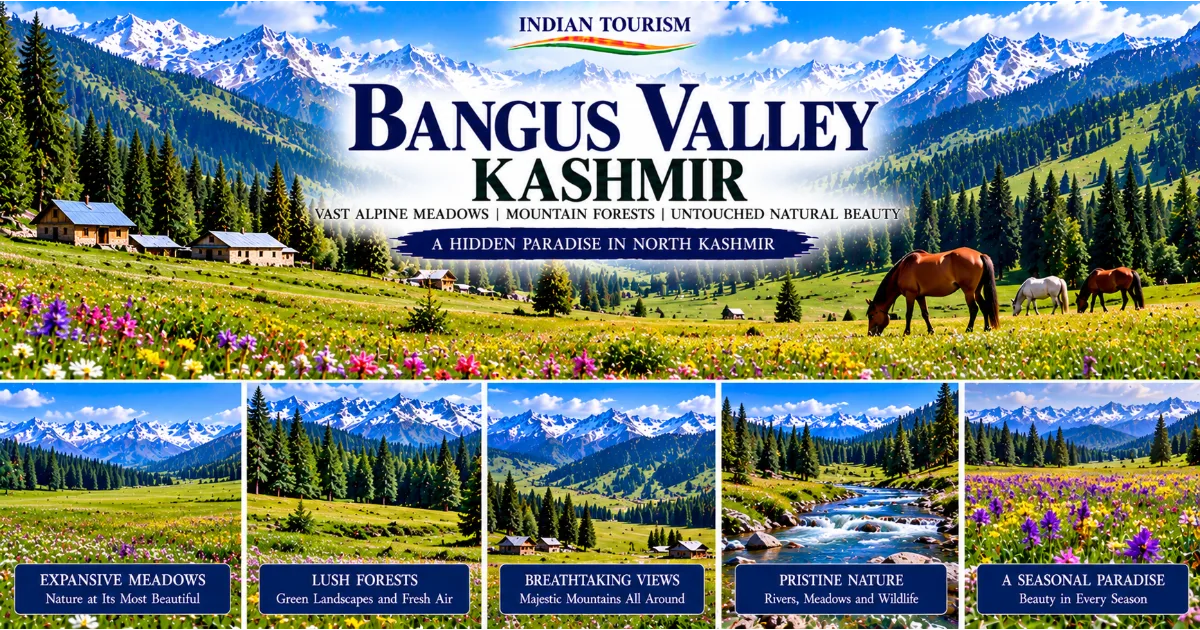
Discovering the Wide Open Landscapes of Bangus Valley
Kashmir is often associated with famous destinations such as Srinagar, Gulmarg and Pahalgam, but the region also contains lesser-known landscapes that offer a different kind of travel experience. Bangus Valley, located in the Kupwara district of northern Kashmir, is one such destination. Known for its expansive grasslands, surrounding mountain ranges, forested slopes and distinctive natural environment, Bangus offers an opportunity to explore a quieter side of the region.
Unlike destinations where hotels, markets and organised attractions define much of the visitor experience, Bangus is valued primarily for its open landscape. Its broad meadows create a sense of space, while the surrounding mountains provide a dramatic backdrop. During suitable seasons, the grasslands become green, wildflowers may appear, and the changing light gives the landscape a different character throughout the day.
The valley is also important as a natural environment. Its meadows and surrounding forests support plant life, wildlife and seasonal grazing. These ecological relationships are part of what makes the landscape valuable, and they require careful management as interest in tourism grows.
For travellers, Bangus is best approached as a nature-focused destination rather than a conventional resort. It may appeal to photographers, landscape enthusiasts and visitors interested in discovering less familiar parts of Kashmir. However, its remote character means that access, facilities and local conditions must be checked before travelling.
This guide explores the landscape of Bangus Valley, its seasonal beauty, forests, meadow ecosystems, cultural surroundings, photography opportunities and practical travel considerations. It also explains why responsible tourism is particularly important in a sensitive mountain environment.
1. Where Is Bangus Valley Located?
Bangus Valley lies in the Kupwara region of northern Kashmir, within the broader Himalayan landscape of Jammu and Kashmir. It is known for its extensive meadow areas and surrounding mountain terrain, which create a striking contrast between open grasslands and forest-covered slopes.
The wider Kupwara district contains several rural settlements, wooded areas and mountain landscapes. Bangus forms part of this diverse geography, although access to the valley can depend on local road conditions, seasonal weather and applicable restrictions.
The destination is often discussed as an alternative to the more familiar tourist centres of Kashmir. Its appeal comes from the scale of its natural landscape rather than from a large concentration of commercial facilities.
Travellers should understand that the name Bangus refers to a wider landscape rather than one small viewpoint. The precise route, access point and area visited can influence the experience, so it is important to confirm the destination with a reliable local source before departure.
Because Bangus is in northern Kashmir, visitors should also check current travel guidance and any security-related or administrative requirements that apply. Access conditions can change, and a route described in an older travel account may not be available at the time of a planned visit.
Planning should include realistic travel times, suitable transport and enough flexibility to respond to changing conditions. Visitors should not assume that a remote meadow destination has the same road access or visitor services as Srinagar or Gulmarg.
Understanding the valley's location is the first step towards appreciating its landscape. Its combination of mountain terrain, grasslands and forested surroundings makes it a distinctive part of Kashmir's natural heritage.
2. The Expansive Meadows of Bangus
The meadows are the defining feature of Bangus Valley. Their broad stretches of grassland create open views that contrast with the steep slopes and dense forests found in other parts of the region.
During suitable warmer months, the grasslands can become richly green. The landscape may include flowering plants, uneven patches of vegetation and distant mountain views that change as the weather moves across the valley.
The openness of the meadows makes them attractive to photographers. Wide-angle views can communicate the scale of the landscape, while closer photographs can reveal the texture of grass, seasonal flowers and the relationship between the meadow and its surrounding hills.
However, the meadows should not be treated as empty land without ecological value. Grasslands support plant communities, insects and other wildlife, while also serving as seasonal grazing areas. Their health depends on natural processes and responsible land use.
Uncontrolled vehicle movement can damage vegetation and compact the soil. Litter can remain in the landscape long after visitors have left, and careless camping can disturb both wildlife and local activities. Visitors should remain on permitted routes and avoid driving across grassland simply to reach a preferred photographic position.
Walking should also be undertaken carefully. Some ground may be uneven, wet or difficult to cross after rain. Travellers should ask local guides about suitable routes rather than assuming that every open area is safe to explore.
The most rewarding way to experience Bangus is to appreciate the landscape without attempting to alter it. Its wide horizons, quiet atmosphere and seasonal colours provide enough interest without the need for elaborate attractions.
3. Mountain Ranges and Panoramic Views
The mountains surrounding Bangus Valley give the meadows their distinctive setting. Their slopes frame the open grasslands, creating a visual relationship between high ground, forested areas and the valley floor.
Mountain scenery changes with the weather and the season. On clear days, distant ridges may appear sharply defined against the sky. Clouds can create moving patterns of light and shadow, while mist may partially conceal the slopes and give the landscape a softer appearance.
These changes make the valley appealing to photographers and visitors who enjoy observing natural scenery. The experience can differ significantly between morning and afternoon, even when the visitor remains in the same location.
The mountains also influence local environmental conditions. Elevation affects temperature, vegetation and the duration of seasonal snow. Water movement from higher ground contributes to the wider landscape, while exposed slopes may experience different conditions from sheltered areas.
Visitors should not underestimate mountain weather. Conditions can change quickly, and temperatures may be lower than expected even during warmer months. Rain, strong winds or reduced visibility can make outdoor exploration less comfortable and potentially unsafe.
Suitable clothing, sturdy footwear and a flexible itinerary are useful for anyone planning to spend time outdoors. Travellers should avoid approaching unstable slopes or entering unfamiliar terrain without appropriate guidance.
The mountain views of Bangus are best enjoyed through patient observation. Rather than rushing between locations, visitors can allow time to notice how the light, clouds and surrounding landscape change throughout the day.
4. Forests and the Natural Environment
The forests surrounding Bangus Valley contribute to its ecological value and visual character. They create a transition between the open grasslands and the surrounding mountain slopes, while providing habitats for a range of plants and animals.
Forest ecosystems perform important functions. Trees and vegetation help stabilise soil, influence water movement and create conditions that support biodiversity. Forested areas can also affect local temperature and provide shelter for wildlife.
For visitors, the forest edges offer opportunities to observe vegetation patterns and photograph the contrast between woodland and open meadows. However, entering a forest is different from viewing it from an authorised route.
Some areas may be restricted or unsuitable for visitors without local knowledge. Travellers should not enter unfamiliar tracks simply because they appear accessible on a map or in a photograph. Local guidance can help identify permitted routes and explain any relevant environmental rules.
Visitors should avoid lighting fires, cutting vegetation or leaving food waste behind. Fires can create serious risks in woodland, while waste can affect animals and degrade the landscape.
Noise should also be kept to a reasonable level. Loud activity can disturb wildlife and reduce the quiet atmosphere that makes nature-focused destinations appealing.
The forests of Bangus should be understood as part of a connected ecosystem rather than merely as scenery around a meadow. Their continued health supports the wider landscape and helps preserve the qualities that attract visitors.
5. Wildlife and Biodiversity Around Bangus Valley
The combination of grasslands, forests and mountain terrain creates varied habitats around Bangus Valley. These habitats can support different plants, insects, birds and other wildlife, although the species present in a particular location depend on local conditions and season.
Visitors interested in wildlife should approach the landscape with patience. Animals may be difficult to see, and the absence of visible wildlife does not mean that an area lacks ecological importance.
Birdwatching can be a rewarding activity where access is permitted. Travellers should observe birds from a distance, avoid approaching nests and refrain from using calls or other methods that could disturb them.
Wildlife photography should prioritise the well-being of animals over the quality of an image. Visitors should never feed wildlife, chase animals for photographs or attempt to approach them closely.
Grassland and forest ecosystems can be affected by changes in land use, disturbance and unmanaged tourism. Vehicle movement, litter and damage to vegetation can alter habitats, even when the immediate effects are not obvious.
Visitors can help by remaining on authorised routes, carrying waste away and following local guidance about sensitive areas. If wildlife is encountered, the safest approach is generally to observe quietly and maintain a respectful distance.
People should also avoid making assumptions about wildlife sightings based on social media posts. The presence of a particular animal in one photograph does not guarantee that visitors will see it during another trip.
Bangus's ecological value is part of its broader identity. Protecting biodiversity helps maintain the natural character of the valley and supports the long-term sustainability of tourism.
6. Seasonal Beauty: When Does Bangus Valley Look Its Best?
Bangus Valley changes throughout the year, and the most suitable season depends on what visitors want to experience. Access conditions are also an important consideration because the valley's mountain setting can make travel more difficult during adverse weather.
Spring: The Landscape Awakens
Spring brings gradual changes to the surrounding vegetation as temperatures rise. The landscape begins to recover from winter, and lower areas may show fresh growth before higher ground fully changes.
Conditions can remain unpredictable during this period. Some routes may be affected by snow, wet surfaces or maintenance work, so visitors should confirm access before travelling.
Summer: Green Meadows and Open Views
The warmer months are generally associated with the green meadow scenery that makes Bangus distinctive. Grasslands may appear more vibrant, and the surrounding mountains provide a dramatic backdrop for photography.
This period is often more suitable for nature-focused visits, but access should never be assumed. Travellers should check local guidance, transport arrangements and any restrictions before setting out.
Visitors should also remember that warm conditions in the plains do not necessarily mean warm weather at higher elevations. Layered clothing and rain protection can be useful.
Autumn: Changing Colours and Clearer Atmosphere
Autumn may bring changes in vegetation and cooler temperatures. The surrounding landscape can take on different colours, while changing light creates opportunities for photography.
The exact appearance of the valley depends on weather and elevation. Travellers should avoid expecting the same conditions every year.
Winter: Snow and Difficult Access
Winter can bring severe cold and snowfall to the surrounding mountains. These conditions may make access difficult or unsuitable for ordinary sightseeing.
Visitors should not attempt winter travel without current information and appropriate arrangements. Road closures, limited services and reduced visibility can create risks in remote areas.
For many travellers, the most practical approach is to plan a visit during a period when local authorities and reliable guides confirm that access is suitable. The best season is not simply the one with the most attractive photographs, but the one that allows a safe and respectful experience.
7. Bangus Valley for Photography
Bangus offers a variety of photographic subjects, including wide meadows, mountain ridges, forest edges, changing skies and seasonal vegetation. Its open landscape allows photographers to experiment with different compositions without relying on built attractions.
Wide-angle photography can help communicate the scale of the valley. Including a foreground element, such as grass or a natural feature, may create depth while leading the viewer's eye towards the distant mountains.
Photographers can also focus on smaller details. Seasonal flowers, patterns in the grass and the boundary between forest and meadow can reveal aspects of the landscape that broad panoramas may overlook.
Light is particularly important in mountain environments. Clouds may move quickly, changing the brightness and colour of the scene. Visitors should allow time for observation rather than rushing to capture a single view.
Photography should not compromise safety or conservation. Visitors should avoid standing on unstable ground, climbing restricted slopes or leaving authorised paths in search of a better angle.
Drone photography may be subject to aviation, security or local restrictions. Travellers should verify the applicable rules and obtain any required permissions before attempting aerial photography.
It is also useful to photograph the landscape in a way that reflects its actual character. Images should not encourage visitors to believe that remote areas have extensive facilities if they do not.
Bangus is well suited to thoughtful landscape photography. The strongest images often come from careful observation of the light, terrain and changing atmosphere rather than from dramatic interventions in the environment.
8. Walking and Nature Observation
Walking can be a rewarding way to experience Bangus Valley, but routes should be selected according to local conditions and the visitor's abilities.
A short walk in an authorised area may provide enough time to appreciate the meadow vegetation, mountain views and forest edges. Visitors who want to explore further should seek local guidance about the route, distance, terrain and expected duration.
Ground conditions can change after rain or during periods of seasonal thaw. Wet grass, muddy sections and uneven surfaces may make walking more difficult than expected. Suitable footwear is therefore important.
Travellers should carry drinking water, weather-appropriate clothing and any essential personal supplies. A charged mobile phone can be useful, although connectivity should not be assumed in remote locations.
Visitors should avoid setting out alone on unfamiliar routes without informing someone of their plans. It is also sensible to return with enough daylight remaining, particularly when transport options are limited.
Nature observation does not require covering long distances. Spending time in one permitted area can allow visitors to notice changing cloud patterns, vegetation and the sounds of the surrounding environment.
Those travelling with children or older family members should select activities that match the group's abilities. The open appearance of a meadow does not guarantee that every part of it is easy to cross.
A responsible walking experience combines preparation with flexibility. If conditions are unsuitable, choosing a shorter route or postponing the outing is better than taking unnecessary risks.
9. Local Communities and the Cultural Landscape
Although Bangus is primarily known for its natural environment, the wider region is also shaped by the communities whose lives are connected to the mountains, forests and meadows.
Rural landscapes often support seasonal activities such as grazing, agriculture and other forms of local livelihood. These activities may influence how particular areas are used throughout the year.
Visitors should understand that a meadow is not necessarily an unused public space. Some areas may have specific management arrangements or local uses that require consideration. Travellers should follow guidance and avoid interfering with livestock, grazing activities or private property.
The wider Kupwara region has its own local history and cultural identity. Learning about the area through knowledgeable local guides can provide a better understanding of the landscape than relying solely on scenic descriptions.
Community-based tourism, where available and appropriately managed, can provide opportunities for local people to benefit from visitor spending. Travellers may support local transport providers, guides and businesses while gaining a more informed perspective on the destination.
Respectful behaviour is essential. Visitors should ask before photographing people, avoid disturbing private activities and follow local instructions about access.
Cultural tourism should not require residents to change their routines for visitors. The value of the experience lies in learning about a living landscape while recognising the rights and priorities of the people who live there.
Bangus is best appreciated as part of a wider regional environment where nature, local livelihoods and community knowledge are connected.
10. Facilities and What Travellers Should Expect
Bangus Valley should be approached differently from a major tourist town. Visitors should not assume that accommodation, restaurants, shops, public toilets or other facilities will be available at every point in the valley.
The level of service may vary according to the route, season and local arrangements. Travellers should confirm essential facilities before departure, particularly if they are planning an extended visit.
Those who require reliable accommodation, regular meals or specialised services may prefer to stay in an established town and arrange a planned excursion, depending on current access and transport conditions.
Visitors should carry essential supplies and avoid relying on last-minute purchases in remote areas. Families, older travellers and people with specific health or accessibility needs may require additional planning.
Mobile connectivity can vary. Travellers should keep important information available offline where practical and should not rely entirely on online navigation.
Waste disposal is another consideration. Remote areas may have limited collection facilities, so visitors should be prepared to carry their rubbish back to a suitable disposal point.
Facilities can change over time, and information from an old travel blog may no longer be accurate. Confirming current arrangements through reliable local sources is the best way to avoid unexpected difficulties.
The absence of extensive tourist infrastructure is part of what makes remote natural destinations different from established resorts. However, this should not be mistaken for an invitation to travel without preparation.
A comfortable visit to Bangus begins with realistic expectations, suitable transport and a flexible schedule.
11. How to Plan a Visit to Bangus Valley
Planning should begin by confirming whether the valley is accessible for the intended travel dates. This is particularly important because weather, road conditions and local restrictions may affect access.
Travellers should obtain current guidance about the route, any necessary permissions and suitable transport. A local guide or experienced driver may be helpful where the roads or access arrangements are unfamiliar.
The amount of time required depends on the starting point and the portion of the valley being visited. Visitors should not rely on a single estimated journey time without confirming the exact destination.
It is wise to leave room for delays. Mountain journeys can take longer than expected, and conditions may change during the day.
The itinerary should prioritise a manageable number of activities. For a short visit, focusing on the accessible meadow landscape and permitted viewpoints may be more rewarding than attempting to cover a large area.
Travellers should carry water, snacks where appropriate, warm clothing, rain protection and essential personal items. They should also confirm whether food and other supplies can be obtained along the route.
Visitors should avoid planning a return journey so late that they are forced to travel in poor visibility or after dark on unfamiliar roads.
If access is restricted or conditions are unsuitable, an alternative destination should be selected rather than attempting to bypass restrictions.
A well-planned visit balances curiosity with caution. Bangus's natural beauty is best enjoyed when the journey respects both the environment and the realities of mountain travel.
12. Responsible Tourism in Bangus Valley
The long-term value of Bangus Valley depends on protecting its meadows, forests and surrounding mountain environment. Tourism can create opportunities, but unmanaged activity can also damage the features that attract visitors.
The first principle is to leave no waste behind. Plastic packaging, bottles and food waste should be carried away and disposed of properly. Litter can remain visible for a long time in remote landscapes and may affect wildlife.
Visitors should remain on authorised routes and avoid driving across grasslands. Vehicle movement can damage vegetation and compact soil, particularly in areas that are wet or ecologically sensitive.
Camping and open fires should only take place where permitted and under appropriate conditions. Fires can create serious risks, and camping may be subject to specific local rules.
Wildlife should be observed from a distance. Feeding animals, disturbing habitats or approaching wildlife for photographs can cause harm.
Visitors should also respect local activities and follow guidance concerning grazing areas, protected locations and other sensitive places.
Supporting local businesses where available can help ensure that tourism benefits nearby communities. However, responsible tourism also requires fair behaviour, respect for privacy and recognition that local residents should help shape how their environment is used.
Photographers and content creators have an additional responsibility. They should avoid presenting restricted areas as freely accessible or encouraging visitors to ignore local rules.
The most sustainable way to enjoy Bangus is to treat it as a living ecological landscape rather than a disposable tourist attraction. Careful behaviour helps preserve its natural qualities and supports the possibility of responsible visits in the future.
13. Who Should Visit Bangus Valley?
Bangus Valley may be particularly rewarding for travellers who value natural scenery over commercial entertainment.
Landscape photographers can appreciate its open meadows, mountain views and changing weather. Nature enthusiasts may enjoy observing the relationship between grasslands and forests, while visitors who prefer quiet outdoor experiences may value the valley's expansive setting.
It may also appeal to repeat visitors to Kashmir who want to explore beyond the most familiar destinations. Those who have already visited Srinagar, Gulmarg or Pahalgam may find Bangus offers a different perspective on the region's geography.
However, the destination may be less suitable for travellers who require extensive facilities or a tightly scheduled sightseeing programme. Its remote character means that access and services must be checked carefully.
Families can consider a visit if the route and conditions are suitable for their needs. They should plan around transport, weather, walking requirements and the availability of essential facilities.
Visitors interested in wildlife or hiking should use appropriate guidance and avoid assuming that the entire valley is open for independent exploration.
Bangus is most rewarding for people who are comfortable with a nature-focused experience and who understand the importance of preparation. Its beauty lies in the landscape itself, so visitors do not need an extensive list of attractions to enjoy the journey.
Conclusion: Preserving the Open Landscapes of Bangus Valley
Bangus Valley represents a distinctive part of Kashmir's natural heritage. Its broad meadows, surrounding mountain ranges, forests and seasonal vegetation create a landscape that feels different from the busy tourist centres commonly associated with the region.
The valley's appeal lies in its openness and ecological character. Visitors can appreciate the changing light across the grasslands, observe the relationship between forest and meadow, and experience the scale of the surrounding mountains.
Yet the qualities that make Bangus attractive also require care. Remote access, limited facilities and sensitive ecosystems mean that visitors should prepare properly and follow current local guidance.
A successful journey begins with realistic planning. Travellers should confirm access, arrange suitable transport, check weather conditions and avoid assuming that every route or activity is available throughout the year.
Responsible behaviour is equally important. Carrying waste away, respecting local activities, avoiding damage to vegetation and observing wildlife from a distance help protect the valley's natural environment.
Bangus also reminds visitors that tourism should not be measured only by the number of attractions or facilities at a destination. Sometimes the most meaningful experience comes from a wide view, a quiet walk or a deeper understanding of a landscape.
By approaching Bangus Valley with curiosity, patience and respect, travellers can appreciate its beauty while helping preserve the meadows and mountain environment for future generations.
Hashtags
#IndianTourism #JammuAndKashmir #BangusValley #KashmirTourism #ExploreKashmir #Kupwara #NorthKashmir #OffbeatKashmir #HiddenGemsOfKashmir #AlpineMeadows #MountainLandscapes #NatureTourism #KashmirPhotography #HimalayanTravel #ForestConservation #ResponsibleTourism #SustainableTravel #MeadowLandscapes #ExploreIndia #KashmirValley

